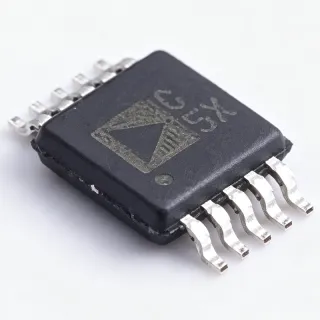
AD52000-1 Digital Potentiometer | Analog Devices
MPN: AD52000-1 ✓ Hoạt độngAD52000-1 Tóm tắt
A digital potentiometer provides repeatable electronic control where a mechanical variable resistor would otherwise require manual adjustment. This distinction matters in instrumentation, industrial controls, sensor interfaces, and test equipment because the controller can update the resistance setting through a digital bus while retaining a resistive signal path for the analog circuit. The AD5200 family includes 256-position and 33-position devices, demonstrating how resolution can be selected according to the required adjustment granularity and control-system architecture.
The AD52000-1 is controlled through a serial digital interface, allowing its wiper position to be programmed from a microcontroller, programmable logic controller, or other digital controller. This architecture supports automatic calibration, programmable gain and offset adjustment, and remote equipment configuration. Because the device changes resistance electronically rather than through mechanical movement, it avoids wiper wear, mechanical contact bounce, and long-term mechanical drift associated with conventional adjustable resistors.
ADI's AD5200 family documentation identifies a compact MSOP package for the AD5200 and AD5201 devices and describes a fixed wiper resistance at the wiper contact. The exact package, electrical ratings, tap resistance, endpoint resistance, wiper resistance, interface timing, and temperature ratings for the AD52000-1 must be confirmed in the manufacturer documentation for that exact ordering code before layout or production release. Those parameters determine whether an existing board can be reused without schematic or footprint changes.
Potential uses include sensor excitation, programmable amplifier and filter networks, laboratory test fixtures, industrial calibration loops, and embedded measurement systems. In a sensor interface, the digital potentiometer can adjust gain, threshold, or excitation level while the controller performs calibration. In a test fixture, it can select calibrated resistance values without manual interaction. In either case, the useful design benefit is the combination of an analog resistive element and programmable wiper control.
The principal layout consideration is to place the device and its bypass or termination components close to the controlled analog node while keeping the serial interface away from sensitive high-impedance paths. Designers should verify the actual pin map, recommended resistor values, logic levels, and maximum terminal voltages for AD52000-1 before finalizing a PCB. Do not infer those values from an AD5200 or AD5201 document unless the manufacturer explicitly identifies the devices as pin-compatible.
This product record combines the manufacturer product description, current sourcing references, technical application guidance, and a conservative replacement assessment. Its most important engineering distinction is the exact-ordering-code review: AD52000-1 should not be treated as interchangeable with every member of the AD5200 family until package, pinout, resistance code, resolution, interface, and environmental requirements have been compared directly.
Bộ thay thế dễ dàng lắp đặt cho AD52000-1 — cùng gói, chân-to-chân tương thích. Các bộ phận yêu cầu hàn PCB bị loại trừ.
Không có bộ thay thế dễ dàng lắp đặt sẵn có cho sản phẩm này.
Yêu cầu các bộ thay thếAD52000-1 Tỷ lệ tối đa & tính chất điện
| Product Type | Digital potentiometer |
| Control Interface | Serial digital interface |
| Chức năng | Programmable variable resistance |
| Kiểu lắp đặt | Surface mount |
| Trạng thái RoHS | unknown |
| REACH Status | unknown |
| Automotive Qualification | unknown |
Hướng dẫn cấu hình chân AD52000-1 standard
Cấu hình chân cho AD52000-1 (standard gói). Thành phần số hiệu này có chân đầu vào, đầu ra và nguồn cung cấp. Tham khảo tài liệu thông số kỹ thuật của nhà sản xuất để biết cấu hình chân bù, bù trừ và chân kích hoạt. Hoàn hảo cho điều kiện tín hiệu và mạch khuếch đại.

Không có dữ liệu chân cụ thể sẵn có cho AD52000-1.
Tham khảo: tài liệu kỹ thuật cho cấu hình chân đầy đủ.
Ứng dụng tiêu biểu
AD52000-1 phù hợp cho 6 Áp dụngs: Sensor Signal Conditioning, Programmable Gain Control, Industrial Equipment Calibration, Precision Test Fixture, Remote Analog Adjustment, Automated Instrument Control.
Sensor Signal Conditioning
AD52000-1 can support programmable sensor interfaces when the controlled resistance falls within the device's documented range. Place it in the gain, excitation, or threshold network so a microcontroller can apply calibration values through the digital interface. This approach preserves an analog resistive signal path while removing manual potentiometer adjustment. Before layout release, verify the exact AD52000-1 resistance code, wiper resistance, endpoint resistance, maximum terminal voltage, and recommended resistor values from the manufacturer documentation.
Được đề xuất
Programmable Gain Control
AD52000-1 is useful in a programmable gain stage when its tap count and resistance network can establish the required gain steps. The wiper code can be changed from a controller to compensate for sensor variation or product tolerances without a mechanical adjustment. Validate the resistor ratios and wiper contribution against the amplifier's noise and stability requirements. The exact AD52000-1 wiper and endpoint characteristics must be included in the error budget because they directly affect gain accuracy.
Được đề xuất
Industrial Equipment Calibration
AD52000-1 can be placed in an industrial calibration loop to store an adjustable reference setting in a digital controller and apply it to an analog measurement or actuation circuit. This approach supports automated setup and repeatable compensation across production units. The circuit should keep the wiper node within the device's rated voltage and resistance limits, and the PCB should isolate digital activity from sensitive analog traces. Confirm package, temperature grade, and resistance tolerances for the production environment.
Được đề xuất
Precision Test Fixture
AD52000-1 is suitable for a programmable test fixture when a microcontroller must select or calibrate a resistance in a measurement path. The fixture can apply known adjustment codes without operator intervention, improving repeatability between test cycles. Account for the device's documented wiper resistance and resolution when defining fixture uncertainty. Use short analog traces and a defined ground reference, and confirm the ordering code's pin map before using the device as a direct replacement in an existing fixture.
Được đề xuất
Remote Analog Adjustment
AD52000-1 enables remote analog adjustment when a system operator or supervisory controller must modify a resistance setting through a serial interface. This can support field adjustment of thresholds, compensation, or operating ranges without opening the equipment. The receiving controller should validate the written resistance code and detect communication faults so an unintended code does not move the wiper to an unsuitable position. The design must also include appropriate logic levels and timing for the exact interface implementation.
Được đề xuất
Automated Instrument Control
AD52000-1 can be used in automated instrumentation to vary an analog parameter while keeping the setting under software control. Examples include test excitation, null adjustment, and programmable attenuator or bridge networks. Because no mechanical wiper wear is involved, repeated software adjustments remain repeatable, although accuracy is still governed by resolution, wiper impedance, and temperature effects. Confirm the device's operating temperature range and resistance code against the instrument's calibration environment before production use.
Được đề xuất
Tóm tắt các sản phẩm được đề xuất
Dữ liệu tham khảo kỹ thuật cho AD52000-1 — so sánh, hướng dẫn thiết kế và thông tin tuân thủ.
Hướng dẫn chọn lựa
Ghi chú thiết kế
Assign the AD52000-1 footprint only after obtaining the package drawing and pin table for the exact ordering code. The Analog Devices family page describes compact MSOP packages for related devices, but it does not establish the AD52000-1 lead arrangement. Place the device so the digitally controlled wiper connection has a short return path, and route serial signals away from the high-impedance analog node to reduce coupling into the programmed resistance.
Do not select a family member solely because it is called a digital potentiometer. Compare tap count, total resistance, wiper resistance, endpoint resistance, logic levels, interface timing, supply range, package, and temperature rating. A different resistance suffix can alter the usable adjustment range, while a different tap count changes the resolution of the calibration step. Treat the ordering code as the controlling specification rather than the abbreviated family name.
Include the manufacturer's recommended terminating and bypass components once the exact AD52000-1 circuit configuration is known. Keep the wiper connection short and preserve a low-impedance return to the analog ground reference. If the controlled node drives a high-gain amplifier, evaluate parasitic capacitance and wiper impedance in the signal path. Digital interface traces should not run directly beneath sensitive analog nodes on a multilayer PCB.
Thông tin tuân thủ
No exact-ordering-code RoHS, REACH, AEC-Q100, lead-free, halogen-free, or conflict-minerals declaration was identified. Confirm compliance with Analog Devices before production release.