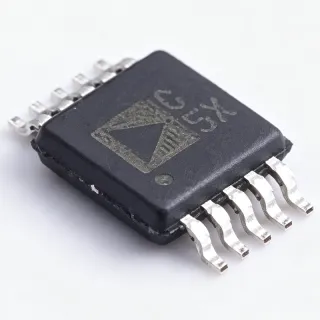
AD976ABRZ - 16-Bit 200 kSPS ADC | Analog Devices
MPN: AD976ABRZ ✓ Hoạt độngAD976ABRZ Tóm tắt
An ADC is an interface IC that converts a continuously varying analog voltage into a numeric code for processing by a microcontroller, DSP, FPGA, or industrial controller. The AD976A belongs to the high-speed ADC category and uses a switched-capacitor, successive-approximation architecture. Its parallel data interface makes it suitable for systems that sample rapidly and require direct acquisition-data access without a serial-interface converter.
The converter provides 16-bit resolution, 200 kSPS throughput, single 5 V operation, and an input range of ±10 V. Its internal 2.5 V reference and choice of internal or external reference support flexible board-level signal-chain designs. Maximum power dissipation is listed as 100 mW, making the device suitable for compact industrial, instrumentation, communications, and embedded control systems.
At the heart of the AD976A is a switched-capacitor successive-approximation conversion stage with a parallel output interface. Successive-approximation ADCs generally provide a practical balance among resolution, conversion throughput, power consumption, and implementation complexity. The 16-bit code represents the analog input with a quantization step determined by the selected input range and reference voltage.
Typical uses include industrial process monitoring, instrumentation, communications equipment, data-acquisition systems, and embedded control platforms. The 200 kSPS rate is suitable for sampling waveforms and transducers whose useful bandwidth is well below the converter's Nyquist limit. System designers should also account for acquisition time, input settling, source impedance, reference stability, digital-interface timing, and analog filtering when defining overall measurement accuracy.
For PCB implementation, use the manufacturer's pin-description table to assign the 28 SOIC connections, connect bypass capacitors close to the supply and reference pins, and keep the analog input route away from high-current digital and clock-return paths. The wide-body SOIC package offers more routing space than a narrow-body variant, but careful grounding and decoupling remain necessary to preserve the converter's full 16-bit performance.
This product record combines the manufacturer's converter specifications, package information, sourcing guidance, application context, and engineering notes in one place. It also distinguishes confirmed device characteristics from parameters that require consultation of the AD976 datasheet, helping engineers plan acquisition boards, compare interfaces, and qualify replacements without relying on incomplete distributor summaries.
Bộ thay thế dễ dàng lắp đặt cho AD976ABRZ — cùng gói, chân-to-chân tương thích. Các bộ phận yêu cầu hàn PCB bị loại trừ.
Các biến thể trong loạt này
Các mẫu cùng loạt có thể lắp đặt dễ dàng tương thích với AD976ABRZ (cùng hình factor và footprint) — khác nhau ở Architecture, Input Range, Supply Voltage, Resolution, Operating Temperature.
Không có bộ thay thế dễ dàng lắp đặt sẵn có cho sản phẩm này.
Yêu cầu các bộ thay thếAD976ABRZ Tỷ lệ tối đa & tính chất điện
| Converter Type | Successive-approximation ADC |
| Độ phân giải | 16 bit |
| Throughput Rate | 200 kSPS |
| Input Channels | 1 input |
| Điện áp cung cấp | 5 V |
| Analog Input Range | ±10 V |
| Internal Reference Voltage | 2.5 V |
| Reference Selection | Internal or external |
| Maximum Power Dissipation | 100 mW |
| Linearity Error | 0.0031% |
| Sample Rate | 0.2 MHz |
| Process Technology | BiCMOS |
| Loại giao diện | Parallel |
| Hộp | 28-pin SOIC, wide body |
| Số lượng chân | 28 pins |
| Lead Form | Gull wing |
| Package Shape | Rectangular |
| Package Code | SOP |
| Temperature Grade | Industrial |
| Khoảng nhiệt độ hoạt động | -40 °C to 85 °C |
Hướng dẫn cấu hình chân AD976ABRZ sop
Cấu hình chân cho AD976ABRZ (sop gói). Thành phần số hiệu này có chân đầu vào, đầu ra và nguồn cung cấp. Tham khảo tài liệu thông số kỹ thuật của nhà sản xuất để biết cấu hình chân bù, bù trừ và chân kích hoạt. Hoàn hảo cho điều kiện tín hiệu và mạch khuếch đại.

Không có dữ liệu chân cụ thể sẵn có cho AD976ABRZ.
Tham khảo: tài liệu kỹ thuật cho cấu hình chân đầy đủ.
Ứng dụng tiêu biểu
AD976ABRZ phù hợp cho 6 Áp dụngs: Industrial Process Monitoring, Laboratory Instrumentation, Communications Signal Acquisition, Data Acquisition Systems, Embedded Control and Measurement, Audio and Vibration Analysis.
Industrial Process Monitoring
The AD976ABRZ fits process-monitoring and instrumentation systems that need 16-bit measurement resolution at a moderate sampling rate. Its 200 kSPS throughput provides a practical conversion rate for pressure, temperature, level, and position transducer signals, while the ±10 V input range supports appropriately conditioned industrial sensor outputs. The 5 V supply and parallel interface simplify implementation around a DSP, FPGA, or embedded controller. Designers should place input filtering and settling components close to the converter, reference the analog ground carefully, and verify acquisition timing for the selected sensor bandwidth. The converter's industrial temperature range of -40 °C to 85 °C supports equipment deployed across ordinary factory environments.
Được đề xuất
Laboratory Instrumentation
The AD976ABRZ can serve as the conversion stage in laboratory measurement equipment requiring more precision than a typical 12-bit mixed-signal converter. Its 16-bit code width supports measurement systems dealing with low-level or closely spaced signal values, and the 200 kSPS rate suits many bandwidth-limited laboratory waveforms. The ±10 V input range allows a practical interface to external signal conditioning, while the internal 2.5 V reference can simplify standalone designs. For precision results, the complete acquisition path must account for sensor noise, analog-filter settling, reference stability, grounding, and calibration. Timing from conversion start to valid parallel data should be coordinated with the controlling processor.
Được đề xuất
Communications Signal Acquisition
The AD976ABRZ is appropriate for communications equipment that samples conditioned analog waveforms and transfers 16-bit samples to a high-speed digital processing section. Its 200 kSPS throughput can support baseband measurement, envelope observation, modulation analysis, and other signals whose useful bandwidth remains below the converter's sampling limit. The parallel interface allows acquisition data to be captured directly by suitable logic or DSP hardware, avoiding an external serial conversion stage. Signal-chain design must include anti-alias filtering, gain control, source-impedance limits, and sufficient acquisition settling time. Clock and data routing also require controlled digital return paths so converter activity does not degrade the accuracy of the analog input.
Được đề xuất
Data Acquisition Systems
The AD976ABRZ fits standalone or embedded data-acquisition systems requiring a compact 16-bit converter with direct parallel data access. A 28-pin SOIC can simplify assembly in a mixed analog-and-digital board while offering enough routing flexibility for input conditioning, reference bypass, and interface logic. Its single 5 V supply is useful for systems already operating around standard logic levels, and the 200 kSPS rate supports many general-purpose measurement channels. To preserve the converter's resolution, designers should use a stable reference arrangement, low-noise supply decoupling, a symmetrical analog-ground strategy, and an input driver that settles within the acquisition window. The controller should also capture and timestamp valid conversion results correctly.
Được đề xuất
Embedded Control and Measurement
The AD976ABRZ can be paired with an embedded processor or FPGA to create a precision control loop that reads analog process variables. Its 16-bit resolution offers more usable measurement granularity than a lower-resolution converter, while 200 kSPS throughput is ample for many motor, actuator, and feedback signals with controlled bandwidth. The parallel interface permits the acquisition result to enter digital control logic directly, although the controller must support the required data width and timing. For closed-loop stability, evaluate conversion latency and acquisition time together with the control update period. Analog filtering, reference quality, grounding, and component tolerances must be included in the loop's overall error budget.
Được đề xuất
Audio and Vibration Analysis
The AD976ABRZ is suitable for compact analysis platforms that digitize appropriately band-limited audio, vibration, or motion signals and require a 16-bit conversion code. The 200 kSPS sampling rate is suitable for signals whose relevant bandwidth is safely below 100 kHz, with the exact usable bandwidth determined by the anti-alias filter and acquisition behavior. Its parallel output can feed an FPGA or DSP that performs filtering, spectral analysis, or event detection. Designers should pay particular attention to input-driver settling, clock jitter, reference noise, and analog grounding because these factors can affect low-level analysis results. A 5 V supply arrangement also helps simplify integration with mixed-signal processing platforms.
Được đề xuất
Dữ liệu tham khảo kỹ thuật cho AD976ABRZ — so sánh, hướng dẫn thiết kế và thông tin tuân thủ.
Hướng dẫn chọn lựa
So sánh với các sản phẩm thay thế
| Tham số | Sản phẩm này |
|---|---|
| Package | 28-pin wide-body SOIC |
| Brand | Analog Devices |
| Resolution | 16 bit |
| Throughput Rate | 200 kSPS |
| Input Channels | 1 input |
| Supply Voltage | 5 V |
| Analog Input Range | ±10 V |
| Reference | Internal 2.5 V or external |
| Interface | Parallel |
| Maximum Power Dissipation | 100 mW |
Bảo phân biệt quan trọng
- Higher conversion throughput than the original AD976 family member (vsAD976)
- Direct 16-bit parallel acquisition interface (vsAD976)
- Single-supply operation with a broad analog input range (vsAD976)
Ghi chú thiết kế
Route the analog input as a short, guarded trace directly from the conditioning network to the converter input. Keep the input driver close enough to settle within the acquisition interval specified by the Analog Devices datasheet. Place reference and supply bypass components at their associated pins, connect the exposed analog and digital grounds according to the manufacturer's guidance, and separate the input trace from clock, logic, and switching-current paths to minimize conversion-coupled errors.
The parallel data bus can create fast edge currents even though the converter's average power is low. Route clock and data outputs consistently, provide a continuous return path beneath the bus where practical, and avoid splitting the analog and digital ground regions without following the recommended star or grounding strategy. Confirm that the receiving device can meet setup and hold timing from the manufacturer timing table, and avoid adding unnecessary long traces or branch stubs to the parallel interface.
Do not select an analog input range or reference configuration independently of the external resistor network and application schematic. Compute the complete signal gain, check absolute input-pin limits, and verify that the input source settles within the converter's acquisition requirement. Also avoid using a generic 28-pin SOP drawing as a substitute for the official pin table: the AD976 family has analog, digital, reference, clock, and parallel-bus connections whose functions must be assigned from the manufacturer documentation.
Thông tin tuân thủ
The AD976ABRZ is identified as an industrial-temperature Analog Devices converter. Confirm environmental material declarations and qualification status in the current manufacturer product documentation before assigning compliance requirements.