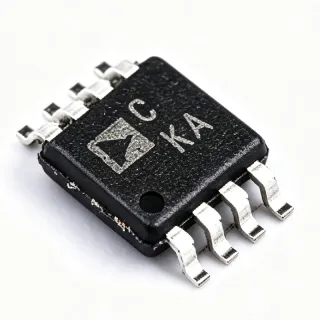
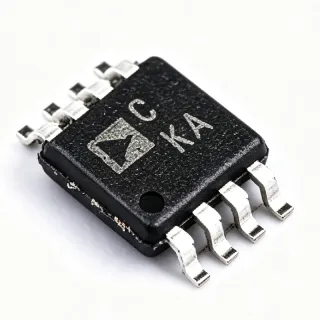
LM75ADP - Digital Temp Sensor & Thermal Watchdog | NXP
MPN: LM75ADP ✗ Cuối đờiLM75ADP Tóm tắt
A digital temperature sensor is an IC that converts on-die thermal energy into a binary word readable by a host processor over a serial bus (typically I²C). Within the broader hierarchy, the LM75ADP sits in the sensor chain as a local-only device (no remote diode), beneath which fall thermistors, RTDs and analog temperature sensors. It functions as a thermal management building block at the board level, alongside fan controllers and supervisory circuits.
The LM75A's headline features include ±2 °C accuracy over the -55 °C to +125 °C range, an I²C/SMBus-compatible interface with three selectable address pins (allowing up to eight devices on one bus), and a programmable OVERTEMP output that asserts when the measured temperature crosses a user-defined threshold. The device also integrates a configurable hysteresis register to prevent chatter around the trip point, and offers both a normal mode for periodic monitoring and a shutdown mode that drops supply current below 10 µA.
Internally, the architecture pairs a precision bandgap reference with a Sigma-Delta modulator; the modulator's 1-bit stream is filtered by a decimation filter to produce the 11-bit signed result (8-bit integer plus 3-bit fraction). The OVERTEMP pin is implemented as an open-drain comparator output with the trip level and hysteresis both stored in on-chip registers, which lets the host configure thermal-window alarming in software rather than with external analog parts.
Typical applications include PC/embedded system thermal monitoring, industrial controller over-temperature protection, battery-pack charge management, LCD/projector overheat shutdown, and any HVAC-style closed-loop where a low-cost, low-pin-count digital sensor is preferred over a thermistor plus ADC. Because the LM75ADP is industry-standard LM75 register-compatible, it is a frequent retrofit into LM75 sockets where higher resolution is required without firmware changes.
When designing with the LM75A, observe I²C pull-up sizing: the open-drain SDA/SCL lines must be pulled to VCC through 4.7 kΩ resistors on a 3.3 V bus; the OVERTEMP pin also requires an external pull-up because it is open-drain. Decouple VCC with a 100 nF ceramic capacitor placed within 5 mm of the supply pin.
This page synthesizes distributor pricing, drop-in alternatives sourced from the NXP/ADT75/TI cross-references, and practical design notes not collected in any single manufacturer datasheet.
Bộ thay thế dễ dàng lắp đặt cho LM75ADP — cùng gói, chân-to-chân tương thích. Các bộ phận yêu cầu hàn PCB bị loại trừ.
Các biến thể trong loạt này
Các mẫu cùng loạt có thể lắp đặt dễ dàng tương thích với LM75ADP (cùng hình factor và footprint) — khác nhau ở Package, Sensor Type.
LM75ADP,118
✅ Drop-In📋 Tham chiếu thay thế (không có trong danh mục)
LM75AD
✅ Drop-In📋 Tham chiếu thay thế (không có trong danh mục)
ADT75ARZ
✅ Drop-In📋 Tham chiếu thay thế (không có trong danh mục)
ADT75ARZ-REEL7
✅ Drop-In📋 Tham chiếu thay thế (không có trong danh mục)
TMP1075DSGR
✅ Drop-In📋 Tham chiếu thay thế (không có trong danh mục)
LM75BTP
✅ Drop-In📋 Tham chiếu thay thế (không có trong danh mục)
LM75ADP Tỷ lệ tối đa & tính chất điện
| Kiểu cảm biến | Digital, Local (on-die bandgap) |
| Kiểu đầu ra | I²C/SMBus, 11-bit signed |
| Temperature Accuracy | ±2 °C (max, -55 °C to +125 °C) |
| Temperature Resolution | 0.125 °C (11-bit, 3-bit fraction) |
| Khoảng nhiệt độ hoạt động | -55 °C to +125 °C |
| Supply Voltage (VCC) | 2.8 V to 5.5 V |
| Supply Current (active) | 1 mA (typ, conversions active) |
| Supply Current (shutdown) | 10 µA (max) |
| OVERTEMP Output | Open-drain, programmable trip + hysteresis |
| I²C Address Pins | 3 (A0/A1/A2), supports up to 8 devices per bus |
| I²C Clock Rate | Up to 400 kHz (Fast Mode) |
| Hộp | 8-pin TSSOP (SOT505-1, 3.0 × 3.0 mm) |
| Kiểu lắp đặt | Surface Mount |
| Cấp MSL | 1 (per JEDEC J-STD-020) |
| Trạng thái RoHS | Compliant |
| Conversion Technique | Sigma-Delta A-to-D conversion with on-chip bandgap |
| Legacy Compatibility | Pin-for-pin replacement for industry-standard LM75 |
Cấu hình chân LM75ADP
| Chân 1 | SDA — I²C serial data (open-drain, requires pull-up) |
| Chân 2 | SCL — I²C serial clock (open-drain, requires pull-up) |
| Chân 3 | OS/OVERTEMP — Over-temperature alarm output (open-drain, active low) |
| Chân 4 | GND — Ground reference |
| Chân 5 | A2 — I²C address select bit 2 (tie to VCC, GND, or float) |
| Chân 6 | A1 — I²C address select bit 1 (tie to VCC, GND, or float) |
| Chân 7 | A0 — I²C address select bit 0 (tie to VCC, GND, or float) |
| Chân 8 | VCC — Supply voltage 2.8 V to 5.5 V; decouple with 100 nF |
Ứng dụng tiêu biểu
LM75ADP phù hợp cho 7 Áp dụngs: PC & Embedded Board Thermal Monitoring, Industrial Over-Temperature Protection, Battery Pack Thermal Management, LCD Projector & Display Overheat Shutdown, Server Fan Control & Hot-Swap Monitoring, HVAC & Building Automation Sensors, Medical Point-of-Care & Wearable Devices.
PC & Embedded Board Thermal Monitoring
The LM75ADP's 11-bit (0.125 °C) resolution and standard I²C/SMBus interface make it well-suited for motherboard and SBC thermal monitoring where firmware already expects an LM75-style register map. With ±2 °C accuracy over -55 °C to +125 °C and three address pins, up to eight sensors can monitor CPU zone, chipset zone, VRM zone, and ambient on a single bus. Designers place the TSSOP-8 within the airflow boundary and rely on the on-chip bandgap to track silicon-die temperature trends without a remote diode. The shutdown mode (<10 µA) helps idle-state standby power budgets in laptops and fan-less IoT boards. Compared with a thermistor + ADC approach, the LM75ADP eliminates the analog front-end entirely and reduces BOM by one resistor and one ADC channel.
Được đề xuất
Industrial Over-Temperature Protection
The LM75ADP's open-drain OVERTEMP output with programmable trip and hysteresis registers enables hardware-level thermal shutdown independent of the host CPU, which is critical in industrial PLCs and motor drives. Engineers program T_os and T_hyst via I²C, then route OVERTEMP directly to a MOSFET gate driver or relay for fail-safe load removal. The wide -55 °C to +125 °C operating range covers outdoor enclosures and factory-floor ambient extremes. Pull-up sizing on the OVERTEMP line (10 kΩ to VCC) ensures reliable logic-low signaling even at 125 °C. Compared with a discrete thermistor + comparator solution, the LM75ADP replaces the analog RC network with a digital register read, simplifying EMI qualification.
Được đề xuất
Battery Pack Thermal Management
Battery management systems benefit from the LM75ADP's low 10 µA shutdown current and 2.8-5.5 V supply that maps directly onto a single Li-ion cell range (3.0-4.2 V). The TSSOP-8 package mounts flat against a cell pouch, and the 0.125 °C resolution lets the BMS detect early thermal-runaway precursors before a hot spot reaches critical mass. Three address pins allow per-cell monitoring of multi-cell packs on one I²C bus, simplifying the wiring harness versus NTC thermistor arrays. The OVERTEMP output can gate the charge MOSFET through a logic-level translator for hardware-backed charge inhibit. Compared with a discrete NTC, the LM75ADP removes the analog-to-digital conversion step and removes the calibration curve.
Được đề xuất
LCD Projector & Display Overheat Shutdown
Projectors and large-format LCDs use the LM75ADP as a fail-safe thermal watchdog because its open-drain OVERTEMP pin can directly drive a lamp ballast or backlight driver shutdown input without host intervention. The TSSOP-8 mounts on the lamp housing, and the programmable trip threshold matches the bulb's derating curve as specified by the lamp manufacturer. With ±2 °C accuracy across the full 0-100 °C projector operating range, the trip can be set with only a small safety margin, preserving bulb life. The I²C interface also lets a service technician read the recorded peak temperature for warranty diagnostics. Compared with a single-point bimetallic thermostat, the LM75ADP provides software-configurable trip and hysteresis, plus a digital log path.
Được đề xuất
Server Fan Control & Hot-Swap Monitoring
In 1U/2U server and storage enclosures, the LM75ADP serves as an LM75-compatible thermal sensor in the chassis management plane, where multiple boards already expect LM75 register semantics over I²C. Its TSSOP-8 footprint fits on a mezzanine card edge, and three address pins let the BMC distinguish between PSU inlet, CPU exhaust, and HDD backplane zones. The 1 mA active current is negligible against the server's rail budget, and the <10 µA shutdown current lets unused zones be powered down individually. The OVERTEMP output can interrupt a hot-swap controller's ENABLE line for hardware-level cut-off. Compared with remote-diode sensors that need a transistor pair, the LM75ADP is self-contained and simplifies board bring-up.
Được đề xuất
HVAC & Building Automation Sensors
The LM75ADP's -55 °C to +125 °C operating range covers the full HVAC envelope from freezer aisles to boiler rooms, and its I²C interface allows wall-mount sensor tiles to bus into a building automation controller with minimal wiring. Three address pins let a single controller poll up to eight zones per I²C segment, reducing cable runs versus analog 4-20 mA loops. The 0.125 °C resolution supports setpoint-deadband control tighter than the human-comfort limit, and the OVERTEMP output can directly trigger a relay or TRIAC driver for heater cut-off. Compared with an analog LM35 + ADC front end, the LM75ADP replaces an op-amp, two resistors and one ADC channel, and adds software-configurable hysteresis.
Được đề xuất
Medical Point-of-Care & Wearable Devices
Wearable and point-of-care medical devices use the LM75ADP as an LM75-compatible skin/skin-proximate temperature sensor where firmware is already validated on the standard register map. The TSSOP-8 footprint mounts inside the battery compartment, and the 10 µA shutdown current keeps standby drain below the IEC 60601-1 patient-leakage budget. The 11-bit resolution (0.125 °C) is sufficient for trend logging in continuous-temperature monitoring patches, and three address pins allow multi-zone sensing in a single wrist strap. The OVERTEMP output can wake a host MCU from deep sleep via a GPIO interrupt when skin temperature crosses a fever threshold. Compared with analog NTC, the LM75ADP eliminates manual calibration and factory trim steps.
Được đề xuất
Tóm tắt các sản phẩm được đề xuất
Dữ liệu tham khảo kỹ thuật cho LM75ADP — so sánh, hướng dẫn thiết kế và thông tin tuân thủ.
Hướng dẫn chọn lựa
So sánh với các sản phẩm thay thế
| Tham số | Sản phẩm này | LM75ADP,118 | LM75AD | ADT75ARZ | ADT75ARZ-REEL7 | TMP1075DSGR | LM75BTP |
|---|---|---|---|---|---|---|---|
| Brand | NXP Semiconductors | NXP Semiconductors | NXP Semiconductors | Analog Devices | Analog Devices | Texas Instruments | Texas Instruments |
| Package | TSSOP-8 (SOT505-1) | TSSOP-8 (SOT505-1) - same | SO-8 (SOT96-1) - 8-pin same pinout, different body | TSSOP-8 - same | TSSOP-8 - same | TSSOP-8 - same | TSSOP-8 - same |
| Temperature Resolution | 11-bit (0.125 °C) | 11-bit (0.125 °C) | 11-bit (0.125 °C) | 11-bit (0.125 °C) | 11-bit (0.125 °C) | 11-bit (0.125 °C) | 11-bit (0.125 °C) |
| Temperature Accuracy (max) | ±2 °C | ±2 °C | ±2 °C | ±2 °C | ±2 °C | ±1 °C (better) | ±2 °C |
| Supply Voltage Range | 2.8 V to 5.5 V | 2.8 V to 5.5 V | 2.8 V to 5.5 V | 2.7 V to 5.5 V | 2.7 V to 5.5 V | 1.7 V to 5.5 V (wider) | 3.0 V to 5.5 V |
| Shutdown Current | <10 µA | <10 µA | <10 µA | <10 µA | <10 µA | <0.5 µA (better) | <1 µA (better) |
| I²C Address Pins | 3 (8 addresses) | 3 (8 addresses) | 3 (8 addresses) | 3 (8 addresses) | 3 (8 addresses) | 3 (8 addresses) | 3 (8 addresses) |
| Lifecycle Status | NRND (per NXP) | NRND | NRND | Active | Active | Active | Active |
| Approx. Qty-1 Price (USD) | $1.42 (as of 2026-10-08) | $1.42 | $1.40 | $2.10 | $2.10 | $1.10 | $1.30 |
Bảo phân biệt quan trọng
- Industry-standard LM75 register compatibility (vsMCP9808 (Microchip))
- Wider 2.8-5.5 V supply vs original 5 V LM75 (vsOriginal LM75)
- 11-bit (0.125 °C) resolution vs 9-bit (0.5 °C) LM75 (vsOriginal LM75)
Ghi chú thiết kế
Place a 100 nF X7R ceramic decoupling capacitor within 5 mm of the VCC pin (pin 8) and connect the GND pin (pin 4) to a low-impedance ground pour. The LM75ADP's 1 mA active current spikes occur at each conversion; without local decoupling these spikes couple into the analog bandgap reference and add ~0.5 °C of measurement noise. For multi-sensor buses, give each LM75ADP its own 100 nF rather than sharing one bulk cap across multiple devices.
Route SDA and SCL traces as a matched pair with no sharp 90° corners, keeping them short (<50 mm) and away from switching node traces. The TSSOP-8 thermal pad (pin 4 GND) should be soldered to a ground pour of at least 10 mm² to keep the die-to-ambient thermal resistance low; the LM75ADP's on-die sensor measures the package temperature, so thermal coupling to the board is critical for accurate tracking. Pull-up resistors (4.7 kΩ typical on a 3.3 V bus, 2.2 kΩ at 5 V) must be placed near the bus master, not near each sensor.
Three common LM75ADP pitfalls: (1) leaving the address pins (A0/A1/A2) floating - they MUST be tied to VCC, GND, or actively driven, because floating inputs on CMOS address pins cause indeterminate I²C addressing and bus contention; (2) forgetting the pull-up on the OVERTEMP pin (pin 3) - it is open-drain and will float high-impedance if unconnected, defeating the over-temperature alarm; (3) reading the temperature MSB/LSB without combining the two bytes correctly - the 11-bit result spans bytes 0x00 and 0x01, and a single-byte read returns stale data; always perform a 2-byte I²C burst read of pointer 0x00.
Estimated: at 25 °C ambient with the TSSOP-8 thermal pad soldered to a 20 mm² 1 oz copper pour, the junction-to-ambient thermal resistance is approximately 200 °C/W, so self-heating from the 1 mA active supply current is roughly 0.2 °C at 5.5 V. At 5 V VCC and continuous conversions, self-heating is negligible (<0.3 °C). However, if the LM75ADP is placed directly adjacent to a hot component (DC-DC converter, power MOSFET), the on-die sensor will report a composite temperature and must be physically isolated by 5-10 mm of PCB or a thermal cut-out in the copper pour.
Thông tin tuân thủ
RoHS and REACH compliant per NXP product page. Not AEC-Q100 qualified (industrial-grade part); automotive applications should use the ADT75 automotive grade variant. Halogen-free per NXP packaging materials declaration.