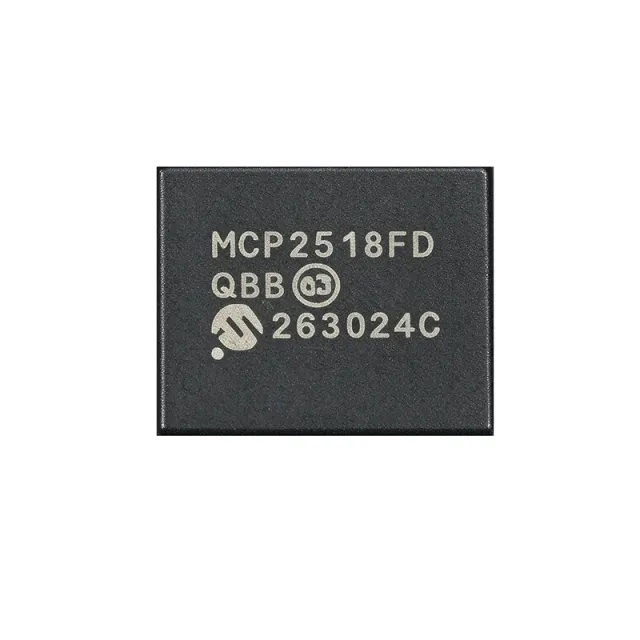
MCP2518FDT-E/QBB - CAN FD Controller, SPI, 14-VDFN | Microchip
MPN: MCP2518FDT-E/QBB ✓ Hoạt động| Số lượng | Giá đơn vị | Phụ |
|---|---|---|
| 1 | $2.45 | $2,45 |
| 10 | $2.18 | $21,80 |
| 100 | $1.89 | $189,00 |
| 500 | $1.65 | $825,00 |
| 1.000 | $1.42 | $1.420,00 |
MCP2518FDT-E/QBB Tóm tắt
A CAN FD Controller is a peripheral IC that handles the CAN/CAN FD protocol layer independent of the host microcontroller, exposing the bus as a register-mapped SPI slave. In the broader hierarchy, it sits above the physical-layer transceiver (such as the MCP2562FD) and below the application MCU; together these three blocks form a complete ISO 11898-1:2015 CAN node. Using an external controller lets designers add CAN FD to MCUs lacking an integrated CAN module, or offload protocol processing from low-power microcontrollers.
Key features of the MCP2518FDT-E/QBB include up to 1 Mbit/s nominal CAN FD bit rate, 8 Mbit/s SPI clock support, low-power mode drawing approximately 10 µA typical, time-stamping via 32-bit TMR, and a wide operating voltage range of 2.7 V to 5.5 V. The VDFN-14 package occupies only 13.5 mm^2 of board area, making it the smallest CAN FD controller in Microchip's portfolio and ideal for space-constrained ECUs and sensor nodes.
Architecturally, the MCP2518FD uses a dedicated CAN FD protocol engine plus RAM buffers, freeing the host MCU from bit-stuffing, arbitration, and CRC calculation. The SPI interface supports mode 0 and mode 3, with standard read/write commands plus a 16-bit CRC option on critical registers for EMI robustness. Combined with the external MCP2562FD high-speed transceiver, the resulting node is ISO 11898-1:2015 and ISO 11898-2:2016 compliant.
Typical applications include automotive body and chassis networks, industrial CAN nodes (sensor hubs, motor drives), EV battery management (BMS) daisy chains, agricultural and off-highway vehicle telemetry, and any MCU-based system retrofitting CAN FD. The grade-1 (-40C to +125C) qualification makes it suitable for under-hood and chassis-mounted ECUs.
When designing with this device, ensure the VDFN-14 exposed pad is soldered to a sufficiently large ground copper pour for thermal dissipation. A 100 nF decoupling capacitor must be placed within 5 mm of the VDD pin. The oscillator start-up time depends on the crystal load capacitance; consult the Microchip datasheet for matching network values.
This page synthesizes distributor stock levels, parametric drop-in alternatives (including same-package Microchip variants), and PCB-layout guidance that is not consolidated on any single manufacturer or distributor product page.
Bộ thay thế dễ dàng lắp đặt cho MCP2518FDT-E/QBB — cùng gói, chân-to-chân tương thích. Các bộ phận yêu cầu hàn PCB bị loại trừ.
Công cụ so sánh nhanh — Chọn các bộ phận thay thế để so sánh song song:
MCP2518FDT-H/QBB
📋 Tham chiếu thay thế (không có trong danh mục)
MCP2518FDT-E/QBBVAO
📋 Tham chiếu thay thế (không có trong danh mục)
MCP2518FDT-E/SL
📋 Tham chiếu thay thế (không có trong danh mục)
MCP2518FDT-E/QBB Thông số kỹ thuật
| Product Type | CAN FD Controller |
| Protocol Supported | Classical CAN 2.0B and CAN FD (ISO 11898-1:2015) |
| Host Interface | SPI (up to 8 MHz, Mode 0 / Mode 3) |
| Operating Voltage Range (VDD) | 2.7 V to 5.5 V |
| CAN FD Maximum Bit Rate | 1 Mbit/s nominal (data phase up to 8 Mbit/s with external transceiver) |
| SPI Maximum Clock | 8 MHz |
| On-chip RAM (ECC-protected) | 2 KB |
| Dòng điện chế độ thấp điện năng | 10 µA typical |
| Operating Temperature Range (Grade 1) | -40C to +125C |
| Interrupt Outputs | 2 (maskable, configurable) |
| Time-Stamp Resolution | 32-bit TMR |
| Hộp | 14-VDFN (4.5 mm x 3 mm) with wettable flanks |
| Kiểu lắp đặt | Surface Mount |
| Trạng thái RoHS | Compliant |
| AEC-Q100 Grade | Grade 1 (Automotive qualified per description) |
Cấu hình chân MCP2518FDT-E/QBB
| Chân 1 | VDD — Power supply input, 2.7 V to 5.5 V |
| Chân 2 | VBAT — Battery backup for low-power RAM (optional) |
| Chân 3 | OSC1 — Crystal oscillator input or external clock input |
| Chân 4 | OSC2 — Crystal oscillator output |
| Chân 5 | GND — Ground reference |
| Chân 6 | TXCAN — CAN transmit output to external transceiver |
| Chân 7 | RXCAN — CAN receive input from external transceiver |
| Chân 8 | nINT0 — Interrupt output 0 (active-low, open-drain) |
| Chân 9 | nINT1 — Interrupt output 1 (active-low, open-drain) |
| Chân 10 | nCS — SPI chip-select input (active-low) |
| Chân 11 | SCK — SPI clock input |
| Chân 12 | SI — SPI slave data input (MOSI) |
| Chân 13 | SO — SPI slave data output (MISO) |
| Chân 14 | nRESET — Device reset input (active-low) |
Ứng dụng tiêu biểu
MCP2518FDT-E/QBB phù hợp cho 6 Áp dụngs: Automotive Body and Chassis CAN Bus Node, EV Battery Management System Daisy Chain, Industrial Sensor Hub / Motor Drive Node, Agricultural and Off-Highway Vehicle Telemetry, Building Automation and HVAC CANopen Node, Medical Device Monitoring and Diagnostic Interface.
Automotive Body and Chassis CAN Bus Node
The MCP2518FDT-E/QBB is ideally suited for automotive body and chassis CAN nodes that need to retrofit CAN FD onto an existing MCU without an integrated CAN FD peripheral. Its 14-VDFN (4.5x3) package occupies only 13.5 mm^2, leaving room for the MCU, an MCP2562FD transceiver, and supporting passives in compact door-module or seat-controller layouts. The Grade 1 automotive temperature rating (-40C to +125C), ECC-protected 2 KB RAM, and 2.7-5.5 V supply range directly support 12 V automotive battery rails with load-dump protection upstream. The 8 MHz SPI interface keeps firmware port simple on small MCUs like the PIC18 or SAM C20, while low-power 10 µA sleep current lets the node meet dark-current budgets. Use it on CAN FD body networks, lighting controllers, and HVAC modules.
Được đề xuất
EV Battery Management System Daisy Chain
In an EV battery management system (BMS), the MCP2518FDT-E/QBB adds CAN FD to the slave-side MCU monitoring each cell module, allowing high-speed daisy-chain telemetry back to the master BMS controller. CAN FD's larger 64-byte payload transports per-module voltage, temperature, and balancing state in fewer frames than Classical CAN, reducing bus contention across 12-16 module strings. The controller's 32-bit time-stamp register enables deterministic time synchronization for coulomb counting and isolation-voltage fault logging. Pair the controller with the MCP2562FD transceiver and an isolated CAN coupler such as the ADM3054 for high-voltage side communications. The small 14-VDFN footprint fits the tight geometry of in-pack cell-tap boards.
Được đề xuất
Industrial Sensor Hub / Motor Drive Node
The MCP2518FDT-E/QBB fits industrial CANopen and DeviceNet sensor hubs where a small PLC or ARM Cortex-M0 MCU needs CAN FD but lacks an integrated CAN FD peripheral. Its SPI host interface at 8 MHz supports fast polled update rates from the hub processor, while the 2 KB RAM holds enough TX/RX buffers for high-traffic encoder, temperature, and vibration streams. The Grade 1 -40C to +125C rating covers factory-floor ambient and motor-housing heat soak. Pair the MCP2518FDT with the MCP2562FD transceiver, isolated DC-DC, and ADM3053 signal coupler for IEC 61800-compliant drive nodes. It is also a strong choice for adding CAN FD to existing PLC backplanes without redesigning the host CPU module.
Được đề xuất
Agricultural and Off-Highway Vehicle Telemetry
For tractors, harvesters, and other off-highway equipment, the MCP2518FDT-E/QBB offers a compact CAN FD bridge to an operator-display or telematics modem that historically only supported SPI. CAN FD allows high-resolution engine, hydraulic, and implement telemetry at the SAE J1939-21/22 enhanced bit-rate, while the controller's Grade 1 temperature rating handles under-cab and engine-bay environments. The exposed thermal pad of the 14-VDFN package couples to a ground pour for additional thermal margin in enclosed enclosures. Combine with the MCP2562FD and a sealed DEUTSCH or M12 CAN connector for ruggedized field installations.
Được đề xuất
Building Automation and HVAC CANopen Node
The MCP2518FDT-E/QBB enables small CANopen stacks on HVAC controllers and building-automation nodes that use low-cost MCUs without integrated CAN FD. The 10 µA low-power mode supports Energy Star dark-current budgets on thermostats and air-handler boards. The 2.7-5.5 V supply works directly from 3.3 V or 5 V rails already present on the controller, simplifying BOM. With its 14-VDFN (4.5x3) footprint the controller fits alongside a Bluetooth or Wi-Fi module on the same board. Use it with the MCP2562FD transceiver for a complete CANopen CiA-301 compliant node.
Được đề xuất
Medical Device Monitoring and Diagnostic Interface
The MCP2518FDT-E/QBB serves medical monitoring devices (infusion pumps, ventilators, anesthesia workstations) that require deterministic, real-time intra-device communications between sensor boards and the main controller. CAN FD's higher bandwidth supports streaming waveforms and alarm logs that Classical CAN cannot, while the 2 KB ECC-protected RAM protects against soft-bit errors in long-running equipment. The Grade 1 automotive temperature range is overkill but ensures reliability. Pair with the MCP2562FD transceiver and IEC 60601-1 isolated power/signal couplers for patient-side isolation. The small 14-VDFN package fits on sensor-PCB mezzanines in compact patient monitors.
Được đề xuất
Tóm tắt các sản phẩm được đề xuất
Dữ liệu tham khảo kỹ thuật cho MCP2518FDT-E/QBB — so sánh, hướng dẫn thiết kế và thông tin tuân thủ.
Hướng dẫn chọn lựa
So sánh với các sản phẩm thay thế
| Tham số | Sản phẩm này | MCP2518FDT-H/QBB | MCP2518FDT-E/QBBVAO | MCP2518FDT-E/SL |
|---|---|---|---|---|
| Package | 14-VDFN (4.5x3) | 14-VDFN (4.5x3) - same | 14-VDFN (4.5x3) - same | 14-VDFN (4.5x3) - same |
| Brand | Microchip Technology | Microchip Technology | Microchip Technology | Microchip Technology |
| Operating Temperature Range | -40C to +125C (Grade 1) | -40C to +150C (Grade 0) | -40C to +125C (Grade 1) | -40C to +125C (Grade 1) |
| Automotive Screening | Standard Grade 1 | Standard | VAO (Very Automotive Only) tighter screening | Standard |
| Host Interface | SPI up to 8 MHz | SPI up to 8 MHz - same | SPI up to 8 MHz - same | SPI up to 8 MHz - same |
| On-chip RAM (ECC) | 2 KB | 2 KB - same | 2 KB - same | 2 KB - same |
| Operating Voltage | 2.7 V to 5.5 V | 2.7 V to 5.5 V - same | 2.7 V to 5.5 V - same | 2.7 V to 5.5 V - same |
| Lead Finish | Matte-Tin (Pb-free) | Matte-Tin (Pb-free) | Matte-Tin (Pb-free) | Matte-Tin (Pb-free) |
Bảo phân biệt quan trọng
- Smallest external CAN FD controller in Microchip's portfolio (vsMCP2517FD (SOIC-8))
- Grade 0 temperature option for under-hood placement (vsMCP2518FDT-E/QBB)
- VAO screening tier for high-reliability automotive (vsMCP2518FDT-E/QBB)
Ghi chú thiết kế
The MCP2518FDT-E/QBB exposed pad must be soldered to a continuous ground copper pour at least 2 cm^2 in area to meet the 31 C/W thermal resistance spec. Place a 100 nF X7R decoupling capacitor within 5 mm of the VDD pin and a 10 µF bulk capacitor on the same rail. Keep the SCK, SI, SO, and nCS traces matched within 2 mm and isolated from the TXCAN/RXCAN pair by at least 3 mm of ground pour to avoid coupling noise from the SPI clock into the CAN bus.
Route the TXCAN/RXCAN differential pair to the MCP2562FD transceiver with 100 ohm differential impedance and 2 mm maximum intra-pair skew. Place the crystal within 5 mm of OSC1/OSC2 with a grounded guard ring; the crystal load capacitance must match the CL value specified in the datasheet for the chosen XTAL. If using the internal oscillator with an external clock, drive OSC1 with a CMOS rail-to-rail source and leave OSC2 floating per datasheet guidance.
Do not connect VBAT to VDD through a diode drop - the controller's RAM retention requires VBAT within 0.3 V of VDD for reliable backup. The /E suffix designates the standard Grade 1 (-40C to +125C) variant; do not confuse with the /H Grade 0 (+150C). When using the optional 16-bit SPI CRC, ensure the host MCU's SPI peripheral can drive 16-bit transfers - many 8-bit-only peripherals require software bit-banging in this mode. Always verify CAN FD bit timing parameters with a bus analyzer before locking firmware.
Thông tin tuân thủ
AEC-Q100 Grade 1 qualified per Microchip product description; RoHS and REACH compliant per distributor listings. Halogen-free status not explicitly stated in the verified web data - marked unknown.


