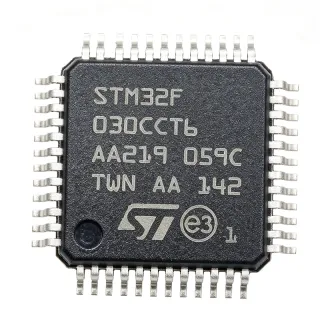
R5F109GEJFB#H0 Low-Power LIN MCU | Renesas Electronics
MPN: R5F109GEJFB#H0 ✓ Hoạt độngR5F109GEJFB#H0 Tóm tắt
A microcontroller is a programmable semiconductor that integrates a CPU, memory, peripherals, and interfaces into one device. The RL78 family combines low power consumption, compact embedded Flash memory, and safety-focused peripheral functions. The R5F109GEJFB#H0 is positioned for automotive and industrial subsystems where a local controller must communicate over LIN while handling low-voltage signals and safety-related diagnostics.
Renesas identifies several functional-safety features within the RL78/F12 family, including Flash memory CRC calculation, illegal memory access detection, RAM guard, A/D converter testing, and special-function-register protection. These mechanisms support fault detection around program storage, RAM, and selected peripherals. The integrated LIN module reduces the need for a separate communications controller in LIN-connected equipment, while the RL78/F12 family emphasizes low current consumption for cost-sensitive embedded systems.
The suffix #H0 identifies a specific ordering configuration, but the suffix alone does not establish electrical ratings or thermal grade. Confirm the exact pin arrangement, peripheral allocation, memory size, clock configuration, and operating-temperature range using the pin-description table, electrical characteristics, and ordering information in the manufacturer datasheet. Program development and board bring-up must also account for the device-specific reset, clock, and peripheral assignments.
Typical uses include LIN-connected automotive body electronics, actuator controllers, sensor-interface modules, small industrial controllers, and low-power equipment requiring an embedded LIN-capable MCU. The LIN interface is particularly useful in distributed vehicle networks where multiple low-bandwidth nodes exchange diagnostic and control data. The safety-diagnostic peripherals can support system monitoring, although final suitability depends on the applicable safety requirements and the device-specific qualification package.
For layout, follow the manufacturer pinout and recommended decoupling values exactly. Place the main input and decoupling capacitors close to their assigned pins, route oscillator and reset signals away from noisy sources, and provide clean grounding for communication and analog peripherals. Confirm programming, erase, write, and operating-voltage requirements before selecting production tools or defining the manufacturing test process.
This product record combines the manufacturer’s RL78/F12 family capabilities, ordering identifiers, and sourcing data with practical guidance for firmware validation, PCB implementation, functional safety, and LIN-interface design. It is intended to accelerate initial engineering review while leaving device-specific implementation decisions to the authoritative datasheet and hardware manual.
Bộ thay thế dễ dàng lắp đặt cho R5F109GEJFB#H0 — cùng gói, chân-to-chân tương thích. Các bộ phận yêu cầu hàn PCB bị loại trừ.
R5F109GEJFB#H0G
✅ Drop-In📋 Tham chiếu thay thế (không có trong danh mục)
R5F109GEJFB#X0
✅ Drop-In📋 Tham chiếu thay thế (không có trong danh mục)
R5F109GECJFB#10
✅ Drop-In📋 Tham chiếu thay thế (không có trong danh mục)
R5F109GEJFB#H0 Tỷ lệ tối đa & tính chất điện
| Product Type | Low-power 8-bit automotive-interface microcontroller |
| Product Family | RL78/F12 |
| Manufacturer | Renesas Electronics |
| CPU Core | RL78 8-bit core |
| LIN Interface | 1 integrated LIN module |
| ADC | A/D converter with test function |
| Flash CRC Function | Supported |
| Illegal Memory Access Detection | Supported |
| RAM Guard | Supported |
| SFR Protection | Supported |
| Kiểu lắp đặt | Surface mount |
| Trạng thái RoHS | unknown |
| REACH Status | unknown |
Hướng dẫn cấu hình chân R5F109GEJFB#H0 standard
Cấu hình chân cho R5F109GEJFB#H0 (standard gói). IC số này bao gồm chân GPIO, giao diện truyền thông (UART, SPI, I2C) và chân nguồn. Tham khảo tài liệu thông số kỹ thuật của nhà sản xuất để biết các chức năng chân thay thế và tùy chọn cấu hình. Cực kỳ quan trọng cho thiết kế hệ thống tích hợp và lập trình PCB.

Không có dữ liệu chân cụ thể sẵn có cho R5F109GEJFB#H0.
Tham khảo: tài liệu kỹ thuật cho cấu hình chân đầy đủ.
Ứng dụng tiêu biểu
R5F109GEJFB#H0 phù hợp cho 6 Áp dụngs: Automotive LIN Body-Control Node, LIN-Connected Door and Seat Module, Industrial Sensor Interface, Low-Power Equipment Controller, Battery-Powered Monitoring Module, Safety-Diagnostic Embedded Controller.
Automotive LIN Body-Control Node
The R5F109GEJFB#H0 fits a distributed vehicle body-control node because the RL78/F12 family combines an embedded LIN module with low-consumption operation and memory-integrity diagnostics. A local MCU can collect switch or sensor inputs, apply embedded logic, and exchange diagnostic data with other LIN nodes. Flash CRC calculation, illegal memory access detection, RAM guard, and SFR protection strengthen the node’s defensive diagnostics. Final deployment still requires verification of the exact #H0 temperature grade, LIN timing settings, transceiver interface, and automotive qualification status.
LIN-Connected Door and Seat Module
A door, seat, or tailgate module can use the R5F109GEJFB#H0 to combine local I/O handling with LIN communication. The integrated LIN module reduces controller overhead while the RL78 core supports timing, debouncing, actuator commands, and diagnostic response functions. Because these modules may remain connected while the vehicle sleeps, the low-consumption emphasis of the RL78/F12 family is valuable. Before schematic release, confirm the exact sleep current, wake-up behavior, supply range, ADC performance, and whether the chosen suffix satisfies the vehicle’s environmental requirements.
Industrial Sensor Interface
The R5F109GEJFB#H0 can serve as the controller for a LIN-connected industrial sensor or actuator interface where a compact, low-power MCU is preferred. It can supervise digital inputs, process ADC measurements, manage local state, and report diagnostics through the LIN interface. Family-level features such as Flash CRC calculation and RAM guard add fault-detection capability around program storage and volatile memory. Engineering validation should compare the device-specific ADC accuracy, conversion timing, calibration method, watchdog behavior, and low-power specifications against the sensor’s measurement and service requirements.
Low-Power Equipment Controller
The R5F109GEJFB#H0 is a candidate for compact low-power equipment that needs embedded control and a communications interface without a separate protocol controller. The RL78/F12 family’s low-consumption focus supports duty-cycled operation, while the integrated LIN interface is useful in distributed networks. The MCU can manage inputs, timers, indicators, and fault reporting in a compact PCB area. The energy budget should be calculated using the exact active, idle, and sleep currents from the manufacturer datasheet rather than generic family-level power figures.
Battery-Powered Monitoring Module
In a battery-powered monitoring module, the R5F109GEJFB#H0 can supervise sensors and communicate status over LIN. Its low-consumption architecture helps preserve standby energy, while Flash CRC calculation, illegal memory access detection, RAM guard, and SFR protection provide useful diagnostic hooks. The module design should use the device-specific low-power modes and wake-up sources to define polling intervals. Confirm the exact supply-voltage limits, ADC input range, oscillator accuracy, and current consumption across each operating mode before selecting the battery and duty cycle.
Safety-Diagnostic Embedded Controller
The R5F109GEJFB#H0 is suitable for preliminary evaluation in embedded controllers that require automatic checks around Flash, RAM, and special-function registers. The RL78/F12 family’s CRC calculation, illegal memory access detection, RAM guard, ADC testing, and SFR protection can support diagnostic routines for non-safety-critical subsystems or contribute to a broader safety architecture. These features must be integrated with the application’s fault-management strategy. Review the device-specific safety manual, diagnostic coverage assumptions, and qualification documents before using the MCU in a safety-related control function.
Dữ liệu tham khảo kỹ thuật cho R5F109GEJFB#H0 — so sánh, hướng dẫn thiết kế và thông tin tuân thủ.
Hướng dẫn chọn lựa
So sánh với các sản phẩm thay thế
| Tham số | Sản phẩm này | R5F109GEJFB#H0G | R5F109GEJFB#X0 | R5F109GECJFB#10 |
|---|---|---|---|---|
| Brand | Renesas Electronics | Renesas Electronics | Renesas Electronics | Renesas Electronics |
| Product Family | RL78/F12 | RL78/F12 | RL78/F12 | RL78/F12 |
Bảo phân biệt quan trọng
- Integrated LIN communication within the MCU (vsR5F109GEJFB#H0G)
- Family-level memory and peripheral diagnostics (vsR5F109GEJFB#X0)
- Low-consumption RL78/F12 architecture (vsR5F109GECJFB#10)
Ghi chú thiết kế
Assign the PCB footprint only after checking the exact package drawing and ordering table for R5F109GEJFB#H0. Route the LIN TX and RX signals as a controlled pair from the MCU to the transceiver, keep the LIN transceiver and protection network near the connector, and place the transceiver supply capacitor close to the device. Use the manufacturer reference layout for exposed-pad, thermal, and assembly requirements rather than relying on a generic package symbol.
Treat the internal oscillator, external resonator or crystal, reset network, and programming signals as sensitive nodes. Keep oscillator traces short, avoid routing them beneath or parallel to switching-power nodes, and provide a stable local return path. Verify startup behavior across the full supply range and temperature range because clock accuracy and initialization timing can affect LIN baud-rate tolerance and peripheral measurement accuracy.
Build the power budget from the device-specific active, idle, sleep, and LIN operating currents in the manufacturer datasheet. Include the MCU, LIN transceiver, pull-up or pull-down networks, status indicators, and any external sensor loads. Because the controller may spend most of its life in a low-duty-cycle state, calculate average current using actual wake-up frequency and communication activity rather than using the active-mode current alone.
Do not approve a substitution based only on the shared R5F109GEJFB base code. Compare the complete ordering suffix, package, Flash and RAM capacity, voltage range, temperature grade, LIN configuration, peripheral allocation, bootloader behavior, and development-tool support. A mismatched suffix can alter qualification or delivery conditions, while a related device code can change memory capacity or pin functions even when the package appears identical.
Thông tin tuân thủ
The exact R5F109GEJFB#H0 environmental grade and compliance declarations must be confirmed in the manufacturer ordering information and material declaration.