SN65HVD11D - 3.3V RS-485 Transceiver | Texas Instruments
MPN: SN65HVD11D ✓ Hoạt độngSN65HVD11D Tóm tắt
A differential transceiver is an interface IC that transmits and receives data across a balanced pair of conductors. The driver converts a single-ended logic input into complementary differential outputs, while the receiver converts the differential bus voltage into a single-ended logic output. In the RS-485 hierarchy, the SN65HVD11D belongs to the class of multipoint differential bus interface ICs used by industrial automation, test equipment, building controls, and communications equipment.
Key features include operation from a 3.3 V power supply, three-state driver output, differential receive capability, one-eighth unit-load operation, and bus-pin ESD protection exceeding 16 kV HBM. The low unit loading allows multiple nodes to share a bus while controlling the loading presented by each receiver. The three-state output also permits multiple drivers to be connected to a shared bus when only one driver is enabled at a time.
The SN65HVD11D family is designed for balanced transmission lines and is stated to meet or exceed ANSI TIA/EIA-485-A and ISO 8482:1993. Its differential signaling improves noise immunity by deriving the receiver decision from the voltage difference between the A and B conductors rather than from either conductor relative to ground. This makes it appropriate for longer cable runs and electrically noisy factory environments when implemented with proper termination and biasing.
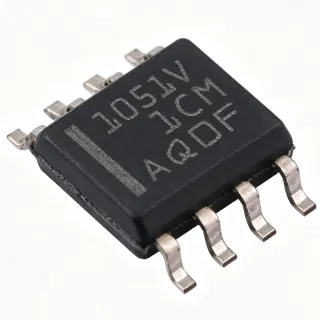
Typical uses include industrial RS-485 multidrop buses, factory sensor networks, building-automation controllers, instrument interfaces, and point-to-point RS-422 links. The eight-pin SOIC package supports conventional surface-mount assembly, while the low unit loading helps preserve bus loading margin as more nodes are added.
PCB design should provide a continuous return or reference path, route the differential pair together with matched spacing, and place termination and fail-safe bias components at physically appropriate bus locations. The supply should be decoupled close to the device, and unused digital inputs should not float. Bus protection, surge-current requirements, and cable length must be checked against the complete system rather than inferred from the transceiver rating alone.
This page combines verified manufacturer and distributor information, practical RS-485 design guidance, a same-package alternative comparison, and structured selection criteria. These details help engineers distinguish genuine footprint-compatible options from parts that only provide similar RS-485 functionality.
Bộ thay thế dễ dàng lắp đặt cho SN65HVD11D — cùng gói, chân-to-chân tương thích. Các bộ phận yêu cầu hàn PCB bị loại trừ.
Các biến thể trong loạt này
Các mẫu cùng loạt có thể lắp đặt dễ dàng tương thích với SN65HVD11D (cùng hình factor và footprint) — khác nhau ở Package, Supply Voltage.
SN75HVD11D
✅ Drop-In📋 Tham chiếu thay thế (không có trong danh mục)
SN65HVD10D
✅ Drop-InLiên hệ để biết giá
Xem tài liệu →SN75HVD10D
✅ Drop-In📋 Tham chiếu thay thế (không có trong danh mục)
SN65HVD12D
✅ Drop-InLiên hệ để biết giá
Xem tài liệu →SN75HVD12D
✅ Drop-In📋 Tham chiếu thay thế (không có trong danh mục)
SN65HVD11D Thông số kỹ thuật
| Product Type | Differential transceiver |
| Supported Interfaces | RS-485 and RS-422 |
| Điện áp cung cấp | 3.3 V |
| Driver Output State | Three-state |
| Receiver Architecture | Differential input |
| Unit Load | 1/8 unit load |
| Maximum Bus Nodes | Up to 256 nodes |
| Bus-Pin ESD Protection | Exceeds 16 kV HBM |
| Standards | ANSI TIA/EIA-485-A and ISO 8482:1993 |
| Nhiệt độ hoạt động | -40 °C to +85 °C |
| Hộp | 8-pin SOIC (D) |
| Số chân | 8 pins |
| Kiểu lắp đặt | Surface mount |
Cấu hình chân SN65HVD11D
| Chân 1 | RO — Receiver output |
| Chân 2 | RE — Receiver enable, active low |
| Chân 3 | DE — Driver enable, active high |
| Chân 4 | DI — Driver data input |
| Chân 5 | GND — Device ground |
| Chân 6 | A — Non-inverting bus terminal |
| Chân 7 | B — Inverting bus terminal |
| Chân 8 | VCC — 3.3 V power supply |
Ứng dụng tiêu biểu
SN65HVD11D phù hợp cho 6 Áp dụngs: Industrial RS-485 Multidrop Networks, Factory Sensor and Actuator Interfaces, Building Automation Controllers, Point-to-Point RS-422 Links, Test and Measurement Equipment, Low-Voltage Communications Equipment.
Industrial RS-485 Multidrop Networks
The SN65HVD11D fits industrial multidrop networks because its 3.3 V operation, one-eighth unit loading, and support for up to 256 nodes reduce the receiver burden placed on a shared bus. It can connect a controller to remote sensors, actuators, gateways, or data modules over a balanced RS-485 pair. The three-state driver permits controlled bus sharing, while differential signaling improves common-mode noise immunity. Deployment still requires a correct termination strategy, fail-safe biasing where required, and verification that the complete bus stays within the permitted node count and data rate.
Được đề xuất
Factory Sensor and Actuator Interfaces
The SN65HVD11D is suitable for linking factory sensors and actuators to a 3.3 V controller when the field bus carries data over appreciable cable lengths. Its one-eighth unit-load receiver can accommodate a larger population of field devices than a standard-unit-load transceiver, while the differential A/B interface rejects noise coupled equally onto both conductors. The 3.3 V supply also simplifies integration with modern embedded processors. Engineers should add appropriate surge and ESD protection at exposed connectors and keep the differential route away from switching-node and motor-power paths.
Được đề xuất
Building Automation Controllers
The SN65HVD11D can connect a low-voltage building-automation controller to distributed sensors, lighting modules, or access equipment using a 3.3 V RS-485 network. Its support for up to 256 nodes is useful in installations where many compact controllers share a building backbone, and the three-state driver supports controlled multidrop communication. Differential operation provides better noise immunity than a single-ended interface when cables pass near lighting and motor-control equipment. Proper grounding, cable segmentation, and bus termination remain important when building wiring creates uneven stubs or long branches.
Được đề xuất
Point-to-Point RS-422 Links
The SN65HVD11D can also support point-to-point RS-422 links between two boards when the interface requirements are compatible with its driver, receiver, and logic thresholds. The balanced differential output and receive path provide a robust signal over cables that may pass near industrial equipment, while the 3.3 V supply reduces the need for level translation. Because the verified product information describes both RS-485 and RS-422 use, the selected SN65HVD11D option must be checked against the exact RS-422 drive and receive requirements before production release.
Được đề xuất
Test and Measurement Equipment
The SN65HVD11D is applicable to test and measurement systems that expose a 3.3 V differential instrument bus to remote fixtures or laboratory equipment. Its low unit load allows numerous attached nodes to share a bus without quickly exhausting the permitted receiver-load budget, while bus-pin ESD protection exceeding 16 kV HBM adds useful protection at a connector interface. Differential signaling improves robustness against laboratory ground offsets and common-mode interference. Engineers must still define the expected cable length, data rate, isolation boundary, and termination arrangement to obtain repeatable measurements.
Được đề xuất
Low-Voltage Communications Equipment
The SN65HVD11D supports low-voltage communications equipment that combines a 3.3 V processor or controller with an external balanced bus. Its one-eighth unit loading permits up to 256 nodes according to the verified TI information, and its three-state driver allows several transmitters to share conductors when only one is active. The receiver’s differential architecture improves common-mode rejection in compact products where internal switching converters and display electronics can create interference. Layout should preserve a continuous ground reference, keep the A/B pair tightly coupled, and separate transceiver routing from noisy power-converter nodes.
Được đề xuất
Tóm tắt các sản phẩm được đề xuất
Dữ liệu tham khảo kỹ thuật cho SN65HVD11D — so sánh, hướng dẫn thiết kế và thông tin tuân thủ.
Hướng dẫn chọn lựa
So sánh với các sản phẩm thay thế
| Tham số | Sản phẩm này | SN75HVD11D | SN65HVD10D | SN75HVD10D | SN65HVD12D | SN75HVD12D |
|---|---|---|---|---|---|---|
| Brand | Texas Instruments | Texas Instruments | Texas Instruments | Texas Instruments | Texas Instruments | Texas Instruments |
| Package | SOIC-8 (D) | SOIC-8 (D) - same package | SOIC-8 (D) - same package | SOIC-8 (D) - same package | SOIC-8 (D) - same package | SOIC-8 (D) - same package |
| Supply Voltage | 3.3 V | 5 V | 3.3 V | 5 V | 3.3 V | 5 V |
| Interface | RS-485 and RS-422 differential transceiver | RS-485 and RS-422 differential transceiver | RS-485 and RS-422 differential transceiver | RS-485 and RS-422 differential transceiver | RS-485 and RS-422 differential transceiver | RS-485 and RS-422 differential transceiver |
| Driver Output | Three-state | Three-state | Three-state | Three-state | Three-state | Three-state |
| Standards | ANSI TIA/EIA-485-A and ISO 8482:1993 | ANSI TIA/EIA-485-A and ISO 8482:1993 | ANSI TIA/EIA-485-A and ISO 8482:1993 | ANSI TIA/EIA-485-A and ISO 8482:1993 | ANSI TIA/EIA-485-A and ISO 8482:1993 | ANSI TIA/EIA-485-A and ISO 8482:1993 |
Bảo phân biệt quan trọng
- Lower bus loading supports more connected nodes (vsSN65HVD12D)
- Matches a 3.3 V system supply (vsSN75HVD11D)
- Verified field-bus node capacity (vsSN65HVD10D)
- Documented bus-pin ESD capability (vsSN75HVD12D)
Ghi chú thiết kế
Route the A and B conductors as a tightly coupled differential pair with consistent impedance and minimal vias. Keep the pair away from switching nodes, relay coils, motor traces, and other high-current paths. Provide a continuous ground reference beneath or adjacent to the interface route, but avoid allowing fast return currents to cross the bus path. The TI family is intended for balanced lines, so preserving the physical differential geometry is important to realize the benefit of the receiver architecture.
Do not assume that matching packages alone guarantee a drop-in replacement. SN65HVD11D operates from 3.3 V, while the listed SN75 variants use a 5 V supply; a direct substitution can therefore exceed an absolute maximum rating. Before replacing the device, compare supply voltage, receiver thresholds, unit load, supported data rate, driver and enable polarity, fail-safe behavior, and the exact eight-pin pinout against the manufacturer datasheets.
Place the transceiver supply decoupling capacitor immediately beside VCC and the ground connection, with the shortest possible return path to the device ground pin. Follow the manufacturer datasheet for the recommended capacitor value and placement. Decoupling helps keep supply transients away from the receiver input, while a clean ground reference prevents bus common-mode voltage from shifting unpredictably relative to the transceiver.
For an RS-485 bus, install termination and fail-safe biasing only where the network topology requires them. Typically, termination belongs at the physical ends of the trunk rather than at every node, and bias resistors establish a defined state when no driver is active. Long stubs increase reflected impedance and can cause communication errors. Validate the cable length, node spacing, termination, and data rate together rather than optimizing each parameter independently.
Thông tin tuân thủ
The verified snippets identify ANSI TIA/EIA-485-A and ISO 8482:1993 as applicable bus standards. RoHS, REACH, lead-free, halogen-free, and conflict-minerals declarations were not included in the supplied product data and are therefore recorded as unknown.