SN65HVD82D - 5V RS-485 Transceiver with IEC ESD | TI
MPN: SN65HVD82D ✓ Hoạt độngSN65HVD82D Tóm tắt
An RS-485 transceiver is an interface IC that converts logic-level signals into differential bus signals and converts received differential signals back into logic levels. As a member of the RS-422 and RS-485 interface hierarchy, it supports noise-resistant, point-to-point or multipoint communication over longer cable runs than conventional single-ended interfaces. The half-duplex arrangement allows a connected node to transmit and receive, but not simultaneously, on the same pair of conductors.
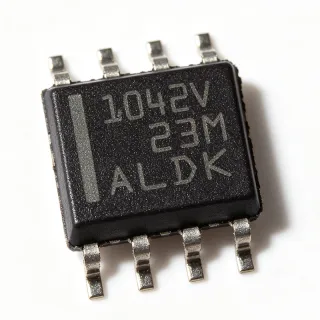
The SN65HVD82D operates from a single 5-V supply and supports data rates up to 250 kbps according to the available FindIC product listing. Its bus pins are designed for robust ESD event handling, with manufacturer and distributor descriptions identifying Human-Body Model, Air-Gap Discharge, Contact Discharge, and IEC ESD protection. The 8-pin SOIC package provides a conventional surface-mount form factor for industrial communication equipment.
Internally, the device combines a differential driver with a differential receiver rather than implementing two unrelated interface channels. This arrangement supports bidirectional data transfer when the design uses a direction-control signal, bus multiplexing, or an application-specific enable strategy. Because RS-485 is a differential bus, correct termination, biasing, grounding, and cable routing remain central to achieving reliable communication.
Typical uses include industrial sensor networks, factory automation equipment, building-control interfaces, process-monitoring systems, and communications equipment that connects a controller to remote nodes. The device is also relevant to laboratory and test systems where a compact 5-V RS-485 interface is required close to a digital controller.
When laying out a board around the SN65HVD82D, place its decoupling capacitor close to the supply pins and route the differential bus as a tightly coupled pair. External protection may still be appropriate when exposed cables or severe industrial transients are expected, because integrated ESD protection does not remove the need for a correctly engineered cable and grounding system.
This page combines the verified manufacturer, distributor, and cross-reference information with a practical view of package compatibility, pricing availability, ESD considerations, and application guidance. It also distinguishes verified facts from electrical details that still require confirmation in the latest manufacturer datasheet before final design release.
Bộ thay thế dễ dàng lắp đặt cho SN65HVD82D — cùng gói, chân-to-chân tương thích. Các bộ phận yêu cầu hàn PCB bị loại trừ.
Các biến thể trong loạt này
Các mẫu cùng loạt có thể lắp đặt dễ dàng tương thích với SN65HVD82D (cùng hình factor và footprint) — khác nhau ở Package, Data Rate, ESD Protection, Operating Temperature, Product Type.
SN65HVD20D
✅ Drop-InLiên hệ để biết giá
Xem tài liệu →SN65HVD22D
✅ Drop-In📋 Tham chiếu thay thế (không có trong danh mục)
SN65HVD07D
✅ Drop-In📋 Tham chiếu thay thế (không có trong danh mục)
SN65HVD888
✅ Drop-In📋 Tham chiếu thay thế (không có trong danh mục)
SN65HVD06D
✅ Drop-In ⚠️ Thông số chưa được xác minhLiên hệ để biết giá
Xem tài liệu →SN65HVD82D Thông số kỹ thuật
| Product Type | RS-422/RS-485 half-duplex transceiver |
| Điện áp cung cấp | 5 V |
| Tốc độ dữ liệu | 250 kbps |
| Interface Standard | RS-422/RS-485 |
| Driver and Receiver Count | 1 differential driver and 1 differential receiver |
| Hộp | 8-pin SOIC |
| Package Pin Count | 8 pins |
| Nhiệt độ hoạt động | -40 C to +85 C |
| ESD Protection | IEC ESD protection |
| ESD Model Coverage | Human-Body Model, Air-Gap Discharge, and Contact Discharge |
| Kiểu lắp đặt | Surface Mount |
| Transceiver Configuration | 1/1 transceiver |
| Operating Mode | Half Duplex |
Hướng dẫn cấu hình chân SN65HVD82D 8 pins
Cấu hình chân cho SN65HVD82D (8 pins gói). Số thứ tự chân, chức năng và sơ đồ kết nối được xác định trong tài liệu thông số kỹ thuật của nhà sản xuất. Tham khảo nó để biết footprint và hướng dẫn hàn chính xác.

Không có dữ liệu chân cụ thể sẵn có cho SN65HVD82D.
Tham khảo: tài liệu kỹ thuật cho cấu hình chân đầy đủ.
Ứng dụng tiêu biểu
SN65HVD82D phù hợp cho 6 Áp dụngs: Factory Automation Sensor Networks, Industrial Process Monitoring, Building Control Networks, Remote Environmental Monitoring, Laboratory and Test Equipment, Security and Access-Control Systems.
Factory Automation Sensor Networks
The SN65HVD82D fits factory automation links that distribute commands and collect measurements over a shared differential bus. Its 5-V supply and 250-kbps capability support controller-to-sensor communication at a rate suitable for many monitoring and control networks. The device combines one differential driver and one differential receiver in an 8-pin SOIC, reducing the interface footprint while preserving noise-resistant differential signaling. In a multidrop installation, the engineer must verify address or direction control, provide proper bus termination and biasing, and confirm common-mode limits for every attached node.
Được đề xuất
Industrial Process Monitoring
The SN65HVD82D can connect a controller to remote pressure, temperature, or process-monitoring equipment over an RS-485 network. Differential signaling is useful in industrial environments because it improves noise immunity compared with a single-ended interface, while the documented IEC ESD protection adds useful protection at the interface. The 250-kbps rate is more than adequate for many slow measurement loops. Deployment still requires careful grounding, twisted-pair routing, surge protection for severe transients, and verification that all devices on the bus share compatible electrical limits.
Được đề xuất
Building Control Networks
The SN65HVD82D is suitable for building-control equipment that distributes heating, ventilation, lighting, or access-control commands over an RS-485 backbone. Its 5-V operation simplifies integration with embedded controllers, while the 8-pin SOIC package supports compact board layouts. The half-duplex arrangement permits bidirectional traffic when the system provides an enable-control strategy, and differential bus signaling helps maintain communication integrity across building wiring. Installations should include correct bus termination and biasing, isolate long cable routes from high-energy transients, and test grounding arrangements in metal distribution cabinets.
Được đề xuất
Remote Environmental Monitoring
The SN65HVD82D can serve as the communications interface in a remote environmental-monitoring station that reports readings from air-quality, weather, or soil sensors. A controller can use the transceiver's 250-kbps capability for periodic telemetry over a balanced cable pair, while its IEC ESD protection is relevant where cables connect to field-installed equipment. The design should use a shielded or twisted differential pair, maintain a common ground reference where required by the interface topology, and include external surge protection if the installation is exposed to lightning or large switching transients.
Được đề xuất
Laboratory and Test Equipment
The SN65HVD82D is useful in laboratory instruments and test systems that need to communicate with remote fixtures or automated test equipment over an RS-485 bus. Its 250-kbps rate supports command transfer and status reporting, while the compact 8-pin SOIC package leaves board area for the instrument's primary functions. Because test equipment may connect to cables with uncertain fault exposure, the engineer should confirm the exact bus pins, protection configuration, and common-mode ratings in the datasheet. External protection and controlled grounding remain recommended for bench fixtures connected to long or poorly terminated cables.
Được đề xuất
Security and Access-Control Systems
The SN65HVD82D can support distributed access-control readers, door controllers, or camera-station interfaces that communicate over an RS-485 industrial network. Differential signaling helps reject common-mode noise in buildings containing elevators, motors, and switching power supplies, while IEC ESD protection adds resilience at the external bus connection. The 5-V supply and 250-kbps rate align with many low-bandwidth identification systems. Engineers should use twisted-pair cabling, define termination and fail-safe biasing for the complete network, and consider external surge protection where reader wiring exits the controlled building environment.
Được đề xuất
Tóm tắt các sản phẩm được đề xuất
Dữ liệu tham khảo kỹ thuật cho SN65HVD82D — so sánh, hướng dẫn thiết kế và thông tin tuân thủ.
Hướng dẫn chọn lựa
So sánh với các sản phẩm thay thế
| Tham số | Sản phẩm này | SN65HVD20D | SN65HVD22D | SN65HVD07D | SN65HVD888 | SN65HVD06D |
|---|---|---|---|---|---|---|
| Brand | Texas Instruments | Texas Instruments | Texas Instruments | Texas Instruments | Texas Instruments | Texas Instruments |
| Interface Standard | RS-422/RS-485 | RS-485 | RS-485 | RS-485 | RS-485 | RS-485 |
Bảo phân biệt quan trọng
- Documented IEC-oriented ESD protection for the external bus interface (vsSN65HVD20D)
- Single integrated differential driver and differential receiver (vsSN65HVD07D)
- Documented 250-kbps operating rate and industrial temperature range (vsSN65HVD888)
- Explicit 5-V RS-422/RS-485 positioning (vsSN65HVD22D)
Ghi chú thiết kế
Place the local supply-decoupling capacitor immediately adjacent to the transceiver's supply and ground pins. Route the differential driver and receiver connections as a tightly coupled pair over uninterrupted ground planes, minimize stub lengths, and keep the bus connector away from switching nodes. Because the available excerpts do not provide the exact pin numbers or recommended capacitor value, confirm both in the current manufacturer datasheet before releasing the PCB layout.
Do not treat the integrated IEC ESD rating as a complete industrial surge-protection solution. Determine whether the installation uses long outdoor cables, unbonded building wiring, motors, or switching devices that can produce larger transients. In those cases, add properly coordinated external protection, establish a suitable grounding strategy, and verify that protection-device capacitance does not destabilize the RS-485 bus or reduce usable communication margin.
Termination and fail-safe biasing must be evaluated at the network level rather than copied independently onto every node. Place termination only at the physical ends of the main bus, normally in a 120-ohm configuration when the complete network matches the cable impedance. Use one controlled bias point where required and avoid excessive bias voltage. Confirm the actual transceiver enable and fail-safe configuration in the manufacturer datasheet before finalizing bus population and direction control.
For half-duplex operation, ensure that software and hardware never enable the driver while the receiver is expected to receive from another node. Multiple drivers can conflict on the bus and produce excessive current. Verify turnaround timing, any external direction-control transistor or driver circuit, and the receiver's behavior during bus contention. These details are essential because the supplied search excerpts do not expose the exact enable pins or their active levels.
Thông tin tuân thủ
The verified excerpts identify IEC ESD protection but do not state RoHS, REACH, AEC-Q100, lead-free, halogen-free, or conflict-minerals status. No compliance claim has been inferred.