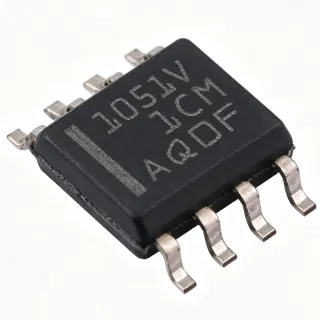
TJF1051T/3 - High-Speed CAN Transceiver 8-SO | NXP
MPN: TJF1051T/3 ✓ Hoạt độngTJF1051T/3 Tóm tắt
A CAN transceiver is a physical-layer interface IC that converts the single-ended transmit/receive logic of a CAN controller into the differential dominant/recessive signaling used on the CAN bus, while also providing bus fault protection, ESD tolerance, and common-mode rejection. Within the broader system hierarchy, the CAN transceiver sits between the protocol controller (typically a microcontroller with a CAN module) and the wired bus; it is a member of the in-vehicle networking IC category under power management and interface functions. Compared to lower-speed LIN or RS-485 transceivers, CAN parts like the TJF1051T/3 emphasize deterministic real-time behavior, multi-node arbitration, and automotive-grade robustness.
Key features include a low-current standby and silent mode with wake-up capability, ±8 kV HBM ESD on the bus pins, ±36 V bus fault tolerance on CANH/CANL, and an integrated VIO level shifter. The device operates over the automotive -40 °C to +125 °C junction range and meets the EMC and transient requirements defined by ISO 11898-2:2016.
The architecture combines a low-drop voltage regulator for the VIO domain, a differential driver with controlled slew rate, and a high-CMRR differential receiver. Internal thermal shutdown protects against bus short-to-battery or short-to-ground events, and the Silent mode (S pin) lets the controller put the part into a low-Iq state without losing bias on the bus.
Common applications include automotive body control modules, CAN gateway nodes, industrial CAN-FD sensor hubs, and any MCU-based system that needs an ISO 11898-compliant differential bus driver. A typical design routes TXD/RXDC straight into a STM32 or S32K microcontroller CAN module with VIO tied to the MCU's logic rail.
The primary design consideration is bus termination: place 120 Ω termination at each end of the bus and keep the split stub to the TJF1051T/3 short to preserve signal integrity at 1 Mbps and above. Decoupling on VCC and VIO with 100 nF ceramic capacitors placed within a few millimeters of the pins is required for EMC compliance.
This page aggregates distributor pricing, drop-in-compatible alternative part numbers, and practical EMC/layout design notes that go beyond the manufacturer datasheet summary, helping engineers select, source, and qualify the TJF1051T/3 with confidence.
Bộ thay thế dễ dàng lắp đặt cho TJF1051T/3 — cùng gói, chân-to-chân tương thích. Các bộ phận yêu cầu hàn PCB bị loại trừ.
Các biến thể trong loạt này
Các mẫu cùng loạt có thể lắp đặt dễ dàng tương thích với TJF1051T/3 (cùng hình factor và footprint) — khác nhau ở Package, Protocol, Operating Temperature, Data Rate, Product Type.
TJA1051T/3/1
✅ Drop-In✓ Còn hàng
$0.4102 / Đơn vị
Xem tài liệu →TJF1051T
✅ Drop-In📋 Tham chiếu thay thế (không có trong danh mục)
TJA1051T/3/1
✅ Drop-In✓ Còn hàng
$0.4102 / Đơn vị
Xem tài liệu →TCAN1044DRQ1
✅ Drop-InLiên hệ để biết giá
Xem tài liệu →NCV7342D10R2G
✅ Drop-In📋 Tham chiếu thay thế (không có trong danh mục)
TLE9251V
✅ Drop-In📋 Tham chiếu thay thế (không có trong danh mục)
TJF1051T/3 Thông số kỹ thuật
| Protocol | CAN, CAN FD (ISO 11898-2:2016) |
| Tốc độ dữ liệu | Up to 1 Mbps (classic CAN) |
| Number of Drivers/Receivers | 1/1 (Half duplex) |
| Supply Voltage VCC | 4.5 V to 5.5 V |
| I/O Supply Voltage VIO | 2.8 V to 5.5 V (TJF1051T/3 only) |
| Bus Fault Tolerance | ±36 V on CANH/CANL |
| ESD Protection (HBM, bus pins) | ±8 kV |
| Nhiệt độ hoạt động | -40 °C to +125 °C |
| Silent / Standby Mode | Yes (S pin, active-low silent) |
| Wake-up Capability | Via bus / local wake-up (per VIO variant) |
| Hộp | 8-SOIC (SO-8), 3.90 mm body width |
| Kiểu lắp đặt | Surface Mount (Gull-wing) |
| Cấp MSL | 1 (per JEDEC J-STD-020) |
| Trạng thái RoHS | Compliant |
| Temperature Grade | Industrial / Automotive extended |
Cấu hình chân TJF1051T/3
| Chân 1 | TXD — Transmit data input from CAN controller (to VIO logic level on /3 variant) |
| Chân 2 | GND — Ground |
| Chân 3 | VCC — 5 V supply for bus driver domain |
| Chân 4 | RXD — Receive data output to CAN controller (VIO-level on /3 variant) |
| Chân 5 | VIO — I/O level adapter supply (TJF1051T/3 only); tied to MCU logic rail |
| Chân 6 | CANL — Low-level CAN bus line |
| Chân 7 | CANH — High-level CAN bus line |
| Chân 8 | S — Silent mode control input (active-low; high = normal, low = silent) |
Ứng dụng tiêu biểu
TJF1051T/3 phù hợp cho 7 Áp dụngs: Automotive Body Control Module (BCM), CAN-FD Industrial Sensor Hub, EV Battery Management System (BMS) Master, CAN Gateway / Telematics Control Unit, Agricultural and Off-Highway Vehicle ECU, Medical Device CAN-Bus Backbone, Industrial PLC CANopen Module.
Automotive Body Control Module (BCM)
The TJF1051T/3 sits between an S32K or other automotive MCU's CAN module and the vehicle's body CAN bus, providing the differential physical layer that drives window, mirror, lighting, and door-lock nodes. Its ±36 V bus-fault tolerance and ±8 kV HBM ESD rating on CANH/CANL protect the BCM against jump-start transients and hot-plug events during end-of-line testing. The integrated VIO pin level-shifts cleanly to the 3.3 V or 5 V MCU rail without external shifters, reducing BOM and PCB area. The Silent/Standby mode (S pin) lets the BCM enter low-Iq sleep while still meeting OEM parasitic-drain budgets.
Được đề xuất
CAN-FD Industrial Sensor Hub
The TJF1051T/3 is well suited for industrial sensor hubs that aggregate CAN-FD data from multiple field sensors and forward it to a PLC or gateway. Its 1 Mbps classic-CAN plus CAN-FD capability (per ISO 11898-2:2016) preserves higher data-phase throughput when sensors stream diagnostic payloads. Operating from -40 °C to +125 °C with industrial-grade ESD tolerance, the part survives factory-floor EMI and ESD exposure. The VIO pin enables direct connection to 3.3 V industrial MCUs without external level shifters, simplifying the BOM. Designers should add a common-mode choke on CANH/CANL and a TVS diode near the bus connector for full IEC 61000-4-2 compliance.
Được đề xuất
EV Battery Management System (BMS) Master
In an EV battery management master, the TJF1051T/3 connects the BMS controller to the chassis CAN bus carrying cell-voltage, temperature, and SOC data from distributed cell monitoring ICs. Its controlled-slew-rate driver keeps EMI within automotive EMC limits while supporting CAN-FD for higher diagnostic bandwidth during service. The VIO-level shifter removes the need for separate logic-rail translation when interfacing to a 3.3 V BMS MCU. The ±36 V bus fault tolerance protects the BMS node against reverse-battery and load-dump transients present in 12 V/24 V automotive rails.
Được đề xuất
CAN Gateway / Telematics Control Unit
Telematics control units and CAN gateways use the TJF1051T/3 to bridge between in-vehicle CAN/CAN-FD networks and external LTE/5G or Wi-Fi modems. The transceiver's low-Iq Silent mode supports OEM-grade sleep-current targets while the wake-up capability lets the TCU re-join the bus on remote command. The 8-SOIC footprint allows compact module designs where PCB real estate is shared with the modem and SIM card. The part's wide -40 °C to +125 °C operating range covers under-hood and cabin thermal environments.
Được đề xuất
Agricultural and Off-Highway Vehicle ECU
Tractors, harvesters, and off-highway machinery require robust CAN nodes that survive 24 V battery systems, load-dump, and extreme temperature swings. The TJF1051T/3's ±36 V bus-fault rating and -40 °C to +125 °C junction range directly address these stresses, while the CAN-FD capability supports modern ISOBUS extensions used in precision agriculture. The VIO pin allows direct connection to 3.3 V MCUs that have replaced legacy 5 V parts. A split-termination network on the bus plus a TVS array extends protection against ESD during outdoor harness maintenance.
Được đề xuất
Medical Device CAN-Bus Backbone
In medical imaging and patient-monitoring systems, the TJF1051T/3 can serve as the physical-layer interface for internal CAN/CAN-FD backbones connecting modality sub-systems. The part's deterministic low-latency behavior, ±8 kV HBM ESD tolerance, and quiet controlled-slew driver minimize emissions that could couple into sensitive analog front-ends. The VIO pin lets designers run modern 1.8 V MCUs that reduce overall system power, important for portable medical carts. Compliance with ISO 11898-2:2016 simplifies regulatory submission by aligning with widely adopted safety standards.
Được đề xuất
Industrial PLC CANopen Module
The TJF1051T/3 acts as the physical-layer interface for CANopen slave modules plugged into a PLC backplane, communicating with motion controllers and I/O nodes over CiA 301/401/402/404 profiles. Its 1 Mbps classic-CAN capability covers standard CANopen bit rates used in factory automation, while the ISO 11898-2:2016 compliance supports CANopen FD extensions. The VIO pin interfaces cleanly to 3.3 V PLC SoCs without external level shifting. The transceiver's Silent mode supports hot-plug removal from the rack while keeping bus bias undisturbed on neighboring nodes.
Được đề xuất
Tóm tắt các sản phẩm được đề xuất
Dữ liệu tham khảo kỹ thuật cho TJF1051T/3 — so sánh, hướng dẫn thiết kế và thông tin tuân thủ.
Hướng dẫn chọn lựa
So sánh với các sản phẩm thay thế
| Tham số | Sản phẩm này | TJA1051T/3 | TJF1051T | TJA1051T | TCAN1044DRQ1 | NCV7342D10R2G | TLE9251V |
|---|---|---|---|---|---|---|---|
| Package | 8-SOIC (SO-8) | 8-SOIC (SO-8) - same | 8-SOIC (SO-8) - same | 8-SOIC (SO-8) - same | 8-SOIC (SO-8) - same | 8-SOIC (SO-8) - same | 8-DSO - same pin count, gull-wing |
| Brand | NXP Semiconductors | NXP Semiconductors | NXP Semiconductors | NXP Semiconductors | Texas Instruments | onsemi | Infineon |
| Protocol / Compliance | ISO 11898-2:2016, CAN FD | ISO 11898-2:2003, CAN FD | ISO 11898-2:2016, CAN FD | ISO 11898-2:2003, classic CAN | ISO 11898-2:2016, CAN FD | ISO 11898-2, classic CAN | ISO 11898-2:2016, CAN FD |
| VIO Level Shifter | Yes (VIO pin) | Yes (VIO pin) | No (5 V logic only) | No (5 V logic only) | No (5 V logic only) | No (5 V logic only) | No (5 V logic only) |
| AEC-Q100 Qualified | Yes (automotive grade) | Yes | Yes | Yes | Yes | Yes | Yes |
| Bus Fault Tolerance | ±36 V | ±36 V | ±36 V | ±36 V | ±36 V | ±36 V | ±40 V |
| ESD (HBM, bus pins) | ±8 kV | ±8 kV | ±8 kV | ±8 kV | ±8 kV | ±8 kV | ±8 kV |
| Silent / Standby Mode | Yes (S pin, active-low) | Yes (S pin) | Yes (S pin) | Yes (S pin) | Yes (S pin) | Yes (S pin) | Yes (S pin) |
Bảo phân biệt quan trọng
- VIO-level shifter on 8-SOIC footprint (vsTJA1051T)
- ISO 11898-2:2016 compliance (CAN FD ready) (vsTJA1051T/3)
- Higher bus-fault tolerance vs TI alternative (vsTLE9251V)
- Established automotive-grade pedigree (vsNCV7342D10R2G)
Ghi chú thiết kế
Estimated: Place a 100 nF X7R ceramic decoupling capacitor on VCC (pin 3) within 3 mm of the pin, and a separate 100 nF X7R on VIO (pin 5) within 3 mm of that pin, with ground returns routed directly to the CAN transceiver GND (pin 2) via a short, wide trace. For high-EMC environments, add a 4.7 µF bulk capacitor on VCC and a ferrite bead in series with VIO to suppress digital-domain noise. Keep the CANH/CANL traces as a 100 Ω differential pair with controlled 50 Ω single-ended impedance, and route them away from switching converter inductors and clock lines by at least 5 mm to preserve signal integrity at 1 Mbps.
Do not leave the VIO pin (TJF1051T/3) floating — it MUST be tied to the MCU logic supply rail (typically 3.3 V or 5 V) for the digital I/O levels on TXD, RXD, and S to be valid. Do not omit the 120 Ω termination at each end of the bus; without termination, signal reflections will corrupt arbitration. Do not apply reverse polarity on VCC or VIO — although the bus pins are ±36 V tolerant, the supply pins are not. Avoid long stubs (>1 m) to the transceiver, especially in CAN-FD networks where reflections at data-phase edges can mask bits.
Place the TJF1051T/3 close to the bus connector to keep the unprotected bus stub length below 10 mm, reducing radiated emissions. Use a split-termination network (60 Ω + 60 Ω + 4.7 nF to ground) at each end of the bus to improve EMC and reduce common-mode emissions per ISO 11898-2:2016 recommendations. Provide a chassis-ground connection through an RC network (typically 1 nF + 1 MΩ) to drain common-mode currents to chassis without disturbing bus DC bias. Reference: per the NXP TJF1051 datasheet section on application diagrams.
For CISPR 25 / IEC 62228 conformance, add a common-mode choke (e.g., 100 µH at 100 MHz) in series with CANH/CANL between the transceiver and the bus connector. This damps common-mode currents that would otherwise couple onto the harness and radiate. Combine the choke with a TVS diode array (rated for ±30 V working) for ESD and transient protection during end-of-line handling. Reference: per NXP's application notes for ISO 11898-2:2016 EMC compliance in automotive CAN-FD networks.
Thông tin tuân thủ
AEC-Q100 qualified per NXP product page. RoHS and halogen-free compliance confirmed by NXP packaging materials declaration.