ADC/DAC
產品(3,100+)

ADS1211P - 24-Bit, 15.6-kSPS Delta-Sigma ADC | TI
Texas Instruments ADS1211P is a precision, 24-bit, delta-sigma analog-to-digital converter with eight channels, a 15.6-kSPS maximum conversion rate, an internal voltage reference, and a programmable gain amplifier in a 24-pin PDIP package. It operates from a single 5 V supply and supports differential inputs for low-level signals and transducers. A delta-sigma ADC is a data-converter category that uses oversampling, noise shaping, and digital filtering to achieve high resolution and excellent noise performance from relatively low-frequency measurements. Within the broader hierarchy of analog-to-digital converters, the ADS1211P occupies the precision, low-speed measurement segment between basic sampling ADCs and higher-speed SAR converters. Its low conversion rate is especially useful when measuring slowly changing bridge, pressure, temperature, and current signals. The converter provides 24-bit resolution and reports 23 effective bits at 10 Hz and 20 effective bits at 1000 Hz. Its programmable gain amplifier accommodates low-level differential inputs, while the internal reference reduces the need for an external precision reference. A programmable digital cutoff frequency supports filtering of noise and out-of-band content, and the flexible serial interface is compatible with SPI while also offering a two-wire control mode. Its architecture is designed for precision measurement rather than waveform capture. The 15.6-kSPS conversion rate, high-resolution output, differential input arrangement, internal voltage reference, and programmable filtering work together to improve the signal-to-noise ratio of low-frequency measurements. Four analog inputs are identified in the product listing, while the manufacturer describes the ADS1211 family as an eight-channel converter. Typical applications include industrial process measurement, load-cell and strain-gauge sensing, pressure and temperature instrumentation, portable measurement equipment, and low-level sensor acquisition. Differential excitation and measurement help reject common-mode noise when sensors and electronics share a grounded industrial environment. Design the analog input network to minimize thermal noise and keep routed traces away from switching converters and high-current digital return paths. Use the manufacturer pin-description table and serial-interface timing specifications when assigning connector and PCB nets. Confirm the selected gain, data rate, and digital cutoff setting against the required settling time before sampling rapidly changing signals. This page combines the device specifications, package details, application guidance, design cautions, and documented drop-in replacement analysis. The replacement list is intentionally limited to verified same-footprint choices because electrically similar converters in different packages cannot be soldered directly onto the ADS1211P footprint.

ADS1211U - 24-Bit, 15.6 kSPS Delta-Sigma ADC | TI
The Texas Instruments ADS1211U is a 24-bit, 15.6 kSPS delta-sigma analog-to-digital converter with eight-channel input multiplexing, a programmable gain amplifier, an internal reference, and a 24-pin SOIC package. It operates from a single 5 V supply and is designed for precision conversion of differential, low-level analog signals. According to the Texas Instruments ADS1211 product page, the device provides 24-bit nominal resolution, 15.6 kSPS maximum data rate, programmable gain, and an integrated voltage reference. A delta-sigma ADC is a type of analog-to-digital converter that uses continuous-time oversampling and digital filtering to provide high resolution and excellent noise performance. In the hierarchy of electronic components, the ADS1211U is a precision ADC, a data-conversion IC, and ultimately a semiconductor designed for measurement and instrumentation. Its low-noise architecture is useful when the input signal is small, slow, or generated by a sensitive transducer and does not require the very high sampling rates associated with SAR converters. Key features include differential inputs, a programmable gain amplifier, a flexible SPI-compatible synchronous serial interface, and a two-wire control mode. The verified feature data also identifies programmable cutoff frequency and 23 effective bits at 10 Hz, with 20 effective bits at 1000 Hz. These characteristics allow the converter to balance conversion speed, filtering, and usable resolution according to the measurement bandwidth required by the application. The ADS1211U uses a delta-sigma conversion architecture rather than a successive-approximation architecture. Digital filtering suppresses out-of-band noise, while the programmable cutoff frequency helps control bandwidth and the amount of averaging. The gain stage accepts low-level differential signals without requiring a separate instrumentation amplifier, although the complete signal chain still requires suitable source impedance, reference stability, and printed-circuit-board layout. The SPI-compatible interface supports conventional four-wire control, while two-wire mode can simplify isolated or pin-constrained systems. Typical applications include low-level bridge and load-cell measurement, industrial process instrumentation, precision temperature sensing, laboratory data acquisition, battery monitoring, and compact sensor interfaces. Its 24-bit conversion word and differential inputs are particularly valuable when the measured quantity is represented by a small voltage difference. The single 5 V architecture can simplify system power design compared with converters requiring separate analog and digital rails. Designers should verify the input voltage range, absolute maximum ratings, common-mode limits, PGA range, reference accuracy, and digital interface timing in the manufacturer datasheet before finalizing a circuit. Decoupling, grounding, and analog-versus-digital layout remain critical because they can affect the effective resolution otherwise provided by the converter. The available verified data does not include numeric timing values, pin assignments, or complete electrical limits, so those details should not be inferred from general ADC experience. This page consolidates the verified Texas Instruments and distributor information, distinguishes documented parameters from unavailable data, and provides engineering-oriented application and design guidance beyond a basic catalog listing. It also records why only one web-supported same-package alternative is presented instead of padding the replacement list with unverified parts.

ADS1212P - 22-Bit Sigma-Delta ADC, 1 Input, 18-PDIP | TI
The Texas Instruments ADS1212P is a 22-bit single-input sigma-delta analog-to-digital converter in an 18-pin PDIP package, optimized for precision low-level signal measurement. It converts one differential analog input at rates up to 6.25 kSPS and provides programmable gain, no missing codes, and an SPI-compatible SSI serial interface. The device is listed with 20-bit effective resolution at 10 Hz and 16-bit effective resolution at 1 kHz, while its low-power consumption is specified as 1.4 mW. A sigma-delta ADC is a voltage-regulating and signal-conditioning device that uses oversampling and digital filtering to provide high resolution and noise performance for low-frequency measurements. Its place in the broader hierarchy is analog-to-digital converter -> data converter -> mixed-signal integrated circuit. The ADS1212P is suited to transducer signals, sensor interfaces, industrial measurement systems, and precision instrumentation where the input bandwidth is modest but conversion accuracy and noise rejection are important. The ADS1212P includes a programmable-gain amplifier, differential inputs, and programmable conversion and data rates. These features allow the analog front end to be configured for different sensor ranges without changing the digital interface. The 22-bit converter is specified as having no missing codes, which supports consistent output-code behavior across the conversion range. The serial interface is compatible with SPI and SSI conventions, allowing connection to microcontrollers and other embedded processors. The 6.25 kSPS maximum data rate is appropriate for slow-changing signals rather than high-bandwidth waveform acquisition. At 10 Hz, the device provides 20-bit effective resolution; at 1 kHz, effective resolution is 16 bits. This relationship illustrates the usual conversion-speed versus noise-resolution tradeoff of a delta-sigma architecture. Lower output rates reduce filtering requirements and can improve usable resolution for slow sensor signals. Typical applications include bridge-based pressure and load-cell measurements, RTD and thermocouple signal conditioning, low-level voltage acquisition, and factory automation. Differential inputs help reject common-mode noise when the sensor is connected through shielded or twisted-pair wiring. The 18-pin PDIP package also favors through-hole prototyping, educational platforms, and industrial control assemblies where a socketed or leaded package is preferred. When laying out the circuit, place the input filtering and reference components close to the ADC pins, use a clean low-noise reference source, and keep the analog and digital return paths separated appropriately. The serial interface timing and data-rate configuration should be checked against the host processor requirements. This page combines the device specifications, package information, application guidance, and replacement considerations for engineers evaluating the ADS1212P.
ADS1212PG4 - 22-Bit Delta-Sigma ADC, 18-PDIP | Texas Instruments
The Texas Instruments ADS1212PG4 is a 22-bit, single-channel, delta-sigma analog-to-digital converter (ADC) housed in an 18-pin PDIP through-hole package. The device operates from a single 5V analog supply, delivers no missing codes at 22 bits, and provides 20 bits of effective resolution at a 10 Hz data rate while still maintaining 16 effective bits at 1 kHz. The architecture combines a fourth-order modulator with a programmable gain amplifier (PGA) and a digital filter, drawing only 1.4 mW of power in normal operation, which makes the part well-suited for low-power instrumentation front-ends. A delta-sigma ADC is a type of oversampling converter that trades speed for resolution by pushing quantization noise to high frequencies, where it is filtered out by a digital decimation filter. The ADS1212PG4 sits within the broader hierarchy of analog-to-digital converters -> precision ADCs -> delta-sigma ADCs -> data-acquisition ICs, and belongs to the power-management CMOS family of mixed-signal products. This category of converter is widely chosen over successive-approximation (SAR) ADCs in slow, high-resolution applications such as weigh scales, strain-gauge bridges, and temperature measurement, where noise rejection at 50 Hz and 60 Hz mains frequencies is required. Key features include 22-bit resolution with no missing codes, a low 1.4 mW power dissipation, differential analog inputs, an on-chip programmable gain amplifier with gain settings typically from 1 to 16, and an SPI-compatible synchronous serial interface (SSI) for host communication. The modulator sampling rate and digital filter characteristics are user-programmable through the serial interface, allowing trade-offs between resolution, data rate, and noise. An on-chip calibration engine supports both self-calibration and system-calibration modes to correct offset and gain errors. Typical applications include industrial weigh scales, precision load-cell readouts, RTD and thermocouple temperature measurement, chromatography and blood-gas analyzers, and other low-frequency precision instrumentation where wide dynamic range is needed. The combination of 22-bit resolution and a built-in PGA allows direct connection to low-output transducers without external instrumentation amplifiers. When designing with the ADS1212PG4, observe the decoupling requirements of the analog and digital sections: a clean 5V rail with separate AVCC and DVCC pins must be tied together at a single point with proper decoupling. The differential input pair must be kept away from digital switching traces on the PCB to preserve CMRR. Because the part is in a PDIP through-hole package, it is typically chosen for prototyping and industrial backplanes rather than high-density SMT designs. This page synthesizes distributor pricing, drop-in alternative listings, and engineering design notes not collected in a single place in the manufacturer datasheet.

ADS1212U - 22-Bit 6.25 kSPS ADC | Texas Instruments
The Texas Instruments ADS1212U is a precision delta-sigma analog-to-digital converter with 22-bit no-missing-code performance, a maximum conversion rate of 6.25 kSPS, and an 8-pin SOIC package. Designed for a single +5 V supply, the device accepts differential inputs suitable for low-level sensor signals and transducer outputs. A delta-sigma ADC is a type of analog-to-digital converter that uses continuous-time sigma-delta modulation and digital filtering to provide high resolution, excellent noise performance, and wide dynamic range. The ADS1212U belongs to the broader precision ADC hierarchy, where it supports measurement systems that require more accuracy than ordinary general-purpose converters while retaining a straightforward serial interface. The primary features include one differential input channel, 22-bit effective resolution, and operation from a single +5 V supply. Its flexible synchronous serial interface is SPI compatible and also supports a two-wire control mode intended to reduce implementation cost in low-cost isolation arrangements. A conversion rate of up to 6.25 kSPS makes the converter suitable for instrumentation that must capture relatively slow, high-accuracy measurements. Internally, the device uses a delta-sigma architecture to achieve wide dynamic range and 22-bit no-missing-code performance. Its differential input structure helps reject common-mode noise when the source is close to the converter's analog ground. The serial interface provides a compact solution for communicating conversion results to a microcontroller, digital controller, or industrial measurement system. Typical applications include smart transmitters, industrial process-control loops, weigh scales, chromatography systems, portable instrumentation, and low-level pressure or temperature measurement. Differential excitation is particularly useful with bridge sensors and other transducers that generate small signals relative to their common-mode voltage. When implementing a circuit around the ADS1212U, verify the input common-mode range, allowable differential input voltage, and external reference requirements against the manufacturer datasheet. Provide a quiet +5 V supply, decouple the analog and digital sections appropriately, and route the differential input pair symmetrically to reduce conversion errors and noise pickup. This product record combines manufacturer specifications, distributor availability information, package details, pricing evidence, verified alternatives, and application-specific design guidance. It is intended to help engineers evaluate the ADS1212U for precision measurement systems while separately checking any replacement against pinout, interface timing, input range, reference voltage, and acquisition requirements.

ADS1213E - 22-Bit 4-Channel Delta-Sigma ADC | Texas Instruments
Texas Instruments ADS1213E is a 22-bit, four-channel delta-sigma analog-to-digital converter with a maximum data rate of 6.25 kSPS, an internal voltage reference, and a programmable-gain amplifier. The device is offered in the ADS1213E configuration as a 28-pin SSOP. It provides 20 bits of effective resolution at 10 Hz and 16 bits at 1,000 Hz, combining high resolution with a low reported power consumption of 1.4 mW. A delta-sigma ADC is a type of analog-to-digital converter that uses continuous-time oversampling, digital filtering, and quantization to produce a high-resolution digital result. The ADS1213 belongs to the broader ADC and data-converter hierarchy, where its differential inputs, programmable gain, selectable data rates, and serial interface make it suitable for precision analog measurement systems. The four-channel input multiplexer allows related sensor signals to be measured sequentially rather than requiring a separate converter for every channel. Key features include 22-bit conversion resolution, four analog inputs, differential input support, a programmable-gain amplifier, and a 6.25 kSPS maximum data rate. Effective resolution is application-dependent because the reported values of 20 bits at 10 Hz and 16 bits at 1,000 Hz reflect the interaction among conversion speed, filtering, noise, and signal bandwidth. The integrated reference and programmable gain reduce the number of external precision components required in many measurement designs. The serial interface is SPI compatible and also supports a two-wire control mode described by Texas Instruments. Two-wire operation can simplify connections to low-cost isolation components, while SPI compatibility supports a broader range of digital controllers. Configuration registers allow the system to select data rate, gain, channel, and operating modes, although the complete register sequence should be implemented according to the manufacturer datasheet. Typical measurement uses include bridge-based sensing, industrial process instrumentation, low-level analog signal acquisition, and multichannel sensor monitoring. The combination of differential inputs and programmable gain is particularly useful when a sensor produces a small differential signal around a common-mode voltage. Four channels also support multiplexed sensing, although the complete settling time and acquisition sequence must be allowed before each converted result is used. Design consideration: the conversion data rate must be selected together with the digital filter, input impedance, gain setting, and reference configuration. Differential input routing, guarding around sensitive analog pins, and a low-noise reference and supply arrangement are more important than simply maximizing the nominal 22-bit converter resolution. This page consolidates the verified manufacturer and distributor information for ADS1213E, distinguishes its documented conversion performance from application-dependent effective resolution, and identifies the design information still required to finalize a complete analog front end.
ADS1213EG4 - 22-bit Delta-Sigma ADC, 4-Ch, SPI | Texas Instruments
The Texas Instruments ADS1213EG4 is a precision 22-bit delta-sigma analog-to-digital converter with 4 input channels, an integrated programmable gain amplifier (PGA), and on-chip voltage reference, packaged in a 28-pin SSOP. It operates from a single +5V supply, delivers up to 6.25 kSPS output data rate, and achieves 22 bits of no-missing-codes performance with 20 bits effective resolution at 10 Hz, dropping to 16 bits at 1 kHz. Low power consumption of 1.4 mW makes it suitable for battery-powered and industrial instrumentation systems. A delta-sigma ADC (also called sigma-delta or oversampling converter) is a converter architecture that trades raw speed for resolution by oversampling the input and using digital filtering to shape quantization noise out of the signal band. Within the broader hierarchy, a delta-sigma ADC is a subset of precision ADC > data converter > signal chain IC > semiconductor. Delta-sigma ADCs dominate high-resolution, low-frequency measurement because their inherent noise shaping rejects broadband noise that would otherwise limit resolution. Key features of the ADS1213EG4 include a programmable gain amplifier with gain settings from 1 to 16, a synchronous SPI-compatible serial interface with optional two-wire mode for galvanic isolation, differential input architecture for direct transducer connection, and an internal 4-channel input multiplexer for multi-channel scanning. The on-chip reference and self-calibration functions remove most offset and gain errors at the system level, simplifying firmware burden. The device uses a fourth-order delta-sigma modulator with a switched-capacitor front end, followed by a decimation-by-64 to 2048 digital filter. Effective resolution is a function of data rate, PGA gain, and reference voltage, so designers should consult the ADS1212/ADS1213 datasheet noise tables when matching dynamic range to a target transducer output. Typical applications include industrial process control weigh scales, direct thermocouple and RTD temperature measurement, multi-channel pressure transducers, instrumentation front ends, and precision sensor signal conditioning. The combination of low power, integrated PGA, and on-chip reference makes the ADS1213EG4 well suited to remote or handheld measurement nodes where PCB area is at a premium. When designing with this part, pay close attention to analog supply decoupling and the differential input common-mode range. Use a low-thermal-EMF ground layout around the analog inputs; even a few nanovolts of stray thermocouple voltage between the input traces and the reference ground can corrupt 22-bit measurements. This page synthesizes distributor stock and pricing, drop-in alternative cross-references, and engineering design notes that go beyond what the manufacturer datasheet alone provides, helping engineers both evaluate and qualify the ADS1213EG4 for production designs.
ADS1213P - 22-Bit, 6.25-kSPS Delta-Sigma ADC | Texas Instruments
Texas Instruments ADS1213P is a 22-bit delta-sigma analog-to-digital converter with four differential input channels, a 6.25-kSPS maximum data rate, programmable gain, an internal voltage reference, and a 24-pin plastic DIP package. It combines high resolution with low power consumption and is designed for precision measurement of low-level differential signals. A delta-sigma ADC is a voltage-regulating ADC category that uses oversampling, noise shaping, and digital filtering to convert analog inputs into high-resolution digital codes. Within the broader semiconductor hierarchy, the ADS1213P belongs to the analog-to-digital converter, data-converter IC, and precision-measurement families. Its differential inputs, programmable gain amplifier, and low-noise architecture are especially useful when measuring signals from sensors, strain gauges, bridges, and industrial transducers. The converter provides 22-bit resolution, 20-bit effective resolution at 10 Hz, and 16-bit effective resolution at 1 kHz. A programmable data rate extends up to 6.25 kSPS, allowing designers to trade conversion speed against noise performance. Differential inputs reject common-mode noise, while programmable gain accommodates low-level transducer outputs without requiring a separate instrumentation amplifier. The ADS1213 architecture includes a four-channel input multiplexer, delta-sigma modulator, programmable gain amplifier, internal reference, and digital interface. The SPI-compatible synchronous serial interface supports conventional SPI communication and a two-wire control mode for isolation-oriented designs. The device is optimized for low power, with a cited consumption of 1.4 mW, making it suitable for compact, precision-oriented measurement systems. Typical uses include factory automation, process monitoring, load-cell and pressure-transducer measurement, temperature acquisition, portable instrumentation, and low-level industrial sensor interfaces. The four differential input channels allow a compact controller to monitor several related bridges without requiring a separate analog multiplexer. Designers should pay close attention to input common-mode range, reference accuracy, digital filtering, and data-rate selection. Differential routing should minimize mismatched traces and ground-loop area, while the serial interface and converter clock require clean layout to preserve conversion accuracy. This product page combines the manufacturer’s core specifications, application guidance, package information, and drop-in replacement assessment. It also distinguishes electrical fit from mere functional similarity, helping engineers determine whether a proposed replacement is truly pin-compatible before committing to a board revision.
ADS1213U - 22-Bit, 6.25 kSPS Delta-Sigma ADC | Texas Instruments
Texas Instruments ADS1213U is a 22-bit, 6.25 kSPS, 8-channel delta-sigma analog-to-digital converter with a programmable gain amplifier, internal reference, and SPI-compatible SSI interface, packaged in a 24-pin SOIC. The converter supports four differential or eight single-ended input channels through its integrated input multiplexer, making it suitable for precision industrial measurement systems that require multiple sensor inputs and high resolution. A delta-sigma ADC is a signal-conversion IC that uses oversampling, digital filtering, and noise shaping to exchange conversion speed for high resolution and noise performance. The ADS1213U belongs to the ADC/DAC category within the broader data-converter and signal-processing hierarchy. Its architecture is intended for low-bandwidth industrial signals where 22-bit nominal resolution can improve measurement fidelity without requiring a high-speed successive-approximation ADC. Key features include 22-bit conversion resolution, a maximum data rate of 6.25 kSPS, differential inputs, a programmable gain amplifier, an internal voltage reference, and a flexible synchronous serial interface. The verified data also identifies 20-bit effective resolution at 10 Hz and 16-bit effective resolution at 1000 Hz. Operation from a single +5 V supply and a stated low-power figure of 1.4 mW align the device with embedded measurement systems that must balance precision, conversion speed, and energy use. The integrated four-channel input multiplexer supports analog-front-end designs that would otherwise require external analog switching. The programmable gain stage can condition low-level sensor outputs before conversion, while the delta-sigma conversion path suppresses out-of-band noise. The SPI-compatible SSI interface and two-wire control mode described by Texas Instruments simplify host communication and can reduce isolated-system implementation complexity when appropriately designed. Typical uses include pressure and temperature transmitters, industrial process monitoring, strain-gauge and bridge-sensor acquisition, laboratory instrumentation, and low-speed data loggers. Its 6.25 kSPS maximum rate favors continuous sensor monitoring rather than waveform capture or high-speed motor-control feedback. Systems requiring several channels can also multiplex analog inputs around the converter while retaining programmable gain and synchronized serial output. Designers should account for the conversion-time penalty associated with delta-sigma filtering, verify the input common-mode range at every programmable-gain setting, and follow the manufacturer’s reference layout and decoupling recommendations. The integrated reference and programmable gain simplify the analog front end, but sensor excitation, protection, grounding, and digital-interface isolation still require careful implementation. This page consolidates verified manufacturer and distributor details, practical application guidance, parameter comparisons, and drop-in replacement information. It also distinguishes the verified ADS1213U from ordering-code or package variants that are not confirmed as pin-compatible substitutes.

ADS1217 - 8-Channel 24-Bit Delta-Sigma ADC | Texas Instruments
The ADS1217 is a precision, wide dynamic range, delta-sigma analog-to-digital converter (ADC) with 24-bit resolution, designed for high-resolution measurement applications. It operates from a 2.7V to 5.25V supply and provides up to 24 bits of no missing code performance with an effective resolution of 22 bits. The device features eight multiplexed input channels, an internal programmable gain amplifier (PGA) with gains from 1 to 128, and a flexible serial interface. It is available in a 48-pin TQFP package (PFB) and is manufactured by Texas Instruments. A delta-sigma ADC is a type of analog-to-digital converter that uses oversampling and noise shaping to achieve high resolution. It is part of the ADC family, which converts analog signals into digital data for processing by microcontrollers or DSPs. Delta-sigma ADCs are known for their excellent linearity and low noise, making them ideal for precision measurement applications where accuracy is critical. Key features of the ADS1217 include 24-bit no missing codes, INL of 0.0012% of FSR (max), full-scale input of ±2VREF, and a PGA with gains from 1 to 128. It offers 22 bits of effective resolution at PGA=1 and 19 bits at PGA=128. The device supports single-cycle settling mode and programmable data output rates up to 1kHz. It also includes an on-chip 1.25V/2.5V reference, reducing external component count. Technically, the ADS1217 uses a delta-sigma modulator followed by a digital filter, achieving high resolution through oversampling. The multiplexed inputs allow multiple sensors to be connected, and the PGA amplifies small signals before conversion, improving dynamic range. The device includes an internal buffer that can be selected to provide high input impedance, simplifying sensor interfacing. Typical applications include smart transmitters, industrial process control, weigh scales, chromatography, and portable instrumentation. Its high resolution and low noise make it suitable for precision measurement systems where accuracy is paramount. The wide input range and programmable gain allow it to handle a variety of sensor outputs. When designing with the ADS1217, ensure proper decoupling of the analog and digital supplies and use a clean reference voltage. The PGA gain setting should be chosen to maximize dynamic range while avoiding saturation. The serial interface allows easy connection to microcontrollers, and the single-cycle settling mode is useful for multiplexed applications.

ADS1220 - 24-Bit Low-Power ADC with PGA | Texas Instruments
The ADS1220 is a precision, 24-bit, delta-sigma (ΔΣ) analog-to-digital converter (ADC) from Texas Instruments, designed for low-power, high-resolution measurement of small sensor signals. It integrates a programmable gain amplifier (PGA), a voltage reference, two programmable current sources, and a temperature sensor, significantly reducing system cost and component count. The device operates from a 2.3 V to 5.5 V supply and consumes as low as 120 μA in duty-cycle mode, making it ideal for battery-powered and loop-powered applications. It is available in a leadless VQFN-16 or a TSSOP-16 package and is specified over a temperature range of -40°C to +125°C. An analog-to-digital converter (ADC) is an electronic component that converts continuous analog signals into discrete digital values, enabling microcontrollers and digital processors to interpret real-world physical quantities such as temperature, pressure, and strain. The ADS1220 belongs to the family of delta-sigma ADCs, which use oversampling and noise shaping to achieve high resolution (24 bits) and excellent noise performance. Within the signal chain hierarchy, the ADS1220 sits between the sensor and the digital host, often following a signal conditioning stage and preceding a microcontroller or DSP. Its integrated PGA and reference eliminate the need for external precision components, simplifying the design and improving overall accuracy. Key features of the ADS1220 include a programmable gain from 1 V/V to 128 V/V, programmable data rates up to 2 kSPS, and up to 20 bits of effective resolution. It supports two differential or four single-ended inputs, and includes a 2.048 V reference with low drift. The device also provides simultaneous 50-Hz and 60-Hz rejection, which is critical for industrial applications where power-line noise is prevalent. The integrated temperature sensor and current sources enable direct RTD and thermocouple measurements without additional circuitry. Technically, the ADS1220 uses a delta-sigma modulator followed by a digital filter, achieving high accuracy with minimal external components. The PGA allows small sensor signals to be amplified before conversion, improving signal-to-noise ratio. The device communicates via a 4-wire SPI interface, and includes a data-ready (DRDY) pin for synchronization. The low-power architecture, combined with a wide supply range, makes it versatile for both portable and industrial designs. Typical applications include temperature measurement with RTDs and thermocouples, pressure and load-cell sensing, 4-20 mA loop-powered transmitters, and portable instrumentation. The ADS1220's low power consumption and integrated features make it particularly well-suited for field transmitters and battery-operated devices where power efficiency is critical. When designing with the ADS1220, ensure proper decoupling of the AVDD and DVDD supplies, and place the reference bypass capacitor close to the REFP/REFN pins. The PGA gain and data rate settings should be chosen to balance resolution and speed for the specific sensor bandwidth. For best noise performance, use a low-noise reference and minimize digital switching noise near the analog inputs.
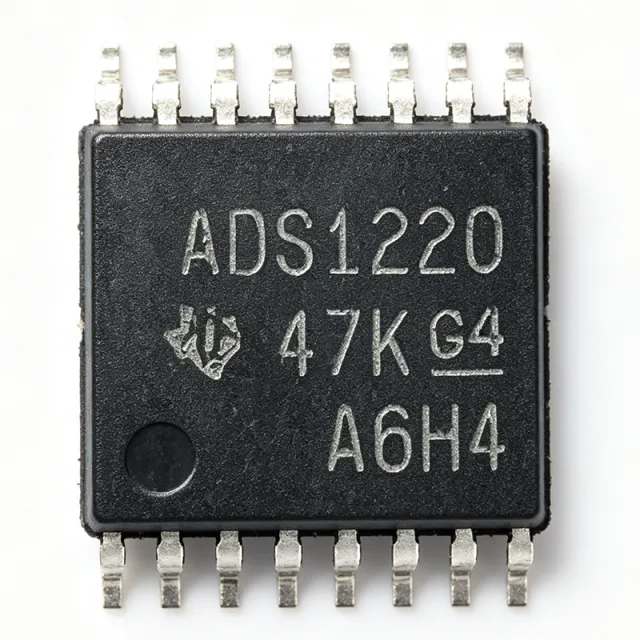
ADS1220IPWR - 24-Bit 2kSPS Delta-Sigma ADC | Texas Instruments
The Texas Instruments ADS1220IPWR is a 24-bit, 2-kSPS, four-channel, low-power delta-sigma analog-to-digital converter with an integrated programmable gain amplifier (PGA), voltage reference, SPI interface and two programmable excitation current sources (IDACs), housed in a 16-pin TSSOP package rated from -40C to +125C. A delta-sigma ADC is a type of analog-to-digital converter that oversamples the input signal and applies digital filtering to achieve very high resolution, making it the dominant architecture in the precision data-converter hierarchy (ADC -> precision ADC -> sigma-delta ADC -> data converter) for measuring small sensor signals. Where successive-approximation (SAR) ADCs favor speed, delta-sigma converters favor noise-free resolution, which is why they dominate sensor front ends. Key features of the ADS1220 include a flexible input multiplexer supporting two differential or four single-ended inputs, a low-noise PGA that reduces system component count, two integrated matched IDACs for ratiometric 3-wire and 4-wire RTD measurements, and an on-chip reference that eliminates external reference circuitry. The integration of PGA, VREF and IDACs in a small TSSOP-16 footprint is the part's central value proposition: TI positions it explicitly as a way to reduce system cost and bill-of-materials count in small-signal sensor applications. Architecturally, the device combines the delta-sigma modulator with a programmable digital filter, allowing trade-offs between output data rate (up to 2 kSPS) and noise performance. The SPI-compatible serial interface provides data reads, register configuration, and a DRDY output for deterministic cycle timing, simplifying interfacing with any MCU, including TI MSP430 and other low-power hosts. Typical applications include RTD and thermocouple temperature measurement, bridge sensors such as load cells and pressure sensors, battery monitoring, and portable industrial instrumentation where low power and small size matter. Design consideration: use the two IDACs with a precision reference resistor to build ratiometric RTD front ends; this cancels IDAC drift from the measurement, but budget the PGA headroom so IDAC compliance voltage plus sensor drop stays within the supply. This page synthesizes distributor pricing, drop-in alternatives, pinout, design notes and comparison data not consolidated in the manufacturer datasheet.
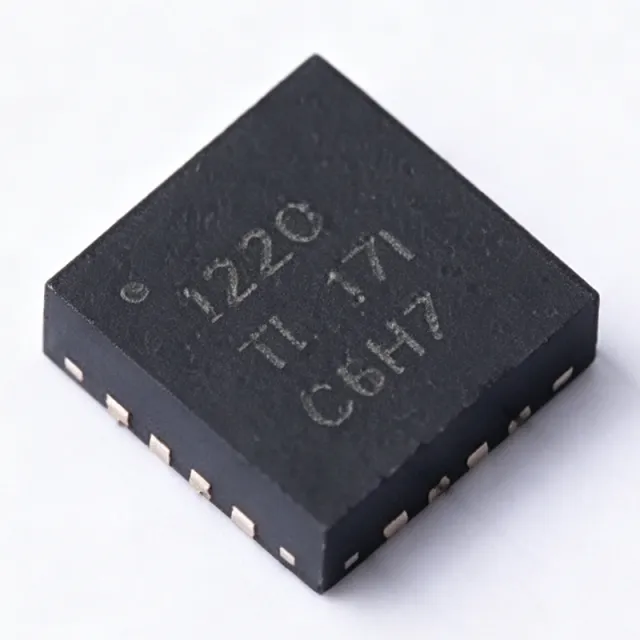
ADS1220IRVAR - 24-Bit 2kSPS Delta-Sigma ADC with PGA | Texas Instruments
The Texas Instruments ADS1220IRVAR is a 24-bit, 2-kSPS, four-channel, low-power delta-sigma analog-to-digital converter with integrated programmable gain amplifier (PGA), internal 2.048 V voltage reference, two matched programmable excitation current sources (IDACs), and an SPI-compatible serial interface, housed in a 16-pin VQFN (3.5 mm x 3.5 mm) package with exposed thermal pad. A delta-sigma ADC is a type of analog-to-digital converter that oversamples the input signal far above Nyquist and applies digital filtering to push quantization noise out of band, achieving very high resolution. It is the dominant architecture for precision sensor measurement (ADC -> data converter -> mixed-signal front end -> semiconductor). The ADS1220 sits in TI's precision ADC portfolio alongside the ADS1120 (lower channel count, similar feature set) and the ADS131M family (higher speed, simultaneous-sampling focus). Key features include a flexible input multiplexer supporting two differential or four single-ended inputs, a low-noise chopper-stabilized PGA with gains of 1, 2, 4, 8, 16, 32, 64, and 128, two matched programmable excitation current sources up to 1.5 mA for ratiometric RTD and thermistor measurements, a burnout current source for open-wire sensor detection, and a 2.048 V integrated reference with 10 ppm/C typical drift. The digital filter provides simultaneous 50 Hz and 60 Hz line-noise rejection at 20 SPS. Technically, the ADS1220 achieves up to 20 bits effective resolution at the maximum 2 kSPS data rate and up to 29.5 bits noise-free resolution at 20 SPS, using a third-order delta-sigma modulator followed by a configurable SINC digital filter. The SPI interface supports clock speeds up to 4.5 MHz with optional CRC packet checking for robust communication in electrically noisy industrial environments. Typical applications include RTD and thermocouple temperature measurement, bridge sensor (load cell, strain gauge) signal digitization, battery cell voltage monitoring, and portable instrumentation such as handheld multimeters, where its low quiescent current and high channel integration reduce both system size and energy budget. Design consideration: for ratiometric RTD designs, route the IDAC excitation current through the reference resistor so reference and ADC share the same supply drift; keep AVDD between 2.3 V and 5.5 V, decouple both AVDD and DVDD with 1 uF X7R ceramics placed within 5 mm of the pins, and ground the exposed thermal pad directly to the analog ground plane. This page synthesizes distributor pricing, drop-in alternative analysis, and practical design notes not found on the manufacturer datasheet, helping engineers select, source, and qualify the ADS1220IRVAR for production.

ADS122C04IRTER - 24-bit 2kSPS 4-ch Delta-Sigma ADC | Texas Instruments
The Texas Instruments ADS122C04IRTER is a precision 24-bit, 2-kSPS, 4-channel, low-power delta-sigma analog-to-digital converter housed in a 16-pin WQFN (3x3 mm) package. It integrates a low-noise programmable gain amplifier (PGA) with gains from 1 to 128, a low-drift internal voltage reference, two programmable excitation current sources (IDACs), an input multiplexer supporting two differential or four single-ended inputs, and an I2C-compatible interface capable of up to 1 Mbps. The device operates from a wide 2.3 V to 5.5 V supply and consumes only 315 uA (typical) in normal conversion mode. What is a delta-sigma ADC? A delta-sigma (sigma-delta) analog-to-digital converter is a type of data converter that uses a modulator loop and digital filtering to achieve very high resolution at lower sample rates, making it the dominant architecture for precision measurement of slowly varying sensor signals. Within the ADC taxonomy, it sits at: ADC > delta-sigma ADC > precision ADC > data converter > signal chain IC > semiconductor. The ADS122C04 specifically belongs to TI's precision, low-power ADC portfolio targeting bridge sensors, thermocouples, RTDs, and thermistors. Key differentiating features include 20 bits of effective resolution (noise-free bits depend on data rate and gain), simultaneous 50-Hz and 60-Hz line-cycle rejection, a 2.3-V to 5.6-V analog and digital supply range, and an extended -40C to +125C operating temperature range. The integrated IDACs simplify ratiometric measurements and can supply bias to resistive bridge sensors directly, eliminating external excitation circuitry. The device uses a switched-capacitor modulator with a digital SINC filter that delivers low total unadjusted error and excellent linearity, while two IDAC outputs are user-programmable from 10 uA to 1.5 mA. Two address pins allow up to 16 unique I2C addresses on a single bus, simplifying multi-channel PCB designs. Typical applications include weigh scales, strain-gauge sensor signal conditioning, industrial process control, temperature measurement with thermocouples or RTDs, and portable instrumentation. The integrated PGA and reference make the ADS122C04IRTER particularly well suited to direct bridge-sensor connection without front-end op-amps. Design consideration: the device's input multiplexer supports both bipolar (differential) and unipolar inputs; for thermocouples use the internal cold-junction compensation path and a separate dedicated temperature sensor. This page synthesizes distributor pricing from October 2026, parametric cross-reference data, and practical design notes that are not found in the standalone manufacturer datasheet.

ADS1240E - 24-Bit, 4-Channel Delta-Sigma ADC | TI
Texas Instruments ADS1240E is a 24-bit, four-channel delta-sigma analog-to-digital converter rated for 30 samples per second, operating from 2.7 V to 5.25 V in a 24-SSOP package. It combines a programmable-gain amplifier, four analog inputs, an SPI-compatible serial interface, and eight configurable GPIO pins for precision measurement systems. A delta-sigma ADC is a data-converter category that uses oversampling, noise shaping, and digital filtering to obtain high resolution from low-frequency or near-DC signals. The ADS1240E belongs to the broader ADC > delta-sigma ADC > precision data-converter hierarchy and is designed for sensors whose useful bandwidth is much lower than the converter's sampling capability. Its 24-bit no-missing-code operation and 21-bit effective resolution support accurate measurement of small signals from bridges, strain gauges, thermocouples, and industrial transducers. Key features include programmable PGA gains from 1 through 128, 0.0015% integral nonlinearity, and simultaneous 50 Hz and 60 Hz rejection of at least 90 dB. Single-cycle settling helps reduce the time required to establish each conversion result. The SPI-compatible serial interface and up to eight configurable I/O pins simplify connection to microcontrollers, programmable logic, and dedicated industrial controllers while supporting alarm, excitation, and digital control functions. The converter uses a delta-sigma architecture to trade conversion speed for resolution and noise performance. At a 30-SPS data rate, the architecture is appropriate for slow sensor signals rather than waveform sampling. The programmable PGA accepts low-level inputs while reducing the signal range that must be resolved by the converter. Select the gain, data rate, digital filter configuration, and input reference according to the sensor output range, common-mode voltage, required update rate, and rejection of line-frequency interference. Typical uses include smart transmitters, industrial process-control loops, electronic weight scales, chromatography systems, portable instrumentation, pressure measurement, and low-level bridge excitation. The four-input architecture allows multiple sensor channels to share the converter when each can meet the settling time, common-mode range, and filtering requirements of the selected configuration. For layout, keep analog input and reference traces short, place input filtering and decoupling capacitors close to their associated pins, and use a quiet ground return for the converter. A solid ground plane and separation from switching nodes reduce coupling into the high-resolution front end. Verify the reference voltage, common-mode limits, input filtering, and digital interface timing before committing the PCB layout. This product record combines manufacturer specifications with practical guidance for sensor measurement design, application selection, interface planning, and replacement evaluation. It also identifies same-footprint alternatives and clearly distinguishes drop-in options from devices that would require a different package or redesigned analog interface.
ADS1241E - 24-Bit 30-SPS 8-Channel ADC | Texas Instruments
Texas Instruments ADS1241E is a 24-bit, 30-SPS, 8-channel delta-sigma analog-to-digital converter with a programmable gain amplifier in a 28-pin SSOP package. It combines high-resolution conversion, multiple analog inputs, and an SPI-compatible serial interface for precision measurement systems. The manufacturer identifies the ADS1241 and ADS1241E for smart transmitters, industrial process control, weight scales, chromatography, and portable instrumentation. A delta-sigma ADC is a type of analog-to-digital converter that uses oversampling and digital filtering to convert continuously varying analog voltages into high-resolution digital codes. Within the broader semiconductor hierarchy, the ADS1241E is an ADC, then a data-converter IC, then an integrated circuit used for precision signal acquisition. Its 24-bit resolution and 30-SPS conversion rate target applications that need accurate measurement without exceptionally high sample throughput. The ADS1241E provides eight analog input channels, a programmable gain amplifier, and an SPI-compatible serial interface. The PGA supports conditioning of low-level sensor signals before conversion, while the 24-bit converter architecture is intended to preserve fine measurement detail. According to the Texas Instruments product page, up to eight bits of data I/O can also be supplied for input or output, expanding its usefulness for hardware control functions beyond primary data acquisition. The 28-pin SSOP package suits compact industrial and instrumentation boards where analog input density matters more than the footprint of a high-lead-count package. The verified distributor listing identifies the ADC as a 24-bit, eight-input, single sigma-delta converter, while the manufacturer describes the family as a 24-bit, 30-SPS, eight-channel device with a PGA. The operating temperature range reported by the LCSC listing is -40°C to +85°C. Typical implementation places the ADS1241E between sensors or conditioning networks and a digital controller. Suitable systems include smart transmitters, process-control instrumentation, precision weighing equipment, chromatography data acquisition, and portable measurement products. SPI-compatible communication allows the converter to connect to a microcontroller while keeping the analog front end isolated from the digital control section. Designers should verify the complete electrical limits, pin functions, recommended application circuit, reference requirements, and digital-interface timing in the manufacturer datasheet before layout. Component placement, analog grounding, reference-voltage stability, and filtering directly affect a precision ADC, so the verified 24-bit resolution should not be treated as useful system accuracy without a complete error budget. This page distinguishes documented capabilities from parameters that still require detailed datasheet review.

ADS1245IDGSR - 24-Bit Delta-Sigma ADC, MSOP-10 | Texas Instruments
The Texas Instruments ADS1245IDGSR is a 24-bit, ultra-low-power delta-sigma analog-to-digital converter (ADC) with a high-impedance buffered input, housed in a 10-pin MSOP (DGS) package. Its buffered input presents 3 GΩ of input impedance, minimizing measurement errors when paired with high-impedance signal sources. The device operates from analog supplies of 2.5 V to 5.25 V and digital supplies of 1.8 V to 3.6 V, consuming only a few milliwatts in active conversion. What is a delta-sigma ADC? A delta-sigma (ΣΔ) ADC is a converter architecture that uses oversampling and noise-shaping to deliver very high effective resolution at low-to-moderate sampling rates. It belongs to the broader class of ADCs (SAR, pipeline, dual-slope, ΣΔ) used wherever precision DC measurements are required. Within the power-management and signal-chain hierarchy, the ADS1245IDGSR sits between a low-impedance analog sensor bridge and a microcontroller's serial interface, providing digital-free-of-low-frequency-noise conversion. Key features include 20-bit effective resolution, ±2.5 V differential input range, simultaneous 50 Hz and 60 Hz line-noise rejection, simple two-wire serial interface, and pin-compatibility with the ADS1244. The ADS1245 offers 0.0006% (typical) and 0.0015% (maximum) integral nonlinearity (INL), supporting demanding measurement accuracy requirements. The architecture is built around a third-order delta-sigma modulator followed by a digital filter that performs simultaneous 50 Hz/60 Hz mains rejection at the appropriate output data rates. The buffered input simplifies front-end signal conditioning by eliminating the need for external op-amps when interfacing directly to high-impedance sensors such as strain gauges, thermocouples, or electrochemical cells. Typical applications include precision temperature and pressure measurement, portable industrial weighing scales, weighing scales and load-cell conditioning, and process control instrumentation. The wide supply range also supports battery-powered handheld meters and 4-20 mA loop-powered industrial transmitters. When designing with this device, place the input bypass capacitors as close to the AVDD/DVDD pins as possible and avoid routing the analog signals near the digital serial clock lines, because even high-PSRR ADCs can couple switching transients into the analog front-end. This page synthesizes distributor pricing, drop-in same-package alternatives, and practical design notes not found in the manufacturer datasheet alone, helping engineers select and qualify the part rapidly.

ADS1250U - 20-Bit, 25 kSPS Sigma-Delta ADC | Texas Instruments
Texas Instruments ADS1250U is a 20-bit, single-channel, delta-sigma analog-to-digital converter with a maximum data rate of 25 kSPS, an effective resolution of 18 bits, and a 16-pin SOIC (DW) package. It operates from a single +5 V supply and uses a serial interface for transferring converted data. An analog-to-digital converter converts an analog input voltage into a digital value suitable for measurement, control, and signal-processing systems. The ADS1250U belongs to the delta-sigma ADC hierarchy within data-converter ICs. Its delta-sigma architecture is intended for precision measurement applications requiring wide dynamic range, high resolution, and effective conversion rates up to 25 kSPS without missing output codes under the stated operating conditions. The primary performance features are 20-bit nominal resolution, 18-bit effective resolution, and 2.8 ppm RMS noise at conversion rates up to 25 kSPS. The device supports one analog input and provides a broad dynamic range for precision acquisition systems. Its single +5 V supply requirement simplifies system-level power planning compared with converters that require separate analog and digital rails. The converter combines an input stage, delta-sigma modulator, digital filter, and serial data interface within one integrated circuit. Digital filtering suppresses out-of-band noise and shapes the frequency response, while the serial interface reduces the number of signal connections required compared with a parallel ADC. Conversion rate, data readiness, and operating mode are managed through the device interface, allowing the acquisition system to balance measurement speed against resolution and filtering requirements. Typical uses include precision industrial instrumentation, pressure and load-cell measurement, low-level sensor acquisition, laboratory data logging, and embedded measurement systems. It is especially appropriate when 20-bit conversion resolution is useful but a high-speed SAR ADC is unnecessary. The 25 kSPS ceiling also allows the converter to handle slowly changing sensor outputs and multiplexed analog channels when the required settling time permits. A critical design consideration is analog signal conditioning. The ADC performance depends on a low-noise reference, properly decoupled supply rails, controlled grounding, and an input source capable of driving the selected conversion rate. Follow the pin-description and application-circuit tables in the manufacturer datasheet when assigning tracks, selecting bypass capacitors, and establishing the digital interface. This page combines the Texas Instruments product characteristics, package information, sourcing context, and practical selection guidance. It also distinguishes true same-footprint alternatives from broader ADC options so engineers can identify when a board-level replacement is technically defensible.
ADS1251U - 24-Bit 20kHz Low-Power Delta-Sigma ADC | Texas Instruments
The Texas Instruments ADS1251U is a 24-bit, 20kHz low-power delta-sigma analog-to-digital converter with one differential input, 19-bit effective resolution, and a single +5V supply. The converter is housed in an 8-pin SOIC package and is designed for precision measurement systems requiring high resolution, wide dynamic range, and no missing-code performance. An analog-to-digital converter converts an analog input voltage into a digital value. Delta-sigma ADCs belong to the broader semiconductor and data-converter hierarchy, combining an analog input stage, sigma-delta modulator, digital filter, and serial interface. The ADS1251U adds differential input capability, which helps reject common-mode interference when measuring small sensor signals referenced to a shared analog ground. The device provides 24-bit resolution with no missing codes and achieves 19-bit effective resolution at conversion rates up to 20kHz. Its stated noise performance is 1.5ppm RMS, while the input nonlinearity is 15ppm maximum. An external 5V reference supports accurate ratio measurements, and a flexible two-wire synchronous serial interface is suitable for low-cost isolation and communication with microcontrollers. The delta-sigma architecture prioritizes resolution and noise performance over conversion latency. Filtering, decimation, and programmable data rates make the ADS1251U appropriate for precision instrumentation rather than high-bandwidth waveform capture. The SYNC and power-down functions provide additional control for synchronized acquisition and low-duty-cycle systems. Typical uses include industrial pressure and temperature acquisition, precision bridge measurement, low-frequency sensor interfaces, and isolated instrumentation. The differential input can be connected to the output of suitable bridge or sensor circuitry, while the digital interface communicates conversion results to an embedded controller. Designers should provide a stable 5V reference, verify the analog input range around the selected reference voltage, and account for digital-filter settling time after changing data rate or synchronization conditions. Reference and analog-ground layout should minimize thermal gradients and coupling from switching circuitry. This page combines the verified manufacturer and distributor specifications with pinout guidance, commercial availability information, compatible-family alternatives, and practical design notes. It is intended to help engineers identify the correct ADC, validate electrical compatibility, and plan a precise, low-noise measurement implementation.
ADS1252U - 24-Bit 40kHz Sigma-Delta ADC | Texas Instruments
Texas Instruments ADS1252U is a 24-bit, 40 kSPS sigma-delta analog-to-digital converter with one differential input, operated from a single +5 V supply and housed in an 8-pin SOIC package. The converter provides wide dynamic range and no-missing-code performance, with an effective resolution of 19 bits, equivalent to 2.5 ppm RMS noise, for conversion rates up to 40 kHz. Its precision architecture is intended for measurement systems that require high resolution without the complexity and switching noise of a high-speed SAR ADC. What is a sigma-delta ADC? A sigma-delta analog-to-digital converter uses a delta-sigma modulator and digital decimation filtering to oversample the analog input and shape quantization noise. The ADS1252U is therefore a precision ADC in the broader semiconductor hierarchy: data converter > analog-to-digital converter > sigma-delta ADC. Its 24-bit nominal resolution, 19-bit effective resolution and differential input support are useful for low-bandwidth industrial instrumentation where signal amplitude and resolution matter more than maximum sampling rate. Key features include 24-bit resolution, operation up to 40 kHz, one differential input and a single +5 V supply. The manufacturer describes the device as providing no missing codes across its 24-bit conversion range, while the 2.5 ppm RMS noise specification identifies it as a high-resolution measurement converter rather than a general-purpose flash or SAR ADC. The SPI-compatible serial interface and external clock arrangement provide a straightforward connection to microcontrollers, DSPs and programmable logic. The ADS1252U is suited to precision current sensing, pressure transducer acquisition, strain-gauge measurement, industrial process monitoring and low-frequency sensor instrumentation. Differential input handling helps reject common-mode noise when the measured source is balanced or when the analog front end uses a differential amplifier. The 40 kSPS maximum conversion rate is appropriate for many industrial control and monitoring loops, but it is not intended for high-frequency waveform capture. Designers should pay close attention to analog input common-mode range, reference voltage, input filtering, clock jitter and layout grounding. The analog and digital sections should be separated thoughtfully, and the datasheet reference and bypass connections should be placed according to the manufacturer layout guidance. External filtering can limit bandwidth and reduce out-of-band delta-sigma modulation noise before the digital decimation stage. This product page consolidates the verified manufacturer specifications, observed distributor pricing, sourcing information and practical design guidance. It also distinguishes the confirmed ADS1252U ordering information from broader functional alternatives, helping engineers avoid treating a merely similar ADC as a guaranteed pin-to-pin replacement.

ADS1253E - 24-Bit 20-kSPS 4-Channel Delta-Sigma ADC | Texas Instruments
Texas Instruments ADS1253E is a precision 24-bit delta-sigma analog-to-digital converter with four differential inputs, a maximum conversion rate of 20 kSPS, and a 16-SSOP package. It operates from a single +5 V supply and combines a wide input dynamic range with a no-missing-codes 24-bit conversion architecture. The device achieves 19-bit effective resolution at conversion rates up to 20 kSPS, corresponding to 1.8 ppm RMS input-referred noise. Its differential inputs support precise measurement of low-level sensor, bridge, and process-control signals while rejecting common-mode noise. A delta-sigma ADC is a category of data-converter IC that uses oversampling, digital filtering, and noise shaping to provide high resolution and excellent dynamic range. The ADS1253E belongs to the broader analog-to-digital converter, data-acquisition IC, and signal-chain semiconductor hierarchy. Compared with a SAR ADC operating at comparable conversion rates, this architecture favors precision measurement over very high throughput, making it appropriate for sensor instrumentation, industrial monitoring, and laboratory data acquisition. The ADS1253E provides 24-bit nominal resolution, 19-bit effective resolution at 20 kSPS, four differential input channels, and 1.8 ppm RMS noise. An integrated four-input multiplexer allows one converter core to service multiple analog sources. The device also includes an external reference input, power-down mode, and synchronization support. These features let a compact design acquire several low-level channels while controlling power and coordinating conversion timing with external equipment. Its delta-sigma conversion stage uses continuous-time sampling and digital filtering to trade conversion latency for noise performance and selectivity. A four-input differential multiplexer precedes the converter, allowing paired positive and negative analog inputs to be selected for conversion. The 20 kSPS rate is suitable for pressure, temperature, load-cell, chemical, and process-control signals that require high resolution but do not require megahertz sampling. The 1.8 ppm RMS noise specification supports stable measurements when the input-referred noise must remain well below the signal of interest. Typical applications include industrial pressure and flow measurement, strain-gauge and load-cell instrumentation, temperature sensing, laboratory measurement systems, and multichannel data-acquisition boards. The four differential inputs reduce the number of external converters needed when several sensors share a common reference. Synchronization support can also help align measurements across multiple converters when coordinated acquisition is required. Design the analog input network to preserve the converter’s differential performance. Keep input traces short, use a low-noise reference, provide local supply bypassing, and ensure source impedances are balanced across differential pairs. Confirm the required data rate, digital filter settling time, input range, and clock configuration with the manufacturer datasheet before fixing the system sampling schedule. External reference and input filtering components should be selected for the required bandwidth and noise target. This product record combines the ADS1253E conversion specifications, package details, application guidance, and replacement considerations into an engineering-oriented reference. It also distinguishes verified same-package family options from converters that require a different footprint, helping designers evaluate PCB reuse without confusing functional similarity with true drop-in compatibility.

ADS1254E - 24-Bit 4-Channel 20-kSPS ADC | Texas Instruments
Texas Instruments ADS1254E is a 24-bit, 20-kSPS, four-channel delta-sigma analog-to-digital converter with separate AVDD and DVDD supplies, supplied in a 20-pin SSOP (DBQ) package. It provides four differential inputs, 19-bit effective resolution at 20 kSPS, low noise of 1.8 ppm, and maximum integral nonlinearity of 15 ppm. The converter supports an external reference, power-down operation, synchronization, and a low-power 20-kSPS operating mode. A delta-sigma ADC is a type of analog-to-digital converter that uses oversampling, digital filtering, and noise shaping to achieve high resolution and wide dynamic range. The ADS1254E belongs to the precision ADC hierarchy and is intended for industrial measurement systems requiring accurate conversion of low-bandwidth analog signals. Its differential inputs are suited to bridge sensors, strain-gauge measurements, and instrumentation-amplifier outputs. The principal features include a 24-bit conversion word without missing codes, four selectable differential input channels, and a maximum data rate of 20 kSPS. Effective resolution reaches 19 bits at that rate, while 1.8-ppm noise and 15-ppm maximum INL support precision measurements. Separate analog and digital supply domains help isolate sensitive analog circuitry from digital switching and interface loads. Internally, the device combines a precision delta-sigma conversion stage with programmable digital filtering and a synchronous serial interface. Synchronization permits coordinated sampling when multiple converters must acquire related analog signals. Power-down mode reduces consumption when measurements are not continuously required, while the low-power mode retains the stated 20-kSPS conversion capability. Typical applications include precision pressure and force measurement, industrial process monitoring, low-frequency data acquisition, laboratory instrumentation, and strain-gauge sensor interfaces. Four differential channels reduce the need for separate converter packages when several sensor outputs must be measured under common control. PCB design should keep analog input routing short, provide local bypass capacitance at AVDD and DVDD, and use a clean grounding strategy that minimizes converter digital-return current beneath sensitive analog traces. The external reference and input network must also be checked for thermal drift, settling time, and overdrive before choosing component values. This product page consolidates the verified manufacturer and distributor information, separates confirmed specifications from unavailable parameters, and provides practical guidance for evaluating the ADS1254E and its same-family drop-in alternatives.
ADS1255IDBR - 24-Bit 30kSPS Low-Noise ADC | Texas Instruments
The Texas Instruments ADS1255IDBR is a 24-bit, 30kSPS, very-low-noise delta-sigma analog-to-digital converter with two selectable inputs and a 20-SSOP package. It accepts differential or single-ended measurements through its flexible input multiplexer. The converter combines a fourth-order delta-sigma modulator with a programmable digital filter to support demanding precision instrumentation. A delta-sigma ADC is a voltage-regulating feedback modulator followed by digital filtering and decimation. It trades a relatively simple analog input stage for high resolution, strong noise suppression, and flexible conversion rates. The ADS1255 belongs to the ADC/DAC category within broader data-converter, signal-processing, and semiconductor hierarchies. Verified headline features include 24-bit resolution, no missing codes, a maximum output rate of 30kSPS, fast channel cycling, differential or single-ended input support, and programmable-gain operation. According to the Texas Instruments ADS1255 datasheet, every data-rate and PGA setting provides noise-free resolution to 23 bits. The published maximum nonlinearity is ±0.0010%. Technically, the fourth-order delta-sigma modulator shapes quantization noise away from the signal band, while the programmable digital filter removes that shaped noise and averages samples. A serial interface configures the converter and transfers conversion results. This architecture favors low-noise measurement rather than very high instantaneous throughput. Typical uses include precision pressure and load-cell front ends, industrial transmitters, laboratory instrumentation, temperature measurement, low-level sensor acquisition, and communication equipment. Differential input is valuable when sensor leads can pick up noise or when the source has meaningful common-mode variation. Design the analog front end around the selected PGA, reference voltage, input range, and desired data rate. Keep input and reference routing compact, decouple supply rails near the device, and provide a clean low-noise ground strategy. SSOP lead pitch also demands careful solderability and inspection planning. This page consolidates verified manufacturer information, distributor availability, procurement data, and engineering guidance. It also separates exact sourced facts from parameters requiring design confirmation instead of filling unsupported values with assumptions.
ADS1256IDBR - 24-Bit 30kSPS Delta-Sigma ADC | Texas Instruments
The Texas Instruments ADS1256IDBR is a 24-bit, 30kSPS, very-low-noise delta-sigma analog-to-digital converter with four differential and eight single-ended inputs, a programmable gain amplifier, and factory automation and process-control capability. It is supplied in a 28-pin SSOP package. The converter combines a fourth-order delta-sigma modulator with a programmable digital filter, enabling high-resolution measurement from low-frequency industrial sensors. A delta-sigma ADC is an analog-to-digital converter category that uses oversampling, noise shaping, and digital filtering to achieve high resolution. The ADS1256 belongs to the broader hierarchy of ADC, data-converter IC, signal-conditioning IC, and analog semiconductor devices. Its sigma-delta architecture is especially useful when high precision and noise performance matter more than very high bandwidth. The verified product information identifies a 24-bit conversion resolution, data rates up to 30kSPS, four differential or eight single-ended input choices, integrated PGA functionality, and a 28-SSOP package. These characteristics make the device suitable for precision current, voltage, resistance, and sensor measurements where the input bandwidth is limited. The manufacturer product page positions the device for factory automation and process control. The integrated PGA supports conditioning of low-level sensor outputs before conversion, while the programmable digital filter helps reject out-of-band noise. The four-wire serial interface supports digital control and data transfer, although signal timing, clocking, reference selection, and filter configuration must be implemented according to the manufacturer datasheet. The part is identified as a 28-SSOP device and is not a power semiconductor, so SOA data are not applicable. Typical applications include pressure and temperature measurement, industrial process monitoring, load-cell signal acquisition, laboratory instrumentation, and low-bandwidth sensor interfaces. The 30kSPS maximum data output rate is useful for many measurement loops, but it does not make the ADC suitable for high-frequency waveform acquisition. Input filtering, grounding, reference stability, and digital timing remain important for achieving predictable results. For PCB implementation, use a clean analog supply and ground structure, place input and reference components close to the converter, and keep digital communication traces away from sensitive analog nodes. Review the manufacturer datasheet for the exact pin names, recommended input network, reference requirements, and timing limits. This page combines the verified manufacturer and distributor information with application guidance and transparent data-gap markers. The main engineering tradeoff is that the ADS1256 prioritizes high-resolution, low-noise delta-sigma measurement over high-speed conversion. It is a strong fit for slow, precise industrial signals, but a different ADC architecture may be preferable when sampling many high-frequency points or handling substantially wider bandwidth.