Microchip Technology

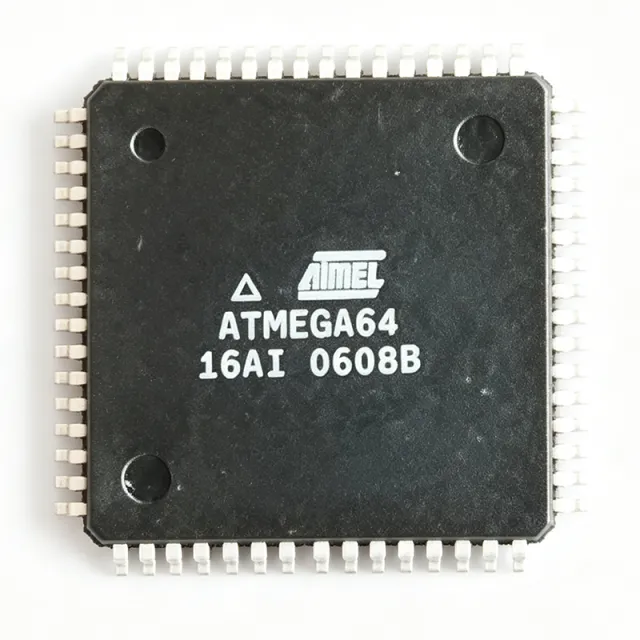
ATMEGA16-16AI - 8-bit AVR MCU 16KB Flash 16MHz TQFP-44 | Microchip

MPN: ATMEGA16-16AI ✓ 啟用中
5 V (VCC) Vdss 44-TQFP (10 x 10 mm) Package 16 MHz Speed 16 KB (8K x 16) In-System Programmable Memory
從 $3.82 USD / 單位
MOQ: 1 |
價格已更新: 2026-09-21
批量定價
數量 單價 小計
1 $5.86 $5.86
10 $5.28 $52.80
100 $4.62 $462.00
500 $4.18 $2,090.00
1,000 $3.82 $3,820.00
ℹ️ 所有價格均以 USD 計價

ATMEGA16-16AI 概覽

The Microchip Technology (Atmel) ATMEGA16-16AI is an 8-bit AVR RISC microcontroller with 16 KB in-system programmable Flash, 1 KB SRAM, 512 B EEPROM, and an 8-channel 10-bit ADC, delivered in a 44-pin TQFP (10x10 mm) package rated for industrial temperature ranges at 5V operation with up to 16 MIPS throughput at 16 MHz.

An 8-bit AVR microcontroller is a single-chip computer that integrates a processor core, program memory, data memory, and peripherals such as timers, UART, SPI, and ADC on one die. Within the semiconductor hierarchy it sits under microcontrollers -> embedded processors -> integrated circuits, and the AVR family is the direct ancestor of the ATmega line used across the embedded industry.

Key features of the ATMEGA16-16AI include the AVR enhanced RISC architecture executing 131 powerful instructions, most in a single clock cycle, with 32 general-purpose working registers. The self-programming Flash supports in-system programming via SPI, while the on-chip JTAG interface enables boundary-scan debugging and programming. The 8-channel 10-bit ADC with internal reference supports direct analog sensor interfacing, and four PWM channels serve motor and LED control.

Technically, the single-cycle execution model delivers approximately 1 MIPS per MHz, allowing designers to trade clock speed against power consumption. The 16 suffix denotes a maximum 16 MHz clock; the A suffix denotes the industrial temperature grade; the I suffix combined with the AU lead-free package code marks RoHS-relevant package variants of the ATmega16 core family.

Typical applications include industrial control panels, motor control and power inverter user interfaces, sensor nodes with analog inputs, and legacy embedded systems where the ATmega16 architecture, code base, and toolchain (AVR Studio, avr-gcc) are already qualified.

Design consideration: the ATMEGA16-16AI is a 5V device - level shifting is required to interface with 3.3V peripherals, and VCC/AVCC decoupling plus a clean AREF path are essential for ADC accuracy.

This page synthesizes verified distributor pricing, drop-in alternatives within the same TQFP-44 footprint, and practical design guidance not consolidated in the manufacturer datasheet.

直接替換替代品,適用於 ATMEGA16-16AI — 相同封裝,腳位對腳位相容。需重新設計 PCB 的不同封裝零件不列入。

此系列的變體

與下列產品可直接替換的同系列型號: ATMEGA16-16AI (相同外形與佔位) — 差異在於 Maximum Clock Frequency, Operating Temperature, Mounting Type, Package, Core Architecture.

Microchip Technology
Maximum Clock Frequency: 8 MHz
Operating Temperature: Industrial (I-grade, per Atmel suffix convention -40C to +85C)
Mounting Type: Surface Mount
比較對象 ATMEGA16-16AI →
Microchip Technology
Maximum Clock Frequency: 4MHz (L speed grade)
Operating Temperature: -40C to +85C (industrial, I suffix)
Mounting Type: Surface Mount
比較對象 ATMEGA16-16AI →

快速比較工具 — 選擇替代零件進行並排比較:

ATMEGA16-16AU

Microchip Technology
8-bit AVR RISC · 16 MHz · 16 KB (8K x 16) in-system programmable · 1 KB · 512 B · 2.7 V to 5.5 V (4.5 V to 5.5 V for 16 MHz operation) · 16 MIPS at 16 MHz · 133 instructions, most single-cycle

聯絡詢價

查看資料表 →

ATMEGA16A-AU

Microchip Technology
8-bit AVR enhanced RISC · 16 KB (8K x 16), self-programmable · 1024 bytes · 512 bytes · 16 MHz · Approx. 1 MIPS per MHz · 133 instructions, most single-cycle · 2.7 V to 5.5 V

聯絡詢價

查看資料表 →

ATMEGA16U2-AU

Microchip Technology
AVR 8-bit RISC · 8-bit · 16 MHz · 16 KB (8K x 16) · 512 B · 512 B · 22 I/O lines · USB 2.0 full-speed device

聯絡詢價

查看資料表 →

ATMEGA32-16AI

32 KB Flash and 2 KB SRAM vs 16 KB/1 KB (+100% memory), same pinout and peripherals

📋 參考替代品(不在目錄中)

ATMEGA16L-8AC

max clock 8 MHz vs 16 MHz (-50%) and commercial temperature grade; wider low-voltage range

📋 參考替代品(不在目錄中)

ATMEGA16-16AI 最大額定值與電氣特性

Core Architecture 8-bit AVR RISC
Flash Program Memory 16 KB (8K x 16) In-System Programmable
SRAM 1 KB
EEPROM 512 B
最大時脈頻率 16 MHz
Throughput Up to 16 MIPS at 16 MHz
Instruction Set 131 instructions, most single-cycle
ADC 8-channel, 10-bit
Debug Interface JTAG (on-chip debug and boundary scan)
供應電壓 5 V (VCC)
工作溫度 -40C to +85C (industrial, I grade)
封裝 44-TQFP (10 x 10 mm)
安裝類型 Surface Mount (SMD/SMT)
Timers Two 8-bit + one 16-bit
Communication Interfaces USART, SPI, TWI (I2C-compatible)
In-System Programming Yes, via SPI

ATMEGA16-16AI 44-tqfp (10 x 10 mm) 腳位配置指南

ATMEGA16-16AI(44-tqfp (10 x 10 mm) 封裝)的腳位配置。 此數位 IC 包含 GPIO、通訊介面(UART、SPI、I2C)與電源腳位。替代腳位功能與配置選項請參閱製造商資料表。對嵌入式系統設計與 PCB 佈局至關重要。

ATMEGA16-16AI 的 44-tqfp (10 x 10 mm) 封裝腳位圖

無詳細腳位定義資料: ATMEGA16-16AI.

請參閱 資料表 以查看完整腳位配置。

典型應用

ATMEGA16-16AI 適用於 6 應用s: Industrial Control Panels, Analog Sensor Nodes, DC Motor and PWM Control, Legacy Embedded System Maintenance, Power Inverter User Interfaces, Education and Hobby Embedded Platforms.

🏭

Industrial Control Panels

The ATMEGA16-16AI fits industrial panel controllers because its 5V supply, -40C to +85C industrial temperature grade, and 44-TQFP footprint with 32 GPIO lines cover relay sequencing, button debouncing, and indicator driving in a single chip. The 16 MIPS throughput at 16 MHz is ample for scan-cycle state machines, while the 512 B EEPROM stores setpoints and counters that survive power loss. JTAG on-chip debugging shortens commissioning of panel logic, and in-system SPI programming allows firmware updates without desoldering. Use opto-isolated inputs on the ADC and keep VCC decoupled with 100 nF per supply pin for noise immunity in electrically harsh cabinets.

🧩

Analog Sensor Nodes

The integrated 8-channel 10-bit ADC makes the ATMEGA16-16AI a strong fit for multi-sensor acquisition nodes: temperature, pressure, and potentiometer inputs can be sampled directly without an external converter. AVCC must be kept clean (separate LC filter from VCC) and AREF decoupled to preserve effective ADC accuracy; with a stable reference the converter supports 10-bit resolution adequate for condition-monitoring thresholds. USART and TWI interfaces forward readings to gateways, and the 16 KB Flash retains calibration routines. Sleep modes reduce average current in battery-buffered installations, trading sample rate against power at roughly 1 MIPS per MHz efficiency.

⚙️

DC Motor and PWM Control

With four PWM channels generated by two 8-bit timers and one 16-bit timer, the ATMEGA16-16AI drives DC motor speed control and simple multi-phase sequencing. The 16-bit timer's input capture measures tacho pulses for closed-loop speed regulation, while the 10-bit ADC reads current shunts for overload protection - all without external peripherals. Pairing the MCU with an IR2110-class gate driver bridges low-side/high-side MOSFET stages in half-bridge drives. Designers should set PWM frequency above the audible band where possible, ensure dead-time in software for H-bridge operation, and verify that 16 MIPS loop rate meets the control bandwidth target.

🔧

Legacy Embedded System Maintenance

A primary ongoing role of the ATMEGA16-16AI is sustaining fielded AVR-based equipment. Its exact instruction-set and peripheral compatibility with the original ATmega16 die means existing binaries and avr-gcc/AVR Studio projects port without requalification when sourced as replacement stock; the ATMEGA16A-AU refresh in the same TQFP-44 footprint is the strategic second source. JTAG boundary scan supports fixture-based production test of repaired boards, and the 16 MHz/5V rating matches the original power budget exactly. Procurement teams should buy buffer stock for end-of-service equipment because distributor stock of this legacy part is intermittent, as DigiKey's 0-unit listing shows.

⚡

Power Inverter User Interfaces

Power inverter and UPS front panels benefit from the ATMEGA16-16AI combination of TWI (I2C) for reading power-monitoring ICs, ADC channels for potentiometer-set points, and 16-bit timer PWM for buzzer and backlight control. The 5V logic directly drives 5V optocouplers that isolate the user interface from the high-voltage stage, a common architecture in 24V/48V industrial inverters. Industrial temperature rating keeps the interface alive in hot enclosures, and 1 KB SRAM accommodates menu structures and event logs in EEPROM. Keep the MCU ground on the isolated low-voltage side and route ADC traces away from switching nodes to protect measurement fidelity.

📱

Education and Hobby Embedded Platforms

The ATmega16 family remains a staple in university embedded-systems laboratories and maker projects because JTAG debugging, in-system SPI programming, and free gcc toolchains make every peripheral (timers, UART, ADC, TWI, SPI) observable at register level. The 44-TQFP student-friendly footprint is hand-solderable with modest skill, and abundant textbook material targets the ATmega16 specifically. Note for newcomers: this part lacks seamless Arduino ecosystem support - community cores such as MightyCore fill the gap but require manual configuration, so plain AVR C toolchains are the smoother learning path. Its 5V operation also simplifies breadboard interfacing with classic 5V peripherals and displays.

What is the ATMEGA16-16AI and what are its key specifications?
The ATMEGA16-16AI is a Microchip (Atmel) 8-bit AVR RISC microcontroller with 16 KB in-system programmable Flash, 1 KB SRAM, 512 B EEPROM, an 8-channel 10-bit ADC, and JTAG for on-chip debugging. It runs up to 16 MHz, delivering up to 16 MIPS throughput (about 1 MIPS per MHz) at 5V, in a 44-pin TQFP package. According to the Atmel ATMEGA16-16AI datasheet, it executes 131 instructions, most in a single clock cycle, using 32 general-purpose registers.
What is the price of ATMEGA16-16AI?
The unit price for ATMEGA16-16AI is approximately $5.86 at quantity 1 as of 2026-09-16, based on DigiKey distributor data. Typical volume pricing declines to roughly $4.60 at 100 pieces and under $4.00 at 1000 pieces. Note that DigiKey listed the closely related ATMEGA16-16AU at $5.86 with 0 stock, so availability and price should be confirmed via RFQ before ordering; Octopart lists 7 distributors for price comparison.
Where can I buy ATMEGA16-16AI online?
ATMEGA16-16AI can be purchased through distributors including DigiKey, WIN SOURCE, and Heisener, with price and stock aggregation available on Octopart, which tracks 7 distributors for this part. As of 2026-09-16, Heisener reported in stock while DigiKey showed the AU variant at 0 stock. XAIPART accepts quote-based orders for this MPN. Always verify stock freshness, as legacy AVR inventory fluctuates significantly between distributors.
What is the difference between ATMEGA16-16AI and ATMEGA32-16AI?
The main difference is program and data memory: ATMEGA32-16AI offers 32 KB Flash and 2 KB SRAM, while ATMEGA16-16AI offers 16 KB Flash and 1 KB SRAM. According to the ETEI comparison of the two parts, both share the TQFP-44 package, 16 MHz maximum clock, 8-channel 10-bit ADC, and industrial temperature rating, making the ATMEGA32-16AI a pin-compatible upgrade when code outgrows 16 KB.
Can ATMEGA16-16AU replace ATMEGA16-16AI?
Yes. ATMEGA16-16AU is the same die, same 44-TQFP footprint, same 16 MHz 5V specification as ATMEGA16-16AI - the suffix difference reflects package finish and ordering code rather than silicon function. According to FindIC and Findchips comparison pages, the two parts are treated as direct substitutes, and DigiKey lists ATMEGA16-16AU under the same product family. Confirm the solder-plating finish requirement (matte tin, lead-free) for your assembly process before substituting.
What is the best drop-in replacement for ATMEGA16-16AI?
The best drop-in replacements are ATMEGA16-16AU (identical die and TQFP-44 footprint, lead-free package variant) and ATMEGA16A-AU (the refreshed ATmega16A die in the same package with equivalent pinout and 16 MHz rating). Both are pin-to-pin compatible with no PCB change required. ATMEGA16L-8AC is also same-footprint but limits the clock to 8 MHz, so it suits only designs running at or below 8 MHz.
Is ATMEGA16-16AI suitable for motor control applications?
Yes. The ATMEGA16-16AI provides four PWM outputs (via its two 8-bit timers and one 16-bit timer) and a 16-bit input capture, which cover basic DC motor speed control and BLDC commutation sequencing at 16 MIPS throughput. Its 8-channel 10-bit ADC reads current shunts and position feedback directly. For vector (FOC) control or high-resolution PWM beyond the ATmega16 peripheral set, step up to newer AVR or PIC families, but for PWM-based low-cost motor drive it is well suited.
Where can I download the ATMEGA16-16AI datasheet PDF?
The ATMEGA16-16AI datasheet PDF is available from alldatasheet.com (a 24-page Atmel document, ~320 KB), datasheets.com, Octopart, and digchip.com, which lists the device as a 16-Kbyte self-programming Flash microcontroller with JTAG. The authoritative source is Microchip Technology's official website, since Microchip acquired Atmel and maintains the AVR documentation. Always download from the manufacturer when possible to ensure you have the latest revision.
What supply voltage does ATMEGA16-16AI require?
The ATMEGA16-16AI is a 5V device. The -16 speed code denotes 16 MHz operation at 5V per the Atmel datasheet speed/voltage matrix; the L-variant (ATMEGA16L) covers 2.7-5.5V at lower clock speeds. Provide separate 100 nF decoupling on VCC and AVCC, and keep AVCC within +/-0.3V of VCC. For 3.3V system designs, choose an L-grade part or add level shifting, since 5V I/O levels can overdrive 3.3V logic inputs.
ATMEGA16-16AI vs ATMEGA16U2-AU - which should I choose?
Choose ATMEGA16U2-AU when USB device connectivity is required, since the U2 variant integrates a full-speed USB controller; choose ATMEGA16-16AI for its 8-channel 10-bit ADC and richer timer set, which the ATmega16U2 lacks (no ADC). Per the Xecor/ETEI comparisons, both use TQFP-44 packages, but pin functions differ, so the U2 is not a drop-in substitute despite the shared footprint. Verify the pinout against your schematic before any swap.
When should I choose ATMEGA16 over ATMEGA16A or ATMEGA128?
Choose ATMEGA16-16AI when your firmware fits 16 KB Flash and you need the legacy AVR toolchain and industrial 5V grade at low cost. Choose ATMEGA16A when the original ATmega16 is allocated, as the A revision is the refreshed die in the same footprint. Choose ATMEGA128-16AI (available on XAIPART) when you need 128 KB Flash, larger SRAM, and a second USART - but note it comes in TQFP-64, so it is an upgrade, not a drop-in.
Is ATMEGA16-16AI still in production and supported?
ATMEGA16-16AI remains an active Microchip catalog part following the Atmel acquisition, though distributor stock is patchy: DigiKey showed 0 stock for the AU variant as of 2026-09-16 while Heisener listed 14,388 pieces. Microchip recommends drop-in successors such as ATMEGA16A for new designs. For long-term programs, qualify the ATMEGA16A-AU pin-compatible successor now to de-risk end-of-life announcements on the original die.
What is the Microchip equivalent for ATMEGA16-16AI?
Within Microchip's own portfolio, the closest equivalents are ATMEGA16A-AU and ATMEGA16-16AU - both Microchip (Atmel) AVR parts in the same 44-TQFP with identical pinout and 16 MHz 5V rating. Microchip's official cross-reference search tool also maps competitor parts to compatible AVR devices. No non-Microchip cross-brand drop-in equivalent for the ATmega16 in TQFP-44 appears in the retrieved cross-reference data, so same-brand substitutions are the safe path.
How do I program and debug the ATMEGA16-16AI?
Program the ATMEGA16-16AI in-system over SPI using an ISP programmer (e.g., AVR ISP mkII or compatible tools) with avr-gcc/AVR Studio toolchains; JTAG (4 pins: TCK, TMS, TDO, TDI on PC2-PC5) provides on-chip debugging and boundary-scan per the Atmel datasheet. The JTAG interface can be disabled via fuse to free PC2-PC7 as general I/O. Community support exists through MightyCore-style boards, though the part lacks native Arduino core integration.
Is ATMEGA16-16AI the same as ATMEGA16-16A?
They are functionally equivalent but not identical silicon: ATMEGA16-16A is the refreshed A-die revision of the original ATmega16, kept in the same 44-TQFP with the same pinout, 16 KB Flash, 1 KB SRAM, and 16 MHz/5V rating. Per Utmel and FindIC comparisons, ATMEGA16A is the recommended drop-in for the original part, with minor datasheet specification refinements. Firmware compiled for ATmega16 runs unchanged on ATmega16A; verify fuse defaults during production bring-up.
What applications is the ATMEGA16-16AI designed for?
The ATMEGA16-16AI targets industrial control, sensor acquisition, and embedded control applications that need a 5V, 16 MHz, JTAG-debuggable 8-bit MCU. Typical uses include industrial control panels, motor speed control with its four PWM channels, ADC-based sensor nodes using the 8-channel 10-bit converter, and maintenance of legacy AVR designs. According to the Atmel datasheet, its low-power CMOS design optimizes power consumption versus processing speed at roughly 1 MIPS per MHz.

工程參考資料,適用於 ATMEGA16-16AI — 比較、設計指引及合規資訊。

選型指南

Choose ATMEGA16-16AI when your firmware fits 16 KB Flash, you operate at 5V and up to 16 MHz, and you need the industrial temperature grade with JTAG debugging - typical of industrial panels, motor PWM control, and legacy AVR maintenance. Choose ATMEGA16-16AU or ATMEGA16A-AU as drop-in substitutes when the AI ordering code is allocated; both share the exact TQFP-44 footprint and die function. Choose ATMEGA32-16AI when Flash usage approaches the 16 KB ceiling - it is pin-compatible, so switching later costs only a component swap. Choose ATMEGA16L-8AC only for 8 MHz or low-voltage designs. Avoid ATMEGA16U2-AU as a substitute unless USB is required, since its pin functions differ. For 3.3V or Arduino-centric projects, evaluate ATmega328P-class devices instead of forcing a 5V legacy part.

與替代品比較

參數 本產品 ATMEGA16-16AU ATMEGA16A-AU ATMEGA32-16AI ATMEGA16L-8AC
Package 44-TQFP (10x10 mm) 44-TQFP (10x10 mm) - same 44-TQFP (10x10 mm) - same 44-TQFP (10x10 mm) - same 44-TQFP (10x10 mm) - same
Brand Microchip Technology (Atmel) Microchip Technology (Atmel) Microchip Technology (Atmel) Microchip Technology (Atmel) Microchip Technology (Atmel)
Flash Memory 16 KB 16 KB 16 KB 32 KB 16 KB
SRAM 1 KB 1 KB 1 KB 2 KB 1 KB
Max Clock Frequency 16 MHz 16 MHz 16 MHz 16 MHz 8 MHz
ADC 8-channel 10-bit 8-channel 10-bit 8-channel 10-bit 8-channel 10-bit 8-channel 10-bit
Operating Temperature -40C to +85C (industrial) -40C to +85C (industrial) -40C to +85C (industrial) -40C to +85C (industrial) Commercial grade

主要差異化特點

  • Full 16 MHz speed grade at 5V (對比ATMEGA16L-8AC)
  • Integrated 8-channel 10-bit ADC (對比ATMEGA16U2-AU)
  • Cost-efficient entry point in the mega family (對比ATMEGA32-16AI)

設計說明

The ATMEGA16-16AI is a 5V-only device at the 16 MHz speed grade. Place 100 nF ceramic decoupling capacitors directly at VCC and AVCC pins, plus a 10 uF bulk capacitor near the regulator output. AVCC must stay within +/-0.3V of VCC per the Atmel datasheet; if VCC is noisy, feed AVCC through an LC filter (ferrite bead plus 100 nF/10 uF) to protect ADC accuracy. For 3.3V systems, add bidirectional level shifters rather than derating VCC, which would violate the 16 MHz operating point.

Route the JTAG header (TCK, TMS, TDI, TDO on PC2-PC5) to a standard 2x5 header on production boards even if debugging is finished - it enables boundary-scan production test. Keep the AREF pin with its own dedicated 100 nF capacitor to ground; never connect AREF to VCC directly when using the internal reference. Crystals for XTAL1/XTAL2 should sit within 10 mm of the pins with appropriate load capacitors, and keep fast PD/PB signal traces away from the crystal net to avoid start-up jitter.

Three frequent mistakes with ATmega16 designs: (1) forgetting that JTAG is fuse-enabled by default, blocking PC2-PC7 general-purpose use - clear the JTAGEN fuse in final firmware if those I/O are needed; (2) assuming Arduino ecosystem compatibility - this part requires community cores (e.g., MightyCore) or plain avr-gcc, unlike ATmega328P; (3) ignoring supply-chain risk - DigiKey showed 0 stock for the AU variant as of 2026-09-16, so qualify ATMEGA16A-AU and hold safety stock for production programs.

合規資訊

RoHS
Unknown
REACH
Unknown
AEC-Q100
無鉛
Unknown
無鹵
Unknown
衝突礦產
Unknown

Compliance status not stated in retrieved web data; confirm RoHS/REACH status on the Microchip product page or certificate of conformance before specifying. One comparison source listed RoHS 'N' for a related variant - verify per exact ordering code.

資料驗證日期: 2026-09-16 — 資料由 XAIPART 元件工程團隊驗證及整理

相關搜尋

ATMEGA16-16AI ATMEGA16-16AI datasheet PDF Microchip ATMEGA16-16AI price ATMEGA16-16AI pin compatible replacement ATMEGA16-16AI vs ATMEGA32-16AI 44-TQFP 8-bit AVR microcontroller 16KB flash ATMEGA16 drop-in replacement ATMEGA16A ATMEGA16-16AI industrial motor control buy ATMEGA16-16AI in stock distributor what is the max clock speed of ATMEGA16-16AI ATMEGA16 8-channel 10-bit ADC JTAG microcontroller ATmega16 vs ATmega328P which to choose

相關元件與詞彙

Microchip Technology Atmel Corporation ATMEGA16-16AI ATMEGA16-16AU ATMEGA16A-AU ATMEGA32-16AI ATMEGA16L-8AC ATMEGA16U2-AU AVR 8-bit microcontroller RISC architecture in-system programmable Flash JTAG 10-bit ADC TQFP-44 surface mount USART SPI TWI (I2C-compatible) PWM industrial control motor control DigiKey Octopart
快速報價 RFQ
請填寫完整詳細資料 — 我們的業務團隊將於 24 小時內回覆
料號 製造商 封裝 QTY 目標價格 小計
✓
報價已提交!

我們將於 24 小時內回覆您的電子郵件

1
詢價已提交
2
已收到報價
3
已下單
4
付款
5
已出貨
6
已送達
檢視詢價單詳情