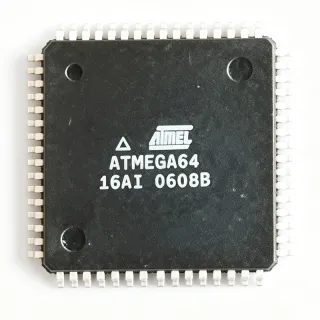
ATMEGA644PA-AUR - 8-Bit AVR MCU 64KB Flash 20MHz TQFP-44 | Microchip
MPN: ATMEGA644PA-AUR ✓ 啟用中ATMEGA644PA-AUR 概覽
An 8-bit microcontroller is an integrated circuit that executes program instructions and controls peripherals using an 8-bit-wide CPU data path. Within the embedded systems hierarchy, the ATmega644PA belongs to the AVR ATmega family of flash-based MCUs, which sits under the broader categories of microcontrollers, embedded processors, and semiconductors. Single-cycle instruction execution allows system designers to optimize power consumption versus processing speed, approaching one MIPS per megahertz.
Key features include 131 powerful instructions with mostly single-clock cycle execution, 32 general purpose working registers, an on-chip 2-cycle hardware multiplier, and Microchip's picoPower technology for ultra-low sleep-mode current. Peripherals comprise three flexible timer/counters with compare modes and PWM, two USARTs, a byte-oriented Two-Wire serial interface (TWI/I2C), an 8-channel 10-bit ADC, a real-time counter, and SPI for in-system programming.
Architecturally, the device uses a Harvard-architecture AVR RISC core with separate program and data buses, enabling read-while-write flash operation and deterministic single-cycle execution. The 64 KB self-programmable ISP flash supports bootloader firmware updates in the field, while the 2 KB EEPROM retains calibration data through power cycles.
Typical applications include industrial automation controllers, sensor data loggers, embedded human-machine interfaces, motor control panels, battery-powered instrumentation, and educational/prototyping boards where a large flash map and rich peripheral set are required.
A key design consideration is supply voltage: the device operates across the industrial range, so choose clock frequency and BOD (brown-out detector) settings according to the rail used to guarantee margin across temperature.
This page synthesizes distributor pricing, drop-in family alternatives, and practical design notes not found in the manufacturer datasheet.
直接替換替代品,適用於 ATMEGA644PA-AUR — 相同封裝,腳位對腳位相容。需重新設計 PCB 的不同封裝零件不列入。
此系列的變體
與下列產品可直接替換的同系列型號: ATMEGA644PA-AUR (相同外形與佔位) — 差異在於 ADC, Package, Timer/Counters, RoHS Status, Core Architecture.
ATMEGA644P-20AUR
✅ 直接替換 ⚠️ 規格未經驗證📋 參考替代品(不在目錄中)
ATMEGA644-20AU
✅ 直接替換聯絡詢價
查看資料表 →ATMEGA1284P-AUR
✅ 直接替換 ⚠️ 規格未經驗證聯絡詢價
查看資料表 →ATMEGA324PA-AUR
✅ 直接替換聯絡詢價
查看資料表 →ATMEGA644P-15AZ
✅ 直接替換聯絡詢價
查看資料表 →ATMEGA644PV-10AUR
✅ 直接替換📋 參考替代品(不在目錄中)
ATMEGA644PA-AUR 最大額定值與電氣特性
| Core Architecture | 8-bit AVR RISC (Harvard) |
| Flash Memory (ISP) | 64 KB (32K x 16) with read-while-write |
| SRAM | 4 KB |
| EEPROM | 2 KB |
| 最大時脈頻率 | 20 MHz |
| Maximum Throughput | 20 MIPS (1 MIPS per MHz) |
| Instructions | 131 instructions, mostly single-clock cycle |
| Hardware Multiplier | On-chip 2-cycle multiplier |
| General Purpose I/O | 32 lines |
| Working Registers | 32 general purpose |
| Timers/Counters | 3 flexible timer/counters with compare modes and PWM |
| USART | 2 |
| Serial Interfaces | TWI (I2C-compatible), SPI |
| ADC | 8-channel 10-bit |
| Real-Time Counter | Yes |
| 供應電壓 | 2.5 V / 3.3 V / 5 V operation |
| 封裝 | 44-TQFP (10 x 10 mm) |
| Low Power Technology | picoPower |
| 安裝類型 | Surface Mount |
| Packaging | Tape & Reel (T/R) |
| RoHS 狀態 | Compliant (GREEN) |
ATMEGA644PA-AUR 44-tqfp (10 x 10 mm) 腳位配置指南
ATMEGA644PA-AUR(44-tqfp (10 x 10 mm) 封裝)的腳位配置。 此數位 IC 包含 GPIO、通訊介面(UART、SPI、I2C)與電源腳位。替代腳位功能與配置選項請參閱製造商資料表。對嵌入式系統設計與 PCB 佈局至關重要。

無詳細腳位定義資料: ATMEGA644PA-AUR.
請參閱 資料表 以查看完整腳位配置。
典型應用
ATMEGA644PA-AUR 適用於 6 應用s: Industrial Automation Controllers, Battery-Powered Sensor Data Loggers, Embedded Human-Machine Interfaces, Motor Control and PWM Actuation, Embedded Instrumentation and Test Equipment, Education and Rapid Prototyping Platforms.
Industrial Automation Controllers
The ATMEGA644PA-AUR fits PLC-style machine controllers because its 64 KB flash hosts protocol stacks and state machines while three timer/counters with PWM drive actuators and the two USARTs link to HMIs and field converters. The 32 GPIO lines provide sufficient parallel I/O for relays, limit switches, and indicator banks without extra port expanders, and the byte-oriented TWI interface chains I2C I/O expanders or EEPROMs as systems grow. Running at 20 MIPS, the AVR core closes control loops in the millisecond range typical of industrial equipment. Surface-mount TQFP-44 assembly suits conformal-coated control boards, and the industrial temperature rating supports cabinet-mounted electronics.
推薦
Battery-Powered Sensor Data Loggers
The picoPower architecture is the deciding factor here: the ATMEGA644PA-AUR's low power-down sleep current lets a logger run for months to years on primary cells when waking periodically via watchdog or asynchronous timer. The 8-channel 10-bit ADC on port A digitizes up to eight analog sensors without an external front end, and 4 KB SRAM buffers sampled data before block writes to the 2 KB EEPROM or an SPI flash. The 64 KB flash retains both logging firmware and a bootloader for field reconfiguration over one of the two USARTs. Designers should size sleep duty cycles so average current, not peak 20 MHz active current, sets battery life.
推薦
Embedded Human-Machine Interfaces
Two USARTs plus TWI make the ATMEGA644PA-AUR effective for front-panel controllers that talk to both a display driver and a host system simultaneously. The 64 KB flash accommodates font tables, localized string sets, and menu logic, while 4 KB SRAM holds framebuffer or line-buffer memory for segmented or small graphic displays. Hardware PWM channels implement backlight dimming and buzzer tones without CPU load, and the 8-channel ADC reads keypads or thermistor-based backlight temperature compensation. The TQFP-44 footprint fits behind standard display bezels, and single-cycle instructions keep scan rates responsive even at modest clock frequencies.
推薦
Motor Control and PWM Actuation
Three flexible timer/counters with compare modes generate multiple independent PWM channels for DC motor speed control, servo actuation, and LED intensity, with the 2-cycle hardware multiplier easing PID arithmetic. The ATMEGA644PA-AUR's 20 MHz clock yields PWM resolutions in the kilohertz-carrier range suitable for quiet motor drives, while external interrupts on PD2/PD3 capture encoder pulses for closed-loop feedback. The ADC samples current shunts or thermistors for protection, and the two USARTs report status to a supervisory controller. Designers must observe ADC source-impedance limits when multiplexing current-sense channels during fast PWM cycles.
推薦
Embedded Instrumentation and Test Equipment
Bench instruments, environmental meters, and custom test fixtures benefit from the ATMEGA644PA-AUR's balance of analog and digital resources: the 10-bit ADC digitizes sensor channels, hardware timers gate frequency counters, and 64 KB flash stores calibration curves, menus, and logging code. The 2 KB EEPROM preserves calibration constants through power cycles, and the read-while-write flash enables nonblocking data writes. Two USARTs allow simultaneous PC telemetry and module-level control (e.g., a peripheral sensor pod). Because the AVR executes one instruction per clock cycle deterministically, timing measurements are predictable - a practical advantage over cached, pipelined cores in timing-sensitive instruments.
推薦
Education and Rapid Prototyping Platforms
The ATmega644PA family is a proven teaching and maker-platform MCU: the AVR core's simple single-cycle instruction set is transparent enough for assembly-level courses, yet the peripheral set (two UARTs, TWI, SPI, PWM, ADC) supports full embedded-systems projects. The 64 KB flash removes the code-size pressure students hit on smaller ATmegas, and 32 GPIO lines drive breadboard-scale I/O directly. Community cores such as MightyCore bring the part into the Arduino IDE, and the same 44-TQFP footprint across the 164/324/644/1284 family lets one PCB support multiple memory variants - an effective way to build scalable lab boards and product prototypes with a single layout.
推薦
推薦產品摘要
工程參考資料,適用於 ATMEGA644PA-AUR — 比較、設計指引及合規資訊。
選型指南
與替代品比較
| 參數 | 本產品 | ATMEGA644P-20AUR | ATMEGA644-20AU | ATMEGA1284P-AUR | ATMEGA324PA-AUR |
|---|---|---|---|---|---|
| Package | 44-TQFP (10x10 mm) | 44-TQFP (10x10 mm) - same | 44-TQFP (10x10 mm) - same | 44-TQFP (10x10 mm) - same | 44-TQFP (10x10 mm) - same |
| Brand | Microchip Technology | Microchip Technology | Microchip Technology | Microchip Technology | Microchip Technology |
| Flash Memory | 64 KB ISP | 64 KB | 64 KB | 128 KB | 32 KB |
| SRAM | 4 KB | 4 KB | 4 KB | 16 KB | 2 KB |
| Max Clock Frequency | 20 MHz | 20 MHz | 20 MHz | 15 MHz | 10 MHz |
| Low Power Technology | picoPower (PA) | No (P) | No | picoPower (PA) | No (PV low-voltage) |
| USARTs | 2 | 2 | 2 | 2 | 2 |
| GPIO | 32 | 32 | 32 | 32 | 32 |
主要差異化特點
- picoPower sleep architecture (對比ATMEGA644-20AU)
- Largest memory in the drop-in footprint without redesign (對比ATMEGA324PA-AUR)
- Lower unit cost than the 128 KB upgrade path (對比ATMEGA1284P-AUR)
設計說明
Decouple each VCC pin of the TQFP-44 with a 100 nF ceramic placed within 5 mm of the pin, plus a 10 uF bulk capacitor per supply domain. Connect AVCC to VCC through a low-pass LC filter (e.g., 10 uH with 100 nF/10 uF) to keep ADC noise low, and never let AVCC deviate more than 0.3 V from VCC per the Microchip datasheet. For battery designs, exploit picoPower sleep modes: power-down with watchdog wake typically dominates the energy budget, so profile average current rather than peak active current.
The most common failure mode on ATmega644 boards is an unconnected or mis-set RESET line: keep a 10 kohm pull-up on RESET and consider a 100 nF cap to ground for improved ESD robustness during ISP programming. Second, when switching from ATMEGA644P-20AUR to this PA part, fuse settings are compatible but verify brown-out detector thresholds against the actual supply rail, since the picoPower electrical characteristics shifted slightly. Finally, clock-source fuses (crystal vs internal RC) are the number-one cause of 'bricked' first-programming attempts - set CKOPT and SUT carefully.
Route the crystal (XTAL1/XTAL2, TQFP pins 7-8 area) with short, symmetric traces and local ground guard to minimize jitter; keep it away from PWM and USART switching edges. Use a solid ground plane under the ADC port A traces, and keep analog sensor routing away from LED/PWM nets. For in-field ISP updates, break out MOSI, MISO, SCK, RESET, VCC, and GND to a standard 2x3 ISP header. The 10x10 mm TQFP-44 needs only standard 0.5 mm-pitch reflow rules; no via-in-pad is required on the periphery.
合規資訊
Distributor listings describe the ATMEGA644PA-AUR as a GREEN (lead-free, halogen-free) industrial-temp part on tape and reel. Formal REACH and conflict-minerals declarations were not present in the provided data and should be confirmed via Microchip's compliance portal.