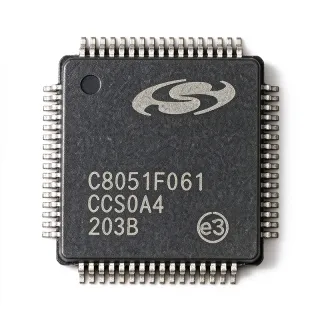
EFM32G842F32-QFP64 - 32MHz Cortex-M3 MCU | Silicon Labs
MPN: EFM32G842F32-QFP64 ✓ 啟用中EFM32G842F32-QFP64 概覽
A microcontroller is a programmable system-on-chip that integrates a CPU, memory, peripherals, and I/O into one package. The EFM32G842 belongs to the EFM32 Gecko family, which combines an ARM Cortex-M3 processor with energy-management hardware for low-power embedded control. This places it in the hierarchy of embedded microcontroller, 32-bit MCU, ARM Cortex-M3 processor, and semiconductor device.
The device provides 32 kB Flash for program storage and 8 kB RAM for working data. The verified manufacturer information also identifies three 16-bit timers and 53 digital I/O pins. The 32 MHz CPU supports responsive control, while low-energy modes and fast wake-up behavior can reduce inactive-system power. Its 2.5 V and 3.3 V supply references are identified in the verified distributor material.
The EFM32G842F32-QFP64 is suited to energy-sensitive embedded products, including sensor nodes, industrial monitoring equipment, portable instrumentation, and connected low-power systems. Its timer resources can support periodic measurement, motor or actuator timing, and control-loop tasks. The digital I/O count provides flexibility for buttons, displays, sensors, relays, and communications peripherals, subject to the device's electrical and multiplexing limitations.
For PCB design, preserve the exact 64-pin TQFP footprint and verify the complete manufacturer pin assignment before routing. Pay particular attention to supply decoupling, ground-return paths, exposed thermal behavior, and any pins assigned to debug, programming, reset, or alternate functions. Firmware should use the Silicon Labs device support configuration for the exact MPN.
This product data combines the verified Silicon Labs device description, distributor specifications, package information, lifecycle-related source material, and application-oriented guidance. It is intended to support initial design review, sourcing, and comparison; final production decisions should be checked against the latest manufacturer datasheet and authorized distribution records.
This page synthesizes the supplied manufacturer and distributor information with practical selection context. Because no verified price, detailed timing specification, pin table, or approved cross-brand substitute was supplied, those fields are marked as unavailable rather than inferred.
直接替換替代品,適用於 EFM32G842F32-QFP64 — 相同封裝,腳位對腳位相容。需重新設計 PCB 的不同封裝零件不列入。
此系列的變體
與下列產品可直接替換的同系列型號: EFM32G842F32-QFP64 (相同外形與佔位) — 差異在於 Package, Flash Memory, Low-Power Features, Product Type, RAM.
EFM32G842F64-QFP64
✅ 直接替換聯絡詢價
查看資料表 →EFM32TG842F32-QFP64
✅ 直接替換📋 參考替代品(不在目錄中)
EFM32G232F128G-E-QFP64R
✅ 直接替換聯絡詢價
查看資料表 →EFM32G842F32-QFP64 最大額定值與電氣特性
| CPU Architecture | ARM Cortex-M3 |
| CPU Maximum Frequency | 32 MHz |
| Memory Architecture | 32-bit |
| Flash Memory | 32 kB |
| RAM | 8 kB |
| Digital I/O Pins | 53 |
| Timers | 3 x 16-bit |
| Supply Voltage Reference | 2.5 V / 3.3 V |
| 封裝 | 64-TQFP (10 x 10 mm) |
| 安裝類型 | Surface mount |
| Low-Power Features | 3 V Shutoff Mode; 3 V Stop Mode |
| Wake-Up Support | Fast wake-up times |
| Processor Core | ARM Cortex-M3 series |
| Product Family | EFM32 Gecko |
| Product Type | 32-bit microcontroller |
| Lead-Free Status | Lead Free |
| RoHS 狀態 | RoHS Compliant |
EFM32G842F32-QFP64 64-tqfp (10 x 10 mm) 腳位配置指南
EFM32G842F32-QFP64(64-tqfp (10 x 10 mm) 封裝)的腳位配置。 此數位 IC 包含 GPIO、通訊介面(UART、SPI、I2C)與電源腳位。替代腳位功能與配置選項請參閱製造商資料表。對嵌入式系統設計與 PCB 佈局至關重要。

無詳細腳位定義資料: EFM32G842F32-QFP64.
請參閱 資料表 以查看完整腳位配置。
典型應用
EFM32G842F32-QFP64 適用於 6 應用s: Battery-Powered Sensor Node, Industrial Monitoring Controller, Portable Measurement Instrument, Low-Power Actuator Controller, Connected Edge Device, Educational Embedded Control Platform.
Battery-Powered Sensor Node
The EFM32G842F32-QFP64 fits battery-powered sensor nodes because its verified low-power platform includes 3 V Shutoff Mode, 3 V Stop Mode, and fast wake-up behavior. The 32 MHz ARM Cortex-M3 core can collect readings, filter data, and manage sensor timing, while 8 kB RAM supports short-lived working buffers and 32 kB Flash stores application firmware. A typical design would place the MCU beside the sensor interface, use a low-leakage regulator, and enable a sleep-and-wake sequence during idle periods. The actual battery life depends on sensor current, wake interval, radio activity, and regulator quiescent current.
推薦
Industrial Monitoring Controller
Use the EFM32G842F32-QFP64 for industrial monitoring when a compact 32-bit controller is needed for sensor acquisition, status logic, and local control. Its 53 digital I/O pins provide substantial board-level connectivity for digital inputs, alarm outputs, indicators, and external control signals, while three 16-bit timers can organize periodic sampling or timing tasks. The MCU should be paired with protection, isolation, filtering, and level translation for real factory signals because the supplied data does not specify the full analog input ratings. The 2.5 V and 3.3 V supply references provide a starting point for industrial interface planning, subject to the final datasheet limits.
推薦
Portable Measurement Instrument
The EFM32G842F32-QFP64 is suitable for portable measurement instruments where low-power operation, compact packaging, and deterministic embedded control are valuable. The 32 MHz Cortex-M3 processor can coordinate measurement sequencing, calibration storage, user input, display updates, and data export, while the three 16-bit timers can support precise timing tasks. Low-energy modes are especially useful between measurements, allowing the system to reduce activity without losing the general-purpose firmware model. The supplied data does not provide ADC resolution or accuracy, so precision analog designs must verify the MCU's converter specifications before selecting this exact part.
推薦
Low-Power Actuator Controller
The EFM32G842F32-QFP64 can act as the central controller in a low-power actuator or relay-control module. Its 53 digital I/O pins allow dedicated control and status assignments, and its three 16-bit timers provide resources for pulse timing, debounce handling, and scheduled outputs. The MCU's low-power modes can reduce consumption when the actuator is idle, provided the firmware disables unnecessary peripherals and uses the device's documented wake-up behavior. Relay, solenoid, or motor interfaces still require suitable drivers, flyback protection, isolation, and power-stage components; the target MCU is not itself a high-current driver.
推薦
Connected Edge Device
The EFM32G842F32-QFP64 can serve as the control-plane MCU in a connected edge device that coordinates local sensing, user input, and an external communications module. Its 32-bit Cortex-M3 core and 8 kB RAM are appropriate for protocol framing, state-machine control, and buffering, while 53 digital I/O pins provide flexibility for indicators, service interfaces, and sensors. A communications transceiver should be selected separately according to the required protocol and distance; the MCU itself does not imply a particular wireless or wired interface. Firmware should use the exact Silicon Labs configuration for the part to avoid assuming peripherals or pin functions that belong to another EFM32 member.
推薦
Educational Embedded Control Platform
EFM32G842F32-QFP64 is appropriate for an educational embedded-control platform because it combines a familiar ARM Cortex-M3 architecture, measurable low-power modes, general-purpose timers, and a high pin count in a 64-TQFP package. Students can use it for blinking, counter, interrupt, PWM, sensor, and communications experiments while learning firmware-driven control and energy-aware design. The 32 kB Flash and 8 kB RAM are sufficient for many introductory projects, although larger applications must stay within verified memory limits. A development board should provide regulated supply, programming/debug access, decoupling, and a controlled test interface rather than exposing unknown peripheral assignments.
推薦
推薦產品摘要
工程參考資料,適用於 EFM32G842F32-QFP64 — 比較、設計指引及合規資訊。
選型指南
與替代品比較
| 參數 | 本產品 | EFM32G842F64-QFP64 | EFM32TG842F32-QFP64 | EFM32G232F128G-E-QFP64R |
|---|---|---|---|---|
| Package | 64-TQFP (10 x 10 mm) | QFP-64 related package; verify exact mechanical dimensions | QFP-64 related package; verify exact mechanical dimensions | QFP-64 related package; verify exact mechanical dimensions |
| Brand | Silicon Labs | Silicon Labs | Silicon Labs | Silicon Labs |
主要差異化特點
- Low-power control platform (對比EFM32TG842F32-QFP64)
- Memory configuration (對比EFM32G842F64-QFP64)
- Digital I/O availability (對比EFM32G232F128G-E-QFP64R)
- Application positioning (對比EFM32G200F32-QFN32T)
設計說明
Use the verified 2.5 V and 3.3 V supply references as a starting point, but confirm the exact recommended operating range, current limits, and power-pin connections in the latest manufacturer datasheet. Place the required bypass capacitors directly beside the MCU supply and ground pins, keep the high-current return path short, and avoid routing sensitive analog or timing signals through switching-current regions. The supplied data identifies 3 V Shutoff Mode and 3 V Stop Mode, but it does not provide wake-up current or timing values; measure those in the final system.
Preserve the 64-TQFP footprint and verify pin 1 orientation, pin pitch, lead width, courtyard, and solder mask geometry against the current package drawing. The supplied data confirms a 64-TQFP package but does not provide a complete pin table or mechanical drawing, so do not infer pin names from a generic TQFP library. Keep programming, debug, reset, and exposed test points accessible, and route sensitive interfaces away from high-current switching nodes.
Do not treat EFM32G842F64-QFP64, EFM32TG842F32-QFP64, or EFM32G232F128G-E-QFP64R as confirmed drop-in replacements based only on the 64-pin package. Verify memory size, peripheral availability, alternate-function mapping, power pins, pin names, clock behavior, and software support before substitution. The supplied cross-reference results identify related parts but do not establish pin compatibility, so production changes require schematic and PCB review.
For communication, display, or sensor interfaces, define signal ownership and termination before layout. Keep clocks and high-speed edges short, provide a continuous ground reference, and separate analog inputs from digital switching activity. For RS-485 or other external links, use the selected transceiver's recommendation for protection, biasing, isolation, and grounding. The MCU's 32 MHz core does not by itself guarantee signal-integrity performance at every peripheral or connector.
合規資訊
RoHS Compliant and Lead Free are stated in the supplied distributor result. REACH, halogen-free, and conflict-minerals status are not provided. AEC-Q100 is marked not_applicable because the verified data does not identify this part as an automotive-qualified device.