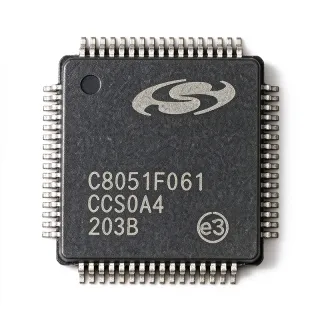
EFM32TG842F8-QFP64 - 32MHz Cortex-M3 MCU | Silicon Labs
MPN: EFM32TG842F8-QFP64 ✓ 啟用中EFM32TG842F8-QFP64 概覽
A microcontroller is a programmable system-on-chip integrating a CPU core, memory, timers, communication peripherals, and I/O into one device. The EFM32 Tiny Gecko family combines an ARM Cortex-M3 processor with low-energy design techniques, fast wake-up behavior, and energy-saving modes. This places it within the hierarchy MCU, embedded processor, semiconductor, and energy-conscious embedded control.
The EFM32TG842F8-QFP64 includes 8 kB of Flash for program storage and 2 kB of SRAM for working memory. Its 53 digital I/O pins provide broad integration opportunities, while two 16-bit timers support timing, pulse-width, and periodic-control tasks. Verified distributor data also identifies the device as an LCD and AES MCU, indicating dedicated support for embedded display and security-oriented applications.
The 64-TQFP package provides 64 physical pins, enabling more peripheral and signal access than the 8 kB memory footprint alone might suggest. Because pin multiplexing determines which peripheral functions can be assigned simultaneously, designers should review the pin configuration tables before fixing a board layout. The 10 x 10 mm package is larger than common QFN packages but remains practical for industrial and consumer boards requiring broad lead-based connectivity.
Typical uses include low-power sensor nodes, compact industrial controllers, wearable and wellness equipment, LCD-driven user interfaces, and security-equipped embedded controls. The 32 MHz Cortex-M3 core provides more compute headroom than lower-clock general-purpose microcontrollers while the Tiny Gecko power-management features support duty-cycled operation.
The principal design constraint is memory sizing: 8 kB Flash and 2 kB RAM may be sufficient for small control loops but restrictive for protocol-heavy firmware, graphical interfaces, or extensive logging. Confirm the required code and data budget, peripheral pin mapping, and voltage tolerances before committing to this MCU.
This product data combines the official specification page, distributor listings, and verified cross-reference results with engineering-focused application, comparison, and design guidance. It also distinguishes confirmed drop-in alternatives from parts that cannot safely replace this exact 64-pin device.
直接替換替代品,適用於 EFM32TG842F8-QFP64 — 相同封裝,腳位對腳位相容。需重新設計 PCB 的不同封裝零件不列入。
EFM32TG842F8-QFP64T
✅ 直接替換聯絡詢價
查看資料表 →EFM32TG842F8-D-QFP64
✅ 直接替換聯絡詢價
查看資料表 →EFM32TG842F8-QFP64 最大額定值與電氣特性
| Product Type | ARM Cortex-M3 Tiny Gecko microcontroller (MCU) |
| Core Processor | ARM Cortex-M3, 32-bit |
| Maximum CPU Frequency | 32 MHz |
| Flash Memory | 8 kB (8K x 8) |
| RAM | 2 kB |
| Digital I/O Pins | 53 pins |
| Timer Configuration | 2 x 16-bit timers |
| 工作電源電壓 | 1.85 V to 3.8 V |
| 封裝 | 64-TQFP (10 x 10 mm) |
| Total Package Pins | 64 pins |
| 安裝類型 | Surface mount |
| Programmable Peripheral I/O | Configurable peripheral I/O locations |
| Display Support | LCD MCU |
| Security Feature | AES MCU |
| Low-Power Features | Energy-saving modes and fast wake-up |
| Architecture | Tiny Gecko |
EFM32TG842F8-QFP64 64 pins 腳位配置指南
EFM32TG842F8-QFP64(64 pins 封裝)的腳位配置。 此數位 IC 包含 GPIO、通訊介面(UART、SPI、I2C)與電源腳位。替代腳位功能與配置選項請參閱製造商資料表。對嵌入式系統設計與 PCB 佈局至關重要。

無詳細腳位定義資料: EFM32TG842F8-QFP64.
請參閱 資料表 以查看完整腳位配置。
典型應用
EFM32TG842F8-QFP64 適用於 6 應用s: Low-Power Sensor Node, Industrial Control Module, LCD User Interface Controller, Wearable Wellness Device, Compact Security Controller, LED and Indicator Control.
Low-Power Sensor Node
The EFM32TG842F8-QFP64 fits a compact sensor node because its Tiny Gecko platform emphasizes low-energy techniques, fast wake-up behavior, and energy-saving modes. Its 53 digital I/O pins leave substantial pin budget for sensors, interrupt lines, status indicators, and actuators, while the 32 MHz ARM Cortex-M3 core can sample and process data without a high-clock MCU. The device operates from 1.85 V to 3.8 V, allowing integration with low-voltage sensor rails. Because memory is limited to 8 kB Flash and 2 kB RAM, the firmware should use compact drivers and carefully scheduled acquisition rather than large buffering. Duty-cycling is especially important when the node spends long periods asleep.
推薦
Industrial Control Module
The EFM32TG842F8-QFP64 is suitable for distributed industrial control when many discrete signal connections would otherwise consume board space. Its 53 digital I/O pins support digital sensors, relay-control inputs, machine-status lines, and communication interfaces, while two 16-bit timers provide dedicated timing resources for periodic sampling or output generation. The 32 MHz Cortex-M3 core provides deterministic responsiveness, and the 64-TQFP package exposes more pins than a compact QFN device. Its 1.85 V to 3.8 V operating range must be reconciled with the controller's industrial supply and I/O levels. Production designs should also verify isolation, transient protection, and functional-safety requirements at the system level.
推薦
LCD User Interface Controller
The EFM32TG842F8-QFP64 can control an LCD-oriented user interface because verified distributor data identifies it as an LCD MCU and the manufacturer highlights configurable peripheral I/O locations. With 53 digital I/O pins, the controller can support display segments or an external parallel interface alongside buttons, indicators, and sensors. The 32 MHz Cortex-M3 core is appropriate for basic menu state machines and input handling, while the 64-TQFP package makes the pin assignments accessible. The main constraint is memory: 8 kB Flash and 2 kB RAM require a simple graphics strategy, limited localization, and compact fonts. Display timing, segment count, and simultaneous peripheral use must be checked against the manufacturer pin table.
推薦
Wearable Wellness Device
The EFM32TG842F8-QFP64 supports a wearable wellness device when the design prioritizes low power, fast wake-up, and a large direct GPIO count rather than high storage capacity. Its Tiny Gecko energy-saving features are relevant for continuously worn devices that spend most of their time in a low-duty-cycle state, and its 1.85 V minimum supply can simplify operation near a low-voltage battery rail. The 53 digital I/O pins may connect motion, temperature, capacitive-touch, or indicator circuitry. Nevertheless, 8 kB Flash and 2 kB RAM constrain Bluetooth or complex sensor-hub firmware, so this MCU is most appropriate when processing stays local and compact. Battery capacity and peak radio-current effects must be evaluated separately.
推薦
Compact Security Controller
The EFM32TG842F8-QFP64 can serve as a compact security-oriented controller because verified distributor data identifies it as an AES MCU. The 32 MHz Cortex-M3 core is suitable for executing authentication, key-handling, or peripheral-access routines when the workload is modest, while the 53 digital I/O pins provide access to sensors, secure elements, communication modules, and status LEDs. The 1.85 V to 3.8 V supply range supports low-voltage embedded security hardware. Engineers should treat the AES designation as a feature marker rather than a complete security architecture, verify cryptographic modes and implementation details in the manufacturer documentation, and keep secrets outside the limited 8 kB Flash region where possible.
推薦
LED and Indicator Control
The EFM32TG842F8-QFP64 is appropriate for multi-LED indication and status-control boards because 53 digital I/O pins provide ample parallel output capacity and the 32 MHz core can implement lighting patterns or fault codes. In a 64-TQFP package, the device can combine display or indicator outputs with button inputs and communication signals without an immediate I/O-expander requirement. The 1.85 V to 3.8 V operating range also supports low-voltage LED-driver control when the MCU does not directly supply the LED current. External transistors or a constant-current driver remain necessary where lighting current or polarity differs from the MCU's specifications. Firmware size must remain within the 8 kB Flash limit, so table-driven effects are preferable to bulky graphics code.
推薦
推薦產品摘要
工程參考資料,適用於 EFM32TG842F8-QFP64 — 比較、設計指引及合規資訊。
選型指南
與替代品比較
| 參數 | 本產品 | EFM32TG842F8-QFP64T | EFM32TG842F8-D-QFP64 |
|---|---|---|---|
| Brand | Silicon Labs | Silicon Labs | Silicon Labs |
| Package | 64-TQFP (10 x 10 mm) | 64-TQFP (10 x 10 mm) - same | 64-TQFP (10 x 10 mm) - same |
| Core | ARM Cortex-M3 | ARM Cortex-M3 | Tiny Gecko MCU; exact core not stated in verified result |
| Maximum CPU Frequency | 32 MHz | 32 MHz | 32 MHz |
| Operating Supply Voltage | 1.85 V to 3.8 V | 1.85 V to 3.8 V | 1.98 V to 3.8 V |
| Ordering/Packaging Suffix | QFP64 | QFP64T tape-and-reel ordering variant | D suffix |
主要差異化特點
- Broad direct GPIO availability (對比EFM32TG842F8-QFP64T)
- Lower minimum operating voltage than the D variant (對比EFM32TG842F8-D-QFP64)
- Identical verified core and memory headline for tape-and-reel production (對比EFM32TG842F8-QFP64T)
設計說明
Do not assume that the EFM32TG842F8-QFP64T and EFM32TG842F8-D-QFP64 listings are unconditional substitutions. The verified data confirms the same 64-TQFP 10 x 10 mm family, but the D variant starts at 1.98 V rather than 1.85 V. Check the board's lowest supply condition, all pin assignments, peripheral multiplexing, and manufacturer ordering information before approving a drop-in change.
Design the supply for the MCU's full 1.85 V to 3.8 V operating range and calculate worst-case brownout behavior at the minimum rail. The manufacturer's low-power modes can reduce average consumption, but wake-up peripherals, active GPIO states, and external sensor loads determine the actual battery life. Use the manufacturer operating-current tables under the intended clock and temperature; do not substitute typical values for worst-case supply-current design.
Route the 64-TQFP with adequate clearance for its 10 x 10 mm body and fine-pitch leads. Decoupling capacitors should be placed at the supply and ground pins according to the manufacturer layout guidance, with short return paths and no long stubs. Because configurable peripheral multiplexing can limit simultaneous functions, freeze pin assignments in firmware only after checking the complete package pin table and board-level requirements.
Separate sensitive analog or sensor inputs from fast-switching digital nets and programming/debug signals, even though the verified listing does not identify an exposed-pad thermal arrangement. Use a continuous ground reference, keep external oscillators and timing components close to their assigned pins, and review unused-pin requirements in the datasheet. Proper grounding matters as much as package placement in a 53-I/O design.
合規資訊
The supplied verified snippets do not explicitly state RoHS, REACH, AEC-Q100, lead-free, halogen-free, or conflict-minerals status. Compliance values are therefore marked unknown rather than inferred.