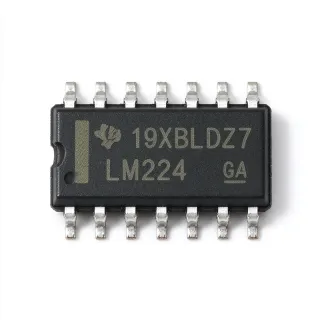
LM2902D - Quad 26V 1.2MHz Op Amp | Texas Instruments
MPN: LM2902D ✓ 啟用中LM2902D 概覽
An operational amplifier is a voltage-gain amplifier that uses negative feedback to control gain, bandwidth, input impedance, and output behavior. The quad LM2902 combines four amplifiers in one integrated circuit, reducing board area compared with four separate single or dual amplifier packages. Its general-purpose architecture belongs to the operational-amplifier, analog-amplifier, and semiconductor hierarchy and is widely used where inexpensive, robust signal conditioning is more important than precision or high speed.
Key characteristics include four independent amplifier channels, push-pull output capability, a 1.2 MHz typical gain-bandwidth product, and 2 mV typical offset voltage. The 26 V maximum supply rating provides compatibility with common industrial voltage ranges. According to the Texas Instruments LM2902 product page, the device is a quad, 26 V, 1.2 MHz, 2 mV-offset operational amplifier. The distributor listing identifies the LM2902D orderable package as 14-SOIC.
The internal architecture is frequency compensated and intended to operate from a single supply or split supply over a wide voltage range. Each amplifier can be used independently, while the common package provides four channels for instrumentation, sensor interfaces, active filters, voltage followers, and signal-conditioning blocks. The device should be selected against the complete input/output voltage, common-mode range, output-current, noise, and thermal requirements of the target circuit.
Typical applications include industrial measurement, transducer interfaces, audio and control circuits, low-frequency active filters, sensor amplifiers, and general-purpose analog signal conditioning. Because it is a general-purpose amplifier, the LM2902D is most appropriate when system cost, supply tolerance, and availability matter more than very low offset, rail-to-rail operation, or high-frequency precision.
The primary design consideration is supply and signal-range verification. Confirm that every input and output remains within the device's specified operating limits under load, temperature, and supply variation. Decoupling capacitors should be placed close to the supply pins, and each amplifier channel requires appropriate feedback and biasing. PCB creepage, grounding, output loading, and decoupling should be checked during layout.
This page combines verified manufacturer and distributor information, drop-in replacement guidance, package comparison data, and practical design notes to help engineers evaluate the LM2902D for new designs and service replacements.
直接替換替代品,適用於 LM2902D — 相同封裝,腳位對腳位相容。需重新設計 PCB 的不同封裝零件不列入。
此系列的變體
與下列產品可直接替換的同系列型號: LM2902D (相同外形與佔位) — 差異在於 Package, Gain-Bandwidth Product, Operating Temperature Range, Product Type, Input Offset Voltage.
LM2902DT
✅ 直接替換📋 參考替代品(不在目錄中)
LM2902M
✅ 直接替換聯絡詢價
查看資料表 →LM324DT
✅ 直接替換聯絡詢價
查看資料表 →LM2902DR
✅ 直接替換📋 參考替代品(不在目錄中)
LM2902DT
✅ 直接替換📋 參考替代品(不在目錄中)
LM2902D 最大額定值與電氣特性
| Product Type | Quad operational amplifier |
| Number of Amplifier Channels | 4 |
| Maximum Supply Voltage | 26 V |
| Typical Gain-Bandwidth Product | 1.2 MHz |
| Typical Input Offset Voltage | 2 mV |
| Supply Configuration | Single supply or split supply |
| 輸出類型 | Push-pull |
| 封裝 | 14-SOIC |
| 安裝類型 | Surface mount |
| Supplier Description | Standard general-purpose amplifier |
| RoHS 狀態 | unknown |
| REACH Status | unknown |
LM2902D 14-soic 腳位配置指南
LM2902D(14-soic 封裝)的腳位配置。 此類比元件具有輸入、輸出與電源腳位。偏移歸零、補償與致能腳位配置請參閱製造商資料表。適用於訊號調理與放大器電路。

無詳細腳位定義資料: LM2902D.
請參閱 資料表 以查看完整腳位配置。
典型應用
LM2902D 適用於 6 應用s: Industrial Sensor Signal Conditioning, Low-Frequency Active Filters, Audio Control and Amplifier Front Ends, Voltage Buffering and Signal Isolation, Power-Supply Monitoring and Control Loops, Test and Measurement Signal Conditioning.
Industrial Sensor Signal Conditioning
The LM2902D fits industrial sensor-conditioning circuits that need several amplified stages within one package. Its four independent channels can support sensor input buffering, gain stages, offset handling, and output conditioning without requiring four separate amplifier packages. The 1.2 MHz typical gain-bandwidth product is suitable for many low-frequency industrial signals, while the 26 V supply rating accommodates common industrial supply contexts. The design must still verify the actual sensor range against the amplifier's input common-mode and output-swing limits, and it should include filtering or gain selection appropriate to the sensor bandwidth.
推薦
Low-Frequency Active Filters
The LM2902D is appropriate for low-frequency active-filter implementations where four amplifier sections can be used for cascaded stages or parallel filtering paths. Its 1.2 MHz typical gain-bandwidth product provides more bandwidth than many precision low-frequency filter applications require, while the internal frequency compensation supports practical feedback-based designs. Component tolerances, noise, slew behavior, and output loading determine the achievable filter response. Designers should derive R and C values from the desired cutoff and validate the final response with the actual source and load impedances rather than relying only on ideal equations.
推薦
Audio Control and Amplifier Front Ends
The LM2902D can serve in audio control, mixing, and low-frequency preamplifier circuits where four channels provide useful flexibility for level control and signal routing. The 26 V maximum supply rating and push-pull output description make it relevant to general-purpose analog signal chains, although the exact output-current and distortion limits must be checked before driving a load. The 1.2 MHz bandwidth is more than adequate for many audio-band control functions but does not by itself establish high-fidelity power-amplifier performance. Use appropriate input coupling, biasing, feedback, and output protection for the selected audio topology.
推薦
Voltage Buffering and Signal Isolation
Each LM2902D channel can be configured as a unity-gain voltage follower to buffer a source from the next circuit stage. Four independent channels make the package useful when several control, measurement, or interface nodes require buffering. The device's 2 mV typical input offset voltage and 1.2 MHz typical gain-bandwidth product are concrete starting points, but actual buffer accuracy depends on input bias current, output loading, supply voltage, temperature, and the selected feedback configuration. Check source and sink current requirements carefully because the verified data does not provide the complete output-current specification.
推薦
Power-Supply Monitoring and Control Loops
The LM2902D can implement comparator-like or control-loop signal conditioning in industrial power systems, provided the monitored signal remains inside the amplifier's valid input and output ranges. Four channels allow reference buffering, error amplification, and output-interface conditioning in a compact arrangement. The 26 V supply rating is relevant to higher-voltage systems, but the complete operating limits, input bias behavior, and output drive must be verified in the manufacturer datasheet. Protection, startup sequencing, and fault-state behavior should be designed around the actual power-supply topology rather than inferred from the generic amplifier description.
推薦
Test and Measurement Signal Conditioning
The LM2902D is usable in general-purpose test and measurement front ends for amplifying, scaling, and buffering low-frequency signals. Four channels allow multiple measurement paths to share one package, reducing board area compared with separate single amplifiers. The device's 1.2 MHz typical gain-bandwidth product is suitable for many low-bandwidth measurement functions, but precision instrumentation may require lower offset, lower noise, or tighter common-mode limits than the verified data provides. Validate input impedance, settling behavior, noise, and calibration stability in the complete measurement system before using it for laboratory or production-test requirements.
推薦
推薦產品摘要
工程參考資料,適用於 LM2902D — 比較、設計指引及合規資訊。
選型指南
與替代品比較
| 參數 | 本產品 | LM2902DT | LM2902M | LM324D | LM2902DR | LM2902DT |
|---|---|---|---|---|---|---|
| Brand | Texas Instruments | STMicroelectronics | STMicroelectronics | Texas Instruments | Texas Instruments | STMicroelectronics |
主要差異化特點
- Four independent amplifier channels in one package (對比LM324D)
- 26 V family supply rating (對比LM2902DT)
- 1.2 MHz typical gain-bandwidth product (對比LM324D)
設計說明
Place the supply bypass capacitor as close as practical to the LM2902D supply pins, and keep the return path short and low-impedance. The supplied data confirms a 14-SOIC package but does not specify pin numbers, so use the official Texas Instruments pinout before laying out the board. Keep sensitive input and feedback traces away from switching nodes, high-current outputs, and inductor coupling paths.
Do not assume that a quad amplifier can be replaced by any LM324 or LM2902-family part solely because the package name is similar. The verified search results identify LM2902D, LM2902DT, LM2902M, LM324D, and LM2902DR as comparison candidates, but they do not provide complete pinout, temperature, offset, bandwidth, common-mode, and output-current data. Verify the exact manufacturer datasheet before substituting a part into production.
Use short, direct feedback routes and avoid adding unnecessary capacitance at amplifier inputs. The LM2902D's 1.2 MHz typical gain-bandwidth product is suitable for many low-frequency signal-conditioning paths, but high-impedance nodes can be sensitive to parasitic capacitance and bias-current errors. Confirm source impedance, load impedance, and stability requirements in the final topology.
Check input and output signal limits separately from the 26 V supply rating. The supply rating describes the device family, not permission to place arbitrary input or output voltages on the pins. Bias single-supply signals within the specified common-mode range and verify output swing under the worst-case load and supply condition before enabling the circuit.
合規資訊
The supplied verified product snippets do not explicitly state RoHS, REACH, lead-free, halogen-free, or conflict-minerals status. Compliance must be confirmed from current manufacturer documentation.