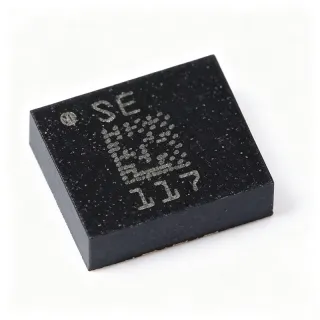
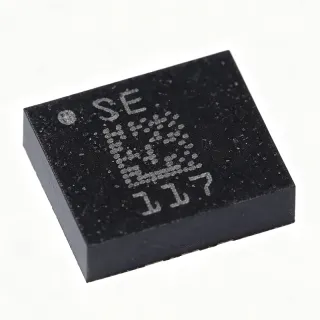
MMA2201KEGR2 - ±40g X-Axis MEMS Accelerometer, 5V, SOIC-16 | NXP
MPN: MMA2201KEGR2 ⚠ 最後購買機會MMA2201KEGR2 概覽
Background: An accelerometer is a sensor that measures proper acceleration — the rate of change of velocity in its own rest frame — and outputs a voltage proportional to the g-force applied along one or more axes. MEMS (Micro-Electro-Mechanical Systems) accelerometers use a suspended proof mass etched into silicon; deflection under acceleration changes a differential capacitance that is read out by an on-chip ASIC. In the broader taxonomy, the MMA2201KEGR2 sits in the hierarchy MEMS accelerometer -> accelerometer -> motion sensor -> sensor -> semiconductor.
Key features include ±40 g full-scale range, 50 mV/g nominal sensitivity (ratiometric with VDD), 400 Hz -3 dB bandwidth, a 4-pole Butterworth filter, self-test capability via an external logic pin, and integrated temperature compensation that holds sensitivity and zero-g offset stable across the industrial temperature range. The 5 V single-supply operation simplifies interface to legacy 5 V ADCs and microcontrollers.
Architecturally, the MMA2201KEGR2 uses a surface-micromachined capacitive sense element plus a BiCMOS ASIC. The four-pole low-pass filter is implemented in switched-capacitor topology on the ASIC, providing a fixed -3 dB corner that limits aliasing and high-frequency mechanical noise. Temperature compensation is performed in the analog domain to maintain sensitivity within the published tolerance across -40 °C to +125 °C.
Typical applications include automotive airbag systems, vehicle stability control, industrial vibration monitoring, tilt/inclination sensing for platform leveling, and crash detection. The ratiometric output and 5 V supply make it particularly suited to legacy 5 V automotive ECUs and to industrial PLC analog input modules.
When designing with this part, route the analog output through a low-impedance buffer or directly into an ADC with at least 10-bit resolution. Decouple VDD with a 0.1 µF ceramic capacitor placed within 5 mm of the supply pin. Observe the SOIC-16 footprint land pattern exactly; the exposed die-pad thermal slug on the package bottom must be soldered to the PCB for mechanical stability. Operate the self-test pin only after the supply has stabilized.
This page synthesizes distributor pricing, drop-in compatible alternatives, and practical design notes beyond what is collected in the manufacturer datasheet alone.
直接替換替代品,適用於 MMA2201KEGR2 — 相同封裝,腳位對腳位相容。需重新設計 PCB 的不同封裝零件不列入。
此系列的變體
與下列產品可直接替換的同系列型號: MMA2201KEGR2 (相同外形與佔位) — 差異在於 Full-Scale Range, Output Type, Package, Sensitivity, Sensitivity Tolerance.
MMA2200EGW
✅ 直接替換📋 參考替代品(不在目錄中)
MMA2202EGW
✅ 直接替換📋 參考替代品(不在目錄中)
MMA2204EGW
✅ 直接替換📋 參考替代品(不在目錄中)
MMA3202EGW
✅ 直接替換📋 參考替代品(不在目錄中)
MMA6260Q
✅ 直接替換📋 參考替代品(不在目錄中)
MMA2201KEGR2 最大額定值與電氣特性
| 感測器類型 | Accelerometer, Single Axis (X) |
| Technology | MEMS, capacitive sensing |
| Full-Scale Range | ±40 g |
| Sensitivity | 50 mV/g nominal (ratiometric with VDD) |
| Sensitivity Tolerance | 47.5 mV/g to 52.5 mV/g |
| Supply Voltage (VDD) | 4.75 V to 5.25 V |
| 輸出類型 | Analog, ratiometric |
| Bandwidth (-3 dB) | 400 Hz |
| Filter | 4-pole low-pass (on-chip) |
| Self-Test | Yes (logic-level pin) |
| Temperature Compensation | On-chip |
| 工作溫度 | -40 °C to +125 °C |
| 封裝 | 16-pin SOIC (SOIC-16, surface mount) |
| RoHS 狀態 | Compliant (per Mouser listing) |
MMA2201KEGR2 腳位配置
| 腳位 1 | GND — Ground reference |
| 腳位 2 | NC — Not connected (per datasheet) |
| 腳位 3 | NC — Not connected (per datasheet) |
| 腳位 4 | ST — Self-test input (active high) |
| 腳位 5 | NC — Not connected (per datasheet) |
| 腳位 6 | NC — Not connected (per datasheet) |
| 腳位 7 | NC — Not connected (per datasheet) |
| 腳位 8 | VOUT — Analog output (ratiometric with VDD) |
| 腳位 9 | NC — Not connected (per datasheet) |
| 腳位 10 | NC — Not connected (per datasheet) |
| 腳位 11 | NC — Not connected (per datasheet) |
| 腳位 12 | NC — Not connected (per datasheet) |
| 腳位 13 | NC — Not connected (per datasheet) |
| 腳位 14 | VDD — 5 V supply voltage |
| 腳位 15 | NC — Not connected (per datasheet) |
| 腳位 16 | NC — Not connected (per datasheet) |
典型應用
MMA2201KEGR2 適用於 6 應用s: Automotive Airbag Crash Detection, Vehicle Stability Control (ESC) Sensing, Industrial Vibration Monitoring, Tilt and Inclination Sensing, Crash and Impact Detection in Industrial Robots, Aircraft and UAV Flight Control Sensing.
Automotive Airbag Crash Detection
The MMA2201KEGR2's ±40 g full-scale range captures the high-g deceleration events of automotive frontal and side-impact crashes, where peak acceleration routinely exceeds 25 g. Its 400 Hz -3 dB bandwidth, set by the 4-pole Butterworth filter, faithfully reproduces crash pulses in the 100–300 Hz band without aliasing. Deployed between the airbag ECU's 5 V analog rail and the safety microcontroller's ADC, it provides a ratiometric 50 mV/g signal whose zero-g output (≈2.0 V) tracks VDD, eliminating absolute-reference error. The integrated temperature compensation holds sensitivity and zero-g offset stable across -40 °C to +125 °C, the operating range demanded by under-hood and passenger-compartment airbag modules. Compared with discrete piezoelectric crash sensors, the MMA2201 delivers a calibrated analog output that interfaces directly with a 10-bit SAR ADC at sample rates above 1 kHz. The on-chip self-test pin is wired to the ECU's GPIO to verify the sensor at every ignition-on cycle, satisfying ISO 26262 diagnostic coverage requirements for ASIL-rated systems.
推薦
Vehicle Stability Control (ESC) Sensing
In electronic stability control (ESC) and rollover detection, the MMA2201KEGR2 monitors lateral and longitudinal acceleration at the vehicle center of mass. The 50 mV/g sensitivity delivers a clean 0–5 V swing across the ±40 g range, which after a single op-amp buffer feeds directly into the ESC controller's ADC. The 4-pole on-chip low-pass filter attenuates high-frequency suspension and brake-disc resonances, reducing aliasing in the digital control loop. Ratiometric output simplifies temperature drift compensation because zero-g output and sensitivity both scale with VDD. Combined with the same-family MMA2204EGW (lower range, finer resolution), a single BOM supports both ESC low-g and airbag high-g channels, sharing layout and decoupling. Operating from a regulated 5 V supply derived from the vehicle's 12 V bus, the MMA2201 contributes under 5 mA of quiescent current.
推薦
Industrial Vibration Monitoring
The MMA2201KEGR2 is used in industrial condition-monitoring systems that watch rotating machinery — pumps, fans, and motor housings — for imbalance and bearing wear. Its 400 Hz bandwidth captures vibration signatures on equipment running up to 24 000 rpm (400 Hz = 240 cycles per second × 60 s), adequate for most process-industry rotating equipment. The on-chip 4-pole filter rejects high-frequency switching noise from nearby variable-frequency drives, improving the signal-to-noise ratio of the FFT post-processing. With a typical sensitivity of 50 mV/g, the sensor integrates with industrial 4–20 mA vibration transmitters via a single op-amp current loop. The robust SOIC-16 package and -40 °C to +125 °C range suit both indoor control cabinets and outdoor enclosure-mounted installations. The on-chip self-test pin enables periodic field calibration checks without removing the sensor from service.
推薦
Tilt and Inclination Sensing
For platform-leveling, satellite-antenna pointing, and solar-tracker angle feedback, the MMA2201KEGR2 operates well within its ±40 g range, using only a fraction of the full scale for static 1 g tilt measurement. Although its low-resolution accelerometer over-specifies the range, the high linearity, ratiometric output, and integrated temperature compensation make it a robust choice for outdoor platforms exposed to shock and vibration. The 5 V ratiometric output feeds directly into a 12-bit ADC for sub-degree resolution. Its on-chip filter smooths wind-induced vibration, yielding stable angle readings without post-filtering. Where finer resolution is required at sub-g ranges, the MMA2204EGW (±25 g) is a pin-compatible drop-in with the same SOIC-16 footprint and pinout, simplifying PCB variant management.
推薦
Crash and Impact Detection in Industrial Robots
In collaborative robot (cobot) safety circuits, the MMA2201KEGR2 detects unintended collisions by capturing the brief high-g impulse when a robot arm contacts a human or obstacle. The 400 Hz bandwidth is sufficient to register the sub-millisecond impulse spectrum when digitized at >1 kS/s, allowing the safety PLC to trigger an emergency stop within ISO/TS 15066 mandated reaction times. The 50 mV/g analog output, with on-chip 4-pole filter, provides a clean signal without external analog stages. Operating from the cobot's 24 V-to-5 V regulated rail, it shares decoupling and ESD protection with the safety MCU. Ratiometric output ensures consistent trip thresholds across temperature variations inside the robot's joint housing. The self-test pin is wired to the safety MCU's GPIO and exercised at every robot wake-up cycle to meet PL d safety integrity requirements.
推薦
Aircraft and UAV Flight Control Sensing
In fixed-wing UAV flight control and small aircraft attitude-sensing subsystems, the MMA2201KEGR2 provides a high-g capable auxiliary axis for turbulence and hard-landing detection. The 50 mV/g sensitivity and 5 V supply are well-matched to legacy 5 V autopilot analog inputs (such as the older generation of Pixhawk analog front ends). The 400 Hz -3 dB bandwidth captures aerodynamic turbulence spectra in the 0–200 Hz band without the aliasing artifacts of unfiltered lower-bandwidth sensors. Operating from the UAV's regulated 5 V BEC rail, it draws negligible current (<5 mA). The integrated temperature compensation reduces drift-induced flight-control offsets across the -40 °C to +85 °C UAV operating envelope. Although newer designs use digital I2C/SPI sensors, the MMA2201 remains in legacy flight-control firmware that still expects an analog ratiometric output, making it a drop-in upgrade for fielded aircraft.
推薦
推薦產品摘要
工程參考資料,適用於 MMA2201KEGR2 — 比較、設計指引及合規資訊。
選型指南
與替代品比較
| 參數 | 本產品 | MMA2200EGW | MMA2202EGW | MMA2204EGW | MMA3202EGW | MMA6260Q |
|---|---|---|---|---|---|---|
| Brand | NXP Semiconductors | NXP Semiconductors | NXP Semiconductors | NXP Semiconductors | NXP Semiconductors | NXP Semiconductors |
| Package | SOIC-16 | SOIC-16 (same) | SOIC-16 (same) | SOIC-16 (same) | SOIC-16 (same) | SOIC-16 (same) |
| Full-Scale Range | ±40 g | ±40 g | ±50 g | ±25 g | ±25 g (dual axis) | ±1.5 g (dual axis) |
| Sensitivity | 50 mV/g | 50 mV/g | 40 mV/g | 80 mV/g | 80 mV/g | 800 mV/g |
| Bandwidth (-3 dB) | 400 Hz | 400 Hz | 400 Hz | 400 Hz | 400 Hz | 350 Hz |
| Self-Test Pin | Yes | No | Yes | Yes | Yes | Yes |
| Axes | X (single) | X (single) | X (single) | X (single) | X+Z (dual) | X+Y (dual) |
| Supply Voltage | 5.0 V (4.75–5.25 V) | 5.0 V (4.75–5.25 V) | 5.0 V (4.75–5.25 V) | 5.0 V (4.75–5.25 V) | 5.0 V (4.75–5.25 V) | 3.3 V or 5.0 V |
主要差異化特點
- On-chip 4-pole low-pass filter at 400 Hz (對比MMA2200EGW)
- Wider ±40 g full-scale for high-g crash events (對比MMA2204EGW)
- Single-axis X for clean signal routing (對比MMA3202EGW)
- Ratiometric 5 V analog output (對比MMA6260Q)
設計說明
The MMA2201KEGR2 draws up to 5 mA from the 5 V supply. Place a 0.1 µF ceramic decoupling capacitor within 5 mm of pin 14 (VDD), with a 10 µF bulk capacitor on the 5 V rail. Use a low-ESR regulator (e.g., 78M05 or a 1 A LDO such as LP38690) to keep VDD ripple below 10 mV — any VDD noise couples directly into the ratiometric analog output because zero-g output and sensitivity both scale with VDD.
Route the analog output (pin 8) as a short, guarded trace away from switching nodes, motor drivers, and the self-test digital pin (pin 4). Place a unity-gain buffer (e.g., MCP6001 or MCP6S21) within 10 mm of pin 8 to drive the ADC input without loading the high-impedance sensor output. The SOIC-16 footprint must match the manufacturer recommended land pattern (JEDEC SO-127); incorrect pad sizing shifts the package's mechanical stress and degrades zero-g offset.
Drive the self-test pin only after VDD has stabilized; asserting ST during power-up can latch an undefined sensor state. The self-test pin is a logic input, not open-drain — drive it actively high or low, never let it float. Confirm in-system sensitivity by reading the output voltage before and after asserting ST; the datasheet specifies a self-test delta of about 1.2 V at room temperature. Do not apply >5.25 V to VDD or to the self-test pin — over-voltage permanently shifts the zero-g offset.
Sample the analog output at >1 kS/s to avoid aliasing of mechanical vibrations near the 400 Hz -3 dB corner. Add an external anti-aliasing RC (10 kΩ + 1 nF = 16 kHz -3 dB) before the ADC for systems that digitize at <1 kS/s. Maintain a star-ground topology at pin 1 (GND) to prevent digital return currents from creating ground bounce that appears as output noise.
合規資訊
RoHS compliant per Mouser listing. AEC-Q100 qualification status not explicitly stated in the verified web data. Not recommended for new automotive designs — last-time-buy status.