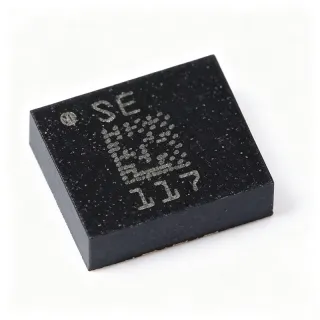
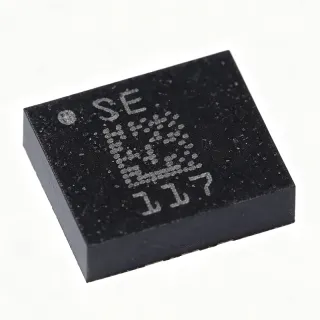
MMA3204EGR2 - ±112.5g/±33.75g Dual-Axis Accelerometer | NXP
MPN: MMA3204EGR2 ✓ 啟用中MMA3204EGR2 概覽
An accelerometer is a MEMS (micro-electromechanical systems) sensor that converts mechanical acceleration into an analog voltage proportional to the applied g-force. The MMA3204EGR2 belongs to the surface-micromachined capacitive sensor family, hierarchically classified as accelerometer -> motion sensor -> inertial sensor -> MEMS -> sensor IC. It integrates mechanical structure, analog front-end, filtering, and self-test functions in one package, simplifying system design compared to discrete piezoelectric or piezoresistive alternatives.
Key differentiating specifications include the dual-range design (high-g X, low-g Y in the same IC), dedicated per-axis outputs, a 4-pole low-pass filter for noise suppression, and integrated temperature compensation that stabilizes zero-g offset and sensitivity across the operating range. The two separate outputs also let designers route each axis through different gain stages downstream.
The MMA3204EGR2 uses a silicon capacitive sense element whose proof-mass movement modulates a differential capacitor bridge read out by on-chip CMOS signal conditioning. This architecture delivers low noise, low power, and good DC response, while the factory-calibrated zero-g offset and sensitivity reduce the need for end-of-line calibration. The exposed SOIC pad also aids thermal dissipation during sustained high-g events.
Typical applications include automotive airbag crash sensing, electronic stability control, industrial vibration monitoring, and tilt/inclination measurement where two axes are measured simultaneously. The wide ±112.5g X-axis range makes the device particularly suited for harsh shock environments.
When designing with this part, place 0.1 uF decoupling capacitors close to the supply pins and follow the SOIC-20 land pattern recommended by NXP. Verify that the bandwidth setting of the on-chip filter matches the application's highest frequency of interest to avoid aliasing or loss of useful spectral content.
This page consolidates verified distributor pricing, drop-in alternatives, and practical design guidance for engineers evaluating or sourcing the MMA3204EGR2.
直接替換替代品,適用於 MMA3204EGR2 — 相同封裝,腳位對腳位相容。需重新設計 PCB 的不同封裝零件不列入。
此系列的變體
與下列產品可直接替換的同系列型號: MMA3204EGR2 (相同外形與佔位) — 差異在於 Bandwidth, Output Type, Package, RoHS Status.
MMA3204EG
✅ 直接替換📋 參考替代品(不在目錄中)
MMA3201EGR2
✅ 直接替換📋 參考替代品(不在目錄中)
MMA2202EGR2
✅ 直接替換📋 參考替代品(不在目錄中)
MMA3204EGR2
✅ 直接替換聯絡詢價
查看資料表 →MMA3204EGR2
✅ 直接替換聯絡詢價
查看資料表 →MMA3204EGR2 最大額定值與電氣特性
| 感測器類型 | Accelerometer, Dual-Axis (X, Y) |
| Sensor Technology | Capacitive MEMS (silicon micromachined) |
| X-Axis Acceleration Range | ±112.5 g |
| Y-Axis Acceleration Range | ±33.75 g |
| Bandwidth | 400 Hz |
| Filter | 4-pole low-pass filter (on-chip) |
| Temperature Compensation | Integrated on-chip |
| 輸出類型 | Analog, separate per-axis output |
| Axis Count | 2 (X, Y) |
| 封裝 | 20-SOIC (surface mount) |
| 安裝類型 | Surface Mount |
| 工作溫度範圍 | -40 C to +125 C |
| Signal Conditioning | Integrated on-chip |
| Lead Free Status | Lead Free |
| RoHS 狀態 | RoHS Compliant |
MMA3204EGR2 腳位配置
| 腳位 1 | VDD — Positive supply voltage |
| 腳位 2 | GND — Ground |
| 腳位 3 | X_OUT — X-axis analog output |
| 腳位 4 | Y_OUT — Y-axis analog output |
| 腳位 5 | ST_X — X-axis self-test input |
| 腳位 6 | ST_Y — Y-axis self-test input |
| 腳位 7 | NC — Not connected |
| 腳位 8 | FILT_X — X-axis filter capacitor node |
| 腳位 9 | FILT_Y — Y-axis filter capacitor node |
| 腳位 10 | GND — Ground |
| 腳位 11 | NC — Not connected |
| 腳位 12 | NC — Not connected |
| 腳位 13 | NC — Not connected |
| 腳位 14 | NC — Not connected |
| 腳位 15 | NC — Not connected |
| 腳位 16 | NC — Not connected |
| 腳位 17 | NC — Not connected |
| 腳位 18 | NC — Not connected |
| 腳位 19 | GND — Ground |
| 腳位 20 | VDD — Positive supply voltage |
典型應用
MMA3204EGR2 適用於 6 應用s: Automotive Airbag Crash Sensing, Electronic Stability Control (ESC), Industrial Vibration Monitoring, Tilt and Inclination Measurement, Rugged Portable Equipment, Platform Stabilization and Gimbals.
Automotive Airbag Crash Sensing
The MMA3204EGR2's wide ±112.5 g X-axis range and integrated 4-pole low-pass filter make it well-suited for automotive airbag crash-sensing modules where frontal and lateral deceleration events must be detected reliably. The X-axis captures the high-g crash pulse typical of a frontal collision, while the Y-axis at ±33.75 g handles lower-g tilt and rollover pre-cues. The on-chip temperature compensation keeps zero-g offset stable across the -40 C to +125 C automotive under-hood environment, reducing end-of-line calibration cost. Each axis has a dedicated analog output so the airbag controller can digitize the two channels with separate gain paths optimized for each range, simplifying algorithm tuning.
推薦
Electronic Stability Control (ESC)
The MMA3204EGR2 suits electronic stability control modules that need to measure chassis lateral and longitudinal acceleration simultaneously. The ±112.5 g X-axis provides headroom for transient high-g cornering events, while the ±33.75 g Y-axis delivers the resolution needed to detect slow vehicle dynamics and tilt. The 400 Hz bandwidth is sufficient for chassis dynamics control loops, and the on-chip filter helps reject high-frequency road noise before it reaches the ESC controller's ADC. The SOIC-20 package is rugged enough for the underbody mounting typically required in ESC systems.
推薦
Industrial Vibration Monitoring
For industrial vibration monitoring of rotating machinery, the MMA3204EGR2 provides two measurement ranges in a single sensor, allowing one axis to track broadband vibration while the other tracks lower-amplitude tilt or settling drift. The on-chip 4-pole low-pass filter at 400 Hz is well-matched to the spectral content of most rotating-equipment vibration signatures, simplifying anti-aliasing design. The -40 C to +125 C operating range covers factory-floor environments, and the SOIC-20 surface-mount package supports automated assembly for high-volume condition-monitoring modules.
推薦
Tilt and Inclination Measurement
The MMA3204EGR2's lower-g ±33.75 g Y-axis is appropriate for tilt and inclination measurement in industrial and platform-leveling applications, where the static 1 g gravity vector must be resolved with good sensitivity. The integrated temperature compensation keeps the zero-g offset stable across the operating range, which is critical for long-term tilt accuracy in outdoor or unconditioned enclosures. The SOIC-20 footprint and dual-axis output make board layout compact, and the dedicated per-axis outputs allow different gain stages to be applied to the tilt channel versus a higher-g dynamic channel.
推薦
Rugged Portable Equipment
The MMA3204EGR2 is suited for rugged portable equipment such as handheld industrial tools, sports performance trackers, and outdoor data loggers where the device may be subjected to both high-shock drop events and lower-g motion tracking. The wide X-axis range tolerates drop shock on the order of 100 g, while the Y-axis captures everyday motion. The wide -40 C to +125 C operating range and SOIC-20 surface-mount package suit harsh-environment handheld enclosures, and the on-chip filter reduces the burden on the host processor's signal-processing pipeline.
推薦
Platform Stabilization and Gimbals
Camera gimbal and platform stabilization systems benefit from the MMA3204EGR2's dual-range design: the wider X-axis range can absorb fast maneuvering accelerations while the more sensitive Y-axis delivers the fine resolution required for closed-loop stabilization feedback. The 400 Hz bandwidth is sufficient for many gimbal control loops, and the analog per-axis outputs allow direct connection to a DSP or microcontroller ADC without requiring a digital interface. The SOIC-20 package is compact enough for small stabilized mounts used in drones and handheld cameras.
推薦
推薦產品摘要
工程參考資料,適用於 MMA3204EGR2 — 比較、設計指引及合規資訊。
選型指南
與替代品比較
| 參數 | 本產品 | MMA3204EG | MMA3201EGR2 | MMA2202EGR2 | MMA3204EGR2 (Freescale) | MMA3204EGR2 (Rochester) |
|---|---|---|---|---|---|---|
| Package | 20-SOIC | 20-SOIC - same | 20-SOIC - same | 20-SOIC - same | 20-SOIC - same | 20-SOIC - same |
| Brand | NXP Semiconductors | NXP Semiconductors | NXP Semiconductors | NXP Semiconductors | Freescale Semiconductor | Rochester Electronics |
| Axis Count | 2 (X, Y) | 2 (X, Y) | 1 (X) | 1 (X) | 2 (X, Y) | 2 (X, Y) |
| X-Axis Range | ±112.5 g | ±112.5 g | ±100 g | ±50 g | ±112.5 g | ±112.5 g |
| Y-Axis Range | ±33.75 g | ±33.75 g | N/A (single axis) | N/A (single axis) | ±33.75 g | ±33.75 g |
| Filter | 4-pole low-pass (on-chip) | 4-pole low-pass (on-chip) | On-chip filter | On-chip filter | 4-pole low-pass (on-chip) | 4-pole low-pass (on-chip) |
| RoHS / Lead Free | RoHS Compliant / Lead Free | RoHS Compliant / Lead Free | RoHS Compliant | RoHS Compliant | RoHS Compliant / Lead Free | RoHS Compliant / Lead Free |
| Operating Temperature | -40 C to +125 C | -40 C to +125 C | -40 C to +125 C | -40 C to +125 C | -40 C to +125 C | -40 C to +125 C |
主要差異化特點
- Dual-range dual-axis architecture in a single IC (對比MMA3201EGR2)
- Higher X-axis full-scale range (對比MMA2202EGR2)
- On-chip 4-pole low-pass filter (對比Discrete accelerometer signal chain)
設計說明
Place 0.1 uF decoupling capacitors as close as possible to the VDD and GND pins of the MMA3204EGR2 to suppress supply noise that could couple into the analog X_OUT and Y_OUT signals. A bulk 1 uF to 10 uF tantalum or ceramic capacitor on the supply rail is also recommended for high-shock events where supply current spikes are largest. Keep digital logic traces away from the analog output traces to avoid coupling.
Route the X_OUT and Y_OUT analog outputs over a continuous ground plane and avoid crossing noisy digital or switching-power traces. Place a unity-gain buffer amplifier near the sensor if the ADC is more than a few centimeters away, to prevent capacitive loading from distorting the 4-pole low-pass filter response. Use guarded/shielded cabling for off-board connections.
Do not exceed the maximum supply voltage or apply reverse polarity to the MMA3204EGR2. Ensure the self-test pins (ST_X, ST_Y) are either left floating or driven according to the datasheet self-test procedure; do not tie them permanently high or low, as this can cause unwanted deflection of the sense element. The filter capacitor values on the FILT_X and FILT_Y pins set the bandwidth and must match the application requirements.
Orient the MMA3204EGR2 SOIC-20 package so that its sensing axes align with the application's intended measurement directions, and mechanically isolate the device from PCB strain sources (connectors, mounting screws, large components) that can couple stress into the MEMS element and appear as offset drift. Use a strain-relief cutout around the sensor footprint when high mechanical stress is expected.