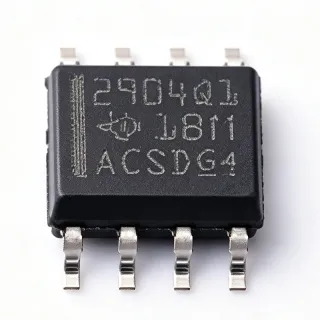
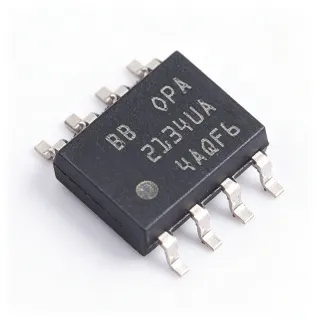
TS321ID - Single 30 V 800 kHz Op Amp | Texas Instruments
MPN: TS321ID ✓ 啟用中TS321ID 概覽
An operational amplifier is an analog integrated circuit that uses high open-loop gain to amplify the difference between two input voltages. The TS321 belongs to the broader hierarchy of operational amplifier, analog amplifier, signal-conditioning IC, and semiconductor. Its basic amplifier functions include voltage amplification, buffering, filtering, summing, and feedback-based control, provided the external feedback network and operating limits are respected.
The verified product information identifies a single amplifier circuit, a 30 V maximum operating framework, 800 kHz bandwidth, general-purpose classification, and an 8-pin SOIC package. The bipolar architecture and low-power positioning suit cost-sensitive designs, while the SOIC footprint supports conventional surface-mount assembly. Exact offset, bias-current, noise, slew-rate, common-mode, and output-swing values require confirmation in the manufacturer datasheet before final circuit sign-off.
TS321ID is useful as a general-purpose amplifier in low- and moderate-bandwidth analog paths. Its verified 800 kHz bandwidth makes it relevant to signal conditioning where the required closed-loop bandwidth is well below that level. The single-amplifier configuration can simplify designs that need one amplifier rather than a dual package, particularly in sensor interfaces, control loops, audio preamplification, and industrial measurement circuits.
The principal design consideration is preserving signal headroom and stability. An 8-pin SOIC package requires adequate PCB spacing, controlled grounding, and decoupling close to the power pins. Feedback resistors, compensation components, and input or output loading determine the actual usable bandwidth and must be evaluated against the application. Because verified operating details beyond the supplied values are incomplete, engineers should consult the TS321 manufacturer datasheet before choosing component values.
This page combines verified manufacturer and distributor information, structured technical context, sourcing guidance, and engineering notes. It also clearly identifies unavailable electrical parameters rather than presenting guessed values, helping engineers move from part selection to a validated TS321ID design with fewer sourcing and specification ambiguities.
直接替換替代品,適用於 TS321ID — 相同封裝,腳位對腳位相容。需重新設計 PCB 的不同封裝零件不列入。
此系列的變體
與下列產品可直接替換的同系列型號: TS321ID (相同外形與佔位) — 差異在於 Package.
TLV9301IDBVR
✅ 直接替換聯絡詢價
查看資料表 →TS321ID 最大額定值與電氣特性
| Product Type | Single bipolar operational amplifier |
| Amplifier Circuit Count | 1 circuit |
| Maximum Operating Voltage | 30 V |
| Gain-Bandwidth Product | 800 kHz |
| 工作溫度範圍 | -40 °C to +125 °C |
| 封裝 | SOIC-8 (D) |
| 腳位數 | 8 pins |
| 安裝類型 | Surface mount |
| Amplifier Classification | Standard general-purpose amplifier |
| Architecture | Bipolar |
| Product Positioning | Low-power, cost-sensitive |
TS321ID soic-8 (d) 腳位配置指南
TS321ID(soic-8 (d) 封裝)的腳位配置。 此類比元件具有輸入、輸出與電源腳位。偏移歸零、補償與致能腳位配置請參閱製造商資料表。適用於訊號調理與放大器電路。
無詳細腳位定義資料: TS321ID.
請參閱 資料表 以查看完整腳位配置。
典型應用
TS321ID 適用於 6 應用s: General-Purpose Analog Signal Conditioning, Industrial Instrumentation, Sensor Interface Conditioning, Audio Preamplification, Control and Feedback Loops, Low-Frequency Active Filters.
General-Purpose Analog Signal Conditioning
The TS321ID is a single bipolar operational amplifier with a verified 800 kHz gain-bandwidth product, making it suitable for moderate-bandwidth conditioning stages. It can provide buffering, gain, summing, or basic active filtering when the closed-loop bandwidth remains comfortably below the verified value. The 8-pin SOIC package also supports compact surface-mount layouts. Verify offset, bias current, noise, input range, output swing, and stability in the datasheet before selecting resistor and capacitor values.
推薦
Industrial Instrumentation
The TS321ID's verified 30 V operating framework and -40 °C to +125 °C temperature range make it a candidate for industrial instrumentation where signal conditioning is required. It can amplify or buffer low-frequency sensor signals in measurement chains, provided the source impedance, common-mode voltage, and output loading remain inside the manufacturer limits. The single-amplifier format simplifies one-channel signal paths, while the SOIC-8 package keeps the footprint compact.
推薦
Sensor Interface Conditioning
The TS321ID can be used in a sensor interface as a voltage amplifier or buffer when the required signal bandwidth is below its verified 800 kHz gain-bandwidth product. A feedback network sets the closed-loop gain, while local supply decoupling and careful grounding reduce noise pickup. Because the supplied data does not provide input bias current, offset voltage, common-mode range, or output swing, verify those parameters against the sensor output and supply rails before finalizing the stage.
推薦
Audio Preamplification
The TS321ID's 800 kHz verified bandwidth is suitable for audio preamplifier and low-frequency audio buffer applications when the circuit does not require high-frequency slew performance beyond the available specification. The bipolar amplifier can support gain and impedance buffering stages, but distortion, noise, offset, and output-drive requirements must be checked in the full datasheet. Place the feedback network close to the amplifier pins and maintain a low-impedance return path.
推薦
Control and Feedback Loops
The single TS321ID channel can serve as an error amplifier or feedback element in low- and moderate-bandwidth control loops. Its verified 800 kHz gain-bandwidth product provides a defined starting point for loop-bandwidth planning, but stability depends on the feedback topology, compensation, load, and plant. Confirm the device's slew rate, output current, output swing, and common-mode limits in the datasheet before using it in a new compensation network.
推薦
Low-Frequency Active Filters
The TS321ID can be used in active-filter stages operating below its verified 800 kHz gain-bandwidth limit. A single amplifier may implement first-order sections or participate in a multi-stage filter, with passive components defining the nominal response. Validate the component values against the actual closed-loop noise gain and verify input/output headroom, load capacitance, and stability. The 8-pin SOIC package is practical for compact analog boards requiring one amplifier per section.
推薦
推薦產品摘要
工程參考資料,適用於 TS321ID — 比較、設計指引及合規資訊。
選型指南
與替代品比較
| 參數 | 本產品 | TLV9301ID |
|---|---|---|
| Package | SOIC-8 (D), 8 pins | SOIC-8 (D), same package family; exact pin compatibility requires datasheet verification |
| Brand | Texas Instruments | Texas Instruments |
| Amplifier Circuit Count | 1 circuit | Single amplifier |
| Operating Voltage | 30 V | 40 V |
| Gain-Bandwidth Product | 800 kHz | 1 MHz |
| Application Class | Standard general-purpose amplifier | Low-power operational amplifier |
主要差異化特點
- Verified 800 kHz gain-bandwidth product for moderate-bandwidth analog signal conditioning (對比TLV9301ID)
- 30 V operating framework (對比TLV9301ID)
- Single amplifier in an 8-pin SOIC package (對比TLV9301ID)
設計說明
Place the TS321ID close to the signal source, feedback network, and load to minimize parasitic capacitance and feedback-loop delay. Keep the SOIC-8 footprint free of unintended copper or solder bridges around adjacent pins, route high-impedance input traces away from switching nodes, and provide a continuous ground reference. The supplied data does not include a pin-level layout drawing, so confirm every connection against the official TS321 datasheet.
Use the TS321ID only within the manufacturer-specified supply and input/output limits. The verified product information identifies a 30 V operating framework but does not provide the minimum supply, common-mode range, or output swing. Before biasing the circuit, check those values in the datasheet and ensure input and output stages do not approach the rails. Decouple the supply pins locally with the recommended capacitor network from the datasheet.
Do not treat the 800 kHz gain-bandwidth product as a guaranteed operating frequency for every gain, load, or output amplitude. Closed-loop bandwidth depends on noise gain, feedback impedance, capacitive loading, and stability. Check the datasheet test conditions and simulate the complete analog path, especially when driving long cables, ADC inputs, motor-control signals, or other high-capacitance loads.
合規資訊
The supplied verified snippets do not explicitly state RoHS, REACH, AEC-Q100, lead-free, halogen-free, or conflict-minerals status. These fields remain unknown rather than inferred.