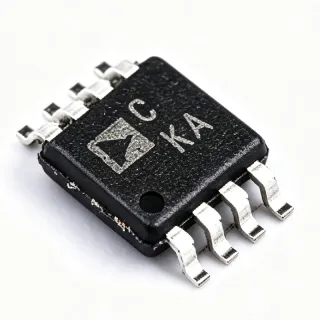
MCP96RL00-E/MX - 8-Type Thermocouple-to-I2C Converter | Microchip
料号: MCP96RL00-E/MX ✓ 量产中| 数量 | 单价 | 小计 |
|---|---|---|
| 1 | $4.41 | $4.41 |
| 10 | $3.96 | $39.60 |
| 100 | $3.52 | $352.00 |
| 500 | $3.08 | $1,540.00 |
| 1,000 | $2.74 | $2,740.00 |
MCP96RL00-E/MX 概述
An EMF-to-temperature converter is a specialized analog front-end IC that linearizes the small millivolt-level output of a thermocouple probe into a digital temperature reading, replacing discrete op-amp, ADC, reference, and lookup-table firmware with one calibrated device. Thermocouple-to-digital converters belong to the broader sensor signal-chain family, sitting between the transducer (analog sensor) and the host MCU (digital domain), and are critical building blocks in industrial, automotive, and appliance temperature monitoring systems where measurement ranges exceed what silicon sensors can reach (typically above +200°C).
Key features include on-chip cold-junction compensation using an internal diode sensor, four user-programmable temperature alert outputs, programmable digital filter (minimum 1 conversion settling time), and built-in open/short thermocouple detection. The I2C address is selectable via two ADDR pins (4 addresses), and an interrupt pin (ALERT) signals threshold events. User-programmable registers configure thermocouple type, resolution, averaging, and shutdown mode for low-power applications.
Architecturally, the device integrates a low-noise chopper-stabilized PGA, a high-resolution ΣΔ ADC, an internal bandgap reference, and the cold-junction sensor. Conversion results are linearized using integrated polynomial coefficients per thermocouple type and delivered over the I2C bus as both the hot-junction temperature and the cold-junction (ambient) temperature, which simplifies host firmware.
Typical applications include industrial furnace and oven controllers, HVAC duct and refrigeration monitoring, 3D-printer extruder and bed temperature sensing, food-service and laboratory equipment, automotive exhaust gas temperature sensing, and battery-pack thermal management. Across these, the MCP96RL00-E/MX replaces multiple discrete components with one calibrated IC, reducing BOM cost and PCB area.
Design consideration: route the thermocouple traces as a differential pair away from switching converters and heat sources to preserve the micro-volt-level EMF signal, and place the input RC filter network (per datasheet typical application) within a few millimeters of the TC+ / TC- pins to minimize noise pickup.
This page synthesizes distributor pricing, drop-in package-compatible alternatives, and practical design notes not consolidated on the manufacturer datasheet or any single distributor page.
直接替换替代料: MCP96RL00-E/MX ——相同封装,引脚兼容。需要 PCB 改动的不同封装料号已排除。
快速对比工具——选择替代料号进行并排对比:
MCP96RL00T-E/MX
✅ 直接替换📋 参考替代料(不在目录中)
MCP9600-E/MX
✅ 直接替换📋 参考替代料(不在目录中)
MCP9600T-E/MX
✅ 直接替换📋 参考替代料(不在目录中)
MCP9601-E/MX
✅ 直接替换📋 参考替代料(不在目录中)
MAX31856ATP+
✅ 直接替换📋 参考替代料(不在目录中)
MCP96RL00-E/MX 最大额定值与电气特性
| Product Type | Thermocouple-to-Digital Converter (EMF to °C) |
| Supported Thermocouple Types | K, J, T, N, S, E, B, R (8 types) |
| Maximum Accuracy (Thermocouple) | ±1.5 °C (factory calibrated, with cold-junction compensation) |
| Supply Voltage (VDD) | 2.7 V to 5.5 V |
| Supply Current (Active) | 300 µA (typical) |
| 接口 | I2C, Standard-mode up to 100 kHz |
| Selectable I2C Addresses | 4 (via ADDR0, ADDR1) |
| 分辨率 | 18-bit (hot-junction + cold-junction data) |
| Temperature Output Format | Degrees Celsius (signed integer, 0.01 °C resolution) |
| Cold-Junction Compensation | Internal diode sensor, on-chip linearization |
| Alert Outputs | 4 user-programmable temperature thresholds (ALERT pin) |
| Thermocouple Open/Short Detection | Built-in (TC open/short detection) |
| Programmable Digital Filter | Yes (minimum 1 conversion settling time) |
| 工作温度范围 | -40 °C to +125 °C |
| 封装 | 20-pin MQFN-EP (5x5 mm) with exposed pad |
| 安装类型 | Surface Mount |
| RoHS 状态 | Compliant |
MCP96RL00-E/MX 引脚配置
| 引脚 1 | TC+ — Thermocouple input positive |
| 引脚 2 | TC- — Thermocouple input negative |
| 引脚 3 | VDD — Power supply input (2.7V to 5.5V) |
| 引脚 4 | GND — Ground |
| 引脚 5 | ADDR0 — I2C address select bit 0 |
| 引脚 6 | ADDR1 — I2C address select bit 1 |
| 引脚 7 | SCL — I2C serial clock |
| 引脚 8 | SDA — I2C serial data |
| 引脚 9 | ALERT — Interrupt / alert output (open-drain) |
| 引脚 10 | GPIO — General-purpose I/O / configuration |
| 引脚 11 | NC — Not connected (per datasheet) |
| 引脚 12 | NC — Not connected (per datasheet) |
| 引脚 13 | NC — Not connected (per datasheet) |
| 引脚 14 | NC — Not connected (per datasheet) |
| 引脚 15 | NC — Not connected (per datasheet) |
| 引脚 16 | NC — Not connected (per datasheet) |
| 引脚 17 | NC — Not connected (per datasheet) |
| 引脚 18 | NC — Not connected (per datasheet) |
| 引脚 19 | NC — Not connected (per datasheet) |
| 引脚 20 | EP — Exposed thermal pad (connect to GND) |
典型应用
MCP96RL00-E/MX 适用于 6 应用s: Industrial Furnace and Oven Temperature Control, 3D Printer Extruder and Heated-Bed Temperature Sensing, HVAC Duct and Refrigeration Monitoring, Battery-Pack Thermal Management (EV / Storage), Food-Service and Laboratory Equipment, Automotive Exhaust and Engine-Conditioning.
Industrial Furnace and Oven Temperature Control
The MCP96RL00-E/MX is well suited for industrial furnace and oven controllers because it natively supports K, J, and N thermocouple types used in these environments, with a measurement range that extends well beyond silicon sensors. Its ±1.5°C maximum accuracy (typically closer to ±0.5°C after system calibration) is adequate for PID temperature regulation of ovens operating from ambient to +600°C. The on-chip cold-junction compensation removes the need for an external temperature sensor and lookup table, simplifying firmware on the host MCU. The 4 alert outputs can drive SSR control loops or interlocks directly, and the I2C interface allows multiple zone sensors on a single bus. Designers should keep the thermocouple leads short and use shielded cable to avoid mains-frequency pickup in noisy industrial cabinets.
推荐
3D Printer Extruder and Heated-Bed Temperature Sensing
In 3D printers, the MCP96RL00-E/MX reads K-type thermocouple temperature at the extruder hot end and the heated bed, where temperatures of 200-300°C exceed the range of common silicon sensors. Its 18-bit resolution delivers the 0.01°C granularity needed for PID firmware loops, while the I2C interface (up to 100 kHz) keeps wiring to a minimum on moving carriage assemblies. The 4 selectable addresses let one bus serve multiple zones. The 20-pin MQFN-EP package is compact enough for direct integration on a hot-end breakout board, and the exposed pad provides thermal dissipation when placed over a copper keep-out near the heater. Cold-junction compensation is critical here because the PCB temperature near the connector can drift significantly during heat-up ramps.
推荐
HVAC Duct and Refrigeration Monitoring
The MCP96RL00-E/MX provides reliable temperature sensing in HVAC and refrigeration systems where supply air, return air, and refrigerant-line temperatures must be monitored continuously. Its wide thermocouple-type support means a single PCB design can accept different probes for different physical locations (e.g., K-type for duct air, T-type for copper refrigerant lines). The on-chip alert outputs enable threshold detection for filter-change, defrost cycle, or compressor-trip events without polling the host, and the low 300µA active supply current suits battery-backed monitoring during power interruptions. The I2C bus with 4 selectable addresses simplifies multi-zone deployments across a single controller. Industrial-grade -40°C to +125°C operation covers rooftop and chiller plant environments.
推荐
Battery-Pack Thermal Management (EV / Storage)
In battery management systems (BMS) for EVs and stationary storage, the MCP96RL00-E/MX monitors cell and pack temperatures via K-type or N-type thermocouples, where temperatures during fast-charge or fault events can exceed +80°C. The 4 programmable alert outputs can independently trigger balancing, cooling fans, or contactor drop-out when thresholds are breached, allowing the BMS host MCU to sleep or focus on cell voltage scanning. The I2C interface allows multiple pack monitoring nodes on a common bus, while the 20-pin MQFN-EP footprint keeps the design compact for integration onto cell-module PCBs. AEC-Q100 qualification status is not declared in the verified data, so automotive use should be reviewed against the latest Microchip qualification reports.
推荐
Food-Service and Laboratory Equipment
The MCP96RL00-E/MX provides sanitary, accurate temperature monitoring in food-service ovens, sous-vide baths, autoclaves, and laboratory incubators where regulatory accuracy is required. Its ±1.5°C max accuracy, integrated cold-junction compensation, and digital output eliminate manual probe calibration steps in production. The 8 thermocouple types allow flexibility across probe suppliers (K-type most common, J-type for legacy systems). The I2C interface enables logging to a host MCU for HACCP or GLP records, and the 4 alert pins can drive buzzer, relay, or interlock outputs directly. The wide -40°C to +125°C operating range covers both refrigeration (-20°C sous-vide) and sterilization (+135°C autoclave) deployment scenarios.
推荐
Automotive Exhaust and Engine-Conditioning
Exhaust gas temperature (EGT) and after-treatment monitoring in diesel/gasoline engines rely on K-type or N-type thermocouples that operate up to +900°C, well beyond silicon sensors. The MCP96RL00-E/MX supports these types, integrates cold-junction compensation (critical given engine-bay temperature swings), and outputs digital temperature data over I2C to the ECU. Its 4 alert outputs can be routed to limp-mode triggers, while the wide supply range (2.7V-5.5V) accommodates both 3.3V and 5V ECUs. AEC-Q100 qualification status is not declared in the verified data; automotive designs should consult Microchip's automotive-grade portfolio (e.g., MCP96xxx-Q1 series where applicable) for safety-critical applications.
推荐
推荐产品汇总
工程参考数据: MCP96RL00-E/MX ——对比、设计指导和合规信息。
选型指南
与替代料对比
| 参数 | 本产品 | MCP96RL00T-E/MX | MCP9600-E/MX | MCP9600T-E/MX | MCP9601-E/MX | MAX31856ATP+ |
|---|---|---|---|---|---|---|
| Brand | Microchip Technology | Microchip Technology | Microchip Technology | Microchip Technology | Microchip Technology | Maxim Integrated (now Analog Devices) |
| Package | 20-pin MQFN-EP (5x5 mm) | 20-pin MQFN-EP (5x5 mm) - same | 20-pin MQFN-EP (5x5 mm) - same | 20-pin MQFN-EP (5x5 mm) - same | 20-pin MQFN-EP (5x5 mm) - same | 20-pin TQFN (5x5 mm) - same body, verify pinout |
| Thermocouple Types Supported | 8 (K, J, T, N, S, E, B, R) | 8 (K, J, T, N, S, E, B, R) | 8 (K, J, T, N, S, E, B, R) | 8 (K, J, T, N, S, E, B, R) | 8 (K, J, T, N, S, E, B, R) | 8 (K, J, T, N, S, E, B, R) |
| Interface | I2C up to 100 kHz | I2C up to 100 kHz | I2C up to 100 kHz | I2C up to 100 kHz | I2C up to 100 kHz | SPI / QSPI / MICROWIRE |
| Supply Voltage | 2.7V to 5.5V | 2.7V to 5.5V | 2.7V to 5.5V | 2.7V to 5.5V | 2.7V to 5.5V | 3.0V to 3.6V |
| Maximum Accuracy | ±1.5°C | ±1.5°C | ±1.5°C | ±1.5°C | ±1.5°C | ±2°C to ±6°C (type dependent) |
| Alert Outputs | 4 programmable | 4 programmable | 4 programmable | 4 programmable | 1 programmable | 0 (interrupt via SPI) |
| Cold-Junction Compensation | Internal on-chip diode sensor | Internal on-chip diode sensor | Internal on-chip diode sensor | Internal on-chip diode sensor | Internal on-chip diode sensor | Internal on-chip diode sensor |
关键差异点
- I2C interface with 4 selectable addresses (vs MAX31856's SPI) (对比 MAX31856ATP+)
- Broader alert output flexibility vs single-alert sibling (对比 MCP9601-E/MX)
- Single IC replaces op-amp + ADC + reference + MCU firmware lookup table (对比 Discrete thermocouple front-end (op-amp + ADC))
设计说明
Route the TC+ and TC- traces as a tightly coupled differential pair, kept short and routed away from switching converters, relay coils, and other high-dV/dt signals. Place the input RC filter network (per datasheet typical application) within 5-10 mm of the TC pins. Avoid running thermocouple traces across PCB splits or under noisy components, because the microvolt-level EMF signal is easily corrupted by ground loops. Use a guard trace tied to GND between the TC pair and any switching signals.
Cold-junction accuracy depends on the PCB temperature at the thermocouple connector matching the internal sensor's measurement point. Position the connector within 1-2 cm of the IC and ensure both share the same copper pour. Avoid placing heat-generating components (LDOs, MCU) adjacent to the connector, as temperature gradients of even 5°C introduce noticeable EMF errors in the cold-junction compensation. The exposed thermal pad (EP) must be soldered to a copper plane, both for thermal dissipation and electrical grounding.
Do not connect a thermocouple directly to the IC without first confirming the polarity (TC+ is the positive leg of the thermocouple, not always color-coded consistently across probe types). Inverting the pair will produce apparently valid but reversed-temperature readings. Always enable the open-thermocouple detection feature in software so a broken probe triggers an ALERT instead of an erroneous room-temperature reading. When using long thermocouple leads in noisy environments, add a 0.1µF-1µF differential capacitor across TC+ / TC- per the datasheet filter recommendation.
合规信息
RoHS compliant per JLCPCB and Lisleapex distributor listings. AEC-Q100 qualification status is not explicitly declared in the verified data; automotive designs should consult Microchip's automotive-grade portfolio for safety-critical applications.