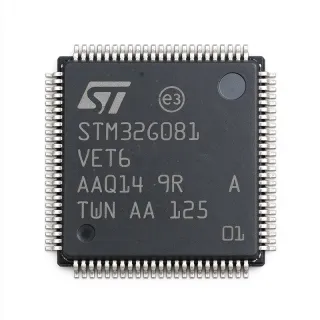
STM32L162VDT6 - 32MHz Cortex-M3 384KB MCU | STMicroelectronics
料号: STM32L162VDT6 ✓ 量产中STM32L162VDT6 概述
A microcontroller is a programmable semiconductor that integrates a CPU core, memory, peripherals, and communication interfaces on one die. The STM32L1 family belongs to the broader embedded-control hierarchy of microcontrollers, embedded processors, and semiconductor devices. STM32L162xD devices specifically combine low-power operation with USB connectivity, allowing firmware, data acquisition, control functions, and USB communication to be implemented in a relatively compact package.
The device provides 384 KB of Flash memory organized as 384K x 8 bits and operates at up to 32 MHz. Its 100-pin LQFP package provides 100 external connection points, while the 2.5 V and 3.3 V operating range supports common embedded supply rails. USB connectivity is the principal feature distinguishing the STM32L162 family from related ultra-low-power STM32L1 devices. These characteristics align with applications requiring low-power USB peripherals, data loggers, industrial interfaces, and compact control platforms.
The Arm Cortex-M3 core uses a 32-bit instruction set and provides a conventional embedded processor architecture suitable for event-driven control, communications, and moderate protocol processing. The STM32L162VDT6 is identified as part of STMicroelectronics' STM32L16 low-power product family, with the STM32L162xD designation identifying the high-density Flash-memory configuration. Exact SRAM capacity, peripheral assignments, pin names, current consumption, and operating-temperature limits must be confirmed in the manufacturer datasheet before PCB or firmware release.
Typical uses include USB-connected sensors, portable measurement equipment, compact industrial controllers, and low-power embedded data-acquisition systems. USB can simplify connection to a host computer or peripheral device while reducing external interface complexity. In a battery-powered design, however, developers should examine the device's active, sleep, and standby current figures, USB bus requirements, regulator efficiency, and peripheral configuration before estimating battery life.
For implementation, begin with the pin-description table, memory map, clock-tree diagram, and USB configuration examples in the STMicroelectronics manufacturer datasheet. Place the device's decoupling capacitors close to the appropriate supply pins, route USB data and power paths carefully, and confirm that the board's 2.5 V or 3.3 V rail satisfies the selected operating mode. Programming and peripheral initialization should be validated against the current reference manual and errata.
This product overview consolidates the verified core, memory, frequency, package, voltage, and USB attributes with package-level replacement guidance and practical design considerations. It also distinguishes true same-footprint alternatives from general STM32 cross-references, helping engineers assess USB capability, Flash capacity, package compatibility, and qualification requirements before committing a design to production.
直接替换替代料: STM32L162VDT6 ——相同封装,引脚兼容。需要 PCB 改动的不同封装料号已排除。
本系列中的变体
可与以下型号直接替换的同系列型号: STM32L162VDT6 (相同外形与封装尺寸) ——差异在于 Flash Memory, Package, SRAM, Supply Voltage.
STM32L162VCT6
✅ 直接替换 ⚠️ 规格未核验联系询价
查看数据手册 →STM32L162VET6
✅ 直接替换 ⚠️ 规格未核验联系询价
查看数据手册 →STM32L152VDT6X
✅ 直接替换📋 参考替代料(不在目录中)
STM32L152VCT6X
✅ 直接替换 ⚠️ 规格未核验📋 参考替代料(不在目录中)
STM32L152VET6X
✅ 直接替换 ⚠️ 规格未核验📋 参考替代料(不在目录中)
STM32L162VDT6 最大额定值与电气特性
| Product Type | 32-bit ultra-low-power microcontroller |
| CPU Core | Arm Cortex-M3 |
| Instruction Set | 32-bit |
| 最大时钟频率 | 32 MHz |
| Flash Memory | 384 KB (384K x 8 bits) |
| Operating Voltage | 2.5 V / 3.3 V |
| Connectivity | Universal Serial Bus (USB) |
| Product Family | STM32L16 low-power |
| Series | STM32L162xD |
| Package Type | 100-pin LQFP |
| Package Body Size | 14 x 14 mm |
| Total Pin Count | 100 pins |
| 安装类型 | Surface mount |
STM32L162VDT6 14 x 14 mm 引脚配置指南
STM32L162VDT6(14 x 14 mm 封装)的引脚配置。 该数字 IC 包含 GPIO、通信接口(UART、SPI、I2C)和电源引脚。请参阅制造商数据手册以了解复用引脚功能和配置选项。对嵌入式系统设计和 PCB 布局至关重要。

暂无详细引脚数据: STM32L162VDT6.
请参阅 数据手册 以查看完整引脚配置。
典型应用
STM32L162VDT6 适用于 6 应用s: USB Portable Data Loggers, Industrial Sensor Interfaces, USB Medical and Laboratory Instruments, Low-Power IoT Gateways, USB Communication Accessories, Battery-Powered Field Test Equipment.
USB Portable Data Loggers
The STM32L162VDT6 fits portable USB data loggers because its Arm Cortex-M3 core processes acquisition and control tasks at up to 32 MHz, while 384 KB of Flash accommodates firmware, configuration data, and local buffering code. USB connectivity simplifies communication with a host computer without requiring a separate USB bridge. In a battery-powered logger, the device is placed between the sensor interface and USB transceiver or connector, with the firmware entering low-power states between samples. Designers must verify USB-suspend current, regulator quiescent current, and the exact USB signal assignments in the manufacturer datasheet.
推荐
Industrial Sensor Interfaces
The STM32L162VDT6 can serve as the control MCU for a compact industrial sensor interface that combines sampling, local signal conditioning, status reporting, and USB-based configuration. Its 32-bit Cortex-M3 architecture and 32 MHz maximum clock provide capacity for digital filtering and communications, while the 384 KB Flash configuration supports a larger embedded application than smaller-memory variants. The MCU should sit beside the analog front end and USB interface, with separate clean grounding and careful routing between sensitive sensor inputs and digital switching nodes. Production designs must verify ADC characteristics, peripheral assignments, and industrial temperature requirements.
推荐
USB Medical and Laboratory Instruments
The STM32L162VDT6 is appropriate for compact laboratory instruments that need local control and a direct USB connection to a host system. The 32 MHz Cortex-M3 core can execute measurement sequencing, calibration logic, status handling, and command parsing, while 384 KB of Flash provides room for application firmware. A practical instrument may use the MCU to supervise sensors, control indicators, and transfer records over USB. Because this is not a medical-grade certification claim, the final product must independently validate electrical isolation, accuracy, software controls, and regulatory requirements for its intended use.
推荐
Low-Power IoT Gateways
The STM32L162VDT6 can serve as the low-power edge controller in an IoT gateway that aggregates sensor data and exposes a USB maintenance or configuration interface. Its ultra-low-power STM32L1 positioning supports battery-conscious designs, while the 32 MHz Cortex-M3 core handles protocol tasks and the 384 KB Flash capacity accommodates firmware updates and device configuration. The implementation should use the MCU's low-power operating modes between gateway activities and control USB loading carefully. Exact standby current, wake-up timing, RAM capacity, and peripheral availability must be taken from the current manufacturer documentation.
推荐
USB Communication Accessories
The STM32L162VDT6 is suitable for USB communication accessories that convert legacy or custom sensor signals into a modern host interface. The Cortex-M3 processor can handle protocol framing, device enumeration support, configuration storage, and status diagnostics, while 384 KB of Flash is useful for boot code, class firmware, and application layers. Place the microcontroller close to the USB connector and data interface, provide correct decoupling, and follow the manufacturer's USB routing and impedance guidance. Firmware should include enumeration handling, suspend/resume behavior, and robust host compatibility testing.
推荐
Battery-Powered Field Test Equipment
The STM32L162VDT6 fits battery-powered field test equipment that performs local measurements and periodically connects through USB for configuration or data export. Its 32-bit Cortex-M3 core supports responsive control, and the 384 KB Flash capacity allows more elaborate measurement, diagnostics, and field-update logic than a 256 KB variant. A typical design places the MCU between the sensor front end, operator interface, and USB circuitry. Battery-life calculations must include the MCU's active and sleep current, USB transceiver consumption, regulator efficiency, and the duration of each measurement cycle.
推荐
推荐产品汇总
工程参考数据: STM32L162VDT6 ——对比、设计指导和合规信息。
选型指南
与替代料对比
| 参数 | 本产品 | STM32L162VCT6 | STM32L162VET6 | STM32L152VDT6X | STM32L152VCT6X | STM32L152VET6X |
|---|---|---|---|---|---|---|
| Brand | STMicroelectronics | STMicroelectronics | STMicroelectronics | STMicroelectronics | STMicroelectronics | STMicroelectronics |
| Package | 100-LQFP (14x14) | 100-LQFP (14x14) | 100-LQFP (14x14) | 100-LQFP (14x14) | 100-LQFP (14x14) | 100-LQFP (14x14) |
| CPU Core | Arm Cortex-M3 | Arm Cortex-M3 | Arm Cortex-M3 | Arm Cortex-M3 | Arm Cortex-M3 | Arm Cortex-M3 |
| Maximum Clock Frequency | 32 MHz | 32 MHz | 32 MHz | 32 MHz | 32 MHz | 32 MHz |
| Flash Memory | 384 KB | 256 KB | 512 KB | 384 KB | 256 KB | 512 KB |
| Instruction Set | 32-bit | 32-bit | 32-bit | 32-bit | 32-bit | 32-bit |
| Pin Count | 100 pins | 100 pins | 100 pins | 100 pins | 100 pins | 100 pins |
关键差异点
- Exact 384 KB Flash configuration in the STM32L162 family (对比 STM32L162VCT6)
- USB connectivity is explicitly established by the manufacturer (对比 STM32L152VDT6X)
- Memory capacity can be increased without changing the LQFP-100 footprint (对比 STM32L162VET6)
- 32 MHz Cortex-M3 performance remains consistent across the compared STM32L1 options (对比 STM32L152VET6X)
设计说明
Use the manufacturer power-supply and decoupling recommendations for the selected 2.5 V or 3.3 V operating condition. Place each required bypass capacitor immediately beside its associated supply and ground pins, and keep the high-current return path short. For battery-powered equipment, calculate energy use from the MCU operating mode, USB transceiver load, regulator efficiency, and peripheral activity rather than using the 32 MHz clock frequency as a proxy for power consumption. Validate wake-up behavior and voltage ramp requirements before enabling USB operation.
Begin the LQFP-100 layout from the STMicroelectronics package drawing and the datasheet pin table. Assign decoupling, ground, supply, reset, boot, debug, and USB-related nets before placing the MCU and routing escape traces. Preserve the manufacturer's pin-1 orientation and verify the exposed perimeter clearances against the selected board-assembly process. Do not infer missing pin functions from generic STM32L1 diagrams because alternate functions can vary across density and family variants.
If the board implements USB, route the differential data connection as a controlled impedance path and follow the STM32L162xD reference documentation for transceiver placement, series-termination requirements, and connection geometry. Keep the USB clock-capacitance and support components close to the relevant device pins, and provide continuous reference-plane return beneath high-speed traces. Validate enumeration, suspend, resume, and full-speed or high-speed operation using the exact USB operating mode required by the product specification.
Do not treat a similar STM32L1 order code as an automatic drop-in replacement. The STM32L162VCT6 and STM32L152VCT6X provide 256 KB rather than 384 KB of Flash, while the STM32L162VET6 and STM32L152VET6X provide 512 KB. USB capability, SRAM, peripheral assignments, pin multiplexing, and firmware initialization must also be reviewed. Record the exact alternate MPN in the schematic and BOM rather than relying on a family-level description.
The 100-pin LQFP provides a larger thermal path than a small-lead package, but final temperature performance still depends on PCB copper, airflow, adjacent heat sources, and the programmed clock and peripheral load. Place ground-connected copper beneath and around the device where the package drawing allows it, avoid long thermal interruptions in planes, and use thermal vias only where the manufacturer's layout guidance permits. Validate the hottest expected operating condition with a thermal prototype rather than relying only on the nominal clock rating.
合规信息
The verified product listings identify the manufacturer, device configuration, package, core, Flash memory, clock, voltage, and USB family feature but do not provide specific environmental or material-compliance declarations. Confirm RoHS, REACH, lead-free, halogen-free, and automotive qualification status in the current manufacturer documentation before release.