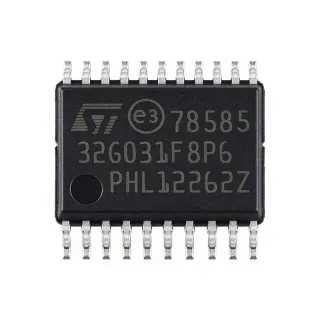
STM8L151F3P6 - 16MHz 8KB Ultra-Low-Power MCU | STMicroelectronics
料号: STM8L151F3P6 ✓ 量产中| 数量 | 单价 | 小计 |
|---|---|---|
| 1 | $0 | $0.00 |
| 10 | $0 | $0.00 |
| 100 | $0 | $0.00 |
| 500 | $0 | $0.00 |
| 1,000 | $0 | $0.00 |
STM8L151F3P6 概述
An ultra-low-power microcontroller is a semiconductor device designed to minimize energy consumption during standby, sleep, and active operation. The STM8L151x2/3 family combines an 8-bit CPU core, Flash program memory, EEPROM, timers, GPIO, communication peripherals, and low-power management in one compact package. This device family is suitable when a controller must balance fast control-loop execution with restricted energy budgets.
The STM8L151F3P6 provides 8 KB of Flash, up to 256 bytes of EEPROM according to the device description, and operation up to 16 MHz. It is identified as an STM8L EnergyLite microcontroller in distributor listings and is available in a 20-pin TSSOP package. The part is intended for low-voltage embedded designs where the MCU must handle control, sensing, communication, and periodic sensing without a high-power processor.
The enhanced STM8 core provides increased processing power while retaining CISC advantages such as compact instruction representation and efficient code density. A 24-bit linear addressing space supports organized access to memory-mapped peripherals. The low-power architecture helps designers select suitable operating modes during idle periods and wake the controller for defined events or scheduled tasks.
Typical applications include low-power sensor nodes, industrial monitoring modules, battery-powered instruments, building automation controls, portable measurement equipment, and embedded consumer devices. The 20-pin TSSOP package is useful for PCB layouts where a relatively small through-hole-style surface-mount footprint is preferred and when the design does not require a large high-pin-count microcontroller.
When designing around STM8L151F3P6, verify the exact peripheral configuration, clock setup, pin multiplexing, memory limits, and low-power behavior in the manufacturer datasheet. The P6 suffix and package markings should be confirmed against the ordered device, and firmware should be tested for all required sleep, wake-up, RTC, and communication paths before production release.
This page combines the verified manufacturer product information, distributor specifications, package details, and application-oriented design guidance. It also distinguishes electrically similar devices from true pin-for-pin drop-in alternatives, helping engineers make a defensible sourcing or redesign decision rather than treating unrelated low-power MCUs as direct substitutes.
直接替换替代料: STM8L151F3P6 ——相同封装,引脚兼容。需要 PCB 改动的不同封装料号已排除。
本系列中的变体
可与以下型号直接替换的同系列型号: STM8L151F3P6 (相同外形与封装尺寸) ——差异在于 Package, Flash Memory, RoHS Status, I/O Ports, Product Type.
快速对比工具——选择替代料号进行并排对比:
STM8L101F3P6
✅ 直接替换✓ 有现货
$1.15 / 个
查看数据手册 →STM8L151F3P3
✅ 直接替换✓ 有现货
$12.5 / 个
查看数据手册 →STM8L151F3P6TR
✅ 直接替换📋 参考替代料(不在目录中)
MSP430G2553IPW20R
✅ 直接替换✓ 有现货
联系询价
查看数据手册 →STM8L151F3P6 最大额定值与电气特性
| Product Type | 8-bit ultra-low-power microcontroller |
| CPU Core | Enhanced STM8 CISC core |
| 最大时钟频率 | 16 MHz |
| Maximum Processing Performance | 16 MIPS at 16 MHz |
| Flash Memory | 8 KB |
| Program Memory Organization | 8K x 8 |
| Data EEPROM | Up to 256 bytes |
| Supply Voltage Range | 1.8 V to 3.6 V |
| Temperature Range | -40 °C to +85 °C or +125 °C |
| 封装 | 20-pin TSSOP |
| Package Format | TSSOP-20 |
| I/O Ports | 41 |
| Addressing Space | 24-bit linear addressing space |
| RTC | Real-time clock capability |
| Timer Support | Integrated timers |
| Low-Power Features | Ultra-low-power operating modes |
| 安装类型 | Surface mount |
| RoHS 状态 | Yes |
| 生命周期状态 | Active |
STM8L151F3P6 tssop-20 引脚配置指南
STM8L151F3P6(tssop-20 封装)的引脚配置。 该数字 IC 包含 GPIO、通信接口(UART、SPI、I2C)和电源引脚。请参阅制造商数据手册以了解复用引脚功能和配置选项。对嵌入式系统设计和 PCB 布局至关重要。
暂无详细引脚数据: STM8L151F3P6.
请参阅 数据手册 以查看完整引脚配置。
典型应用
STM8L151F3P6 适用于 6 应用s: Low-Power Sensor Node, Battery-Powered Measurement Instrument, Industrial Monitoring Module, Building Automation Controller, Portable Consumer Device, RTC-Based Timekeeping Module.
Low-Power Sensor Node
The STM8L151F3P6 fits a low-power sensor node that periodically samples an environmental or physical signal, processes the result locally, and returns to a low-power state. Its 16 MHz maximum clock provides headroom for short measurement and control routines, while the 8 KB Flash footprint supports compact firmware. The device is especially relevant when the product requires a low-voltage 1.8 V to 3.6 V operating range and an 8-bit control loop rather than a high-performance application processor. The key design tradeoff is that total battery life depends on sensor standby current, wake-up frequency, analog front-end power, and firmware discipline; the MCU specification alone cannot determine the final runtime.
推荐
Battery-Powered Measurement Instrument
STM8L151F3P6 can serve as the control MCU in a compact battery-powered measurement instrument that combines sensor conditioning, display control, and data logging. The 16 MIPS processing capability supports responsive control tasks at 16 MHz, while the 8 KB Flash memory keeps the firmware footprint practical for embedded products. Its ultra-low-power positioning helps the designer minimize energy use during idle intervals, although the external sensor, display, analog converter, and regulator may dominate current draw. Firmware should use explicit low-power modes, disable unused peripherals, and document wake-up sources so the advertised battery life reflects the complete system rather than the MCU name alone.
推荐
Industrial Monitoring Module
The STM8L151F3P6 is appropriate for an industrial monitoring module that reads sensors, checks thresholds, records events, and communicates status through a host interface. Its 8-bit STM8 core provides a simple control architecture for supervisory logic, and the 20-pin TSSOP package allows a compact controller footprint. The 1.8 V to 3.6 V operating range can simplify integration with low-voltage sensor and communication circuitry, provided the complete interface voltage levels are compatible. For industrial deployment, engineers should verify the exact temperature grade, ESD requirements, watchdog behavior, communication peripherals, and supply-noise tolerance against the manufacturer datasheet.
推荐
Building Automation Controller
STM8L151F3P6 can be used in a low-cost building automation controller for occupancy, temperature, or equipment-status monitoring. The MCU can combine timer-based sampling, GPIO control, and event-driven wake-up behavior while retaining a small 8 KB program-memory footprint. The TSSOP-20 package is practical when the controller must remain compact but does not require a large pin count. A robust design should account for relay or valve drive isolation, debouncing, fault recovery, and communication timing. The MCU's low-power capability helps reduce standby consumption, but the selected sensor, bus transceiver, isolation components, and actuator drivers must be evaluated as part of the total system power budget.
推荐
Portable Consumer Device
The STM8L151F3P6 is suitable for a portable consumer accessory that performs simple control functions and must remain responsive without a high-power processor. Its 16 MHz clock can handle button handling, LED indication, sensor fusion at a basic level, and low-rate serial communication. The ultra-low-power MCU positioning is useful for devices that spend substantial time idle, while the 20-pin TSSOP package helps limit board size. Product designers should not infer a complete wearable platform from the MCU alone; display drivers, radio modules, sensors, power regulation, and battery protection determine the practical design. Validate suspend behavior and peripheral shutdown in the target board rather than relying only on nominal specifications.
推荐
RTC-Based Timekeeping Module
STM8L151F3P6 can serve as the control platform for an RTC-based timekeeping or scheduling module because the verified device description identifies real-time-clock capability. The MCU can maintain time, execute scheduled tasks, read inputs, and drive an external display or communications interface while using low-power operation between events. The 8 KB Flash memory is sufficient for compact firmware when the application avoids large libraries and complex graphical functions. Accurate timekeeping depends on the external crystal or clock source, oscillator loading, calibration, and backup-power design. Before production, confirm the exact RTC registers, oscillator requirements, startup behavior, and low-power current from the manufacturer documentation.
推荐
推荐产品汇总
工程参考数据: STM8L151F3P6 ——对比、设计指导和合规信息。
选型指南
与替代料对比
| 参数 | 本产品 | STM8L101F3P6 | STM8L151F3P3 | MSP430G2553IPW20R |
|---|---|---|---|---|
| Product Type | 8-bit ultra-low-power microcontroller | 8-bit low-power microcontroller | STM8L151F3 family microcontroller | Low-power 16-bit microcontroller |
| Brand | STMicroelectronics | STMicroelectronics | STMicroelectronics | Texas Instruments |
| Package | TSSOP-20 | TSSOP-20 | TSSOP-20 | TSSOP-20 |
关键差异点
- Ultra-low-power STM8L positioning (对比 STM8S003F3P6)
- 16 MHz and up to 16 MIPS processing capability (对比 STM8L101F3P6)
- 8 KB Flash with up to 256 bytes EEPROM (对比 STM8L101F3P6)
- 20-pin TSSOP package (对比 MSP430G2553IPW20R)
设计说明
Design the STM8L151F3P6 supply for the verified 1.8 V to 3.6 V operating range and place local decoupling close to the device power pins. Confirm the exact pin names and recommended capacitor values in the STMicroelectronics datasheet. If the MCU is battery powered, measure active and sleep current with the real sensor, pull-up, interface, and regulator loads installed; nominal MCU specifications alone do not determine battery life.
Use the manufacturer TSSOP-20 land pattern and verify pin 1 orientation against the package drawing before routing. Keep oscillator, reset, and sensitive analog or communication traces away from noisy switching nodes. Although the device is small, poor grounding or long high-impedance traces can degrade clock reliability, communications, and RTC accuracy. Perform assembly and rework checks with the exact 20-pin footprint rather than relying only on the package name.
Do not treat STM8L101F3P6, STM8S003F3P6, or MSP430G2553IPW20R as automatic replacements for STM8L151F3P6. The verified data shows related low-power devices, but memory type, CPU architecture, peripheral mapping, pinout, interrupt behavior, and toolchain may differ. Before substitution, compare every used pin and peripheral and perform boot, timing, low-power, and brownout tests on the replacement hardware.
Plan the TSSOP-20 layout around the verified package but not an assumed pinout. Validate alternate-function assignments, debug access, programming interface, reset behavior, and exposed test points against the official datasheet. Leave routing options for oscillator components and communication interfaces when applicable. A compact 20-pin footprint can constrain simultaneous UART, timer, ADC, and GPIO requirements, so perform a pin-budget review before schematic capture.
合规信息
The verified comparison data identifies STM8L151F3P6 as RoHS Code: Yes. No verified REACH, lead-free, halogen-free, conflict-minerals, or automotive qualification statement was supplied.