المنتجات (46,000+)

STM32F412RET6 - 512KB Flash ARM Cortex-M4F MCU | STMicroelectronics
STM32F412RET6

STM32F412RET6 - 512KB Flash ARM Cortex-M4F MCU | STMicroelectronics

The STMicroelectronics STM32F412RET6 is a high-performance ARM Cortex-M4F based microcontroller with floating-point unit (FPU) running at up to 100 MHz. It features 512 KB of flash memory and 256 KB of SRAM, making it suitable for a wide range of applications including industrial control, consumer electronics, and IoT devices. The device is housed in a 64-pin LQFP package (LQFP64) with a 10x10 mm body and 0.5 mm pitch, providing a compact footprint for space-constrained designs. What is an ARM Cortex-M4F microcontroller? It is a 32-bit processor core designed for embedded systems, combining the ARM Cortex-M4 architecture with a hardware floating-point unit (FPU) for efficient digital signal processing (DSP) and math-intensive tasks. The 'F' suffix indicates the presence of the FPU, which accelerates single-precision floating-point operations. In the system hierarchy, the STM32F412RET6 sits within the STM32F4 series of microcontrollers, which are part of the broader STM32 family of 32-bit MCUs from STMicroelectronics. These devices integrate a processor core, memory, and peripherals on a single chip, enabling embedded control in applications ranging from simple sensors to complex motor control systems. Key features of the STM32F412RET6 include a 100 MHz ARM Cortex-M4F core with FPU, 512 KB flash memory, 256 KB SRAM, and a comprehensive set of peripherals. It offers multiple communication interfaces including USART, SPI, I2C, USB OTG FS, SDIO, and CAN, along with advanced analog peripherals such as 12-bit ADCs, DACs, and comparators. The device also includes a true random number generator (RNG), a cryptographic acceleration cell (AES), and a real-time clock (RTC) with calendar function. The operating voltage range is 1.7V to 3.6V, and the temperature range is -40°C to +85°C, making it suitable for industrial environments. From a technical depth perspective, the STM32F412RET6 is built on a 90nm process technology, offering a balance between performance and power consumption. The core supports a rich instruction set including DSP instructions and single-cycle multiply-accumulate (MAC) operations, enabling efficient execution of signal processing algorithms. The memory architecture includes a flexible memory controller (FMC) that supports external memory expansion via parallel interfaces, and the device supports a wide range of clock sources including internal RC oscillators, external crystals, and PLLs for precise timing. Typical applications include industrial automation (PLC, motor control), consumer electronics (smart home hubs, wearables), IoT gateways, and audio processing. The rich peripheral set and high performance make it ideal for applications requiring real-time control and connectivity. For example, in an IoT gateway, the STM32F412RET6 can manage multiple communication protocols (Wi-Fi, Ethernet via external PHY, USB) while handling sensor data acquisition and processing. When designing with this device, ensure adequate decoupling capacitors (100nF and 4.7uF) are placed close to the power pins, and follow the recommended layout guidelines in the datasheet for the crystal oscillator and USB interface. The device supports multiple low-power modes (Sleep, Stop, Standby) which can be leveraged to optimize battery life in portable applications.

طلب عرض سعر اتصل بنا
STM32F412REY6 - 100MHz Cortex-M4 MCU 512KB Flash | ST
STM32F412REY6

STM32F412REY6 - 100MHz Cortex-M4 MCU 512KB Flash | ST

The STMicroelectronics STM32F412REY6 is an ARM Cortex-M4 32-bit microcontroller with FPU and DSP extensions, delivering 125 DMIPS at 100 MHz, packaged in a 64-ball WLCSP. According to the ST datasheet DS10347, it integrates 512 KB of Flash, 256 KB of SRAM, and the full STM32 Dynamic Efficiency feature set including Batch Acquisition Mode (BAM) and a smart DMA engine that offloads data movement to minimize CPU wake-time and active power. An ARM Cortex-M4 microcontroller is a 32-bit MCU core based on the ARMv7-M instruction set architecture, featuring a single-precision floating-point unit, hardware DSP instructions (MAC, single-cycle multiply), and a Nested Vectored Interrupt Controller. Cortex-M4 sits in the middle of the Cortex-M family between the cost-optimized M0/M0+ and the higher-performance M7, and the part numbering suffix (STM32) further specializes it into ST's broad 32-bit MCU portfolio targeting industrial, consumer, and IoT applications. Key features of the STM32F412REY6 include USB OTG Full-speed with on-chip PHY, two CAN 2.0B interfaces, an SDMMC interface, three I2S ports for audio, four USART plus two UART, three SPI, two I2C, an FSMC flexible static memory controller, one 12-bit 2.4 MSPS ADC, two 12-bit DAC channels, seventeen timers, a true random number generator, and 114 GPIO. The integrated crypto/hash suite adds AES-256, TDES, SHA-1/SHA-2, and HMAC accelerators for secured firmware and data-at-rest. Architecturally, the device pairs an ART Accelerator with a multi-layer AHB/APB bus matrix so that Flash execution at 100 MHz sustains zero-wait-state performance from the 512 KB on-chip Flash. The on-chip voltage regulator supports 1.7 V–3.6 V operation across industrial temperature range, and the chip consumes roughly 100 µA/MHz in run mode while dropping to a few µA in Stop/Standby, making it a strong fit for battery-powered edge nodes. Typical applications include industrial motor control and field-bridge gateways, USB-C audio dongles and consumer headsets, secure IoT terminals, point-of-sale terminals, home appliances with capacitive touch, and wearable health sensors. The 64-ball WLCSP package enables compact wearable and space-constrained designs where traditional QFP/LQFP footprints cannot fit. When designing with this MCU, allocate decoupling capacitors close to every VDD pin pair, follow ST AN2867 EMC guidelines for oscillator PCB layout, and select the LQFP64/WLCSP64 variant on the basis of mechanical robustness versus board area. For first-party firmware, the STM32CubeF4 HAL and the STM32CubeIDE toolchain are officially supported and validated against errata ES0287. This page synthesizes distributor pricing, verified drop-in alternatives, and practical design notes beyond the manufacturer datasheet, including pin-compatible same-family WLCSP variants and Chinese cross-companion MPNs with documented pin-compatibility statements.

طلب عرض سعر اتصل بنا
STM32F412RGT6 - 100MHz Cortex-M4 MCU | STMicroelectronics
STM32F412RGT6

STM32F412RGT6 - 100MHz Cortex-M4 MCU | STMicroelectronics

The STMicroelectronics STM32F412RGT6 is a 32-bit Arm Cortex-M4 microcontroller with a 100 MHz operating frequency, 125 DMIPS performance, 1 MB of flash memory, 256 KB of SRAM, and USB OTG FS support in a 64-LQFP 10 x 10 mm package. It combines a single-precision floating-point unit, DSP instructions, 17 timers, one ADC, and 17 communication interfaces in a compact embedded-control device. A microcontroller, or MCU, integrates a processor core, memory, and peripheral interfaces on one semiconductor package. In the product hierarchy, the STM32F412 belongs to the STM32 family of 32-bit embedded microcontrollers and uses an Arm Cortex-M4 RISC core. Its combination of deterministic control, substantial memory, USB connectivity, and efficient DMA-based data movement makes it suitable for connected industrial, consumer, medical, and communications equipment. Three headline characteristics define this device. The Cortex-M4 core operates at up to 100 MHz and delivers 125 DMIPS. Its 1 MB flash permits larger embedded applications and firmware, while 256 KB of SRAM supports working buffers and real-time data processing. The integrated FPU accelerates floating-point calculations, and DSP instructions support filtering and signal-processing workloads. A dedicated USB OTG FS interface adds USB connectivity without requiring a separate controller. The peripheral set includes 17 timers, one ADC, and 17 communication interfaces. These resources allow the MCU to combine control-loop timing, analog measurement, serial communications, and USB device or host behavior in one design. The STM32F412 family also emphasizes smart DMA and dynamic efficiency, allowing data transfers and low-power operation to complement its 100 MHz processing performance. Typical applications include USB-connected data acquisition, industrial control and monitoring, digital audio and sensor products, compact consumer devices, and embedded communications equipment. The 1 MB flash capacity is particularly useful when a product requires local data storage, networking code, USB stack support, and application firmware within one controller. The 256 KB SRAM also permits larger buffers than would be practical with many entry-level MCUs. PCB design should preserve clean power, ground, decoupling, clock, and signal routing. Place the required bypass capacitors close to their supply pins, keep high-current return paths compact, and follow the pin-description and recommended-layout tables in the manufacturer datasheet. Confirm crystal, boot, reset, and debug connections before routing the 64-LQFP footprint. This page combines the verified device specifications, strict same-package replacement candidates, comparison parameters, and practical integration guidance for engineers evaluating the STM32F412RGT6. The alternatives are restricted to documented or same-family candidates rather than general-purpose microcontrollers with incompatible footprints.

طلب عرض سعر اتصل بنا
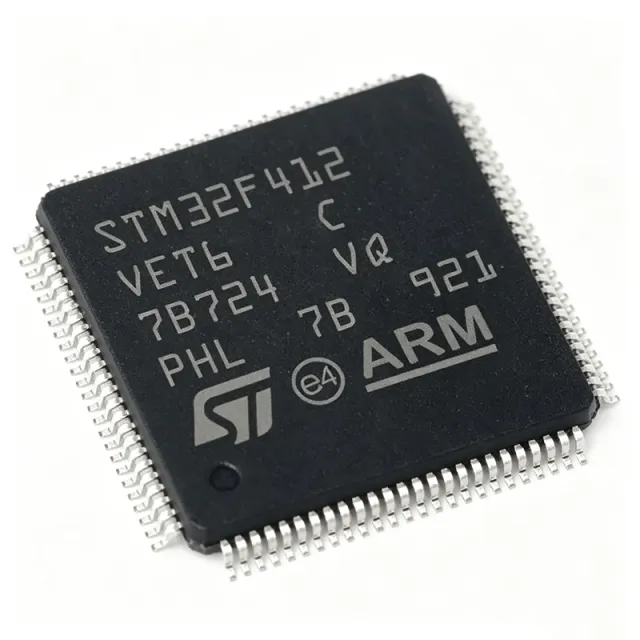
STM32F412VET6 - 512KB Flash ARM Cortex-M4F MCU | STMicroelectronics
STM32F412VET6

STM32F412VET6 - 512KB Flash ARM Cortex-M4F MCU | STMicroelectronics

The STM32F412VET6 is a high-performance ARM Cortex-M4F based microcontroller from STMicroelectronics, featuring a 32-bit core with FPU, running at up to 100 MHz. It integrates 512 KB of Flash memory and 256 KB of SRAM, making it suitable for a wide range of embedded applications. The device is housed in a 100-pin LQFP package (14x14 mm) and operates over a supply voltage range of 1.7V to 3.6V. What is a microcontroller? A microcontroller (MCU) is a compact integrated circuit designed to govern a specific operation in an embedded system. It contains a processor core, memory (Flash and SRAM), and programmable input/output peripherals on a single chip. Microcontrollers are the brains of countless electronic devices, from automotive engine control units to IoT sensors and consumer electronics. The STM32F412VET6 belongs to the STM32F4 series, which is part of the broader STM32 family of 32-bit ARM Cortex-M based MCUs, positioned between the value-line STM32F0/F1 series and the high-performance STM32F7/H7 series. Key features of the STM32F412VET6 include a 100 MHz ARM Cortex-M4F core with DSP instructions and a floating-point unit (FPU), 512 KB of Flash memory, 256 KB of SRAM, and a comprehensive set of peripherals. It offers multiple communication interfaces: 3x I2C, 4x USART, 5x SPI, 2x CAN, 1x SDIO, 1x USB 2.0 OTG FS, and 1x FMC (Flexible Memory Controller) for external memory expansion. The device also includes a 12-bit ADC with up to 16 channels, a 12-bit DAC, advanced timers, and a true random number generator (TRNG). The operating temperature range is -40°C to +85°C, and it is available in a 100-pin LQFP package. Technically, the STM32F412VET6 is built on a 90nm process technology, offering a good balance between performance and power consumption. The Cortex-M4F core with FPU accelerates mathematical computations, making it ideal for digital signal processing (DSP) applications. The device supports a wide range of clock sources, including an external crystal, internal RC oscillators, and a PLL for frequency multiplication. It also features a comprehensive power management system with multiple low-power modes (Sleep, Stop, Standby) to optimize energy consumption in battery-powered applications. Typical applications include industrial control systems, motor drives, IoT gateways, consumer electronics, and medical devices. The rich peripheral set and large memory make it suitable for applications requiring complex algorithms, such as predictive maintenance, real-time data acquisition, and human-machine interfaces (HMI). The USB OTG and CAN interfaces enable connectivity in industrial and automotive environments. When designing with this device, ensure proper decoupling of the power supply pins with 100nF capacitors placed close to each VDD pin, and a 4.7uF bulk capacitor. The VDDA pin should be connected to a clean analog supply, and the VREF+ pin should be decoupled with a 1uF capacitor. For reliable operation, the NRST pin should have a 100nF capacitor to ground. The device supports in-circuit programming and debugging via SWD or JTAG interfaces.

USD $7.95 اتصل بنا
STM32F412ZGJ6 - 100MHz Cortex-M4 MCU | STMicroelectronics
STM32F412ZGJ6

STM32F412ZGJ6 - 100MHz Cortex-M4 MCU | STMicroelectronics

STMicroelectronics STM32F412ZGJ6 is an Arm Cortex-M4 32-bit RISC microcontroller with a 100 MHz maximum operating frequency, 1 MB (1M x 8) embedded Flash memory, and a 144-pin UFBGA package measuring 10 mm x 10 mm. The device provides 125 DMIPS computational performance and includes an FPU and DSP instructions for responsive control, signal-processing, and communications workloads. A microcontroller is a programmable semiconductor that integrates a processor core, memory, peripherals, and communication interfaces onto one device. The STM32F4 family belongs to the embedded-processing hierarchy of Arm Cortex-M microcontrollers, 32-bit microcontrollers, and general-purpose semiconductor devices. STM32F412 devices combine real-time control capability with USB connectivity, direct-memory-access support, and a substantial SRAM allocation for data-intensive embedded systems. The STM32F412ZGJ6 combines a 100 MHz Cortex-M4 core with 1 MB of Flash and 256 KB of SRAM. Its single-precision FPU accelerates floating-point calculations, while DSP instructions support common filtering and transform workloads. USB OTG FS provides a full-speed USB interface, and the STM32F4 peripheral set supports practical industrial, consumer, communications, and instrument-control designs. The 144-pin UFBGA package also exposes substantially more I/O than smaller packages in the family. The STM32F412 product family is designed around an Arm Cortex-M4 processor operating up to 100 MHz and delivering 125 DMIPS. This performance level is suitable for control loops that need deterministic peripheral access without moving routine computation to an external processor. The 256 KB SRAM helps retain working data locally, while the 1 MB Flash supports bootloader code, application firmware, configuration data, and update mechanisms. Typical uses include industrial data acquisition, USB-connected instruments, sensor-hub controllers, building automation modules, compact gateways, and embedded human-interface devices. USB OTG FS is particularly useful for a USB peripheral interface, while the large I/O count supports simultaneous communication and control functions. Engineers can pair the device with USB transceivers, Ethernet interfaces, serial transceivers, and precision analog front ends when the system requires more than its integrated peripherals provide. Board design should preserve the voltage and decoupling requirements defined by STMicroelectronics, use the correct UFBGA land pattern, and validate high-speed signal routing against the manufacturer reference layout. Firmware replacement requires confirmation of memory map, peripheral compatibility, boot behavior, and the exact device order code. This page combines core specifications, sourcing guidance, drop-in alternatives, and design-focused comparisons to support component selection and PCB planning.

طلب عرض سعر اتصل بنا
STM32F412ZGT6 - 1MB Flash, 100MHz ARM Cortex-M4F MCU | STMicroelectronics
STM32F412ZGT6

STM32F412ZGT6 - 1MB Flash, 100MHz ARM Cortex-M4F MCU | STMicroelectronics

The STMicroelectronics STM32F412ZGT6 is a high-performance ARM Cortex-M4F based microcontroller with floating-point unit (FPU) running at up to 100 MHz. It features 1 MB of flash memory and 256 KB of SRAM, making it suitable for a wide range of embedded applications requiring substantial code and data storage. The device is housed in a 144-pin LQFP package (LQFP144) with a 20x20 mm body and 0.5 mm pitch, offering extensive GPIO and peripheral connectivity. What is an ARM Cortex-M4F microcontroller? It is a 32-bit processor core designed for embedded systems, combining the ARM Cortex-M4 core with a hardware floating-point unit (FPU) that accelerates single-precision floating-point math. This makes it ideal for digital signal processing (DSP) and control applications. In the system hierarchy, the STM32F412ZGT6 sits as a microcontroller unit (MCU) within the broader category of embedded processors, which also includes microprocessors (MPUs) and digital signal processors (DSPs). The Cortex-M4F core is a member of the ARM Cortex-M family, which is widely used in industrial, consumer, and automotive applications. Key features of the STM32F412ZGT6 include a 100 MHz ARM Cortex-M4F core with FPU, 1 MB of flash memory, 256 KB of SRAM, and a comprehensive set of peripherals. It supports multiple communication interfaces including USART, SPI, I2C, USB OTG FS, SDIO, and CAN. The device also includes advanced analog peripherals such as three 12-bit ADCs, two 12-bit DACs, and multiple timers. The STM32F412ZGT6 operates from a 1.7V to 3.6V power supply and is specified for the industrial temperature range of -40°C to +85°C. Technically, the STM32F412ZGT6 is built on STMicroelectronics' advanced 90nm process technology, which balances performance and power efficiency. The Cortex-M4F core includes a single-precision FPU and DSP instructions, enabling efficient execution of complex algorithms. The device features a memory protection unit (MPU), a nested vectored interrupt controller (NVIC), and a flexible clock tree with a PLL that can generate frequencies up to 100 MHz. The STM32F412ZGT6 also includes a true random number generator (RNG) and a cryptographic acceleration cell for AES-256, enhancing security for connected applications. Typical applications include industrial control systems, motor control, consumer electronics, IoT gateways, and audio processing. The combination of high clock speed, large memory, and rich peripherals makes it a versatile choice for applications requiring real-time performance and connectivity. For example, in motor control, the FPU accelerates PID loops, while the advanced timers generate precise PWM signals. When designing with the STM32F412ZGT6, ensure adequate decoupling on the power supply pins (VDD, VDDA) with 100nF and 4.7uF capacitors. The device supports multiple boot modes via BOOT0 and BOOT1 pins, which must be configured correctly for programming. Also, consider the thermal characteristics: the LQFP144 package has a thermal resistance (theta_JA) of approximately 40°C/W, so for high-current applications, a heatsink or airflow may be necessary.

طلب عرض سعر اتصل بنا
STM32F413CGU6 - 1.5MB Flash ARM Cortex-M4F MCU | STMicroelectronics
STM32F413CGU6

STM32F413CGU6 - 1.5MB Flash ARM Cortex-M4F MCU | STMicroelectronics

The STMicroelectronics STM32F413CGU6 is a high-performance 32-bit microcontroller based on the ARM Cortex-M4F core with floating-point unit (FPU), operating at up to 100 MHz. It is part of the STM32F4 series, offering a rich set of peripherals and connectivity options. The device is housed in a 48-pin UFQFPN (UFQFPN-48) package, providing a compact solution for space-constrained applications. What is a microcontroller? A microcontroller (MCU) is a compact integrated circuit designed to govern a specific operation in an embedded system. It integrates a processor core, memory (Flash and RAM), and programmable input/output peripherals on a single chip. Microcontrollers are the brains of countless electronic devices, from automotive engine control units to IoT sensors and consumer electronics. The STM32F413CGU6 belongs to the STM32F4 family, which is known for its balance of performance, power efficiency, and peripheral integration, making it a popular choice for industrial, consumer, and IoT applications. Key features of the STM32F413CGU6 include 1.5 MB of Flash memory and 320 KB of SRAM, providing ample storage for complex firmware. It supports a wide supply voltage range of 1.7V to 3.6V, making it suitable for battery-powered devices. The MCU includes a comprehensive set of peripherals: multiple USARTs, SPIs, I2Cs, a USB OTG FS, a CAN controller, a 12-bit ADC with 16 channels, and advanced timers. It also features a true random number generator (RNG), a cryptographic acceleration cell (AES), and a real-time clock (RTC). Technically, the STM32F413CGU6 leverages the ARM Cortex-M4F core with DSP instructions and a single-precision FPU, enabling efficient execution of signal processing algorithms. The device operates over a temperature range of -40°C to +85°C (industrial grade) and is available in a UFQFPN-48 package with a 7x7 mm footprint. The MCU supports various low-power modes, including Sleep, Stop, and Standby, to optimize energy consumption in battery-operated applications. Typical applications include industrial control systems, motor drives, IoT gateways, smart home devices, and portable medical equipment. The rich connectivity options and high memory capacity make it ideal for applications requiring complex user interfaces, communication protocols, and data logging. When designing with this MCU, ensure proper decoupling of the power supply pins with 100nF capacitors placed close to each VDD pin. The VDDA pin should be connected to a clean analog supply, and the VREF+ pin should be decoupled with a 1uF capacitor for accurate ADC conversions. Additionally, the BOOT0 pin configuration must be set correctly for the desired boot mode (Flash, System memory, or SRAM).

طلب عرض سعر اتصل بنا
STM32F413CHU6 - 100MHz Cortex-M4 MCU, 1.5MB Flash | STMicroelectronics
STM32F413CHU6

STM32F413CHU6 - 100MHz Cortex-M4 MCU, 1.5MB Flash | STMicroelectronics

STMicroelectronics STM32F413CHU6 is a 32-bit Arm Cortex-M4 microcontroller with a 100 MHz operating frequency, 1.5 MB of Flash memory, and a 48-pin UFQFPN package measuring 7 mm by 7 mm. It belongs to the STM32F4 series and combines a high-performance RISC core with integrated microcontroller resources for compact embedded control systems. A microcontroller is a semiconductor device that integrates a CPU core, Flash program memory, RAM, peripherals, and communication interfaces onto one package. STM32 microcontrollers are widely used as the central controller in industrial equipment, consumer products, communications equipment, medical devices, and sensor-driven systems. The STM32F413xG/H family is based on the Arm Cortex-M4 32-bit RISC core and operates at up to 100 MHz. The STM32F413CHU6 provides 1.5 MB of Flash for application firmware, while its 100 MHz maximum core frequency supports timely control-loop and signal-processing tasks. Its 48-pin UFQFPN package offers a compact surface-mount option for designs requiring numerous mixed-signal and digital connections without using a larger leaded package. The -6 temperature-grade suffix identifies the specified industrial temperature grade. The Arm Cortex-M4 architecture provides a 32-bit processing path with floating-point-oriented performance characteristics suited to control, communications, and signal-processing workloads. Its architecture also supports an interrupt-driven embedded software model, allowing firmware to respond to external events through peripherals rather than continuous polling. Exact RAM capacity, peripheral set, electrical limits, and performance figures must be confirmed from the manufacturer datasheet before release. Typical uses include industrial control modules, connected sensor nodes, compact communications equipment, audio and interface controllers, and general-purpose embedded products. The 100 MHz Cortex-M4 core is particularly relevant when a design must combine protocol handling, real-time control, and local data processing on a single device rather than divide those tasks across multiple chips. Designers should confirm the exact UFQFPN48 land pattern, exposed-pad requirements, pin multiplexing, decoupling strategy, clock configuration, and operating-voltage limits in the STM32F413xG/H manufacturer datasheet. Firmware should also be validated against the device revision and the STM32CubeMX configuration database before production programming. This product record combines the manufacturer device description, an official datasheet link, package and memory details, sourcing information, and a focused replacement assessment. It also highlights the engineering checks required when comparing same-package alternatives, including memory capacity, peripheral equivalence, firmware compatibility, and electrical validation.

طلب عرض سعر اتصل بنا
STM32F413RGT6 - 100MHz Cortex-M4 MCU 1MB Flash 64-LQFP | ST
STM32F413RGT6

STM32F413RGT6 - 100MHz Cortex-M4 MCU 1MB Flash 64-LQFP | ST

The STMicroelectronics STM32F413RGT6 is a high-performance Arm Cortex-M4 32-bit RISC microcontroller with FPU and DSP instructions, operating at up to 100 MHz and delivering 125 DMIPS, integrated with 1 MB of Flash memory and housed in a 64-pin LQFP (10x10 mm) package. Key headline parameters include 1 MB Flash, 256 KB SRAM, 100 MHz CPU speed, and 64-pin LQFP surface-mount packaging. A microcontroller (MCU) is a single-chip computer that integrates a CPU core, memory (Flash for code, SRAM for data), and programmable peripherals on one die. The Arm Cortex-M4 core specifically adds a single-precision floating-point unit (FPU) and DSP extensions, enabling efficient handling of motor-control loops, audio processing, and digital-filter math. Within the broader taxonomy, the STM32F413RGT6 is a 32-bit MCU -> Arm Cortex-M4 MCU -> STM32 family -> STM32F4 high-performance access line -> power management-aware connected MCU. The STM32F413RGT6 features a rich peripheral set including USB 2.0 full-speed with on-chip PHY, CAN 2.0B, three SPIs, three I2C, four USART plus two UARTs, one SAI (serial audio interface), one SDMMC, and a 12-bit ADC with up to 16 channels. The device also integrates a real-time clock, two 12-bit DACs, a 16-bit timer with motor-control PWM capability, and an independent watchdog. Internal regulators and power-saving Run/Stop/Standby/Shutdown modes support portable and battery-powered designs. Architecturally, the Cortex-M4F core couples a 3-stage pipeline with branch prediction to the STM32 adaptive real-time (ART) accelerator, which pre-fetches and caches instructions from Flash - this is what allows zero-wait-state execution from on-chip memory at 100 MHz. An additional SRAM-backed cache bank accelerates code executed from external memories via the FSMC interface, expanding addressable storage for graphics or data-logging firmware. Typical applications include industrial motor control (BLDC/PMSM FOC drives), home-automation gateways with USB-CDC and CAN connectivity, audio peripherals leveraging the SAI and dedicated I2S paths, USB HID/COM devices, and small-form-factor HMI panels with TFT displays driven via the integrated LTDC-free SPI/8080 interface. The wide 1.71 V to 3.6 V supply range also makes it well-suited to coin-cell or Li-ion powered IoT nodes. Designers should plan PCB decoupling around the multiple VDD/VSS pairs (especially the dedicated VDDA/VSSA for the ADC), keep the NRST reset trace short with the recommended 10 kΩ pull-up, and ensure HSE crystal traces are length-matched and guarded by a ground ring. For USB designs, the D+/D- pair must be 90-ohm differential and routed within 8 mm of the connector. This page combines distributor pricing, pin-compatible drop-in alternatives, and practical design notes not found on a single distributor page - use the comparison table and design_notes sections below to shortlist alternatives and avoid common pitfalls.

طلب عرض سعر اتصل بنا
STM32F413RHT6 - 1.5MB Flash ARM Cortex-M4F MCU | STMicroelectronics
STM32F413RHT6

STM32F413RHT6 - 1.5MB Flash ARM Cortex-M4F MCU | STMicroelectronics

The STMicroelectronics STM32F413RHT6 is a high-performance ARM Cortex-M4F based microcontroller with floating-point unit (FPU) running at up to 100 MHz. It features 1.5 MB of Flash memory and 320 KB of SRAM, making it suitable for complex applications requiring substantial code and data storage. The device is housed in a 64-pin LQFP package (10x10 mm) and operates over a supply voltage range of 1.7V to 3.6V. What is an ARM Cortex-M4F microcontroller? It is a 32-bit processor core designed for embedded systems, combining the efficient ARM Cortex-M4 core with a hardware floating-point unit (FPU) that accelerates single-precision floating-point arithmetic. This makes it ideal for digital signal processing (DSP) and control applications. In the system hierarchy, a microcontroller (MCU) integrates a processor core, memory, and peripherals on a single chip, serving as the 'brain' of embedded systems. The STM32F413 series sits in the mid-to-high performance range of ST's STM32 portfolio, offering a balance of performance, memory, and peripheral integration. Key features include a rich set of communication interfaces: 6x SPI, 3x I2C, 4x USART, 2x UART, 2x CAN, 1x SDMMC, 1x USB OTG FS, and 1x SAI. It also integrates a 12-bit ADC with up to 16 channels, a 12-bit DAC with 2 channels, advanced timers, and a true random number generator (TRNG). The device supports a wide range of power-saving modes, including Sleep, Stop, and Standby, with typical power consumption as low as 1.8 uA in Standby mode. The operating temperature range is -40C to +85C, making it suitable for industrial environments. Technically, the STM32F413RHT6 is built on a 90nm process technology, offering a good balance of performance and power efficiency. The Cortex-M4F core with FPU and DSP instructions enables efficient execution of complex algorithms, such as FFTs and control loops. The memory architecture includes a 1.5MB Flash with read-while-write support and 320KB SRAM, allowing for large data buffers and multitasking. The device also features a memory protection unit (MPU) for enhanced security and reliability. Typical applications include industrial control systems, motor control, medical devices, consumer electronics, and IoT gateways. The rich peripheral set and high memory capacity make it suitable for applications requiring connectivity, such as smart home hubs and industrial automation. The USB OTG FS interface enables direct connection to PCs or mobile devices for data transfer and firmware updates. When designing with this MCU, ensure proper decoupling of the power supply pins with 100nF capacitors placed close to each VDD pin. The VDDA pin should be connected to a clean analog supply, and the VREF+ pin should be decoupled with a 1uF capacitor. For reliable operation, the NRST pin should have a 100nF capacitor to ground. The device supports SWD and JTAG debugging, with SWD recommended for production to save pins.

طلب عرض سعر اتصل بنا
STM32F413VGH6 - 32-Bit 100MHz Cortex-M4 MCU | STMicroelectronics
STM32F413VGH6

STM32F413VGH6 - 32-Bit 100MHz Cortex-M4 MCU | STMicroelectronics

STMicroelectronics STM32F413VGH6 is a 32-bit Arm Cortex-M4 microcontroller operating at up to 100 MHz, with 1 MB of Flash memory and a 100-UFBGA package measuring 7 x 7 mm. It combines the Cortex-M4 processor core with a substantial collection of embedded peripherals for compact control and signal-processing systems. A microcontroller is a semiconductor device that integrates a processor core, program memory, data memory, and peripherals such as timers, communication interfaces, and analog inputs on one package. The STM32F413 belongs to the STM32F4 family of Arm Cortex-M4 devices, providing a compact platform for industrial controls, communications equipment, audio and digital signal processing, and connected embedded products. The STM32F413VGH6 operates at a maximum frequency of 100 MHz and includes 1 MB of Flash organized as 1M x 8 bits. Its 32-bit Arm Cortex-M4 core supports compact real-time control while the higher operating frequency provides additional processing margin for communications, control loops, and DSP-oriented firmware. The device is identified with a 3.3 V supply rating by its distributor listing. The STM32F413xG/H device family is documented in the STMicroelectronics manufacturer datasheet. That datasheet is the controlling reference for peripheral availability, electrical limits, pin multiplexing, clock-tree configuration, electrical characteristics, package dimensions, and programming considerations. Cortex-M4 programming and instruction-set guidance is referenced separately through PM0214 in the manufacturer documentation. Typical uses include industrial automation modules, connected sensor equipment, audio interfaces, motor and motion-control systems, and compact embedded controllers. The combination of 100 MHz processing, 1 MB Flash, and a 7 x 7 mm UFBGA package supports designs that require substantial firmware and peripheral integration without allocating substantial board area. When laying out a new board, use the manufacturer pinout, package drawing, and land pattern to assign every ball and confirm that exposed-pad and thermal requirements are met. Place decoupling capacitors close to the supply pins, route clocks away from sensitive analog inputs, and follow the recommended programming and debug interface connections before committing the PCB layout. This product page combines the exact manufacturer and distributor identifiers with practical design guidance, package-focused comparison criteria, and an explicit review of drop-in replacement constraints. It helps engineers distinguish genuine pin-compatible substitutions from parts that merely use similar microcontroller specifications.

طلب عرض سعر اتصل بنا
STM32F413VGT3 - 100MHz Cortex-M4 1MB MCU | STMicroelectronics
STM32F413VGT3

STM32F413VGT3 - 100MHz Cortex-M4 1MB MCU | STMicroelectronics

The STMicroelectronics STM32F413VGT3 is a 32-bit Arm Cortex-M4 microcontroller operating up to 100 MHz, with 1 MB of Flash memory and 81 I/O pins, packaged in a 100-pin LQFP measuring 14 x 14 mm. It belongs to STMicroelectronics’ STM32F4 high-performance access line and combines an Arm Cortex-M4 core with DSP and floating-point capabilities in a compact surface-mount package. A microcontroller is a programmable system-on-chip that integrates a processor core, memory, peripherals, and communication interfaces onto one device. The STM32F413VGT3 uses a 32-bit RISC architecture to execute control and signal-processing tasks. Within the product hierarchy, it can be described as an Arm Cortex-M4 MCU, a 32-bit microcontroller, an embedded processor, and a semiconductor designed for real-time embedded systems. The headline configuration is a 100 MHz Arm Cortex-M4 processor, 1 MB of Flash memory, and a 100-LQFP package. The device also includes DSP instructions and an FPU according to the manufacturer’s product description. Its 81 I/O positions make it suitable for systems that need multiple control signals, communication ports, analog interfaces, and debug or clock connections without moving to a larger package. The STM32F413xG/H family combines high processing speed with extensive peripheral integration for embedded control. Firmware can use the DSP and FPU resources for filtering, control calculations, and other floating-point workloads, while the Flash capacity supports a more substantial application code and configuration image than smaller microcontroller variants. The exact peripheral configuration, voltage limits, memory-map details, and electrical operating limits should be confirmed in the manufacturer datasheet before schematic sign-off. Typical applications include industrial monitoring, connected sensor nodes, motor and motion-control equipment, medical instrumentation, consumer interfaces, and compact embedded gateways. The 100-pin package is especially useful when a design requires more I/O capacity than a 48-pin or 64-pin MCU provides. It also suits mixed-signal products where digital control, serial communications, timers, and analog functions must coexist on one board. For new hardware, preserve the package footprint and verify every power, ground, debug, clock, and peripheral connection against the STM32F413xG/H datasheet. Boot configuration, clock planning, decoupling, and firmware support for the selected peripherals are critical to a reliable design. A working prototype should also be tested across the intended supply voltage and ambient-temperature range. This page combines the manufacturer family specifications, package information, drop-in ordering variants, application guidance, and practical design considerations into a concise engineering reference for evaluating the STM32F413VGT3 on an embedded-control board.

طلب عرض سعر اتصل بنا
STM32F413VGT6 - 1MB Flash, 100MHz ARM Cortex-M4F MCU | STMicroelectronics
STM32F413VGT6

STM32F413VGT6 - 1MB Flash, 100MHz ARM Cortex-M4F MCU | STMicroelectronics

The STMicroelectronics STM32F413VGT6 is a high-performance ARM Cortex-M4F based microcontroller with floating-point unit (FPU) and DSP instructions, operating at up to 100 MHz. It features 1 MB of flash memory and 320 KB of SRAM, making it suitable for complex embedded applications requiring substantial code and data storage. The device is housed in a 100-pin LQFP package (LQFP100) with a 14x14 mm body and 0.5 mm pitch, providing a compact yet accessible footprint for PCB design. What is a microcontroller? A microcontroller (MCU) is a compact integrated circuit designed to govern a specific operation in an embedded system. It integrates a processor core, memory (flash and SRAM), and programmable input/output peripherals on a single chip. Microcontrollers are the backbone of embedded systems, ranging from simple household appliances to complex industrial automation. The STM32F413VGT6 belongs to the STM32F4 series, which is part of the broader STM32 family of 32-bit ARM Cortex-M based MCUs. This hierarchy places it within the high-performance segment of the STM32 portfolio, offering a balance of processing power, memory, and peripheral integration. Key features of the STM32F413VGT6 include a 100 MHz ARM Cortex-M4F core with FPU, 1 MB flash, 320 KB SRAM, and a comprehensive set of peripherals: multiple 12-bit ADCs, DACs, timers, communication interfaces (USART, SPI, I2C, CAN, USB OTG, SDIO), and a cryptographic acceleration unit. The device supports a wide supply voltage range of 1.7V to 3.6V and operates over a temperature range of -40°C to +85°C. It also includes a true random number generator (TRNG) and a real-time clock (RTC) for secure and time-sensitive applications. Technically, the STM32F413VGT6 is built on a 90nm process technology, enabling high performance with low power consumption. The Cortex-M4F core includes a single-precision FPU and DSP instructions, accelerating mathematical computations for signal processing and control algorithms. The device features a memory protection unit (MPU) for enhanced security and reliability. With up to 100 MHz clock speed, it can execute complex algorithms efficiently, making it ideal for real-time control and data acquisition. Typical applications include industrial control systems, motor drives, medical devices, consumer electronics, and IoT gateways. The rich peripheral set and large memory make it suitable for applications requiring connectivity (USB, CAN, Ethernet via external PHY) and advanced user interfaces. The cryptographic unit and TRNG enable secure communication protocols, essential for IoT security. When designing with this device, ensure proper decoupling of the power supply pins with 100nF capacitors placed close to each VDD pin, and a 4.7uF bulk capacitor. The VDDA pin requires a dedicated analog supply with filtering to maintain ADC accuracy. The BOOT0 pin configuration determines the boot source; a pull-down resistor is recommended for normal flash boot. For high-speed USB, a 22-ohm series resistor on the USB D+ and D- lines is required.

طلب عرض سعر اتصل بنا
STM32F413ZGT6 - 100MHz Cortex-M4 MCU | STMicroelectronics
STM32F413ZGT6

STM32F413ZGT6 - 100MHz Cortex-M4 MCU | STMicroelectronics

STMicroelectronics STM32F413ZGT6 is an ARM Cortex-M4 32-bit RISC microcontroller operating up to 100 MHz, with 1 MB of flash organized as 1M x 8 bits and a 144-pin LQFP package measuring 20 x 20 mm. The device belongs to STMicroelectronics' STM32F4 high-performance access line and combines a DSP and FPU with extensive connectivity and mixed-signal resources. A microcontroller is a programmable semiconductor that integrates a processor core, memory, peripherals, and interface circuitry on one integrated circuit. The STM32F4 family follows the hierarchy MCU -> embedded processor -> real-time control platform -> semiconductor. Its ARM Cortex-M4 core executes instructions from embedded flash and can service interrupts and peripheral events without a separate external processor, making the STM32F413ZGT6 suitable for responsive control, communication, and data-acquisition systems. Three principal features define the part: a 100 MHz Cortex-M4 core, 1 MB of flash memory, and a 144-LQFP package with a 20 x 20 mm body. The Arm Cortex-M4 core includes DSP instructions and a single-precision floating-point unit, while the STM32F413xG/H family is documented with up to 125 DMIPS, 320 KB of RAM, USB full-speed OTG, one ADC, two DACs, and two DFSDM channels. These resources support mixed signal, control, storage, and communications-oriented designs. The STM32F413ZG product family combines an ARM Cortex-M4 32-bit RISC processor with high-performance access-line positioning. Its interrupt-driven architecture allows timing-critical activities to run concurrently with communications and control tasks. The family documentation identifies USB full-speed OTG, analog conversion resources, digital filter sampling, and DSP/FPU processing as defining capabilities. Firmware should use the STM32 peripheral architecture and appropriate clock, memory, and low-power initialization sequence from the manufacturer reference material. Typical uses include industrial control and factory automation, USB-connected data loggers, audio and signal-processing modules, medical monitoring equipment, consumer accessories, and communications infrastructure. The 1 MB flash capacity gives embedded software room for application code, protocol stacks, boot functions, and configuration data, while the LQFP package supports conventional inspection, assembly, and rework methods. PCB design should preserve clean supply distribution, short high-current return paths, and controlled impedance for USB and high-speed signals. Place decoupling capacitors close to each supply pin, keep analog and digital return currents separated where practical, and verify oscillator, reset, boot, and programming connections against the pin-description table in the manufacturer datasheet before layout release. This product data combines the manufacturer product family specifications with practical engineering guidance, compatible ordering variants, and a structured comparison of memory and package options. It is intended to accelerate part identification, PCB planning, firmware preparation, and sourcing decisions without replacing the complete manufacturer datasheet.

طلب عرض سعر اتصل بنا
STM32F413ZHJ6 - 100MHz Cortex-M4 MCU, 1.5MB Flash | STMicroelectronics
STM32F413ZHJ6

STM32F413ZHJ6 - 100MHz Cortex-M4 MCU, 1.5MB Flash | STMicroelectronics

The STMicroelectronics STM32F413ZHJ6 is a high-performance ARM Cortex-M4 32-bit RISC microcontroller operating at up to 100 MHz with single-precision FPU and DSP instructions, integrating 1.5 MB of Flash and 320 KB of SRAM in a 144-ball UFBGA (10x10 mm) package. It belongs to the STM32F4 access-line family, delivering 125 DMIPS / 273 CoreMark while featuring crypto/hash peripherals, a USB 2.0 OTG full-speed controller, a CAN 2.0B interface and an external memory controller for SRAM, NOR/NAND and SDRAM. A microcontroller (MCU) is a system-on-chip that integrates a CPU core, program and data memory, peripherals and I/O on a single die. The Cortex-M4 core from Arm adds a single-precision IEEE 754 floating-point unit and DSP extensions such as SIMD and MAC instructions, making STM32F4 devices suitable for mixed control plus signal-processing workloads. Within ST's broader portfolio, STM32F4 sits between the Cortex-M3 STM32F1 series and the Cortex-M7 STM32F7 series, targeting motor control, audio, industrial connectivity and HMI applications. Key features of the STM32F413ZHJ6 include a 12-bit ADC sampling up to 2.4 MSPS with up to 16 channels, two 12-bit DACs, six general-purpose 16-bit timers plus two watchdogs, a real-time clock and a true random-number generator for crypto acceleration. Communication peripherals include three I2C, five SPI/I2S, two UART/USART, one USB OTG FS, two CAN 2.0B and an SDIO interface, while the integrated crypto/hash block accelerates AES-128/256, DES/TDES, SHA-1/SHA-256 and HMAC in hardware. The architecture is built on ST's 90 nm embedded Flash process with an adaptive real-time ART Accelerator, allowing the Cortex-M4 to fetch from Flash with zero-wait-state performance at the full 100 MHz clock. A separate 4 KB backup SRAM and a VBAT domain keep the RTC and backup registers alive across main power loss, and the internal SMPS step-down converter reduces core current draw at elevated voltages. Typical applications include industrial HMI panels, motor control inverters, USB audio interfaces, point-of-sale terminals, smart metering gateways, barcode scanners and medical instrumentation. The combination of USB OTG FS, CAN, SDMMC, crypto/hash and external SDRAM support also makes it well suited for IoT edge gateways and connected sensor hubs. When designing with this part, plan for a 3.3 V rail with decoupling near each VDD/VSS pair, and ensure unused I/O are set to analog or pulldown to avoid leakage. Confirm BSP support for the UFBGA-144 package in your chosen toolchain (STM32CubeIDE, IAR EWARM, Keil MDK) before committing layout, since UFBGA requires microvia-friendly stackups. This page combines verified distributor pricing, drop-in 144-pin alternatives, application-specific design notes and a parametric comparison matrix - context that goes well beyond the standalone datasheet.

طلب عرض سعر اتصل بنا
STM32F413ZHT3 - 100MHz Cortex-M4 MCU 1.5MB Flash 144-LQFP | STMicroelectronics
STM32F413ZHT3

STM32F413ZHT3 - 100MHz Cortex-M4 MCU 1.5MB Flash 144-LQFP | STMicroelectronics

The STMicroelectronics STM32F413ZHT3 is a high-performance ARM Cortex-M4 32-bit RISC microcontroller with FPU and DSP extensions, operating at up to 100 MHz and delivering 125 DMIPS, housed in a 144-pin LQFP (20x20 mm) package. The device integrates 1.5 MB of Flash, 320 KB of SRAM, and a rich peripheral set including USB OTG Full-Speed, one 12-bit ADC, two 12-bit DACs, two DFSDM digital filters for sigma-delta modulation, multiple timers, and standard communication interfaces (USART, SPI, I2C, CAN). What is a Cortex-M4 microcontroller? A Cortex-M4 microcontroller is a 32-bit RISC processor core designed by Arm Holdings for embedded applications, featuring a single-precision floating-point unit (FPU) and Digital Signal Processing (DSP) instructions. It sits within the broader taxonomy of microcontroller -> 32-bit MCU -> ARM Cortex-M family -> Cortex-M4 sub-family -> power management IC ecosystem. Cortex-M4 MCUs target applications requiring deterministic real-time control combined with signal processing, replacing combinations of 8/16-bit MCUs and external DSPs in compact BOMs. Key features of the STM32F413ZHT3 include 1.5 MB of embedded Flash with read-while-write support, 320 KB of SRAM (including 4 KB of backup SRAM), a 100 MHz Cortex-M4F core with single-precision FPU, and a low-power RTC with sub-second accuracy. The device also includes a 4 KB backup register area, a true random number generator (TRNG), and cryptographic acceleration supporting AES-256, plus a USB 2.0 Full-Speed On-The-Go controller with internal PHY. Architecturally, the STM32F413ZHT3 uses ST's 90 nm embedded Flash process, integrates an L1 cache to offset Flash wait-states at 100 MHz, and supports memory-mapped external memories through its Flexible Static Memory Controller (FSMC). The dual DFSDM blocks enable hardware sigma-delta demodulation for MEMS microphones and isolated current sensing, which is unusual in this MCU class. Typical applications include industrial motor control (BLDC/PMSM via timers + DFSDM), building automation HMI panels, USB-powered measurement instruments, audio front-ends (USB Audio + DACs), and IoT gateways using the integrated USB OTG plus CAN bus. The wide 1.7 V to 3.6 V supply range also suits battery-powered designs with direct Li-Ion cell connection. When designing with this part, consider that the 144-LQFP package has limited thermal headroom; at full 100 MHz operation with all peripherals active, expect around 120 mA core current. The DFSDM digital filter is a key advantage in audio and sensor applications but requires a separate sigma-delta modulator in the signal chain. This page synthesizes distributor pricing, drop-in same-package alternatives, and practical design notes not consolidated in the manufacturer datasheet. Engineers evaluating second sources for STMicroelectronics STM32F413ZHT3 should consider same-package and pin-compatible cross-references listed below.

طلب عرض سعر اتصل بنا
STM32F413ZHT6 - 100MHz Cortex-M4 MCU | STMicroelectronics
STM32F413ZHT6

STM32F413ZHT6 - 100MHz Cortex-M4 MCU | STMicroelectronics

The STMicroelectronics STM32F413ZHT6 is a 32-bit Arm Cortex-M4 microcontroller with up to 100 MHz operating frequency, up to 1.5 MB of Flash memory, and a 144-pin LQFP package measuring 20 mm by 20 mm. The device provides 125 DMIPS performance and includes an FPU according to the STM32F413xG and STM32F413xH family datasheet. A microcontroller is a programmable semiconductor that integrates a processor core, memory, peripherals, and communication interfaces onto one package. It sits within the embedded-controller hierarchy and executes firmware that senses inputs, controls outputs, and manages communications in industrial equipment, consumer products, sensors, and embedded systems. The STM32F413ZHT6 belongs to STMicroelectronics' STM32F4 access-line family and uses the Arm Cortex-M4 RISC architecture. Principal characteristics include a maximum core frequency of 100 MHz, a 32-bit architecture, up to 1.5 MB of Flash program memory, and 320 KB of SRAM. The 3.3 V operating point shown in distributor product records suits conventional embedded power systems. The LQFP-144 package provides a high pin count for systems requiring extensive peripheral routing while retaining through-hole lead geometry for assembly and inspection. The Cortex-M4 core uses the Arm Thumb instruction set and includes a single-precision floating-point unit, supporting digital signal processing and control calculations that benefit from hardware floating-point execution. At a maximum frequency of 100 MHz, the family is positioned for responsive control loops, communication gateways, human-interface systems, and connected embedded equipment without requiring a higher-performance application processor. Typical uses include industrial sensor hubs, building-control terminals, connected actuators, communications equipment, audio interfaces, and compact consumer-control products. Designers select this part when firmware needs more memory and I/O than a small microcontroller but the application can remain within a compact 100 MHz embedded-control architecture. A successful layout should preserve clean power distribution, provide the decoupling and external-component arrangements specified by the family datasheet, and route sensitive interfaces away from switching nodes. Confirm the complete pin assignments, electrical limits, clock requirements, and unused-pin treatment against the manufacturer datasheet before releasing the PCB. This page combines manufacturer specifications, package information, drop-in alternatives, comparison parameters, and practical engineering guidance to accelerate component selection and board-design review.

طلب عرض سعر اتصل بنا
STM32F415RGT6 - 168MHz ARM Cortex-M4F MCU, 1MB Flash | STMicroelectronics
STM32F415RGT6

STM32F415RGT6 - 168MHz ARM Cortex-M4F MCU, 1MB Flash | STMicroelectronics

The STMicroelectronics STM32F415RGT6 is a high-performance 32-bit microcontroller based on the ARM Cortex-M4F core with floating-point unit (FPU), operating at up to 168 MHz. It integrates 1 Mbyte of Flash memory and 192 Kbytes of SRAM, making it suitable for demanding applications that require both computational power and large memory footprint. The device is housed in a 64-pin LQFP package (LQFP64) with a 10x10 mm body and 0.5 mm pitch, offering a compact solution for space-constrained designs. What is an ARM Cortex-M4F microcontroller? It is a 32-bit processor core designed for embedded systems, featuring a floating-point unit (FPU) that accelerates mathematical operations, a digital signal processing (DSP) instruction set, and a memory protection unit (MPU). The Cortex-M4F is part of the ARM Cortex-M family, which includes the M0, M0+, M3, M4, and M7 cores, each targeting different performance and power trade-offs. In the system hierarchy, the STM32F415RGT6 sits as a microcontroller unit (MCU) within the broader category of embedded processors, which also includes microprocessors (MPUs), digital signal processors (DSPs), and application-specific integrated circuits (ASICs). Key features of the STM32F415RGT6 include a 168 MHz maximum clock speed, 1 Mbyte of Flash memory, 192 Kbytes of SRAM, and a comprehensive set of peripherals: three 12-bit ADCs, two DACs, a true random number generator (RNG), a camera interface, a crypto/hash processor, and multiple communication interfaces including USART, SPI, I2C, USB OTG FS/HS, CAN, and SDIO. The device also features a flexible memory controller (FMC) for external memory expansion, and a DMA controller with 16 channels. Technically, the STM32F415RGT6 is built on a 90nm process technology, offering a balance between performance and power consumption. It supports a wide supply voltage range of 1.8V to 3.6V, with a typical operating temperature range of -40°C to +85°C (industrial grade). The device includes a rich set of power-saving modes (Sleep, Stop, Standby) and a battery backup domain for RTC and backup registers, making it suitable for battery-powered applications. Typical applications include industrial control systems, motor drives, medical devices, consumer electronics, and IoT gateways. The combination of high clock speed, FPU, and large memory makes it ideal for real-time control, signal processing, and complex user interfaces. When designing with this MCU, ensure proper decoupling of the power supply pins (VDD, VDDA) with 100nF capacitors placed close to each pin, and a 4.7uF bulk capacitor. The VDDA pin must be connected to a clean analog supply to achieve the specified ADC accuracy. Also, consider the crystal oscillator layout for the HSE (high-speed external) clock to minimize noise and ensure reliable startup.

طلب عرض سعر اتصل بنا
STM32F415VGT6 - 168MHz ARM Cortex-M4F MCU, 1MB Flash | STMicroelectronics
STM32F415VGT6

STM32F415VGT6 - 168MHz ARM Cortex-M4F MCU, 1MB Flash | STMicroelectronics

The STMicroelectronics STM32F415VGT6 is a high-performance 32-bit ARM Cortex-M4F microcontroller with single-precision floating-point unit (FPU), operating at up to 168 MHz. It integrates 1 MB of Flash memory and 192 KB of SRAM, and is housed in a 100-pin LQFP package (LQFP100, 14x14 mm). The Cortex-M4F core delivers 1.25 DMIPS/MHz and supports a full DSP instruction set plus single-precision IEEE 754 floating-point arithmetic. What is an ARM Cortex-M4F microcontroller? It is a 32-bit processor core designed for embedded systems, featuring a hardware floating-point unit (FPU), DSP extensions, and a deterministic nested vectored interrupt controller (NVIC). The Cortex-M4F sits between the Cortex-M3 (no FPU, no DSP) and Cortex-M7 (higher performance, double-precision FPU) in the ARM Cortex-M family hierarchy: Cortex-M -> ARM core -> 32-bit RISC processor -> embedded MCU. Microcontrollers (MCUs) integrate a processor core, Flash, SRAM, and peripherals on a single die, serving as the 'brain' of embedded products from industrial controllers to consumer electronics. Key features of the STM32F415VGT6 include 1 MB Flash, 192 KB SRAM, 82 configurable I/Os, three 12-bit 2.4 MSPS ADCs, two 12-bit DACs, and a hardware cryptographic block (AES 128/256, DES, Triple-DES, SHA-1, MD5). Communication peripherals include USB 2.0 OTG Full-Speed and High-Speed with on-chip PHY, two CAN 2.0B interfaces, one SDIO, up to six USARTs, three SPIs, and two I2Cs. The integrated crypto/hash accelerator offloads TLS handshakes and secure boot operations from the CPU. Technically, the device is built on a 90 nm CMOS process, supports a 1.8 V to 3.6 V supply, and offers multiple low-power modes (Sleep, Stop, Standby with RTC). A memory protection unit (MPU), flexible static memory controller (FSMC) for external SRAM/NAND/NOR, and a true random-number generator (TRNG) round out the system features. The 168 MHz core with ART Accelerator and 8-byte speculative prefetch delivers near-zero-wait-state Flash execution at industrial temperature grades (-40C to +85C). Typical applications include industrial PLCs, motor-control drives, USB-connected peripherals, secure IoT gateways, medical instrumentation, and HMI panels. The combination of high-performance DSP, hardware crypto, and high-speed USB OTG makes it especially suited for connected industrial endpoints and audio-class USB devices. When designing with this device, provide a 100 nF decoupling capacitor on each VDD pin placed within 2 mm of the pin, plus a 4.7 uF bulk capacitor near the regulator. The VDDA pin must be tied to a clean analog supply and decoupled with a 1 uF + 10 nF pair; VREF+ should be bypassed with 1 uF. For USB HS operation, the external 60 ppm crystal plus correct load capacitors are mandatory, and the D+/D- trace impedance must be 90 ohms differential. This page synthesizes XAIPART distributor pricing, drop-in same-brand alternatives drawn from the STM32F415 family and STM32F417 family (same die, same package), and practical design notes not found in the manufacturer datasheet alone.

طلب عرض سعر اتصل بنا
STM32F415ZGT6 - 168MHz ARM Cortex-M4F MCU, 1MB Flash | STMicroelectronics
STM32F415ZGT6

STM32F415ZGT6 - 168MHz ARM Cortex-M4F MCU, 1MB Flash | STMicroelectronics

The STMicroelectronics STM32F415ZGT6 is a high-performance 32-bit microcontroller based on the ARM Cortex-M4F core with floating-point unit (FPU), operating at up to 168 MHz. It integrates 1 MB of Flash memory and 192 KB of SRAM, along with a rich set of peripherals including advanced connectivity, analog, and control interfaces. The device is housed in a 144-pin LQFP package (LQFP144, 20x20 mm), making it suitable for a wide range of industrial, consumer, and IoT applications. What is an ARM Cortex-M4F microcontroller? It is a 32-bit processor core designed for embedded systems that require a balance of performance, power efficiency, and advanced digital signal processing (DSP) capabilities. The 'F' suffix indicates the presence of a hardware floating-point unit, which accelerates mathematical operations for applications like motor control, audio processing, and sensor fusion. In the system hierarchy, a microcontroller (MCU) integrates the processor core, memory, and peripherals on a single chip, serving as the 'brain' of embedded systems. The STM32F4 series sits in the high-performance tier of ST's STM32 portfolio, positioned above the mainstream F1/F3 series and below the higher-end F7/H7 series. Key features of the STM32F415ZGT6 include a 168 MHz CPU with 210 DMIPS performance, 1 MB of Flash memory, 192 KB of SRAM, and a comprehensive set of peripherals: three 12-bit ADCs (up to 24 channels), two 12-bit DACs, advanced timers, and multiple communication interfaces (USART, SPI, I2C, USB OTG FS/HS, CAN, SDIO, and Ethernet MAC). The device also features a true random number generator (RNG), a cryptographic acceleration cell (AES, DES, 3DES), and a camera interface (DCMI). These features make it ideal for applications requiring high computational throughput and rich connectivity. From a technical architecture perspective, the STM32F415ZGT6 is built on a 90nm process technology, offering a good balance of performance and power consumption. The Cortex-M4F core includes a single-precision FPU and DSP instructions, enabling efficient execution of complex algorithms. The memory architecture uses a Harvard bus structure with separate instruction and data buses, allowing simultaneous access to Flash and SRAM. The device supports a wide supply voltage range of 1.8V to 3.6V, with a comprehensive clock management system including a PLL, multiple internal/external oscillators, and a real-time clock (RTC). Typical applications include industrial motor control, medical devices, consumer electronics, IoT gateways, and audio processing. The combination of high-speed ADC, advanced timers, and Ethernet MAC makes it particularly well-suited for real-time control and networked systems. For example, in a motor control application, the advanced PWM timers and high-resolution ADC enable precise current and speed regulation. When designing with this device, pay attention to power supply decoupling: place a 100nF capacitor close to each VDD pin and a 4.7uF bulk capacitor on the main supply. Also, ensure proper configuration of the boot pins (BOOT0 and BOOT1) to select the desired boot source. The device supports in-circuit programming and debugging via SWD and JTAG interfaces, facilitating development.

طلب عرض سعر اتصل بنا
STM32F417IET6 - 168MHz ARM Cortex-M4F MCU | STMicroelectronics
STM32F417IET6

STM32F417IET6 - 168MHz ARM Cortex-M4F MCU | STMicroelectronics

The STM32F417IET6 is a high-performance 32-bit microcontroller from STMicroelectronics, based on the ARM Cortex-M4F core with floating-point unit (FPU). It operates at up to 168 MHz, delivering 210 DMIPS and 1.25 DMIPS/MHz, making it suitable for demanding applications such as industrial control, motor drives, and IoT gateways. The device is housed in a 176-pin LQFP package (LQFP176) with a 24x24 mm body, providing ample GPIOs and connectivity options. What is a microcontroller? A microcontroller (MCU) is a compact integrated circuit designed to govern a specific operation in an embedded system. It integrates a processor core, memory (Flash and SRAM), and programmable input/output peripherals on a single chip. In the system hierarchy, an MCU sits between a microprocessor (which requires external memory and peripherals) and a system-on-chip (SoC) that may include more complex subsystems. The STM32F417IET6 belongs to the STM32F4 series, which is part of the broader STM32 family of 32-bit ARM Cortex-M based MCUs, known for their balance of performance, power efficiency, and rich peripheral sets. Key features include 512 KB of Flash memory and 192 KB of SRAM, a 168 MHz CPU with FPU, and a comprehensive set of peripherals: 3x 12-bit ADCs, 2x DACs, 12x general-purpose timers, 2x advanced-control timers, and a true random number generator (RNG). It also integrates a camera interface (DCMI), a crypto/hash processor for AES-256, 3DES, and SHA-1/SHA-256, and a DMA controller with 16 streams. Connectivity is extensive: 4x USARTs, 2x UARTs, 3x SPI, 3x I2C, 2x CAN, 1x USB 2.0 OTG FS/HS, 1x Ethernet MAC, and an SDIO interface. The STM32F417IET6 is built on a 90nm process technology, offering a good balance of speed and power consumption. It supports a wide supply voltage range of 1.8V to 3.6V and operates over a temperature range of -40°C to +85°C (industrial grade). The device includes a power-on reset, brown-out reset, and a programmable voltage detector, ensuring reliable operation in harsh environments. The advanced interrupt controller (NVIC) supports up to 82 interrupt vectors, enabling responsive real-time control. Typical applications include industrial automation (PLC, motor control), medical devices (patient monitoring), consumer electronics (smart home hubs), and communication infrastructure (Ethernet gateways). The combination of high-speed processing, rich analog peripherals, and robust connectivity makes it a versatile choice for complex embedded systems. When designing with this MCU, pay attention to the power supply decoupling: place 100nF capacitors close to each VDD pin and a 4.7uF bulk capacitor. The VDDA pin requires a dedicated analog supply with a ferrite bead to reduce noise. Also, configure the boot pins correctly to select the boot source (Flash, SRAM, or system memory) for programming and debugging.

طلب عرض سعر اتصل بنا
STM32F417IGH6 - 168MHz Cortex-M4 MCU | STMicroelectronics
STM32F417IGH6

STM32F417IGH6 - 168MHz Cortex-M4 MCU | STMicroelectronics

STMicroelectronics STM32F417IGH6 is a 32-bit Arm Cortex-M4 microcontroller operating up to 168 MHz, with 1 MB of flash memory, 192 KB of SRAM, and 140 I/O pins in a 201-UFBGA package measuring 10 mm by 10 mm. It belongs to the STM32F4 series of high-performance embedded microcontrollers. A microcontroller is a programmable system-on-chip that integrates a processor core, nonvolatile program memory, volatile data memory, peripherals, and communication interfaces into one component. The STM32F4 family sits within the hierarchy of embedded controller, 32-bit RISC microcontroller, Arm Cortex-M processor, and embedded semiconductor. It is used where deterministic control, real-time communication, graphical data handling, and multiple peripheral functions must operate within a compact device. The STM32F417IGH6 provides up to 168 MHz processing performance, 1 MB of flash storage, and 192 KB of SRAM. Its 140 I/O pins provide access to communications, timing, debugging, and application-specific functions. Published specifications identify Ethernet MAC and camera-interface capabilities, making the device applicable to connected industrial equipment, imaging systems, and network-aware embedded controllers. The Cortex-M4 processor core uses a 32-bit architecture and supports the Thumb instruction set. At its maximum 168 MHz operating frequency, the MCU is designed for computationally demanding control tasks that need more memory and peripheral capacity than entry-level Cortex-M devices. Flash memory retains firmware while SRAM supports working data, stack operations, buffers, and protocol stacks during execution. Typical uses include Ethernet-connected industrial controls, camera-based monitoring equipment, data acquisition units, motion and automation controllers, and compact embedded gateways. The large pin count permits simultaneous use of several communications and peripheral functions, while the 1 MB flash capacity can accommodate networking firmware, application code, and configuration data. PCB design must account for the 201-UFBGA footprint, high pin density, multilayer escape routing, power integrity, and thermal performance. Place decoupling capacitors close to supply pins, route high-speed signals with continuous reference planes, and follow the manufacturer's recommended land pattern and pin-definition tables. Confirm the exact pin functions and alternate-function assignments before finalizing the schematic and layout. This product overview combines the verified electrical, memory, package, and interface characteristics with practical replacement guidance, application analysis, and design considerations. It helps engineers distinguish exact-ordering-code options from broader STM32F4 alternatives and identify whether a candidate is suitable for a new design or only for an existing board revision.

طلب عرض سعر اتصل بنا
STM32F417IGT6 - 168MHz Cortex-M4 MCU | STMicroelectronics
STM32F417IGT6

STM32F417IGT6 - 168MHz Cortex-M4 MCU | STMicroelectronics

The STMicroelectronics STM32F417IGT6 is an Arm Cortex-M4 32-bit RISC microcontroller operating up to 168 MHz, with 1 MB of flash memory, 192 KB of SRAM, and 140 I/O in a 176-LQFP package. It combines high-performance control processing with Ethernet, camera-interface, LCD-interface, and general-purpose embedded connectivity functions. A microcontroller is a programmable semiconductor that integrates a processor core, memory, and peripherals into one device. In the product hierarchy, the STM32F417IGT6 is an Arm Cortex-M4 microcontroller, an embedded processor, and a semiconductor designed for real-time control, communications, and human-machine-interface applications. Unlike a general-purpose desktop processor, it combines deterministic peripheral access with compact package options suitable for industrial and embedded equipment. Key features include a 168 MHz maximum core frequency, 1 M × 8-bit flash, 192 KB of SRAM, and up to 140 I/O. The device also provides an LCD parallel interface supporting 8080 and 6800 modes, Ethernet MAC and camera-interface capability, and factory-trimmed clock sources. A 4–26 MHz crystal-oscillator range supports external clock sources, while internal 16 MHz and 32 kHz RC oscillators support startup, timing, and RTC-related clocking. The Cortex-M4 core delivers up to 125 DMIPS, or 1.25 DMIPS/MHz, according to Dhrystone 2.1. This processing headroom is useful when control tasks must coexist with communications, display handling, data acquisition, or protocol processing. Sleep and stop modes also provide design options for reducing power consumption when the application does not require continuous operation. Typical uses include industrial controllers, Ethernet-connected equipment, camera-based imaging modules, human-machine interfaces, and LCD-based embedded systems. The 176-LQFP package provides a high pin count for applications requiring multiple communications peripherals, parallel display connections, or extensive discrete I/O. PCB design should preserve clean clock routing, adequate decoupling, and separated analog and digital return paths. Firmware production must also account for peripheral differences among STM32F4 devices; pin-compatible alternatives can share a footprint without being functionally identical. Programming and debugging should follow the manufacturer’s reference configuration for the selected package. This page combines the manufacturer product overview with exact ordering information, electrical identifiers, application guidance, package considerations, and engineering-focused replacement analysis. It emphasizes the practical distinctions engineers should confirm before reusing an existing PCB or modifying production firmware.

طلب عرض سعر اتصل بنا
STM32F417IGT7 - 168MHz Cortex-M4 MCU | STMicroelectronics
STM32F417IGT7

STM32F417IGT7 - 168MHz Cortex-M4 MCU | STMicroelectronics

The STMicroelectronics STM32F417IGT7 is a 32-bit ARM Cortex-M4 microcontroller with a 168 MHz maximum clock, 1 MB of Flash memory, and 192 KB of SRAM in a 176-pin LQFP package measuring 24 mm by 24 mm. It combines high-performance embedded processing with extensive serial, analog, timing, and communication peripherals for industrial, consumer, communications, and embedded-control systems. A microcontroller is a programmable semiconductor that integrates a processor core, nonvolatile program memory, working RAM, peripherals, and interface circuitry on one device. The STM32F417IGT7 belongs to the STM32F4 family of 32-bit embedded microcontrollers, combining real-time control capability with extensive general-purpose connectivity. Its Cortex-M4 architecture supports efficient event-driven and control-loop software while keeping the external hardware footprint compact. Principal device characteristics include a 168 MHz operating frequency, 1 MB of Flash organized as 1M x 8 bits, and 192 KB of SRAM. The large code and data memories support bootloader routines, communications stacks, control software, logging, and graphical or touch-oriented user interfaces without requiring an external memory device. Its 176-LQFP package also provides more I/O and peripheral access than smaller microcontroller packages while remaining compatible with established surface-mount assembly methods. The STM32F417IGT7 integrates key peripherals for connected embedded products, including high-speed serial interfaces, timer and PWM resources, debug support, and general-purpose digital I/O. This combination makes it useful when a design requires more processing performance and memory than an entry-level Cortex-M0 or Cortex-M3 device. Peripheral consolidation can reduce board area, simplify firmware architecture, and lower the number of external supporting components. Typical uses include industrial automation equipment, motor and motion control, communications infrastructure, data acquisition, medical monitoring equipment, and consumer products with embedded human interfaces. Developers can connect sensors through serial peripherals, generate timing signals with advanced timers, drive displays through dedicated interfaces, and update firmware through standard embedded-programming workflows. A 168 MHz clock also provides useful margin for protocol handling and moderately complex real-time control. PCB design should preserve clean power distribution and controlled-impedance routing for high-speed signals. Place decoupling capacitors near each supply pin, route high-current outputs carefully, and consult the manufacturer datasheet for the exact pin assignments, alternate-function selections, and recommended external components. Firmware development should use the supported STM32 toolchain and the device-specific startup, clock, peripheral, and memory definitions.

طلب عرض سعر اتصل بنا