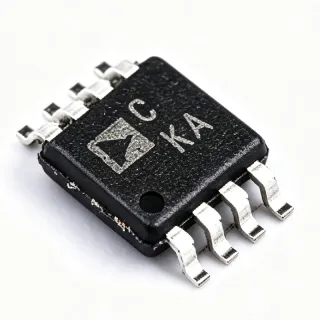
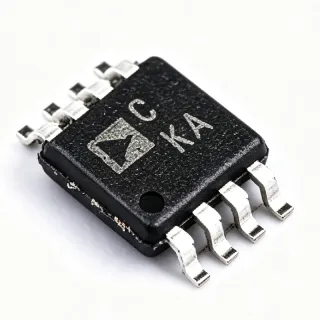
TMP411CQDGKRQ1 - ±1C Remote/Local Temp Sensor AEC-Q100 | TI
MPN: TMP411CQDGKRQ1 ✓ نشطTMP411CQDGKRQ1 نظرة عامة
A remote/local temperature sensor is a digital IC in the temperature sensor family of semiconductor devices that monitors two thermal points simultaneously: an on-chip local sensor and a remote sensing transistor. The remote element is typically a diode-connected NPN or PNP transistor that is built into microcontrollers, microprocessors, FPGAs, or ASICs. These sensors digitize the remote junction temperature and communicate it over a 2-wire serial interface (I2C/SMBus), sitting at the top of the monitoring hierarchy in thermal management systems.
Key features of the TMP411CQDGKRQ1 include remote accuracy of ±1°C for multiple IC manufacturers' on-chip transistors, 11-bit digital output resolution, N-factor correction that allows beta compensation for different process transistors, and series resistance correction that cancels the error caused by PCB trace resistance in the D+/D- loop. The device integrates alert and THERM outputs for over-temperature interrupt and throttling control, supporting both hardware and software thermal management schemes.
The TMP411 architecture uses a band-gap-based local sensor and a delta-VBE remote measurement core. Successive-approximation conversion delivers the 11-bit result, while programmable registers set conversion rate, high/low temperature limits, and hysteresis. The 2-wire serial interface (I2C-compatible, SMBus) supports multiple devices on one bus, and the ALERT output supports SMBus protocol actions.
Typical applications include FPGA and microprocessor die-temperature monitoring in networking and telecom equipment, automotive ECUs and infotainment thermal supervision, and server/datacenter board-level thermal management where remote diode sensing is required.
Design tip: keep the D+ and D- traces matched and short; the series-resistance correction handles residual trace resistance, but noise pickup on long runs still degrades accuracy - filter and guard these lines.
This page adds value beyond the manufacturer datasheet by compiling distributor pricing tiers, drop-in same-family alternatives, design notes, and an AEO-optimized FAQ for engineering and sourcing teams.
بدائل مباشرة لـ TMP411CQDGKRQ1 — نفس الحزمة، متوافق دبوس بدبوس. تُستثنى القطع ذات الحزم المختلفة التي تتطلب تعديل PCB.
الطرازات في هذه السلسلة
طرازات من نفس السلسلة متوافقة تمامًا مع TMP411CQDGKRQ1 (نفس عامل الشكل والبصمة) — يختلف في Resolution, Interface, N-Factor Correction, Package, Packaging.
TMP411AQDGKRQ1
✅ بديل مباشرتواصل لمعرفة السعر
عرض ورقة البيانات ←TMP411BDGKR
✅ بديل مباشرتواصل لمعرفة السعر
عرض ورقة البيانات ←TMP411CDGKR
✅ بديل مباشر ⚠️ مواصفات غير مُتحقق منها📋 بديل مرجعي (غير موجود في الكتالوج)
TMP411BQDGKRQ1
✅ بديل مباشر ⚠️ مواصفات غير مُتحقق منها📋 بديل مرجعي (غير موجود في الكتالوج)
TMP411CQDGKRQ1 الحدود القصوى والخصائص الكهربائية
| نوع المستشعر | Remote and Local Temperature Sensor |
| Remote Accuracy | +/-1 C |
| الدقة | 11 bit |
| الواجهة | 2-Wire Serial (I2C, SMBus) |
| نطاق درجة حرارة التشغيل | -40 C to +125 C |
| Special Features | N-Factor and Series Resistance Correction |
| Qualification | Automotive, AEC-Q100 |
| العلبة | 8-VSSOP (DGK) |
| نوع التركيب | Surface Mount |
| نوع الخرج | Digital, Serial |
| Alert Outputs | ALERT and THERM |
| Remote Sensor Type | Diode-connected NPN/PNP transistor |
| Part Marking | 411CQ |
| Packaging | Tape & Reel (T/R) |
| حالة RoHS | Compliant |
تكوين أطراف TMP411CQDGKRQ1
| دبوس 1 | D+ — Remote temperature sensor positive input (diode-connected transistor anode) |
| دبوس 2 | D- — Remote temperature sensor negative input (diode-connected transistor cathode) |
| دبوس 3 | ALERT — Over-temperature alert interrupt output (open-drain) |
| دبوس 4 | GND — Ground |
| دبوس 5 | SDA — 2-wire serial data (I2C/SMBus) |
| دبوس 6 | SCL — 2-wire serial clock (I2C/SMBus) |
| دبوس 7 | THERM — THERM over-temperature/turboboost output (open-drain) |
| دبوس 8 | V+ — Power supply, decouple with 0.1 uF to GND |
التطبيقات النموذجية
TMP411CQDGKRQ1 مناسب لـ 6 التطبيقs: FPGA and Processor Thermal Monitoring, Automotive ECU and Infotainment Thermal Supervision, Server and Datacenter Board-Level Monitoring, Networking and Telecom Equipment, Industrial Automation and Motor Drives, Test and Measurement Instrumentation.
FPGA and Processor Thermal Monitoring
The TMP411CQDGKRQ1 fits FPGA and microprocessor die-temperature monitoring because its remote channel reads the diode-connected transistor embedded in these dies with ±1 degrees C accuracy, and its N-factor correction compensates for different manufacturers' process transistors, per TI's TMP411-Q1 product data. In a typical design the D+/D- pins connect directly to the FPGA's remote diode pins, while the 2-wire I2C/SMBus interface reports 11-bit temperature to the system controller. The series resistance correction cancels PCB trace resistance errors, allowing the sensor to sit several centimeters from the die. The THERM output can trigger throttling directly, protecting silicon before software intervention is required.
موصى به
Automotive ECU and Infotainment Thermal Supervision
In automotive ECUs and infotainment head units, the TMP411CQDGKRQ1 is used because its AEC-Q100 qualification and -40 C to +125 C operating range meet automotive environmental requirements, while ±1 degrees C remote accuracy gives the thermal management ECU a trustworthy reading of the SoC or graphics processor junction temperature. The ALERT and THERM outputs provide hardware-level over-temperature interrupts and throttling signals that keep functioning even if the main MCU hangs. The 2-wire SMBus interface integrates with the vehicle's existing low-speed digital infrastructure, and N-factor correction adapts the sensing to the specific processor die used in each vehicle platform variant.
موصى به
Server and Datacenter Board-Level Monitoring
Datacenter and server baseboards use the TMP411CQDGKRQ1 to monitor CPU, GPU, and ASIC temperatures through their on-die thermal diodes. The 11-bit resolution (nominally 0.125 degrees C steps in the family) supports fine-grained fan-control curves, and the series resistance correction tolerates the longer D+/D- routing typical of large server boards. Multiple TMP411 sensors share a single SMBus segment, letting a BMC (board management controller) poll dozens of thermal points; the ALERT pin supports SMBus alert protocol for low-latency fault reporting. The 8-VSSOP (DGK) small footprint allows placement directly adjacent to high-power devices where gradients are steepest.
موصى به
Networking and Telecom Equipment
Networking switches, routers, and telecom line cards generate concentrated heat in ASICs and optics that must be monitored continuously. The TMP411CQDGKRQ1's remote diode sensing reads these dies with ±1 degrees C accuracy while its local channel tracks board ambient temperature in the same 8-VSSOP package, reducing BOM count versus discrete solutions. The programmable conversion rate lets designers trade bus traffic against update speed, and the THERM output can directly gate fan controllers or throttle the line-card ASIC. Although the standard grade is industrial rather than extended-temperature, the -40 C to +125 C range covers most central-office and outdoor-enclosure board environments.
موصى به
Industrial Automation and Motor Drives
Industrial drives, PLCs, and power modules benefit from the TMP411CQDGKRQ1's ability to monitor both the control processor junction temperature (remote channel) and the local PCB temperature near power stages (local channel) with a single IC. The -40 C to +125 C range suits factory-floor ambient extremes, and AEC-Q100 qualification provides headroom for reliability-critical industrial equipment that borrows automotive-grade components. The ALERT output wires into the drive's safety shutdown logic, while the I2C/SMBus interface feeds temperature data to predictive-maintenance software. Series resistance correction keeps readings accurate even with wiring parasitics in noisy inverter environments.
موصى به
Test and Measurement Instrumentation
Bench instruments, modular PXI/ePCI chassis, and environmental chambers use the TMP411CQDGKRQ1 to log processor and board temperatures during self-test and calibration routines. The 11-bit digital output removes analog front-end calibration burden, and the N-factor and series resistance correction registers allow the same PCB to support different monitored dies without redesign - useful across instrument product families. The SMBus-compatible interface connects directly to the instrument's housekeeping microcontroller, and the ALERT output supports hard fault interruption. The small 8-VSSOP (DGK) footprint simplifies placement in dense measurement backplanes.
موصى به
ملخص المنتجات الموصى بها
بيانات مرجعية هندسية لـ TMP411CQDGKRQ1 — المقارنة وإرشادات التصميم ومعلومات الامتثال.
دليل الاختيار
المقارنة مع البدائل
| المعامل | هذا المنتج | TMP411AQDGKRQ1 | TMP411BDGKR | TMP411CDGKR | TMP411BQDGKRQ1 |
|---|---|---|---|---|---|
| Package | 8-VSSOP (DGK) | 8-VSSOP (DGK) - same | 8-VSSOP (DGK) - same | 8-VSSOP (DGK) - same | 8-VSSOP (DGK) - same |
| Brand | Texas Instruments | Texas Instruments | Texas Instruments | Texas Instruments | Texas Instruments |
| Remote Accuracy | +/-1 C | +/-1 C | +/-0.8 C | +/-1 C | +/-0.8 C |
| AEC-Q100 Qualification | Qualified (automotive Q1) | Qualified (automotive Q1) | Not qualified (commercial) | Not qualified (commercial) | Qualified (automotive Q1) |
| Resolution | 11 bit | 11 bit | 12 bit | 11 bit | 12 bit |
| Interface | 2-wire I2C/SMBus | 2-wire I2C/SMBus | 2-wire I2C/SMBus | 2-wire I2C/SMBus | 2-wire I2C/SMBus |
| Operating Temperature | -40 C to +125 C | -40 C to +125 C | -40 C to +125 C | -40 C to +125 C | -40 C to +125 C |
| N-Factor / Series-R Correction | Yes | Yes | Yes | Yes | Yes |
أبرز الفروقات
- Automotive AEC-Q100 qualification (مقابلTMP411BDGKR)
- Lower cost with same accuracy in commercial builds (مقابلTMP411BQDGKRQ1)
- N-factor and series resistance correction (مقابلGeneric local-only sensors)
ملاحظات التصميم
Route D+ and D- as a closely coupled, equal-length differential pair from the TMP411CQDGKRQ1 to the remote transistor pins. Keep total trace length under a few centimeters where possible; the series resistance correction register cancels residual resistance, but only up to the limit specified in the datasheet. Do not route D+/D- adjacent to clock or switching-regulator nets, and place the 0.1 uF V+ decoupling capacitor within 2 mm of pin 8.
The remote transistor N-factor must match the correction register setting for the monitored die; using the default value with a non-typical process transistor shifts remote readings. Also confirm the correct TMP411 variant is populated - the C version is ±1 degrees C while the B/D versions are ±0.8 degrees C, and the Q1 suffix denotes automotive grade. Mixing these on one BOM line causes silent accuracy regressions.
Pull up SDA, SCL, ALERT, and THERM to the appropriate rail with resistors per the datasheet recommendation (typically 1-10 kohm for SMBus loads) because all four are open-drain. On long SMBus segments with several sensors, keep bus capacitance below the SMBus 400 pF limit and consider an SMBus-compliant buffer. Add a small RC filter at ALERT if it drives a noisy digital input near switching circuitry.
معلومات الامتثال
AEC-Q100 automotive qualification stated in datasheets.com and TI product data. RoHS and lead-free status per TI standard product data; REACH and halogen-free status not stated in provided data.