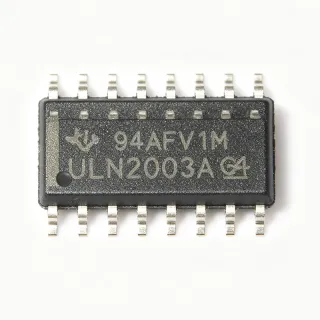
TMP411AQDGKRQ1 - ±1°C Remote/Local Temp Sensor AEC-Q100 | TI
MPN: TMP411AQDGKRQ1 ✓ Active| Qty | Unit Price | Extended |
|---|---|---|
| 1 | $2.35 | $2.35 |
| 10 | $2.11 | $21.10 |
| 100 | $1.83 | $183.00 |
| 500 | $1.58 | $790.00 |
| 1,000 | $1.36 | $1,360.00 |
TMP411AQDGKRQ1 Overview
A remote temperature sensor is a power-management IC that measures die temperature of external devices such as CPUs, GPUs, FPGAs, and microcontrollers by sensing the base-emitter voltage of a diode-connected transistor integrated in those chips. Remote sensors sit within the broader hierarchy of temperature sensors, digital temperature sensor ICs, and thermal monitoring subsystems, and are a core element of system-level thermal management in electronics.
Key features include ±1°C remote accuracy for multiple IC manufacturers' on-chip transistors, remote and local temperature channels, programmable N-factor correction, and series-resistance correction that cancels PCB trace resistance errors. The TMP411-Q1 supports programmable high- and low-temperature limits with ALERT and THERM outputs for fault and overtemperature indication, all monitored over a 2-wire SMBus serial interface.
The device operates from a 2.7V to 5.5V supply and digitizes temperature with 11-bit resolution, giving 0.125°C steps. The N-factor correction register allows adaptation to different transistor ideality factors, while series resistance correction compensates up to a specified ohmic value on the D+/D- lines, eliminating the largest systematic remote-sensing error source without external calibration.
Typical applications include automotive ECU and infotainment thermal monitoring, CPU/FPGA die-temperature supervision in industrial and telecom equipment, and overtemperature protection in power supplies and base stations.
Design tip: minimize and match the D+/D- trace lengths and use the series-resistance correction register to cancel residual board resistance; place the local sensor away from high-dissipation components to keep local readings representative.
This page adds distributor-sourced pricing, drop-in alternatives within the TMP411-Q1 family, and practical design notes that go beyond the manufacturer datasheet.
Drop-in alternatives for TMP411AQDGKRQ1 — same package, pin-to-pin compatible. Different-package parts requiring PCB rework are excluded.
Variants in this series
Same-series models that are drop-in compatible with TMP411AQDGKRQ1 (same form factor and footprint) — differing in Resolution, Interface, Package, N-Factor Correction, Operating Temperature Range.
Quick Comparison Tool — Select alternative parts for side-by-side comparison:
TMP411BDGKRQ1
✅ Drop-In ⚠️ Specs Unverified📋 Reference alternative (not in catalog)
TMP411CDGKRQ1
✅ Drop-In ⚠️ Specs Unverified📋 Reference alternative (not in catalog)
TMP411DDGKRQ1
✅ Drop-In📋 Reference alternative (not in catalog)
TMP411BDGKR
✅ Drop-In ⚠️ Specs Unverified✓ In Stock
$1.02 / Unit
View Datasheet →TMP411ADGKR
✅ Drop-In ⚠️ Specs Unverified✓ In Stock
$0.38 / Unit
View Datasheet →TMP411ADGKRQ1
✅ Drop-In ⚠️ Specs Unverified📋 Reference alternative (not in catalog)
TMP411AQDGKRQ1 Maximum Ratings & Electrical Characteristics
| Sensor Type | Remote and Local Digital Temperature Sensor |
| Sensing Temperature Range | -40°C to +125°C |
| Remote Accuracy | ±1°C |
| Resolution | 11 bit |
| Interface | 2-Wire SMBus |
| Supply Voltage | 2.7 V to 5.5 V |
| N-Factor Correction | Yes (programmable) |
| Series Resistance Correction | Yes |
| Alert Output | ALERT / THERM outputs |
| Automotive Qualification | AEC-Q100 Qualified |
| Package | 8-VSSOP (DGK), 3.00 mm width |
| Mounting Type | Surface Mount |
| Output Type | Digital (SMBus), Local/Remote |
| Packaging | Tape & Reel (TR) |
| Operating Temperature | -40°C to +125°C |
TMP411AQDGKRQ1 Pin Configuration
| Pin 1 | D+ — Remote diode positive sense input |
| Pin 2 | D- — Remote diode negative sense input |
| Pin 3 | ALERT — SMBus alert / interrupt output |
| Pin 4 | GND — Ground reference |
| Pin 5 | SDA — SMBus serial data |
| Pin 6 | SCL — SMBus serial clock |
| Pin 7 | THERM — Overtemperature limit output |
| Pin 8 | V+ — Power supply, 2.7 V to 5.5 V |
Typical Applications
TMP411AQDGKRQ1 is suitable for 6 applications: Automotive ECU Thermal Monitoring, CPU / GPU Die Temperature Supervision in Servers, FPGA Thermal Management in Industrial Automation, Base Station and Telecom Power Amplifier Protection, Automotive Infotainment and Cluster Display, Power Supply and Battery Management Overtemperature Protection.
Automotive ECU Thermal Monitoring
The TMP411AQDGKRQ1 is AEC-Q100 qualified specifically for automotive applications, making it a natural fit for engine control units, body controllers, and domain controllers that must supervise their own microcontroller die temperature. The remote channel connects directly to the ECU MCU's on-chip diode, delivering ±1°C accuracy over -40°C to +125°C, while the local channel tracks ambient temperature near the sensor. With 11-bit (0.125°C) resolution and programmable high/low limits driving ALERT and THERM outputs, the system can implement graduated responses - fan activation, clock throttling, then safe shutdown. Series-resistance correction tolerates practical PCB routing between sensor and MCU, and the 2.7V to 5.5V supply range suits standard automotive-grade 3.3V and 5V logic rails.
Recommended
CPU / GPU Die Temperature Supervision in Servers
Server and telecom equipment designers use the TMP411AQDGKRQ1 to monitor processor and FPGA die temperatures over SMBus. The remote sensing inputs D+ and D- connect to the low-cost NPN or PNP diode-connected transistor integrated in CPUs, GPUs, and FPGAs from multiple IC manufacturers - a use case the TI TMP411-Q1 datasheet explicitly supports with its ±1°C multi-vendor remote accuracy. N-factor correction adapts the transfer function to each vendor's transistor ideality, while series-resistance correction cancels the IR error from long motherboard traces between the sensor and the processor socket. The 2-wire SMBus interface drops onto existing server management buses, and ALERT/THERM outputs provide hardware-level overtemperature interrupts for out-of-band protection.
Recommended
FPGA Thermal Management in Industrial Automation
Industrial controllers, PLCs, and vision systems built around FPGAs benefit from continuous die-temperature monitoring because FPGA junction temperature drives timing derating and long-term reliability. The TMP411AQDGKRQ1 senses the FPGA's on-chip temperature diode with 11-bit resolution, giving the system controller early warning well before critical temperatures are reached. Its SMBus interface integrates with industrial management microcontrollers, and the programmable N-factor register matches the specific FPGA vendor's diode characteristics, supporting devices from multiple suppliers on one BOM. The AEC-Q100 qualification provides extra robustness margin for factory-floor temperature cycling and vibration, and the compact 8-pin VSSOP (DGK) package fits dense FPGA power-distribution regions of the PCB.
Recommended
Base Station and Telecom Power Amplifier Protection
Remote radio units and baseband cards contain power amplifiers and ASICs whose junction temperatures must be supervised to prevent thermal runaway. The TMP411AQDGKRQ1 monitors the PA bias transistor or ASIC diode remotely with ±1°C accuracy and feeds temperature data over SMBus to the system's power-control loop. The THERM output can trigger hardware-level fan speed-up or PA bias reduction without software intervention, reducing latency in fault response. Series-resistance correction is valuable here because RF board layouts often require long, routed D+/D- connections away from sensitive RF sections. The wide 2.7V to 5.5V supply range and -40°C to +125°C operation cover outdoor telecom cabinet environments, and AEC-Q100 qualification adds environmental robustness margin.
Recommended
Automotive Infotainment and Cluster Display
Infotainment SoCs and display driver electronics in vehicles generate significant heat inside sealed dashboards, and the TMP411AQDGKRQ1 provides the die-level monitoring needed to throttle the SoC before user-visible performance drops or reliability degradation occurs. The remote channel reads the SoC's built-in temperature diode while the local channel tracks the ambient temperature near display backlight drivers, which are typically the hottest local components. Over a 2-wire SMBus, the vehicle's body controller or SoC itself polls temperature with 0.125°C granularity, and the ALERT pin provides an interrupt-driven path to fault handlers. AEC-Q100 qualification satisfies automotive OEM component requirements, and 11-bit resolution enables smooth, gradual backlight dimming and fan-control curves rather than abrupt protective shutdowns.
Recommended
Power Supply and Battery Management Overtemperature Protection
Automotive and industrial power supplies, DC-DC modules, and battery management systems use the TMP411AQDGKRQ1 as a low-cost electronic overtemperature trip. The local channel placed near hot power components (MOSFETs, inductors, battery packs) reports -40°C to +125°C temperatures with 11-bit resolution, while the remote channel can monitor an attached power device's die diode where available. Programmable THERM limits create a hardware overtemperature latch-out independent of the main controller, improving functional safety architectures. The 2.7V to 5.5V supply range allows operation directly from the controller rail, and N-factor plus series-resistance correction keeps remote readings trustworthy despite board-level wiring, which is common in distributed battery-pack sensing where the diode sits meters of copper away from the monitor IC.
Recommended
Recommended Products Summary
Engineering reference data for TMP411AQDGKRQ1 — comparison, design guidance, and compliance information.
Selection Guide
Comparison with Alternatives
| Parameter | This Product | TMP411BDGKRQ1 | TMP411DDGKRQ1 | TMP411BDGKR | TMP411ADGKR |
|---|---|---|---|---|---|
| Package | 8-VSSOP (DGK) | 8-VSSOP (DGK) - same | 8-VSSOP (DGK) - same | 8-VSSOP (DGK) - same | 8-VSSOP (DGK) - same |
| Brand | Texas Instruments | Texas Instruments | Texas Instruments | Texas Instruments | Texas Instruments |
| Sensing Temperature Range | -40°C to +125°C | -40°C to +125°C | -40°C to +125°C | -40°C to +125°C | -40°C to +125°C |
| Resolution | 11 bit | 11 bit | 11 bit | 11 bit | 11 bit |
| Supply Voltage | 2.7 V to 5.5 V | 2.7 V to 5.5 V | 2.7 V to 5.5 V | 2.7 V to 5.5 V | 2.7 V to 5.5 V |
| Interface | 2-Wire SMBus | 2-Wire SMBus | 2-Wire SMBus | 2-Wire SMBus | 2-Wire SMBus |
| N-Factor / Series-Resistance Correction | Yes | Yes | Yes | Yes | Yes |
| AEC-Q100 Qualified | Yes | Yes | Yes | No | No |
Key Differentiators
- Series-resistance correction cancels PCB trace error (vs TMP75AIDGKR (local-only comparator))
- Higher remote accuracy grade available in same footprint (vs TMP411AQDGKRQ1 vs TMP411DDGKRQ1)
- AEC-Q100 automotive qualification (vs TMP411ADGKR (non-Q1))
Design Notes
Route the D+ and D- traces as a tightly coupled pair, matched in length, away from high-dv/dt clock and switching nodes. The series-resistance correction register cancels a defined amount of trace resistance, but noise pickup is not corrected - a 0.1uF differential capacitor placed across D+/D- close to the remote diode, per the TI TMP411-Q1 datasheet filter recommendation, suppresses coupled interference. Guard the remote sense pair with ground traces where it crosses noisy regions of an automotive ECU or server motherboard.
Decouple the V+ pin (2.7V to 5.5V) with a 100 nF ceramic capacitor placed within a few millimeters of pin 8. Avoid powering the sensor from a rail shared with high di/dt loads without local filtering, since supply noise can corrupt the small base-emitter voltage measurements of the remote channel. In multi-rail systems, generate the sensor supply from the same rail domain as the SMBus master so SDA/SCL logic levels stay compatible without level shifting.
Always program the N-factor correction register to match the ideality factor of the specific remote transistor (CPU, FPGA, or discrete diode) - using the default value with a mismatched transistor produces systematic remote reading errors that series-resistance correction cannot fix. Also confirm the BETA compensation setting for PNP versus NPN diode connections. Verify ALERT/THERM polarity and pull-up configurations against the datasheet before firmware development; misconfigured limits cause spurious interrupts during startup when temperatures are read before the first conversion completes.
Compliance Information
AEC-Q100 qualified for automotive applications, confirmed by TI product page and DigiKey datasheet listings. RoHS/REACH/lead-free status not stated in provided data - verify on TI.com product page.