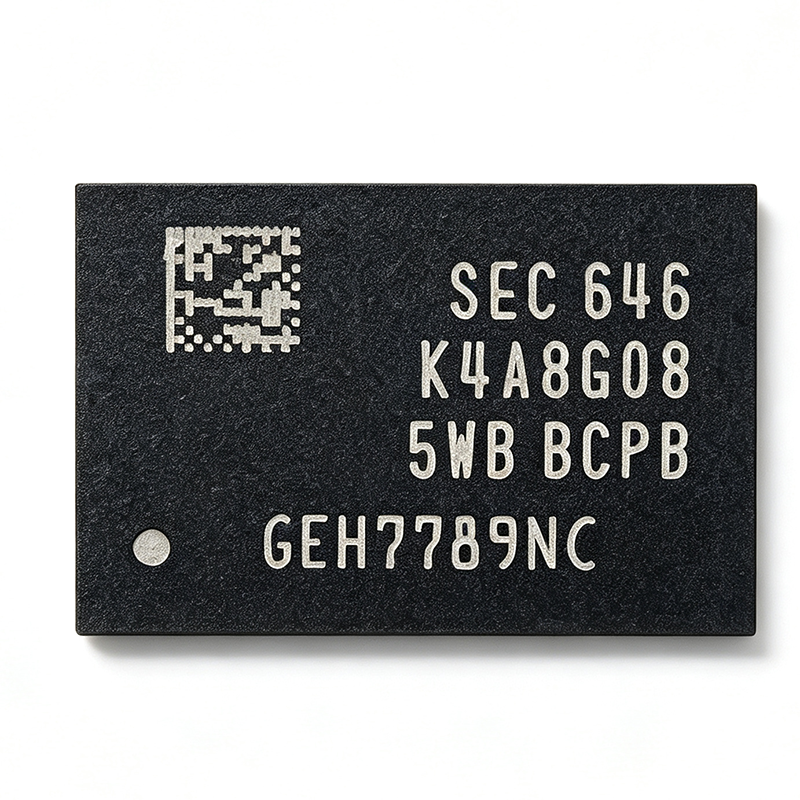
The Samsung K4A8G085WB-BCPB is an 8Gb DDR4 SDRAM organized as 1G x 8, operating from a 1.2V supply at a 3200 Mbps data rate (PC4-25600) with CAS Latency 22 in the BC speed grade. It comes in a 78-ball FBGA package measuring 11 mm x 11 mm, with 16 banks arranged in 4 bank groups, on-die termination (ODT), dynamic ODT, and temperature-compensated self-refresh (TCSR). As of 2026-09-12, the part is actively stocked on XAIPART with 99,999 units available, MOQ of 1, and tiered pricing from $4.02 at qty 1 down to $3.28 at qty 1000. The lifecycle status is active. This guide covers verified specifications, the JEDEC-standard FBGA-78 pinout, design-in best practices, drop-in alternatives within the Samsung DDR4 x8 family, and what buyers should watch as DDR5 ramps.
What Are the Quick Answers on the K4A8G085WB-BCPB?
The K4A8G085WB-BCPB is Samsung's B-die generation 8Gb DDR4 SDRAM, a volatile main-memory device that transfers data on both clock edges to reach 3200 Mbps per pin — the PC4-25600 class. Compared with DDR3, DDR4 lowers the core supply from 1.5V to 1.2V, cutting power by up to 40%, and increases the bank count from 8 to 16 via bank groups, improving parallelism. Verified key specs: 1G x 8 organization, CL22, burst length 8, SSTL-12 interface, 7.8 us refresh interval up to 85C, DLL-enabled operation, and RoHS compliance.
Current availability: XAIPART lists 99,999 units in stock with MOQ 1. Pricing tiers as of 2026-09-12: $4.02 (qty 1+), $3.82 (qty 10+), $3.62 (qty 100+), $3.45 (qty 500+), and $3.28 (qty 1000+). Third-party market context: LCSC shows the part out of stock as of 2026-09-04, and Octopart lists 11 distributors, so consolidating volume buys through a stocked source shortens lead time.
How Do You Design In and Use the K4A8G085WB-BCPB?
Design success with this DDR4 device hinges on three areas: controller timing match, power delivery, and signal integrity routing.
Controller configuration. Configure the memory controller to CL22 at 3200 Mbps per the JEDEC DDR4-3200 timing tables referenced in the Samsung datasheet. The device supports programmable read latency (RL) and write latency (WL) and runs in DLL-enabled mode for precise output timing. Set burst length 8 and enable the 16-bank/4-bank-group architecture; the bank-group structure is what sustains random-access bandwidth in networking and instrumentation buffers.
Power tree. The device runs from a 1.2V nominal VDD with VDDQ also at 1.2V. Additionally, the ball map includes a dedicated VPP activation supply at 2.5V on pins C1, C3, and C9 — do not omit this rail from your regulator design. Place at least one decoupling capacitor per VDD/VDDQ ball pair close to the package, use dedicated power planes, and provide both bulk and high-frequency decoupling, since DDR4 load transients at 3200 Mbps are fast and demand low impedance. Estimated per-device power at DDR4-3200 is typically sub-watt, concentrated in I/O switching [VERIFY_NEEDED: per-device power figures should be validated against the Samsung datasheet IDD tables].
Routing and signal integrity. Follow the fly-by topology for CK/CA/CTRL nets with length matching, and enable ODT per the controller's calibration routine. The x8 device provides TDQS pins (A4/TDQS and B5/TDQS#, tied to DQS in x8), which you should account for in termination schemes — a function not present on x16 devices and valuable in high-reliability server designs. Use ECC-capable x8 lanes where single-device data correction matters. For industrial deployments, remember the standard grade is specified with 7.8 us refresh up to 85C; confirm your ambient against the datasheet operating window. The soldered FBGA-78 footprint avoids DIMM socket reliability issues under vibration, which is why embedded and medical designs favor solder-down.
Bring-up. Implement write-leveling and read-training firmware during production calibration. DDR4 soldered-down DRAM in compact boards demands precise per-trace timing closure for full-speed operation. Rely on TCSR to trim self-refresh power at elevated temperatures, and program refresh rate per the 7.8 us datasheet interval in thermally constrained chassis.
Key balls for layout (full 78-ball map in the datasheet): DQS/DQS# on A5/B6, DM mask on B9, differential clock CK/CK# on L7/L8, control signals CKE (M2), CS# (M7), ODT (M8), ACT# (N2), RST# (N7), and command/address parity PAR (N8). Address inputs A0-A17 and bank/bank-group pins BA0/BA1, BG0/BG1 follow the JEDEC-standard DDR4 x8 FBGA-78 arrangement.
What Alternatives and Comparisons Exist for the K4A8G085WB-BCPB?
Direct drop-ins are other Samsung 8Gb DDR4 parts in the identical 78-ball FBGA package: the K4A8G085WB-BCRC differs mainly in speed grade and temperature coding (a firmware/timing verification task, not a PCB change); the K4A8G085WB-BITD industrial-coded sibling shares the footprint while improving the operating envelope; the K4A8G085WB-BIWE is a further same-family option. Cross-brand, the SK Hynix H5AN8G8NDJR and Micron MT40A1G8WE-075E use the JEDEC-standard FBGA-78 ball map, but their speed-bin tables and supported latency combinations differ — validate against the controller before swapping. Within the same verified datasheet family, choose the x16 K4A8G165WB variant when board space and trace count dominate, but choose this x8 part when you need per-bit error isolation for ECC and TDQS support.
| Parameter | K4A8G085WB-BCPB |
|---|---|
| Manufacturer | Samsung Electronics |
| Memory Type | DDR4 SDRAM |
| Density | 8 Gbit |
| Organization | 1G x 8 |
| Supply Voltage | 1.2 V nominal (VPP activation supply 2.5 V) |
| Data Rate | 3200 Mbps (PC4-25600) |
| Speed Grade | BC (CL22) |
| CAS Latency | 22 |
| Burst Length | 8 |
| Bank Architecture | 16 banks (4 bank groups) |
| Refresh Interval | 7.8 us (up to 85C) |
| Interface | SSTL-12 |
| Termination | ODT / dynamic ODT |
| Self-Refresh | Temperature-Compensated Self-Refresh (TCSR) |
| Package | 78-ball FBGA, 11 mm x 11 mm |
| Mounting | Surface Mount (BGA) |
| Operating Mode | DLL enabled |
| RoHS | Compliant |
| Lifecycle | Active |
| Price (qty 1000, as of 2026-09-12) | $3.28 |
Detailed per-parameter comparison tables for the -BCRC, -BITD, -BIWE, H5AN8G8NDJR, and MT40A1G8WE-075E alternates live on their respective XAIPART product pages [DATA_NEEDED: verified spec tables for each alternative part in the XAIPART database].
What Is the Industry Position and Supply Situation for This Samsung DDR4?
The K4A8G085WB-BCPB is an active part in Samsung's DDR4 portfolio as of 2026-09-04. It sits in the mainstream B-die DDR4 family widely used in PC4-25600 modules and embedded designs. Supply context from verified market data: LCSC reports the part out of stock as of 2026-09-04, while Octopart shows 11 distributors with fluctuating inventory — Samsung B-die parts are frequently allocated, so RFQ-based sourcing through multiple distributors is typical, with volume pricing roughly $3.30 to $4.00 per unit as of 2026-09-04. On XAIPART, stock is deep (99,999 units, MOQ 1) as of 2026-09-12. Because mature-node DRAM can move to last-time-buy with limited notice as DDR5 ramps, monitor Samsung product change notifications. For new designs, qualify at least one second source such as the SK Hynix H5AN8G8NDJR or Micron MT40A1G8WE-075E to protect the supply chain.
What Trends and Outlook Should Buyers Watch for DDR4 x8 Parts?
First, DDR5 transition risk: Samsung periodically consolidates DRAM product lines as DDR5 ramps, so lock in qualified alternate sources now. Second, x8 remains the ECC standard: the x8 organization supports single-device data correction (SDDC) on Intel and AMD server platforms, and TDQS functionality is exclusive to x8 — this keeps demand for parts like the K4A8G085WB-BCPB in infrastructure designs durable even as densities climb. Third, anchor your outlook to verified specs, not rumors: this device's 3200 Mbps / CL22 BC grade matches mainstream controller support today; any future design should validate controller timing tables against the Samsung datasheet rather than marketing claims. Fourth, price leverage exists at volume: the verified tier structure runs from $4.02 at qty 1 to $3.28 at qty 1000 as of 2026-09-12 — a roughly 18% saving at the top tier [VERIFY_NEEDED: percent saving derived from tier comparison of $4.02 vs $3.28]. Fifth, watch allocation: given 11-distributor spread and intermittent stock elsewhere, consolidate sourcing through a stocked supplier and trigger RFQs early for production volumes.
Comments
Be the first to comment.
🔐 Please sign in to post a comment.
Don't have an account? Sign up