Products (44,000+)

TUSB7340RKMT - USB 3.0 4-Port xHCI Host Controller | Texas Instruments
TUSB7340RKMT

TUSB7340RKMT - USB 3.0 4-Port xHCI Host Controller | Texas Instruments

The Texas Instruments TUSB7340RKMT is a SuperSpeed USB 3.0 four-port xHCI host controller that bridges a PCI Express host bus to as many as four downstream USB 3.0 ports, powered from 1.1 V core and 3.3 V I/O rails and housed in a 100-pin WQFN-MR (RKM) 9 x 9 mm surface-mount package. An xHCI (eXtensible Host Controller Interface) host controller is the standardized silicon interface that allows a host processor to enumerate, configure and manage attached USB devices through a single register model rather than a legacy host-controller stack. In the device hierarchy, the TUSB7340RKMT is a USB interface IC, which is a subclass of interface IC within the broader integrated-circuit and semiconductor categories, and it is frequently placed alongside Type-C port controllers and USB hubs on the same board. Key features include support for up to four downstream SuperSpeed USB 3.0 ports, a PCI Express device interface for host attachment, I2C configuration access, and dual-rail 1.1 V core / 3.3 V I/O operation. The RKM package exposes a thermal pad for improved heat spreading, and the device is offered in a commercial temperature grade as well as industrial-grade orderable variants sharing the identical 100-pin footprint. Architecturally, the TUSB7340 family is designed so that the TUSB7320 and TUSB7340 devices share a pin-compatible 100-pin RKM package, so a design can move between a two-port and a four-port implementation without a PCB respin. The host-facing PCIe link, the UTMI/ULPI-style device-side PHY signalling, and the low-power 1.1 V core rail let the controller sit between the processor root complex and external USB connectors while keeping the number of external active components low. Typical applications include docking stations and port-replicator designs, industrial human-machine interface panels, embedded servers and thin clients, test and measurement instrumentation, medical cart and diagnostic console hardware, and multi-display or multi-storage peripheral platforms where several SuperSpeed devices attach to one host. When laying out the board, allocate a solid ground plane under the exposed thermal pad, place the 1.1 V and 3.3 V decoupling capacitors close to their supply pins, keep the PCIe reference-clock and differential pairs routed with matched impedance, and confirm the downstream port count against your cable and connector plan before committing to the footprint. This page consolidates the TUSB7340 family documentation, package and pin-count details, drop-in replacement options in the same 100-pin RKM footprint, and practical layout guidance that is not collected in a single manufacturer document.

RFQ Contact
TUSB8020BPHP - 2-Port USB 3.0 Hub 5Gbps | Texas Instruments (Tape & Reel)
TUSB8020BPHP

TUSB8020BPHP - 2-Port USB 3.0 Hub 5Gbps | Texas Instruments (Tape & Reel)

The Texas Instruments TUSB8020BPHP is a two-port SuperSpeed USB 3.0 hub controller that supports 5.0 Gbps upstream and downstream signaling, housed in a 48-pin HTQFP (PHP) package measuring 7x7 mm. It provides simultaneous SuperSpeed and high-speed/full-speed connections on the upstream port while offering SuperSpeed, high-speed, full-speed, or low-speed connections on the downstream ports, making it a true multi-speed USB 3.0 compliant hub. The device operates from 1.1 V and 3.3 V supplies and exposes USB, GPIO, I2C, and SMBus interfaces for host-side configuration. A USB hub is a device that expands a single USB host port into multiple downstream ports, allowing several peripherals to share one upstream connection. The TUSB8020B belongs to the USB hub controller product family within the broader interface IC taxonomy (USB hub controller -> interface IC -> integrated circuit -> semiconductor). USB 3.0 hubs operate at 5 Gbps SuperSpeed, which is roughly ten times faster than USB 2.0 high-speed (480 Mbps), and are required to remain backward compatible with USB 2.0 and USB 1.1 devices through dedicated signaling pipelines. Key features include two downstream ports, full SuperSpeed 5 Gbps support per port, integrated termination and pull-up/pull-down resistors, per-port or ganged power switching control, configurable through I2C/SMBus, and individual port overcurrent detection. The device supports battery charging (BC1.2) detection logic when paired with an external charger IC. Its commercial temperature range of 0C to 70C and HTQFP package make it suitable for consumer docking stations, monitors, and embedded platforms. The TUSB8020B uses a UTMI/UTMI+ (USB 2.0 Transceiver Macrocell Interface) plus a PIPE (PHY Interface for the PCI Express and USB 3.0 Architectures) physical interface to its internal PHYs, eliminating the need for external PHY components. The hub transaction translator manages bandwidth sharing between USB 2.0 and USB 3.0 traffic streams. Typical applications include desktop and laptop docking stations, USB 3.0 port expanders, multi-function monitors, embedded system host boards, industrial PCs, and storage enclosures with multiple USB 3.0 connectors. When designing with this part, provide a 12 MHz crystal or clock reference and follow the USB 3.0 layout guidelines: 90-ohm differential impedance for SuperSpeed pairs, length matching within 150 mil, and continuous reference planes on adjacent layers. This page synthesizes distributor pricing, pin-compatible drop-in alternatives, application circuits, and practical design notes not consolidated on the manufacturer datasheet landing page.

RFQ Contact
TUSB8020BPHPR - 2-Port USB 3.0 Hub 5Gbps | Texas Instruments
TUSB8020BPHPR

TUSB8020BPHPR - 2-Port USB 3.0 Hub 5Gbps | Texas Instruments

The Texas Instruments TUSB8020BPHPR is a two-port SuperSpeed USB 3.0 hub controller that supports 5.0 Gbps upstream and downstream signaling, housed in a 48-pin HTQFP (PHP) package measuring 7x7 mm. It provides simultaneous SuperSpeed and high-speed/full-speed connections on the upstream port while offering SuperSpeed, high-speed, full-speed, or low-speed connections on the downstream ports, making it a true multi-speed USB 3.0 compliant hub. The device operates from 1.1 V and 3.3 V supplies and exposes USB, GPIO, I2C, and SMBus interfaces for host-side configuration. A USB hub is a device that expands a single USB host port into multiple downstream ports, allowing several peripherals to share one upstream connection. The TUSB8020B belongs to the USB hub controller product family within the broader interface IC taxonomy (USB hub controller -> interface IC -> integrated circuit -> semiconductor). USB 3.0 hubs operate at 5 Gbps SuperSpeed, which is roughly ten times faster than USB 2.0 high-speed (480 Mbps), and are required to remain backward compatible with USB 2.0 and USB 1.1 devices through dedicated signaling pipelines. Key features include two downstream ports, full SuperSpeed 5 Gbps support per port, integrated termination and pull-up/pull-down resistors, per-port or ganged power switching control, configurable through I2C/SMBus, and individual port overcurrent detection. The device supports battery charging (BC1.2) detection logic when paired with an external charger IC. Its commercial temperature range of 0C to 70C and HTQFP package make it suitable for consumer docking stations, monitors, and embedded platforms. The TUSB8020B uses a UTMI/UTMI+ (USB 2.0 Transceiver Macrocell Interface) plus a PIPE (PHY Interface for the PCI Express and USB 3.0 Architectures) physical interface to its internal PHYs, eliminating the need for external PHY components. The hub transaction translator manages bandwidth sharing between USB 2.0 and USB 3.0 traffic streams. Typical applications include desktop and laptop docking stations, USB 3.0 port expanders, multi-function monitors, embedded system host boards, industrial PCs, and storage enclosures with multiple USB 3.0 connectors. When designing with this part, provide a 12 MHz crystal or clock reference and follow the USB 3.0 layout guidelines: 90-ohm differential impedance for SuperSpeed pairs, length matching within 150 mil, and continuous reference planes on adjacent layers. This page synthesizes distributor pricing, pin-compatible drop-in alternatives, application circuits, and practical design notes not consolidated on the manufacturer datasheet landing page.

RFQ Contact
TUSB8040A1RKMR - 4-Port USB 3.0 Hub, 100-WQFN | Texas Instruments
TUSB8040A1RKMR

TUSB8040A1RKMR - 4-Port USB 3.0 Hub, 100-WQFN | Texas Instruments

The Texas Instruments TUSB8040A1RKMR is a four-port USB 3.0 compliant hub controller housed in a 100-pin WQFN-MR (9x9 mm) package with an exposed thermal pad, operating from a single 3.3V supply over the commercial 0C to 70C temperature range. The device supports simultaneous SuperSpeed USB (5 Gbps) and high-speed or full-speed signaling on the upstream port, while each downstream port independently supports SuperSpeed, high-speed, full-speed, or low-speed connections, making it a flexible building block for hosts that must expose multiple downstream USB devices. A USB hub is a tier-1 interconnect device in the USB topology that expands one upstream port into multiple downstream ports while managing transaction translation, power distribution, and signaling at each speed node. The TUSB8040A1 family implements a USB 3.0 SuperSpeed transaction translator along with the classic USB 2.0 hub repeater logic on a single die, exposing configuration pins, GPIOs, and battery-charging controls so designers can scale the same part from low-cost consumer docks to high-port-count industrial hosts. Key features include support for USB 3.0 SuperSpeed on all four downstream ports, integrated USB 2.0 hub repeater logic, configurable downstream port power switching and over-current inputs, an I2C/SMBus slave interface for status and configuration, multi-status LED indicators, and pin-selectable SMBus or I2C address options. The 100-pin WQFN-MR footprint provides a compact thermal path through the exposed pad, allowing sustained 5 Gbps operation without external heatsinking in well-ventilated enclosures. Architecturally, the TUSB8040A1 combines a USB 3.0 physical layer capable of 5 Gbps serial signaling, a SuperSpeed transaction translator, a USB 2.0 high-speed hub controller, and an integrated power-management block that handles per-port VBUS switching and over-current fault reporting. The configuration strap pins, combined with the I2C/SMBus interface, allow firmware to control per-port battery-charging modes, compound hub behavior, and the device's dual-role flexibility. Typical applications include USB 3.0 docking stations, desktop and laptop port-replicators, industrial PCs with multiple USB peripherals, embedded platforms requiring USB-3 Vision or USB mass-storage fan-out, and embedded host boards for point-of-sale, kiosk, and test-and-measurement systems where a processor only exposes one upstream USB-3 port but the design requires multiple downstream USB-3 endpoints. When designing with the TUSB8040A1, follow the High-Speed PCB layout guidelines in the manufacturer datasheet: route the SuperSpeed differential pairs with 90 ohm differential impedance, place the 12 MHz crystal close to the XI/XO pins, and connect the exposed thermal pad to a solid ground plane. Per-port VBUS switches must be sized for the cumulative downstream load and protected against inrush faults to comply with USB-IF compliance testing. This page synthesizes distributor stock data, cross-reference alternatives, and practical PCB layout notes that go beyond the manufacturer datasheet, helping engineers select and integrate the TUSB8040A1RKMR quickly into new USB-3.0 host designs.

RFQ Contact
TUSB8040PFP - USB 3.0 4-Port Hub Controller | Texas Instruments
TUSB8040PFP

TUSB8040PFP - USB 3.0 4-Port Hub Controller | Texas Instruments

Texas Instruments TUSB8040PFP is a SuperSpeed USB 3.0 four-port hub controller in an 80-pin HTQFP (PFP) package measuring 12 x 12 mm. It is designed to manage one upstream USB connection and four downstream ports, providing a central interface between a USB host and multiple peripherals. The device supports SuperSpeed, High-Speed, and Full-Speed USB operation, making it suitable for systems that need a managed multi-port USB interface. A USB hub controller is an interface integrated circuit that coordinates traffic between a host and attached USB devices. It belongs to the hierarchy of USB interface controllers, interface integrated circuits, and general-purpose semiconductors. Rather than acting as a data endpoint, the controller implements hub functions such as port enumeration, connection management, and routing traffic between the upstream port and downstream ports. These functions allow several peripherals to share one host-side USB connection. The principal feature of the TUSB8040 is its four-port hub architecture. Each downstream connection can participate in the USB topology managed by the upstream port, while SuperSpeed operation supports devices and links requiring the higher bandwidth of USB 3.0. High-Speed and Full-Speed support also allows compatible USB 2.0 and USB 1.1 devices to remain connected. The manufacturer identifies the TUSB8040PFP as a USB 3.0-compliant four-port hub controller. The TUSB8040PFP uses an 80-pin HTQFP package identified by the PFP ordering code. Its exposed thermal-pad construction provides a practical path for heat transfer from the controller on a PCB designed for adequate copper area. The exact electrical limits, internal USB transceiver details, auxiliary supply requirements, and pin-level signal assignments should be taken from the Texas Instruments TUSB8040 data sheet rather than inferred from the distributor summaries. Typical uses include industrial USB data acquisition, USB-to-Ethernet adapters, peripheral docking stations, test equipment, and embedded systems that expose multiple USB connections through one host port. The controller is also appropriate for systems requiring backward compatibility with lower-speed USB devices. Board-level implementation must preserve the USB routing and power-delivery requirements associated with four SuperSpeed downstream channels. When laying out a TUSB8040PFP design, give priority to the upstream and downstream SuperSpeed differential pairs, maintain the routing geometry specified in the data sheet, and place the prescribed input, output, and bypass capacitors close to their associated pins. Thermal performance depends on the exposed pad being connected to a suitable copper plane and the assembled PCB reaching its intended temperature range. This product record combines the verified manufacturer and distributor identity, package, interface type, port count, USB version, and commercial temperature information with practical application, sourcing, and design guidance. It also distinguishes a directly purchasable 80-pin PFP configuration from related TI hub controllers that use different package formats and therefore are not treated as drop-in replacements.

RFQ Contact
TUSB8041ARGCR - 4-Port USB 3.1 Hub Controller | Texas Instruments
TUSB8041ARGCR

TUSB8041ARGCR - 4-Port USB 3.1 Hub Controller | Texas Instruments

The Texas Instruments TUSB8041ARGCR is a 4-port SuperSpeed USB 3.1 Gen1 hub controller operating at 5 Gbps, housed in a 64-pin VQFN (RGC) 9x9 mm package with exposed thermal pad. It provides upstream USB 3.0 connectivity and four downstream ports, each capable of SS (5 Gbps), HS (480 Mbps), FS (12 Mbps), and LS (1.5 Mbps) signaling. A USB hub is a USB class-defined device that expands a single upstream USB port into multiple downstream ports while managing power, enumeration, and transaction translation. The TUSB8041 family sits within the broader hierarchy of USB controllers, peripheral interface ICs, and interface ICs in the semiconductor taxonomy. It supports USB Type-A downstream ports and is commonly used to add four ports to a system with a single USB 3.0 upstream port. Key features of the TUSB8041ARGCR include support for USB Battery Charging (BC) 1.2 charging downstream ports, integrated 5-V tolerant I/O, per-port power switching with individual enable control, and configuration via GPIO, I2C, or SMBus interfaces. The device also supports USB Type-C port-reversal logic when used with an external Type-C controller, and offers pin-selectable upstream port configuration. Internal spread-spectrum clocking reduces EMI on the SuperSpeed signal paths. The architecture combines a USB 2.0 hub controller and a USB 3.0 hub controller on a single die, sharing common configuration logic. Per-port SuperSpeed PHY blocks operate independently, and traffic scheduling is managed by a hardware transaction translator. The device enumerates as a compound USB hub and supports standard USB hub class commands plus vendor-specific commands for charger-port behavior and GPIO control. Typical applications include USB expansion in desktop motherboards, docking stations, automotive infotainment head units, industrial PCs, monitor USB hubs, and embedded computing platforms that require multiple downstream USB 3.0 ports from a single host connection. The wide industrial temperature support enables in-vehicle and factory-floor deployment. When designing with this part, observe the PCB layout guidelines in the datasheet: keep the SuperSpeed differential pairs matched to 85 ohm differential impedance, decouple each VBUS supply pin with a 0.1 uF ceramic capacitor, and place the upstream port common-mode chokes close to the connector. Daisy-chained hubs are supported up to 5 tiers per USB specification. This page synthesizes distributor pricing, same-brand drop-in alternatives, and practical PCB layout notes not consolidated in the manufacturer datasheet alone.

RFQ Contact
TUSB8041ARGCT - 4-Port USB 3.1 Gen1 Hub Controller | Texas Instruments
TUSB8041ARGCT

TUSB8041ARGCT - 4-Port USB 3.1 Gen1 Hub Controller | Texas Instruments

The Texas Instruments TUSB8041ARGCT is a 4-port SuperSpeed 5-Gbps USB 3.1 Gen1 hub controller in a 64-pin VQFN (RGC) 9x9 mm package with an exposed thermal pad. The device integrates four downstream USB ports that simultaneously support Low-Speed, Full-Speed, High-Speed, and SuperSpeed signaling, delivering up to 5 Gbps per downstream port while presenting a single upstream USB 3.1 Gen1 Type-A or Type-C interface to the host. A USB hub controller is an interface IC that multiplies a single upstream USB port into multiple downstream ports while preserving protocol compliance, port power switching, and per-port status reporting. Hubs occupy a fixed position in the USB device-class hierarchy between the host controller root hub and downstream peripherals. Modern SuperSpeed hubs additionally embed PHYs and link-training state machines so legacy USB 2.0 traffic and 5 Gbps SuperSpeed traffic are bridged transparently across the same physical connector stack. The TUSB8041ARGCT provides per-port battery-charging detection, downstream-port power-enable controls routed through GPIO, and over-current flag inputs that simplify USB Type-A VBUS switching designs. Configuration is achieved through pin-strap modes, OTP ROM, an external I2C EEPROM, or an I2C/SMBus slave interface for VID, PID, and custom-string descriptors. The integrated 1.1 V core LDO and 3.3 V I/O supply mean only a single external 3.3 V rail is required for the hub itself. Typical applications include desktop and laptop docking stations, retail POS terminals, industrial PCs, USB 3.0/3.1 port replicators, automotive infotainment hubs, and embedded systems that fan out a single Type-C upstream port into multiple USB Type-A ports. The -40C to +85C industrial temperature range supports deployment in factory automation and vehicle environments. When designing with the TUSB8041ARGCT, route the SuperSpeed differential pairs (USB3_TX/RX) for 85 ohm differential impedance with intra-pair length matching within 150 mil, and provide an external 24 MHz crystal with the datasheet-recommended load capacitors. Place the upstream port ESD protection array adjacent to the USB connector and verify the bulk-decoupling ESR budget against the 5V VBUS load step on hot-plug events. This page synthesizes distributor pricing from DigiKey and Arrow, cross-references the TUSB8041A 'A' revision orderability codes (RGC = tape-and-reel, RGT = tray), and provides drop-in alternatives plus design notes not collected in any single datasheet document.

RFQ Contact
TUSB8041IPAPRQ1 - Automotive 4-Port USB 3.0 Hub | Texas Instruments
TUSB8041IPAPRQ1

TUSB8041IPAPRQ1 - Automotive 4-Port USB 3.0 Hub | Texas Instruments

The Texas Instruments TUSB8041IPAPRQ1 is an automotive-grade, four-port, SuperSpeed 5-Gbps USB 3.0 hub controller in a 64-pin HTQFP (PAP) 10x10 mm package with exposed thermal pad, qualified to AEC-Q100 standards and operating across -40C to +85C. It supports simultaneous SuperSpeed, Hi-Speed, Full-Speed and Low-Speed upstream connections while delivering full backward compatibility on every downstream port. A USB hub controller is a class of interface IC that aggregates one upstream USB port into multiple downstream ports, managing enumeration, power switching, transaction translation and battery-charging detection across every port. The TUSB8041 sits in a hierarchy of USB Type-C and USB-C hub ICs, which themselves belong to the broader interface ICs and connectivity category within mixed-signal semiconductors. The Q1 suffix designates AEC-Q100 qualification, meaning the device is engineered and tested for the temperature, vibration and reliability stresses of in-vehicle electronics such as infotainment head units, telematic control units and rear-seat entertainment modules. Key specifications include four downstream ports, integrated USB 2.0 hub with multi-translation support, configurable via I2C, SMBus, GPIO and pin straps, and 1.1V / 3.3V dual-rail operation. The PAP variant of the family uses the 64-HTQFP footprint (10 mm x 10 mm) and offers broad flexibility for USB Type-C deployments when paired with a downstream crosspoint switch or PD controller. Typical applications include automotive head-unit USB expansion, rear-seat USB charging hubs, telematic USB pass-through, factory-floor USB test rigs and embedded computing platforms that need multiple USB-3 connections from a single root port. Because the device supports per-port power switching via the USB specification and individual over-current flags, designers can implement ganged or individual port power policies directly through hardware strap settings. When evaluating USB-3 hub alternatives, confirm that any candidate supports simultaneous SuperSpeed on all four ports, matches the 64-HTQFP land pattern, retains the I2C/SMBus configuration interface and meets AEC-Q100 grade-2 or stricter temperature targets. Note that 3.3 V supply noise from upstream regulators must remain below the threshold documented in TI's USB-3 hub electrical spec section, otherwise link-training jitter on SuperSpeed pairs can rise substantially.

RFQ Contact
TUSB8041IRGCT - 4-Port USB 3.0 Hub 5Gbps VQFN-64 | Texas Instruments
TUSB8041IRGCT

TUSB8041IRGCT - 4-Port USB 3.0 Hub 5Gbps VQFN-64 | Texas Instruments

The Texas Instruments TUSB8041IRGCT is a four-port SuperSpeed USB 3.0 hub controller delivering 5 Gbps per port, housed in a 64-pin VQFN (RGC, 9x9 mm) package and rated for -40C to +85C industrial operation. A USB 3.0 hub controller is an integrated circuit that fans a single upstream SuperSpeed USB link out to multiple downstream ports, handling enumeration, transaction translation, and power management transparently to the host. Hub controllers sit in the USB interconnect tier of the system I/O hierarchy: host controller -> hub controller -> downstream devices, bridging the gap between a PC or embedded host and the peripherals it must serve. The TUSB8041 supports USB 3.0 SuperSpeed (5 Gbps) operation on all four downstream ports while remaining backward compatible with USB 2.0 and USB 1.1 devices on the same ports. It provides GPIO, I2C, and SMBus interfaces for configuration and status monitoring, allowing designers to customize hub behavior, set port modes, and read fault status in embedded systems. The industrial temperature rating (-40C to +85C) of the TUSB8041I variant makes it suitable for deployments beyond office-climate conditions. Architecturally, the device integrates the SuperSpeed hub repeater, USB 2.0 hub engine, and configuration ROM/EEPROM loading logic in a single die. Configuration can be performed via an external serial EEPROM or through the SMBus/I2C host interface, eliminating external glue logic. Integrated charge-pump and linear regulators generate the internal core supply from a single 3.3 V rail, simplifying power tree design. Typical applications include docking stations, port replicators, industrial PC and HMI USB expansion, embedded computing boards, and test and measurement instrumentation that requires multiple robust SuperSpeed ports from one upstream connection. Design consideration: USB 3.0 is a multi-gigabit differential signaling standard, so the 90-ohm differential impedance routing, length matching, and AC-coupling capacitor placement for the SuperSpeed pairs dominate signal integrity; place the device close to both the upstream connector and EEPROM, and follow the layout guidelines in the manufacturer datasheet. This page synthesizes verified distributor data, drop-in alternatives, pricing tiers, and practical design notes not found in the manufacturer datasheet alone, with pricing references stated as of 2026-09-03.

RFQ Contact
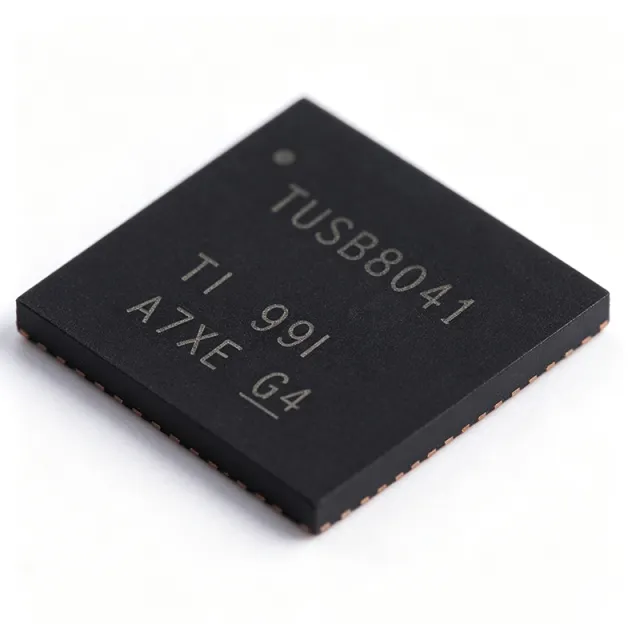
TUSB8041RGCR - 4-Port USB 3.0 Hub 5Gbps | Texas Instruments
TUSB8041RGCR

TUSB8041RGCR - 4-Port USB 3.0 Hub 5Gbps | Texas Instruments

The Texas Instruments TUSB8041RGCR is a four-port SuperSpeed USB 3.0 hub controller delivering 5-Gbps data rates per port, powered from dual 1.1V and 3.3V supplies and housed in a 64-pin VQFN (RGC) package measuring 9x9 mm with an exposed pad. A USB hub controller is an integrated circuit that fans out a single upstream USB connection into multiple downstream ports, handling enumeration, packet routing, and power management per the USB 3.0 specification. Within the system hierarchy it sits at the interface-IC layer, bridging the USB physical layer and the host controller of a computer, docking station, or embedded processor. Key features include four downstream SuperSpeed ports supporting 5 Gbps, backward compatibility with USB 2.0 full-speed and high-speed traffic, and configuration via GPIO, I2C, or SMBus interfaces for flexible SMBus-based platform integration. The device supports battery charging scenarios and standard hub power management, and TI offers both commercial (0C to 70C) and industrial (-40C to 85C) temperature grades in the same 64-pin RGC footprint. Architecturally, the TUSB8041 integrates the SuperSpeed repeater/retimer functions and hub transaction logic on a single die, using internal PLL-based clocking to regenerate the 5-Gbps link. The dual-rail 1.1V core / 3.3V I2V supply scheme reduces core power while maintaining signaling compliance, and the exposed-pad VQFN package provides low-inductance ground return for the high-speed differential pairs. Typical applications include PC motherboards and docking stations, monitors and displays with integrated USB hubs, industrial PCs requiring multiple USB 3.0 ports, and self-powered or bus-powered peripheral hubs. The 5-Gbps throughput makes it suitable for external storage, video capture, and camera aggregation. When designing with the TUSB8041, maintain 90-ohm differential impedance on the SuperSpeed pairs, keep them short and matched, and decouple both the 1.1V and 3.3V rails with low-ESR ceramics close to the pins. Configuration strapping or an I2C EEPROM must be present for non-default VID/PID settings. This page synthesizes distributor pricing, temperature-grade alternatives, and practical design notes not found in the manufacturer datasheet, verified as of 2026-09-03.

USD $4.05 Contact
TUSB8041RGCT - 4-Port 5Gbps USB 3.0 Hub Controller | TI
TUSB8041RGCT

TUSB8041RGCT - 4-Port 5Gbps USB 3.0 Hub Controller | TI

Texas Instruments TUSB8041RGCT is a four-port USB 3.0 hub controller with 5-Gbps SuperSpeed USB operation, GPIO, I2C, and SMBus interfaces, and a 64-pin VQFN package measuring 9 x 9 mm. It supports 3 V to 3.6 V operation alongside a 0.99 V to 1.26 V internal rail and provides BC1.2 protocol support, downstream port power-switch control, and overcurrent protection. A USB hub controller is an interface IC that manages one upstream USB connection and multiple downstream ports. Within the semiconductor hierarchy, it is a USB interface controller, then an interface IC, then an integrated circuit. By coordinating traffic, power, and attach events across four ports, this type of device reduces the host burden associated with multiple USB peripherals. The four downstream ports support simultaneous SuperSpeed, high-speed, and full-speed USB connections. A 5-Gbps SuperSpeed data path suits storage peripherals, docking equipment, and other bandwidth-intensive devices when the connected host and cables provide the required USB 3.0 support. The controller also includes GPIO, I2C, and SMBus connectivity for configuration, monitoring, and board-level control functions. Power-management features include downstream port power-switch control and overcurrent protection. The 3 V to 3.6 V operating range accommodates common 3.3 V system rails, while the 0.99 V to 1.26 V range corresponds to the lower-voltage internal supply requirement. BC1.2 protocol support adds compatibility with common USB battery-charging control conventions. Typical implementations include USB docking stations, multi-port desktop and industrial peripherals, data-storage hubs, embedded USB expansion boards, and test systems that require more than one downstream USB connection. The 64-pin VQFN keeps the controller compact while exposing four downstream ports and dedicated hub-management functions. PCB implementation requires careful high-speed signal routing, solid supply-plane design, and thermal management around the exposed pad. Place USB differential pairs according to the manufacturer layout guidance, maintain continuous reference planes, and decouple each supply rail close to the device. This page also organizes sourcing, replacement, comparison, and application guidance around the controller's four-port, 5-Gbps architecture.

RFQ Contact
TUSB8042RGCR - 4-Port 5 Gbps USB 3.1 Hub | Texas Instruments
TUSB8042RGCR

TUSB8042RGCR - 4-Port 5 Gbps USB 3.1 Hub | Texas Instruments

The Texas Instruments TUSB8042RGCR is a four-port SuperSpeed USB 3.1 hub controller supporting data rates up to 5.0 Gbps, with USB 2.0 and USB 1.1 compatibility, in a 64-pin VQFN (RGC) package. It is designed to extend multiple USB connections across desktop computers, industrial equipment, test systems, and peripheral-heavy embedded platforms. A USB hub controller is an interface integrated circuit that manages one upstream USB connection and multiple downstream ports. Within the hierarchy of USB interface controllers, it adds device enumeration, port routing, power-management coordination, and traffic arbitration while allowing USB peripherals to share one host controller. The TUSB8042RGCR combines SuperSpeed and legacy USB support in one device, simplifying system design where both high-bandwidth storage and conventional peripherals must coexist. The principal features include four downstream ports, SuperSpeed operation at 5.0 Gbps, and backward compatibility with Full Speed and High Speed USB devices. GPIO, I2C, and SMBus interfaces support configuration and supervisory functions. Per-port power switching and overcurrent detection improve fault isolation when a downstream device faults. The manufacturer specifies a commercial operating range of 0°C to 70°C for the TUSB8042RGCR ordering option. Internally, the controller coordinates traffic between the upstream host-facing port and four downstream USB ports while maintaining independent command, data, and status paths needed for USB connectivity. This integrated hub architecture reduces the number of discrete USB interface and switching elements required in a design. The exposed-pad VQFN construction also supports thermal transfer into a multilayer PCB, an important consideration when several attached devices can drive continuous data activity. Typical uses include external docking stations, laboratory data-acquisition equipment, industrial USB expansion, computer accessories, and embedded systems that need multiple USB connections. In each case, the five-gigabit SuperSpeed path is useful for storage, cameras, and other high-throughput peripherals, while legacy support allows existing USB 1.1 and USB 2.0 devices to operate without separate downstream controllers. Design the board with the exposed pad connected to the ground plane and follow the manufacturer’s recommended decoupling and high-speed layout guidance. Place decoupling capacitance close to supply pins, provide a continuous reference plane beneath the high-speed region, and route differential pairs with matched geometry. Verify power-distribution capacity and overcurrent behavior for the intended downstream-load combination. This page consolidates the manufacturer ordering information, package characteristics, verified source links, compatible same-package options, and practical PCB guidance for engineers evaluating the TUSB8042RGCR as a four-port USB hub controller.

RFQ Contact
TUSB8042RGCT - 4-Port USB 3.1 Hub | Texas Instruments
TUSB8042RGCT

TUSB8042RGCT - 4-Port USB 3.1 Hub | Texas Instruments

The Texas Instruments TUSB8042RGCT is a four-port SuperSpeed USB 3.1 Gen 1 hub controller supporting data rates up to 5.0 Gbps. It is packaged in a 64-pin VQFN package measuring 9 mm by 9 mm and provides GPIO, I2C, and SMBus interfaces for configuration, monitoring, and peripheral connectivity. The controller consolidates one USB host connection into four downstream ports for systems that require expanded USB connectivity without using multiple independent host controllers. A USB hub controller is an interface integrated circuit within the USB interface IC hierarchy. Its role is to manage traffic between an upstream USB host and multiple downstream ports while providing the electrical and protocol functions required for USB SuperSpeed operation. Unlike a passive USB splitter, a hub controller contains active logic for enumerating devices, managing port events, and coordinating data transfers across the hub. The TUSB8042RGCT provides four SuperSpeed downstream ports and a 5.0 Gbps maximum data rate. Its GPIO, I2C, and SMBus interfaces support configuration and control functions beyond basic USB signaling. These interfaces can assist with port-status monitoring, programmable control logic, and system-level management. The manufacturer datasheet also identifies a reference-clock requirement for designs using an external clock source. The clock source requires frequency stability of plus or minus 100 ppm or better. It must also have less than 50 ps absolute peak-to-peak jitter, or less than 25 ps peak-to-peak jitter after applying the USB 3.1 jitter transfer function. These requirements are important because reference-clock instability can reduce margin for eye closure, timing compliance, and reliable enumeration across all four ports. Typical uses include industrial USB equipment, test and measurement systems, peripheral expansion, embedded computing platforms, and docking systems. In these applications, the controller allows one upstream SuperSpeed USB link to serve multiple downstream peripherals while preserving a single controlled hub function. The I2C and SMBus connections also complement USB devices that require configuration or supervisory access outside the USB protocol. PCB implementation should follow the manufacturer’s VQFN land pattern and high-speed layout guidance. The 64-pin VQFN package requires careful thermal-pad connection, short differential routing, and continuous reference planes. Power and ground distribution must also support the simultaneous operation of the upstream port and four downstream SuperSpeed ports without introducing unacceptable signal degradation. This product page combines the exact ordering information, package details, interface capabilities, and clock constraints into an engineering-focused guide. It also distinguishes the confirmed TUSB8042RGCT ordering variant from the limited drop-in alternatives supported by manufacturer and cross-reference information.

RFQ Contact
TUSB8043RGCR - 4-Port 5Gbps USB 3.1 Hub | Texas Instruments
TUSB8043RGCR

TUSB8043RGCR - 4-Port 5Gbps USB 3.1 Hub | Texas Instruments

The Texas Instruments TUSB8043RGCR is a four-port SuperSpeed USB 3.1 hub controller with a maximum data rate of 5.0 Gbps, HID-to-I2C support, and a 64-pin RGC VQFN package measuring 9 x 9 mm. It provides the upstream and downstream interface logic required to manage multiple USB SuperSpeed devices through one host connection. A USB hub controller is a semiconductor that manages traffic between a host USB port and multiple downstream ports. The TUSB8043 belongs to the hierarchy of USB interface controllers, interface ICs, and integrated circuits. Its SuperSpeed capability follows the USB 3.1 Gen1 data-rate ceiling of 5.0 Gbps, while its HID-to-I2C bridge enables configuration information to be transferred between a USB host and an attached I2C EEPROM. The principal features are four downstream hub ports, USB 3.1 Gen1 operation at 5.0 Gbps, USB 1.1 and USB 2.0 backward-compatible interface support, an internal USB HID-to-I2C bridge, and support for programming an attached EEPROM. The commercial TUSB8043RGCR version is specified for an operating-temperature range of 0°C to 70°C and uses a 64-pin RGC package. Technically, the device consolidates hub-control and configuration functions into one controller. The HID interface provides a standardized host-access path, while the I2C interface connects the controller to an external configuration memory device. This architecture reduces the need for separate host-controlled configuration logic and supports designs where hub identification or nonvolatile configuration must be stored in EEPROM. The 9 x 9 mm VQFN package also supports compact desktop, industrial, and embedded USB hub implementations. Typical applications include four-port USB docking stations, industrial USB hubs, embedded host systems, test and measurement equipment, and USB peripheral expansion. The device is particularly suitable when one USB connection must support several downstream peripherals while maintaining a configurable SuperSpeed hub. The associated crystal-selection guidance for USB 2.0 devices is identified by Texas Instruments application note SLLA122. PCB implementation should preserve short high-speed USB traces, provide continuous return-path references, place the crystal and supporting components close to the controller, and follow the manufacturer’s recommended power and decoupling layout. Keep copper away from the exposed-pad region where electrical isolation is required, and use the exposed pad as a thermal and low-inductance ground connection when the package drawing directs it. This page organizes the verified product identity, package, interface, ordering, pricing, and sourcing information for the TUSB8043RGCR and adds application guidance, design considerations, and engineering-oriented comparisons. Use the manufacturer datasheet and pin-description table when assigning all 64 package connections and when validating the final USB, power, EEPROM, and clock implementation.

RFQ Contact
TUSB8043RGCT - 4-Port USB 3.1 Gen1 Hub Controller | Texas Instruments
TUSB8043RGCT

TUSB8043RGCT - 4-Port USB 3.1 Gen1 Hub Controller | Texas Instruments

The Texas Instruments TUSB8043RGCT is a 4-Port SuperSpeed USB 3.1 Gen1 hub controller supporting 5.0 Gbps signaling on downstream ports, housed in a 64-pin VQFN (RGC) 9x9 mm package. It integrates USB HID to I2C bridging, allowing host-side configuration of an attached EEPROM without an external bridge chip. The device supports full-speed, high-speed, and SuperSpeed USB operation across all four ports. A USB 3.1 hub is a connectivity expansion device that multiplies one upstream USB port into four downstream USB ports while maintaining protocol-aware traffic management. In the hierarchy of USB silicon, the TUSB8043 sits between USB 2.0 hubs (480 Mbps legacy) and USB 3.2 Gen2 (10 Gbps) hubs, serving the dominant consumer, docking-station, and embedded segment where 5 Gbps SuperSpeed is sufficient and power/area efficiency matter. Key features include per-port transaction translators (TTs) for full-/high-speed traffic, USB Battery Charging specification 1.2 support, integrated USB 2.0 PHY and SuperSpeed PHY per port, and configurable I2C/SMBus access through the HID endpoint. The device draws from a single 3.3 V supply rail and uses an external 25 MHz crystal, simplifying board layout. The RGC VQFN package exposes a thermal pad for heat spreading in sealed enclosures. Architecturally, the TUSB8043 implements a multi-RTL pipeline that schedules USB isochronous, interrupt, bulk, and control transfers independently per port, with split transactions across the 5 Gbps SuperSpeed lane for upstream traffic. Its hardware HID-to-I2C bridge maps vendor-specific USB control requests to I2C writes on the firmware-configured address, enabling platform designers to configure downstream peripherals from the host without an additional MCU. Typical applications include Thunderbolt and USB-C docking stations, industrial PCs and factory workstations, monitor bases with multiple USB peripherals, embedded computing platforms, point-of-sale terminals, and USB expansion cards. With USB-IF compliance built into the silicon, the TUSB8043 also powers medical imaging carts and test instrumentation where certified interoperability is mandatory. Designers should remember that downstream port power-enable and current-limit control require external TPS2041B/TPS2051B load switches; the TUSB8043 itself does not source VBUS. The 25 MHz reference must be a fundamental-mode crystal with ±50 ppm tolerance, and DP/DN traces on each downstream port require 90 Ω differential impedance matching to USB-IF compliance masks. This page aggregates distributor pricing, drop-in equivalents, and application-level design guidance drawn from the manufacturer datasheet and field reference designs, going well beyond a single-source product listing.

RFQ Contact
TUSB8044RGCR - 4-Port 5Gbps USB 3.1 Hub | Texas Instruments
TUSB8044RGCR

TUSB8044RGCR - 4-Port 5Gbps USB 3.1 Hub | Texas Instruments

The Texas Instruments TUSB8044RGCR is a 4-port SuperSpeed USB 3.1 hub controller with a maximum data rate of 5.0 Gbps per USB port and USB Billboard support, housed in a 64-pin VQFN RGC package measuring 9 mm by 9 mm. The controller supports 1.1 V and 3.3 V supply rails and is designed for industrial and embedded USB expansion applications. A USB hub controller is an interface integrated circuit that manages one upstream USB connection and multiple downstream ports. Within the semiconductor hierarchy, it belongs to the USB interface controller family, interface IC category, and broader integrated-circuit domain. Its function is to divide an upstream USB data path among connected peripherals while coordinating enumeration, power, status, and configuration across four external SuperSpeed ports. The TUSB8044 provides four 5.0-Gbps SuperSpeed downstream ports and includes USB Billboard capability for presenting device identity and compatibility information. Configuration can be implemented with pin straps for supported functions, one-time-programmable ROM, an I2C EEPROM, or an I2C or SMBus slave interface for programmable PID, VID, port, and PHY configurations. These options support both standardized product identification and customized hub behavior. The device also supports one Alternate mode, according to the Texas Instruments product page. In a system design, the upstream interface connects the hub to a host or another USB controller, while the four downstream ports connect external devices such as storage, peripherals, Ethernet adapters, or industrial interfaces. USB Billboard can make the hub appear as a useful interface to a connected USB-C host when a more appropriate class-specific presentation is unavailable. Typical uses include industrial control panels, medical carts, test and measurement systems, embedded computers, docking stations, and multi-port peripheral hubs. The 9 mm by 9 mm VQFN package supports compact designs, but its 64-pin land pattern requires careful high-speed layout and complete ground-plane treatment. For signal integrity, route all SuperSpeed differential pairs as controlled-impedance, length-matched connections with minimal stubs and continuous reference planes. Follow the Texas Instruments datasheet for the complete pin list, decoupling configuration, crystal or clock requirements, power sequencing, and layout geometry. This page combines the verified manufacturer characteristics with practical USB layout guidance, sourcing information, comparison fields, and engineering-oriented selection notes. It also identifies where detailed electrical, timing, mechanical, and configuration values must be obtained directly from the manufacturer datasheet.

RFQ Contact
TUSB8044RGCT - 4-Port 5Gbps USB 3.1 Hub | Texas Instruments
TUSB8044RGCT

TUSB8044RGCT - 4-Port 5Gbps USB 3.1 Hub | Texas Instruments

Texas Instruments TUSB8044RGCT is a 4-port SuperSpeed USB 3.1 hub controller with support for 5.0-Gbps signaling, a billboard interface, and I2C configuration support in a 64-pin VQFN (RGC) package measuring 9 x 9 mm. It is designed to manage one upstream SuperSpeed USB connection and four downstream SuperSpeed ports while providing the device coordination required for a multi-port USB hub. A USB hub controller is an interface integrated circuit that converts the physical USB topology of a host and multiple peripherals into an internally managed connection. Within the product hierarchy, the TUSB8044RGCT belongs to the USB interface controller class, interface IC category, and broader semiconductor ecosystem. Its four-port architecture reduces the need for separate host adapters when several compatible USB devices must share one upstream port. The primary headline specifications are a port count of 4, SuperSpeed data signaling at 5.0 Gbps, USB 3.1 support, and a 64-pin VQFN package. The billboard interface supports the device-side connection of USB Type-C cables, while I2C provides a configuration and control interface for system integration. The exact operating voltage, current limits, temperature range, USB power-delivery capabilities, and supported power modes should be confirmed against the manufacturer datasheet before a circuit is released. The TUSB8044 is positioned for systems that require more than one SuperSpeed USB connection from a single host port. Its four downstream-port architecture can support storage, external data-acquisition equipment, communications modules, and other USB peripherals when the host, cable, operating system, and downstream devices support the applicable USB specifications. The controller handles hub functions, while the system still requires suitable USB data routing, power, protection, and connector implementation. Typical uses include compact workstation peripherals, USB test equipment, industrial control systems, server-adjacent connectivity panels, and external storage or media appliances. In each case, the four-port hub reduces connector demand at the host while retaining a 5.0-Gbps SuperSpeed signal path for each compatible downstream link. Product configuration may be handled through I2C, simplifying integration with a supervising controller in larger equipment. The most important layout consideration is controlled-impedance routing of the high-speed USB differential pairs. Place the controller and its associated passive components close to the relevant connector or routing transition, keep return paths continuous, and follow the reference layout and layer stack in the manufacturer datasheet. Power sequencing, USB connector orientation, and advertised current capability must also be designed together rather than treated as independent requirements. This page organizes the known TUSB8044RGCT capabilities, practical application context, package information, sourcing questions, and design considerations. It also distinguishes directly supportable drop-in alternatives from options that cannot be claimed as pin-compatible replacements, helping engineers make package and functional comparisons before committing a USB hub design to production.

RFQ Contact
TUSB9260PVP - USB 3.0 to SATA Bridge | TI Storage
TUSB9260PVP

TUSB9260PVP - USB 3.0 to SATA Bridge | TI Storage

The Texas Instruments TUSB9260PVP is a SuperSpeed USB 3.0 to Serial ATA bridge based on an ARM Cortex-M3 microcontroller. It connects a USB 3.0 host interface to a SATA storage device and supports 1.1 V, 1.8 V, and 3.3 V supply rails. The device is offered in a 64-pin HTQFP package with an exposed pad, measuring 7 mm by 7 mm. A USB-to-SATA bridge is an interface controller that translates commands and data between a USB host and a Serial ATA drive. This USB 3.0-to-SATA bridge sits within the interface-controller and storage-connectivity hierarchy, allowing compatible storage equipment to use USB connectivity while retaining a SATA device interface. Its microcontroller-based implementation supports the command, data, and power-management functions needed for USB-attached storage. The TUSB9260PVP provides SuperSpeed USB 3.0 operation together with USB 2.0 support, enabling it to serve as the storage interface in systems that need backward compatibility with slower USB links. The manufacturer identifies the product as a USB 3.0-to-Serial ATA bridge, while the component listing identifies the interface as an SPI serial interface with 1.1 V, 1.8 V, and 3.3 V supply options. The TUSB9260 architecture combines an ARM Cortex-M3 microcontroller with dedicated USB-to-SATA bridge hardware and firmware support. This implementation is intended to provide the necessary protocol translation for USB-attached storage devices. Designers should allocate separate routing for high-speed USB and SATA signals, maintain continuous return-path references, and observe the exposed-pad requirements of the HTQFP package. Typical uses include external storage enclosures, USB-to-SATA adapters, backup appliances, and industrial data-acquisition systems that require an established USB 3.0 host connection to a SATA drive. The device can also serve in equipment where a legacy SATA storage interface must remain accessible through a newer USB-facing system architecture. Layout quality is central to reliable SuperSpeed operation. Place differential USB and SATA pairs over continuous ground planes, use short matched routing, minimize stub lengths, and provide low-impedance power distribution for 1.1 V, 1.8 V, and 3.3 V rails. Follow the manufacturer pin-description table and layout guidance when assigning tracks and connecting the exposed thermal pad. This product page combines the exact package, supply, interface, and lifecycle characteristics with a design-focused comparison against TUSB9261PVP. It also identifies practical implementation considerations for USB 3.0-to-SATA storage products and distinguishes documented pin-compatible upgrades from alternatives requiring broader hardware validation.

RFQ Contact
TUSB9261-Q1 - USB 3.0 to SATA Bridge AEC-Q100 | TI
TUSB9261-Q1

TUSB9261-Q1 - USB 3.0 to SATA Bridge AEC-Q100 | TI

The Texas Instruments TUSB9261-Q1 is an automotive-qualified, ARM Cortex-M3 microcontroller-based USB 3.0 to Serial ATA (SATA) bridge delivered in a 64-pin HTQFP package rated for -40C to +85C operation. It provides the hardware and firmware needed to implement a USB Attached SCSI Protocol (UASP)-compliant mass storage device, bridging HDDs, SSDs, optical drives, and other SATA 1.5-Gbps or SATA 3.0-Gbps devices to a SuperSpeed USB 3.0 host. A bridge IC is a dedicated interface converter that sits between two different bus protocols and translates transactions between them. Within the interface IC hierarchy (bridge -> USB interface controller -> interface IC -> semiconductor), the TUSB9261-Q1 belongs to TI's second generation of SuperSpeed USB-to-SATA bridges, specifically qualified for automotive applications per AEC-Q100, with a device CDM ESD classification of Level C3 as the noted exception. Key features include an embedded ARM Cortex-M3 processor core running TI firmware for UASP compliance, native support for SATA 1.5-Gbps and 3.0-Gbps device classes, and USB 3.0 SuperSpeed 5-Gbps connectivity on the host side. UASP support delivers significantly higher command queuing efficiency than legacy BOT (Bulk-Only Transport), reducing latency and improving throughput with modern SSDs. Integrated PHYs reduce external component count and BOM cost. The Cortex-M3 architecture allows TI to update bridge firmware, adding features and fixing interoperability issues without hardware changes, which is valuable for long-lifecycle automotive programs. AEC-Q100 qualification supports infotainment, telematics, and diagnostic ports where USB-attached storage must survive automotive temperature and ESD environments. Typical applications include automotive infotainment USB storage ports, in-vehicle diagnostic data loggers with SSD storage, and external HDD/SSD docking designs requiring automotive grade qualification. Design consideration: this device is flash-based firmware dependent; plan for firmware update provisions (I2C/EEPROM boot) in the PCB layout, and observe the datasheet note regarding SATA pin swapping documented on the TI E2E forum before finalizing routing.

RFQ Contact
TUSB9261PVP - 5Gbps USB 3.0 to SATA Bridge | Texas Instruments
TUSB9261PVP

TUSB9261PVP - 5Gbps USB 3.0 to SATA Bridge | Texas Instruments

The Texas Instruments TUSB9261PVP is a USB 3.0 to serial ATA bridge that operates at 5 Gbps on the USB side and bridges compatible SATA 1.5 Gbps or SATA 3.0 Gbps storage devices. It is a second-generation SuperSpeed USB bridge controller based on an ARM Cortex-M3 microcontroller, supplied in a 64-lead HTQFP package measuring 7 mm by 7 mm. A USB-to-SATA bridge is an interface controller that translates commands and data between USB and the Serial ATA protocol. Its place in the product hierarchy is USB interface bridge, then interface IC, then semiconductor. TUSB9261PVP provides the hardware and firmware needed to implement a USB Attached SCSI Protocol, or UASP, compliant mass-storage device. It can therefore connect external HDD, SSD, and optical-drive interfaces to a USB 3.0 host while preserving a native bridge-oriented architecture. The TUSB9261PVP combines a 5 Gbps USB 3.0 interface with support for both 1.5 Gbps and 3.0 Gbps SATA devices. Its operating supply range is 3 V to 3.6 V, and the integrated ARM Cortex-M3 microcontroller provides programmable control for the bridge function. The device is intended for storage applications that require higher transfer rates than USB 2.0 can provide while maintaining compatibility with multiple SATA generations. Technical differentiation is primarily functional rather than a simple electrical upgrade. A USB-to-SATA bridge handles protocol translation, command handling, device detection, and data transfer between a USB host and SATA storage media. Supporting both SATA 1.5 Gbps and SATA 3.0 Gbps allows one bridge design to cover legacy and higher-speed SATA devices. The 64-lead HTQFP package also provides a substantial pin count for high-speed interfaces, power connections, control signals, and configuration functions. Typical applications include external HDD enclosures, external SSD adapters, USB 3.0 storage docks, optical-drive bridges, portable storage accessories, and industrial storage systems that connect a SATA-compatible device to a USB 3.0 host. The UASP capability is especially relevant to systems intended to reduce command-processing overhead through a standards-based mass-storage protocol. PCB design should prioritize short, impedance-controlled routing for USB and SATA differential pairs, solid return paths, careful separation between high-speed and sensitive signals, and power-plane integrity near the bridge. Use the pin-description and layout guidance in the manufacturer datasheet when assigning tracks, and follow its recommended input and output capacitor network. This page combines the manufacturer interface description with package information, application guidance, comparison criteria, and practical PCB recommendations. It is intended to help engineers identify the correct bridge, confirm protocol compatibility, and plan a USB 3.0-to-SATA storage design before schematic capture and layout.

RFQ Contact
TVP5146M2PFP - 10-bit NTSC/PAL/SECAM Video Decoder | TI HTQFP-80
TVP5146M2PFP

TVP5146M2PFP - 10-bit NTSC/PAL/SECAM Video Decoder | TI HTQFP-80

The Texas Instruments TVP5146M2PFP is a 10-bit high-quality single-chip digital video decoder that digitizes and decodes all popular baseband analog video formats - including NTSC, PAL, SECAM composite, S-Video, component RGB and YPbPr - into digital component video, housed in an 80-pin PowerPAD HTQFP package (12x12 mm). It integrates Macrovision detection, a 5-line adaptive comb filter, SCART support, and four 30 MSPS 10-bit ADC channels, replacing multiple discrete decoder/filter ICs in mainstream consumer video designs. A digital video decoder is a mixed-signal IC that converts legacy analog broadcast and consumer video signals into a digital YCbCr or RGB pixel stream for downstream processing by a scalar, encoder, SoC, or capture ASIC. Within the broader taxonomy of mixed-signal ICs, the TVP5146M2 belongs to the video decoder family, which sits below video processors and above simple video amplifiers in the signal-chain hierarchy. Multi-standard support (NTSC M/N/4.43, PAL B/G/H/I/M/N/60, SECAM) allows one hardware design to ship worldwide without regional BOM variants. Key differentiating specifications include four integrated 10-bit ADCs sampling at up to 30 MSPS, an integrated 5-line adaptive comb filter for superior chroma/luma separation, Macrovision copy-protection detection, and 12 analog front-end inputs that multiplex automatically - composite, S-Video, component YPbPr, RGB, and SCART - under software control via I2C. Programmable gain, clamp, and offset on each channel allow direct connection to consumer-grade video sources without external op-amps. Architecture is built around TI's analog front-end, 10-bit ADC array, comb filter, and digital formatter block. The decoder outputs 8/16-bit ITU-R BT.601/BT.656 or 20-bit ITU-R BT.1120 digital component video, and supports both 2x and 1x oversampling modes. An internal color-space converter generates YCbCr and RGB outputs simultaneously, reducing host CPU overhead and shortening time-to-market for set-top box, DVR, and capture-card designs. Typical applications include set-top boxes and DVRs decoding composite or component broadcast video, USB video capture cards capturing VHS/DVD or legacy consoles, video conferencing codecs, surveillance DVRs, and automotive rear-seat entertainment head units that digitize external composite sources. The wide input tolerance also suits broadcast monitor walls and medical imaging reference inputs. When laying out a PCB, allocate a solid ground plane beneath the PowerPAD and stitch the exposed pad with at least 9 thermal vias to the inner ground layer. Use 75 ohm-controlled-impedance routing on all analog video inputs to preserve 2T pulse response, and place anti-alias RC networks within 5 mm of each analog pin. Decouple both 1.8 V and 3.3 V rails with 0.1 uF X7R ceramics in parallel with 10 uF bulk capacitors at the supply pins. This page synthesizes distributor pricing from Mouser and DigiKey, drop-in same-package alternatives, and practical design notes (PCB layout, thermal pad, decoupling) not found in the manufacturer datasheet alone, giving engineers a one-stop reference for the TVP5146M2PFP.

RFQ Contact
TVP5147M1PFPR - 10-bit NTSC/PAL/SECAM Video Decoder | TI HTQFP-80
TVP5147M1PFPR

TVP5147M1PFPR - 10-bit NTSC/PAL/SECAM Video Decoder | TI HTQFP-80

The Texas Instruments TVP5147M1PFPR is a 10-bit high-quality single-chip digital video decoder that digitizes and decodes NTSC, PAL, and SECAM analog composite, S-Video, and component YPbPr signals into digital component video (YCbCr 4:2:2), housed in an 80-pin HTQFP (PFP) PowerPAD package with 12x12 mm body. According to TI product page, it integrates two 10-bit ADCs, a 5-line adaptive comb filter, and Macrovision 1.x/2.x detection, providing a complete analog front-end plus decoder in a single device. What is a video decoder? A video decoder is a type of interface IC that converts analog baseband video signals (composite CVBS, Y/C, or YPbPr component) into digital ITU-R BT.656 or BT.601 video streams. Within the broader taxonomy, video decoders belong to encoders/decoders/converters in interface ICs, sitting between analog video sources (tuners, cameras, DVD players) and digital video processors (DSPs, SoCs, FPGAs). They are essential building blocks in LCD TV/Monitor designs where legacy analog video must be displayed on digital panels. The TVP5147M1's key differentiating features include a hardware Macrovision detection circuit (Macrovision 1.x and 2.x compliant), a 5-line adaptive comb filter for superior luminance/chrominance separation in NTSC/PAL, automatic gain control with peak/average modes, and TI's proprietary chroma transient improvement (CTI) and luminance peaking circuitry. The device supports ten analog input channels selected via I2C, programmable H/V sync outputs, VBI data slicing for teletext/closed caption, and outputs ITU-R BT.656, BT.601, or raw VBI data over an 8- or 16-bit parallel interface. A single 27 MHz reference clock serves all standard video formats. Architecturally, the TVP5147M1 combines two 10-bit, 30 MSPS ADCs with a programmable automatic gain control, a chroma demodulator with subcarrier PLL, a 5-line comb filter, and a digital output formatter. Analog supplies are 1.8 V (analog) and 3.3 V (I/O), while the digital core runs from an internally regulated 1.8 V supply. The HTQFP-80 PowerPAD package provides a thermal pad that must be soldered to a ground plane for adequate heat dissipation; PowerPAD operation lowers junction temperature and improves long-term reliability in always-on consumer equipment. Typical applications include LCD TV and LCD monitor analog video inputs, set-top boxes archiving analog broadcasts, digital video recorders (DVR), video capture cards for PCs, in-car rear-seat entertainment displays, and security DVR systems. The Macrovision detection makes it suitable for licensed playback equipment where copy protection circuitry is mandated by content owners. When designing with this device, ensure the PowerPAD is soldered to a continuous ground copper pour with multiple thermal vias to maximize heat flow. Use a 27 MHz crystal with low jitter (<50 ps RMS) to minimize pixel-clock jitter on the digital output, which directly impacts downstream display quality. Decouple the 1.8 V analog and 3.3 V I/O rails with 0.1 uF and 10 uF ceramic capacitors placed as close to the supply pins as practical. This page synthesizes distributor pricing, drop-in alternatives, Macrovision-equipped pin-compatible parts, and practical design notes not found in the manufacturer datasheet alone.

RFQ Contact
TVP5150AM1IPBS - Ultra-Low Power NTSC/PAL/SECAM Video Decoder | TI
TVP5150AM1IPBS

TVP5150AM1IPBS - Ultra-Low Power NTSC/PAL/SECAM Video Decoder | TI

The Texas Instruments TVP5150AM1IPBS is an ultralow-power NTSC/PAL/SECAM video decoder that converts baseband analog video (composite, S-Video, or component Y/C) into 8-bit ITU-R BT.656 digital output. Housed in a 32-pin TQFP (PBS) 5x5 mm package, it integrates a high-speed 9-bit ADC, two composite or one S-Video input, and fully differential CMOS analog preprocessing channels with clamping and automatic gain control (AGC) for best signal-to-noise performance. What is a video decoder? A video decoder is a mixed-signal integrated circuit that digitizes analog broadcast video (NTSC, PAL, SECAM) and reformats it into a standard digital stream that downstream processors, image signal processors (ISPs), or video encoders can consume. In the broader taxonomy, the TVP5150AM1IPBS sits under video front-end ICs -> interface ICs -> integrated circuits, and historically it dominated mobile, surveillance, and set-top box designs where small footprint and low power were non-negotiable. Key features include a robust sync detector for non-standard and weak signals, Genlock/real-time control (RTC) output for synchronizing downstream encoders, complementary 4-line adaptive comb filtering for both luminance and chrominance paths, and a programmable chrominance trap filter. Per the TI datasheet, power consumption is typically below 150 mW, and the device operates from a 1.8 V core supply with a 3.3 V I/O supply via an integrated level shifter. Technically, the device uses a 9-bit pipelined ADC architecture, two fully differential analog preprocessing channels, and an on-chip PLL to generate the 27 MHz sampling clock from a 27 MHz crystal or external reference. The I2C interface is used for configuration of video standard, brightness, contrast, saturation, hue, and comb-filter enable, while the parallel 8-bit output uses the ITU-R BT.601 or BT.656 interface standard. Typical applications include handheld/personal video recorders, mobile phone video capture, portable media players, digital still cameras, automotive infotainment rear-seat displays, and CCTV/DVR surveillance front ends where composite CVBS must be digitized for compression ASICs or SoCs. When designing with this device, provide adequate bulk decoupling on both the 1.8 V (DVDD) and 3.3 V (IO_DVDD) rails and route the analog video inputs with controlled 75 ohm impedance to minimize reflections. The S-Video Y/C pair is preferred over CVBS for best comb-filter performance.

RFQ Contact
TVP5150AM1IPBSR - Ultra-Low Power NTSC/PAL/SECAM Video Decoder | TI
TVP5150AM1IPBSR

TVP5150AM1IPBSR - Ultra-Low Power NTSC/PAL/SECAM Video Decoder | TI

The Texas Instruments TVP5150AM1IPBSR is an ultra-low-power NTSC/PAL/SECAM video decoder that converts analog composite or S-Video inputs to digital ITU-R BT.656 formatted output. It integrates a high-speed 9-bit ADC, supports two composite or one S-Video input, and is housed in a 32-pin TQFP (PBS) 5x5mm package. Operating from 1.65 V to 1.95 V analog and 1.65 V to 3.6 V digital supplies, the device consumes only 115 mW typical, making it ideal for portable and battery-powered imaging systems. What is a video decoder? A video decoder is an integrated circuit that converts analog video signals (such as those from sensors, cameras, or broadcast receivers) into a digital pixel stream that downstream processors or displays can interpret. Within the broader signal chain (image sensor -> analog front end -> video decoder -> image signal processor -> display), video decoders sit between the analog capture stage and the digital processing stage, performing analog-to-digital conversion, sync recovery, chromatic decoding, and adaptive comb filtering. The TVP5150AM1 belongs to the dedicated video processing IC family, commonly termed "video decoder IC" or "video ADC." Key features include a 9-bit ADC sampling at up to 30 MSPS, fully differential CMOS analog preprocessing channels with integrated clamping and automatic gain control (AGC), adaptive four-line comb filtering for both luma and chroma paths, a robust sync detector, and a programmable VBI slicer supporting teletext, closed caption, and CGMS-A data services. A genlock/RTC output is provided for synchronizing downstream video encoders. The TVP5150AM1 is configured through an industry-standard I2C interface (up to 400 kHz), and the decoder provides separate syncs output, 8-bit multiplexed ITU-R BT.656 output, and 16-bit YCbCr output formats. Available in 32-pin TQFP and 48-pin BGA MicroStar Junior packages, the TQFP variant is suited for hand-reworkable prototype layouts, while the BGA variant targets high-density production. Typical applications include mobile phones, PDAs, portable media players, portable video recorders, surveillance DVRs, automotive rear-view camera displays, and digital still cameras. AEC-Q100 qualification also enables use in automotive vision ECUs. When designing with this device, provide separate analog and digital supplies, decoupled with 0.1 uF and 10 uF ceramic capacitors placed within 5 mm of the supply pins, and route the analog inputs over a continuous ground plane to minimize substrate noise coupling into the 9-bit ADC. This page synthesizes cross-brand alternatives, ready-stock distributor tiers, and design notes beyond those in the manufacturer datasheet to accelerate part selection and downstream schematic capture.

RFQ Contact