Microcontrollers
Products (422)

STM8L001J3M3TR - Ultra-Low-Power 8-bit MCU, 8KB Flash | STMicroelectronics
The STM8L001J3M3TR is an ultra-low-power 8-bit microcontroller from STMicroelectronics, featuring the enhanced STM8 CPU core with up to 16 MIPS at 16 MHz. It comes in an 8-SOIC package and integrates 8 KB of Flash memory, 1.5 KB of RAM, and up to 2 KB of data EEPROM, making it ideal for battery-powered and energy-harvesting applications. An 8-bit microcontroller is a compact computing device that processes data in 8-bit chunks, balancing performance and power efficiency for embedded control tasks. The STM8L EnergyLite family is designed specifically for ultra-low-power operation, with multiple low-power modes including Halt, Active-Halt, and Wait, enabling extended battery life in portable and IoT devices. This MCU sits within the broader hierarchy of embedded systems, from simple 8-bit controllers to complex 32-bit processors, and is optimized for applications where energy efficiency is paramount. Key features include a 16 MHz CPU with 16 MIPS throughput, 8 KB Flash, 1.5 KB RAM, and 2 KB EEPROM with error correction. The device operates from 1.8V to 3.6V, with a low-power oscillator and multiple clock sources. It also integrates a 12-bit ADC, comparators, and a variety of communication interfaces including SPI, I2C, and UART, all in a compact 8-SOIC package. The STM8L001J3M3TR is built on ST's low-power process technology, achieving ultra-low current consumption in Halt mode (typically 0.4 µA) and fast wake-up times. The architecture includes a flexible clock system, power management with multiple low-power modes, and a rich set of peripherals, enabling efficient handling of sensor data and control tasks. Typical applications include portable medical devices, smart sensors, wearable electronics, and industrial monitoring systems. Its low power consumption and small footprint make it particularly suitable for battery-operated devices where long operational life is critical. When designing with this MCU, careful attention to the power supply decoupling and clock configuration is essential to achieve the specified low-power performance. The device supports in-application programming (IAP) and in-circuit programming (ICP), facilitating firmware updates in the field.

STM8L101F3P6 - 8-bit Ultra-Low-Power MCU, 8KB Flash | STMicroelectronics
The STM8L101F3P6 is an 8-bit ultra-low-power microcontroller from STMicroelectronics, part of the STM8L EnergyLite family. It features an enhanced STM8 CPU core running at up to 16 MHz, delivering up to 16 MIPS while maintaining the advantages of a CISC architecture with improved code density and a 24-bit linear addressing space. The device integrates 8 KB of Flash memory, 2 KB of RAM, and 1.5 KB of data EEPROM, making it suitable for a wide range of battery-operated and energy-efficient applications. An 8-bit microcontroller (MCU) is a single-chip computer with an 8-bit data bus, designed for embedded control applications. It integrates a processor core, memory (Flash, RAM, EEPROM), and peripherals (timers, communication interfaces, I/O ports) on a single integrated circuit. In the system hierarchy, an MCU is a type of embedded processor, which falls under the broader category of integrated circuits (ICs) and semiconductors. The STM8L101F3P6 is specifically optimized for ultra-low-power operation, making it a key component in the power management and energy-harvesting domain. Key features of the STM8L101F3P6 include a supply voltage range of 1.8V to 3.6V, ultra-low power consumption with Halt mode at 0.3 µA and Active-halt mode at 0.8 µA, and a rich set of peripherals including multifunction timers, comparators, USART, SPI, and I2C interfaces. The device is available in a 20-pin TSSOP package (0.173", 4.40mm width), which is ideal for space-constrained designs. It operates over a temperature range of -40°C to +85°C, ensuring reliability in industrial and consumer environments. From a technical depth perspective, the STM8L101F3P6 leverages ST's proprietary STM8 core, which is designed for low-power operation without compromising performance. The architecture includes a 24-bit linear addressing space, enabling efficient code execution and data handling. The device also features a flexible clock system with internal and external oscillators, allowing designers to optimize power consumption based on application requirements. The integrated data EEPROM provides non-volatile storage for calibration data or configuration parameters, reducing the need for external memory components. Typical applications for the STM8L101F3P6 include battery-powered devices such as portable medical monitors, smart sensors, and wearable electronics. Its ultra-low-power modes make it ideal for energy-harvesting systems and IoT edge nodes where power efficiency is critical. The device's communication interfaces (USART, SPI, I2C) enable seamless integration with sensors, displays, and wireless modules, making it a versatile choice for embedded system designers. When designing with the STM8L101F3P6, it is essential to consider the power supply decoupling and PCB layout to minimize noise and ensure stable operation. The device supports multiple low-power modes, and designers should leverage these modes to extend battery life in portable applications. Additionally, the STM8L101F3P6 is supported by ST's comprehensive development ecosystem, including the STM8CubeMX configuration tool and various IDEs, which accelerates firmware development and reduces time-to-market.

STM8L151C6T6 - 8-bit Ultra-Low-Power MCU, 32KB Flash | STMicroelectronics
The STM8L151C6T6 is an 8-bit ultra-low-power microcontroller from STMicroelectronics' STM8L EnergyLite family, featuring a 16 MHz STM8 core, 32 KB of Flash memory, 2 KB of RAM, and 1 KB of data EEPROM. Housed in a 48-pin LQFP (7x7 mm) package, this MCU is designed for energy-sensitive applications requiring long battery life and high integration. An 8-bit microcontroller (MCU) is a single-chip computer with an 8-bit data bus, integrating a processor core, memory, and programmable peripherals. The STM8L151C6T6 belongs to the STM8L ultra-low-power family, which is optimized for applications where power consumption is critical, such as portable medical devices, smart sensors, and industrial monitoring. As a member of the STM8L series, it balances processing capability with energy efficiency, making it a key component in the power management hierarchy of embedded systems. Key features include an operating power supply range of 1.8V to 3.6V, multiple low-power modes (Wait, Low-power Run, Low-power Wait, Active-halt, and Halt), and a rich set of peripherals: USART, I2C, SPI, 12-bit ADC, 12-bit DAC, comparators, timers, and an RTC. The device also supports an LCD driver (on STM8L152 variants) and offers up to 41 I/O pins. Its ultra-low-power design achieves typical current consumption as low as 0.3 µA in Halt mode, making it ideal for battery-powered applications. The STM8L151C6T6 is built on ST's proprietary STM8 core architecture, which is designed for high code density and efficient execution. The device includes a flexible clock system with internal and external oscillators, a comprehensive set of timers (including a basic timer, general-purpose timers, and a low-power timer), and a 12-bit ADC with up to 28 channels. The integrated EEPROM allows for data storage without external memory, simplifying system design and reducing BOM cost. Typical applications include portable medical devices (e.g., glucose meters, pulse oximeters), smart sensors for IoT nodes, industrial process control, and battery management systems. The ultra-low-power modes and wide operating voltage range make it particularly suited for devices powered by coin cells or energy harvesting. The rich analog peripherals (ADC, DAC, comparators) enable direct sensor interfacing without external components. When designing with this MCU, pay attention to the power supply decoupling: place a 100 nF capacitor close to each VDD pin and a 1 µF capacitor at the main power input. For lowest power consumption, use the Halt mode with the RTC running, and configure unused I/Os as analog inputs or outputs to avoid floating inputs. The STM8L151C6T6 is supported by ST's free development tools, including the ST Visual Develop (STVD) IDE and the STM8CubeMX configuration tool, which simplify firmware development and peripheral initialization.
STM8L151G6U6 - 8-bit Ultra-Low-Power MCU, 32KB Flash | STMicroelectronics
The STM8L151G6U6 is an 8-bit ultra-low-power microcontroller from STMicroelectronics' STM8L EnergyLite family. It operates at a clock speed of 16 MHz and features 32 KB of Flash memory, 2 KB of SRAM, and 1 KB of data EEPROM. The device is housed in a compact 28-pin UFQFPN (4x4 mm) package, making it ideal for space-constrained applications. An 8-bit microcontroller (MCU) is a single-chip computer with an 8-bit central processing unit (CPU), which processes data in 8-bit chunks. It integrates a processor core, memory (Flash, SRAM, EEPROM), and programmable peripherals (timers, communication interfaces, ADC, DAC) on a single integrated circuit. In the system hierarchy, an 8-bit MCU is a type of embedded controller, which falls under the broader category of microcontrollers, which are themselves a subset of integrated circuits used in embedded systems. The STM8L151G6U6 is specifically optimized for ultra-low-power operation, targeting battery-powered and energy-harvesting applications. Key features of the STM8L151G6U6 include a 16 MHz CPU clock, 32 KB Flash memory, 2 KB SRAM, and 1 KB data EEPROM. It also integrates a 12-bit ADC, a 12-bit DAC, two comparators, an RTC, LCD driver, and multiple communication interfaces (USART, I2C, SPI). The device supports a wide supply voltage range of 1.8V to 3.6V, and its ultra-low-power modes include a Halt mode with 0.35 µA current consumption, making it suitable for battery-powered devices. The STM8L151G6U6 is built on ST's low-power 8-bit core, which is designed for energy efficiency. It features a modular peripheral set that is shared across STM8 and STM32 families, simplifying code migration. The device includes a 4-channel DMA controller, which offloads data transfer tasks from the CPU, improving overall system performance. The ultra-low-power design extends battery life in portable applications. Typical applications include portable medical devices, sensor nodes, smart meters, and industrial control systems. The device's low power consumption and rich peripheral set make it ideal for applications requiring long battery life and reliable operation. For example, in a wireless sensor node, the STM8L151G6U6 can wake up periodically, read sensors, and transmit data via its USART or SPI interface, then return to Halt mode to conserve power. When designing with the STM8L151G6U6, ensure proper decoupling of the power supply pins with 100 nF capacitors placed close to the VDD and VSS pins. The device's low-power modes require careful configuration of the clock system and peripheral clocks to achieve the specified current consumption. Additionally, the UFQFPN-28 package has an exposed pad that should be connected to ground for optimal thermal performance.
STM8L152C6T6 - 8-bit Ultra-Low-Power MCU 32KB Flash | STMicroelectronics
The STM8L152C6T6 is an 8-bit ultra-low-power microcontroller from STMicroelectronics' STM8L EnergyLite family, featuring a 16 MHz STM8 core, 32 KB of Flash memory, 2 KB of RAM, and 1 KB of data EEPROM. It is housed in a 48-pin LQFP (7x7 mm) package and operates over a supply voltage range of 1.8V to 3.6V, with a temperature range of -40°C to 125°C. This device integrates a rich set of peripherals including an LCD driver, real-time clock (RTC), timers, USART, I2C, SPI, 12-bit ADC, 12-bit DAC, and comparators, making it ideal for battery-powered and energy-sensitive applications. An 8-bit microcontroller is a single-chip computer with an 8-bit data bus, executing instructions on 8-bit words. It typically integrates a CPU, memory (Flash, RAM, EEPROM), and peripherals (timers, communication interfaces, ADC) on a single die. In the system hierarchy, an 8-bit MCU sits below 16-bit and 32-bit MCUs in processing power but excels in ultra-low-power operation and cost-effectiveness for simple control tasks. The STM8L152C6T6 belongs to the STM8L ultra-low-power family, which is designed for applications where energy efficiency is paramount, such as portable medical devices, smart meters, and wireless sensor nodes. Key features of the STM8L152C6T6 include its ultra-low-power modes (Halt, Active-Halt, Wait) with current consumption as low as 0.35 µA in Halt mode, a 16 MHz CPU clock, and a 12-bit ADC with up to 28 channels. The integrated LCD driver supports up to 4x28 segments, enabling direct connection to segment LCDs without external drivers. The device also includes a true data EEPROM with up to 1 KB, allowing non-volatile data storage without external memory. The RTC provides accurate timekeeping with a separate clock domain, and the multiple communication interfaces (USART, I2C, SPI) facilitate connectivity with sensors and other peripherals. From a technical architecture perspective, the STM8L152C6T6 is built on a Harvard architecture with a 3-stage pipeline, achieving up to 16 MIPS at 16 MHz. The core includes an 8-bit accumulator, 16-bit index registers, and a 16-bit stack pointer, with a rich instruction set optimized for C and assembly programming. The device features a flexible clock system with multiple internal and external oscillator options, including a low-speed internal RC oscillator for low-power operation. The power management unit provides multiple low-power modes and a programmable voltage detector, enabling fine-grained control over energy consumption. Typical applications for the STM8L152C6T6 include smart meters (electricity, water, gas), portable medical devices (glucose meters, pulse oximeters), remote controls, and battery-powered sensor nodes. Its ultra-low-power consumption and integrated LCD driver make it particularly well-suited for devices that require long battery life and direct LCD display. The device is also used in industrial control and home automation systems where reliability and low power are critical. When designing with the STM8L152C6T6, engineers should pay attention to the power supply decoupling, placing a 100 nF capacitor close to each VDD pin and a 1 µF capacitor on the main supply. The VDDA pin should be connected to VDD through a ferrite bead to reduce noise for the ADC. Additionally, the LCD driver requires a charge pump capacitor (typically 100 nF) between the VLCD pin and ground, and the RTC requires a 32.768 kHz crystal for accurate timekeeping. Proper layout of the crystal and decoupling capacitors is essential for reliable operation.

STM8L152R8T6 - 8-Bit Ultra-Low-Power MCU, 64KB Flash | STMicroelectronics
The STM8L152R8T6 is an 8-bit ultra-low-power microcontroller from STMicroelectronics, part of the STM8L EnergyLite family. It features an enhanced STM8 CPU core running at up to 16 MHz, 64 KB of Flash memory, 4 KB of RAM, and 2 KB of data EEPROM. The device is housed in a 64-pin LQFP (10x10 mm) package and operates over a supply voltage range of 1.8V to 3.6V, with a temperature range of -40°C to 125°C. It integrates a rich set of peripherals including an LCD driver, real-time clock (RTC), timers, USART, I2C, SPI, ADC, DAC, and comparators, making it suitable for a wide range of low-power applications. An 8-bit microcontroller is a single-chip computer with an 8-bit data bus, typically used in embedded systems where cost, power efficiency, and simplicity are prioritized over raw processing power. The STM8L152R8T6 belongs to the STM8L series, which is specifically designed for ultra-low-power operation, featuring multiple low-power modes (Wait, Low-power Run, Low-power Wait, Active-halt, and Halt) to minimize energy consumption. In the broader hierarchy, it sits as a microcontroller -> 8-bit MCU -> ultra-low-power MCU -> STM8L EnergyLite family, and is a key component in battery-powered and energy-harvesting applications. Key features include an ultra-low-power STM8 core with up to 16 MHz operation, 64 KB Flash with read-while-write capability, 4 KB RAM, 2 KB true data EEPROM with error correction code (ECC), and a 12-bit ADC with up to 28 channels. The device also integrates a 12-bit DAC, two comparators, an LCD driver supporting up to 8x40 segments, and a real-time clock with calendar and alarm functions. Its low-power design achieves typical current consumption of 3.4 µA in Halt mode with RTC on, and 0.35 µA in Halt mode without RTC, making it ideal for battery-powered devices. From a technical depth perspective, the STM8L152R8T6 uses a Harvard architecture with a 3-stage pipeline, allowing most instructions to execute in a single clock cycle. The Flash memory supports read-while-write, enabling firmware updates without halting the CPU. The device includes a flexible clock system with internal and external oscillators, a phase-locked loop (PLL) for frequency multiplication, and a clock security system for fail-safe operation. The ultra-low-power design is achieved through advanced process technology and multiple power domains, allowing independent power management of the core, peripherals, and I/O. Typical applications include portable medical devices (e.g., glucose meters, pulse oximeters), smart meters, wireless sensor nodes, and industrial control systems. The STM8L152R8T6's low power consumption and rich analog peripherals make it particularly well-suited for battery-powered applications where long battery life is critical. Its LCD driver and RTC also make it ideal for consumer electronics like digital thermometers and smart watches. When designing with this device, pay careful attention to the power supply decoupling: place a 100 nF capacitor close to each VDD pin and a 1 µF capacitor at the main power input. Additionally, configure the unused I/O pins to analog mode or low-power mode to minimize leakage current, and use the low-power modes effectively to extend battery life.
STM8L162M8T6 - 8-Bit Ultra-Low-Power MCU, 64KB Flash | STMicroelectronics
The STM8L162M8T6 is an 8-bit ultra-low-power microcontroller from STMicroelectronics' STM8L EnergyLite family. It features a 16 MHz STM8 core, 64 KB of Flash memory, 4 KB of RAM, and 68 I/O pins in an 80-pin LQFP package (14x14 mm). Operating from 1.8V to 3.6V, it is designed for energy-efficient applications requiring long battery life. An 8-bit microcontroller (MCU) is a single-chip computer with an 8-bit data bus, executing instructions sequentially. It integrates a processor core, memory (Flash, RAM), and peripherals (timers, UART, SPI, I2C, ADC) on one IC. In the hierarchy of embedded systems, an MCU is a type of integrated circuit, specifically a microcontroller, which falls under the broader category of semiconductors. The STM8L EnergyLite series is optimized for ultra-low-power operation, making it a key component in battery-powered and energy-harvesting designs. Key features include multiple low-power modes (Wait, Low-power Run, Low-power Wait, Active-halt, Halt) with current consumption as low as 0.3 µA in Halt mode, a 12-bit ADC, two comparators, a real-time clock (RTC), and a wide range of communication interfaces (USART, SPI, I2C). The device also includes an LCD driver (up to 8x40 segments), a 12-bit DAC, and a DMA controller, enhancing its versatility for sensor and display applications. The STM8L162M8T6 is built on a low-leakage CMOS process, achieving industry-leading energy efficiency. Its architecture supports fast wake-up times (as low as 4 µs) and dynamic voltage scaling, allowing designers to balance performance and power consumption. The integrated bootloader and in-application programming (IAP) capabilities simplify firmware updates in the field. Typical applications include portable medical devices (glucose meters, pulse oximeters), smart meters, wireless sensor nodes, and industrial process control. Its ultra-low-power modes and rich analog peripherals make it ideal for battery-powered systems where every microamp matters. When designing with this MCU, pay attention to the power supply decoupling: place a 100 nF capacitor close to each VDD pin and a 1 µF capacitor at the main supply. Use the low-power modes strategically to extend battery life, and ensure the crystal oscillator layout is clean to maintain accurate timing.
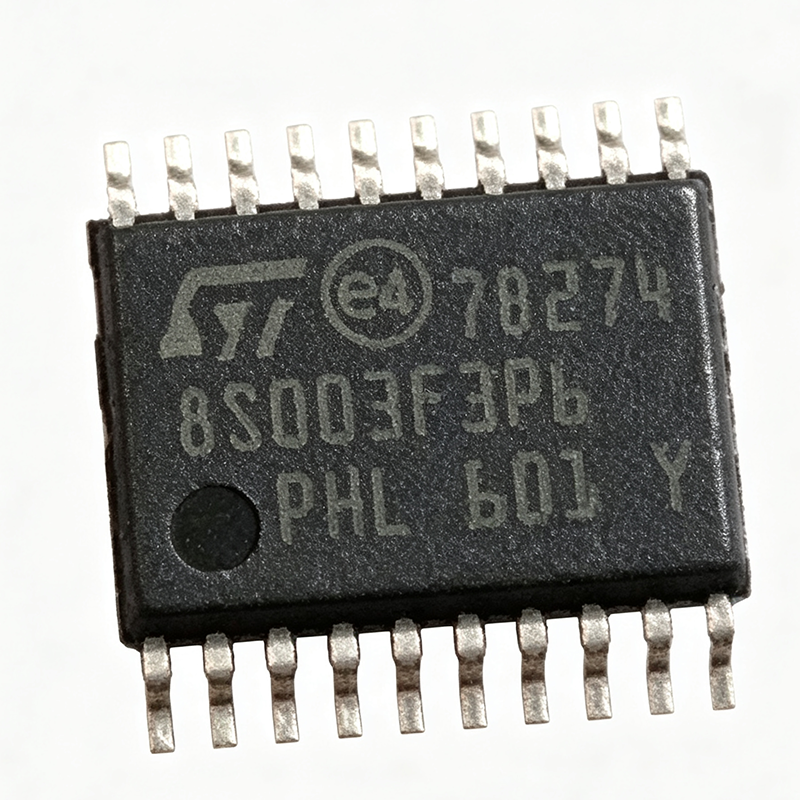
STM8S003F3P6 - 8-bit MCU 8KB Flash 16MHz TSSOP-20 | STMicroelectronics
The STMicroelectronics STM8S003F3P6 is a value line 8-bit microcontroller based on the STM8 core, running at up to 16 MHz with 8 KB of Flash memory, 1 KB of RAM, and 128 bytes of true data EEPROM in a 20-pin TSSOP package. An 8-bit microcontroller (MCU) is a single-chip computer integrating an 8-bit CPU, program memory, data memory, and programmable peripherals. The STM8S003F3P6 belongs to the STM8S series within the STM8 family, positioned below the 32-bit STM32 series in STMicroelectronics' product hierarchy and targeting cost-sensitive embedded control. Key features include 8 KB Flash with integrated true EEPROM (up to 100,000 write/erase cycles), a 10-bit ADC with 5 channels, and UART, SPI, and I2C interfaces. The device operates from 2.95V to 5.5V, supporting both 3.3V and 5V systems, with 16 programmable I/Os and 7 timers/counters including a 16-bit timer, an 8-bit timer, and watchdog timers. The STM8 core uses a Harvard-architecture 3-stage pipeline delivering 16 MIPS at 16 MHz. An internal 16 MHz RC oscillator eliminates the need for an external crystal in many designs. Low-power modes include Halt, Active-Halt, and Wait, with 3.6 mA typical in Run mode at 16 MHz and about 1 uA in Halt mode. Typical applications include home appliances, industrial control, consumer electronics, motor control helpers, and sensor interfaces. Its wide voltage range and robust I/O make it popular in white goods, power tools, and battery-powered devices, while the integrated EEPROM removes external non-volatile memory from the BOM. Design tip: decouple VDD with a 100 nF capacitor placed close to the pin. The internal RC is accurate to approximately 2%, so use an external crystal when precise timing is required. SWIM single-wire in-circuit programming simplifies firmware updates. This page synthesizes distributor pricing, drop-in alternatives, and practical design notes beyond the ST datasheet, as of 2026-08-29.

STM8S003F3P6TR - 8-bit MCU, 8KB Flash, 16MHz | STMicroelectronics
The STMicroelectronics STM8S003F3P6TR is an 8-bit microcontroller based on the STM8 core, offering 8KB of Flash memory, 1KB of RAM, and 640 bytes of EEPROM in a 20-pin TSSOP package. It operates at a maximum frequency of 16 MHz and supports a supply voltage range of 2.95V to 5.5V, making it suitable for a wide range of cost-sensitive embedded applications. Data verified as of 2026-08-05. An 8-bit microcontroller (MCU) is a compact integrated circuit that contains a processor core, memory, and programmable input/output peripherals on a single chip. The STM8 core is an 8-bit CISC architecture designed for high code density and efficient performance in low-cost applications. As a member of the STM8S series, this MCU sits within the broader hierarchy of microcontrollers, which are themselves a subset of embedded processors used in everything from consumer electronics to industrial control systems. Key features include 8KB of Flash program memory, 1KB of SRAM, and 640 bytes of true data EEPROM with write protection. The device integrates a 10-bit analog-to-digital converter (ADC) with up to 5 channels, a UART, SPI, and I2C interface, and a 16-bit timer with PWM capability. It also includes a watchdog timer, a clock security system, and a low-power mode to minimize energy consumption. The STM8S003F3P6TR is built on a robust 8-bit architecture with a 3-stage pipeline, enabling most instructions to execute in a single clock cycle. The device supports a wide operating temperature range from -40°C to +85°C, making it reliable for industrial environments. The TSSOP-20 package offers a compact footprint of 6.4mm x 4.4mm, ideal for space-constrained PCB designs. Typical applications include home appliances, small appliances, lighting control, power tools, and sensor interfaces. Its rich peripheral set and low cost make it a popular choice for high-volume consumer products where cost efficiency is paramount. When designing with this MCU, ensure proper decoupling of the VDD pin with a 100nF capacitor placed close to the device. The NRST pin should be connected to VDD through a 100nF capacitor and a pull-up resistor to prevent spurious resets. For programming, the SWIM interface requires a single-wire connection, simplifying in-circuit programming. This page synthesizes distributor pricing, drop-in alternatives, and practical design notes not found in the ST datasheet, providing engineers with a comprehensive resource for evaluating the STM8S003F3P6TR.
STM8S005C6T6 - 8-bit MCU, 32KB Flash, 16MHz | STMicroelectronics
The STM8S005C6T6 is an 8-bit microcontroller from STMicroelectronics' STM8S value line, featuring a 16 MHz STM8 core, 32 Kbytes of Flash program memory, and 128 bytes of data EEPROM. It is housed in a 48-pin LQFP (7x7 mm) package, offering a compact footprint for space-constrained embedded applications. An 8-bit microcontroller (MCU) is a single-chip computer with an 8-bit data bus, integrating a processor core, memory, and programmable peripherals. The STM8S005C6T6 belongs to the STM8S family, which is part of the broader STM8 8-bit MCU category, positioned below 32-bit ARM Cortex-M devices in the microcontroller hierarchy. It provides a cost-effective solution for applications requiring moderate processing power and rich peripheral integration without the complexity of 32-bit architectures. Key features include a 16 MHz CPU clock, 32 KB Flash, 2 KB RAM, 128 bytes EEPROM, and a comprehensive set of peripherals: 10-bit ADC, UART, SPI, I2C, timers, and up to 38 I/O pins. The device operates from a 2.95V to 5.5V supply, making it suitable for both 3.3V and 5V systems. Its robust ESD protection and wide operating temperature range (-40°C to +85°C) enhance reliability in industrial environments. The STM8S005C6T6 is built on ST's proprietary STM8 core, which delivers up to 20 MIPS at 16 MHz, providing efficient code execution for control-oriented tasks. The integrated EEPROM allows data storage without external components, simplifying BOM and reducing system cost. The device supports in-circuit programming and debugging via SWIM interface, enabling rapid firmware development. Typical applications include home appliances, industrial control, sensor interfaces, and consumer electronics. Its 5V-tolerant I/Os and rich peripheral set make it ideal for motor control, lighting, and power management systems. The wide voltage range and low power consumption support battery-powered devices. When designing with this MCU, ensure proper decoupling of the VDD pins with 100nF capacitors and a bulk capacitor. The SWIM pin should be pulled high for programming. For EMC-sensitive designs, follow ST's layout guidelines for the LQFP package to minimize noise coupling.

STM8S007C8T6 - 8-Bit MCU, 64KB Flash, 24MHz | STMicroelectronics
The STM8S007C8T6 is an 8-bit microcontroller from STMicroelectronics' STM8S Value Line family, featuring a 24MHz advanced STM8 core with Harvard architecture and a 3-stage pipeline. It comes in a 48-pin LQFP package and offers 64KB of Flash memory, 6KB of RAM, and true data EEPROM. With 38 programmable I/O lines, 9 timers/counters, and interfaces including I2C, SPI, and 2 UARTs, this MCU is designed for cost-sensitive embedded applications requiring robust performance and low power consumption. An 8-bit microcontroller is a single-chip computer with an 8-bit central processing unit (CPU), memory, and programmable input/output peripherals. It is a type of embedded microcontroller, which is a compact integrated circuit designed to govern a specific operation in an embedded system. The STM8S007C8T6 belongs to the STM8 family, which is a line of 8-bit microcontrollers from STMicroelectronics, positioned between low-end 8-bit MCUs and higher-performance 32-bit ARM Cortex-M devices. Its Harvard architecture separates instruction and data buses, enabling simultaneous access and faster execution, while the 3-stage pipeline increases throughput at a given clock frequency. Key features of the STM8S007C8T6 include a maximum CPU frequency of 24MHz with 0 wait states at 16MHz, 64KB of Flash memory, 6KB of RAM, and true data EEPROM for non-volatile data storage. It integrates a 10-bit ADC, multiple timers, and communication interfaces (I2C, SPI, 2 UARTs), making it versatile for various control and monitoring tasks. The device operates over a temperature range of -40°C to 85°C and has a maximum power dissipation of 443mW, suitable for industrial and consumer environments. Technically, the STM8 core is an advanced 8-bit architecture with a 3-stage pipeline, allowing most instructions to execute in a single clock cycle. The 24MHz clock speed provides up to 24 MIPS throughput, which is competitive for 8-bit MCUs. The Flash memory supports in-application programming (IAP) and in-circuit programming (ICP), enabling firmware updates in the field. The true data EEPROM allows for byte-level read/write operations, useful for storing calibration data or system parameters without external memory. Typical applications include home appliances, industrial control, sensor interfacing, and automotive body electronics. The rich peripheral set and 38 I/O lines make it suitable for motor control, lighting systems, and human-machine interfaces. Its low power consumption and wide operating voltage range (typically 2.95V to 5.5V) support battery-powered devices and 5V logic systems. When designing with this MCU, consider the power supply decoupling and crystal oscillator layout. Use a 0.1uF capacitor close to each VDD pin and a 10uF bulk capacitor. For the external crystal, place it near the OSC pins with proper load capacitors as specified in the datasheet. Ensure the reset pin has a pull-up resistor and a capacitor for reliable power-on reset.
STM8S105C6T6 - 8-bit MCU, 16MHz, 32KB Flash | STMicroelectronics
The STM8S105C6T6 is an 8-bit microcontroller from STMicroelectronics' STM8S access line, featuring a 16 MHz advanced STM8 core with Harvard architecture and a 3-stage pipeline. It offers 32 KB of Flash program memory, 2 KB of RAM, and 1 KB of true data EEPROM, making it a cost-effective solution for a wide range of embedded control applications. The device is housed in a 48-pin LQFP package (7x7 mm) and operates over a supply voltage range of 2.95V to 5.5V, with an operating temperature range of -40°C to +85°C. An 8-bit microcontroller (MCU) is a single-chip computer with an 8-bit data bus, integrating a processor core, memory, and programmable input/output peripherals. The STM8S105C6T6 belongs to the STM8S family, which is part of the broader STM8 microcontroller series, positioned below the 32-bit STM32 family in STMicroelectronics' product hierarchy. It is designed for applications requiring moderate processing power, low power consumption, and rich peripheral integration, such as industrial control, home appliances, and automotive body electronics. Key features include a 10-bit analog-to-digital converter (ADC) with up to 10 channels, multiple 16-bit timers, and a full set of communication interfaces: UART, SPI, and I2C. The device also integrates a true data EEPROM with up to 300,000 write/erase cycles, enabling data storage without external memory. The STM8 core operates at up to 16 MHz, delivering 16 MIPS throughput, and supports a wide range of clock sources including internal RC oscillators and external crystals. The STM8S105C6T6 is built on a high-density Flash technology, providing robust program memory endurance and fast programming. The architecture includes a nested interrupt controller with 28 interrupt vectors, enhancing real-time responsiveness. The device also features a low-power mode with typical current consumption of 5 µA in Halt mode, making it suitable for battery-powered applications. Typical applications include industrial automation, home appliances (e.g., washing machines, air conditioners), power tools, and automotive body control modules. The rich peripheral set and 5V-tolerant I/Os allow direct interfacing with sensors, relays, and displays without level shifting. The LQFP-48 package provides 38 I/O pins, offering ample connectivity for control and communication. When designing with this MCU, ensure proper decoupling of the VDD and VDDA pins with 100 nF capacitors placed close to the device. The NRST pin should be connected to a 100 nF capacitor to ground for reliable reset. For applications requiring precise timing, use an external crystal oscillator with load capacitors as specified in the datasheet.
STM8S105K4T6 - 8-bit MCU, 16KB Flash, 16MHz | STMicroelectronics
The STM8S105K4T6 is an 8-bit microcontroller from STMicroelectronics' STM8S access line, featuring a 16 MHz STM8 core, 16 KB of Flash program memory, and 1 KB of true data EEPROM. It comes in a 32-pin LQFP package, offering a compact footprint for space-constrained embedded applications. The device operates over a supply voltage range of 2.95V to 5.5V, making it suitable for both 3.3V and 5V systems. An 8-bit microcontroller (MCU) is a single-chip computer containing a processor core, memory, and programmable input/output peripherals. The STM8S105K4T6 belongs to the STM8S family, which is designed for cost-sensitive industrial and consumer applications. As a medium-density device per reference manual RM0016, it balances performance and peripheral integration, providing a 10-bit ADC, multiple timers, and standard communication interfaces like UART, SPI, and I2C. Key features include a 16 MHz CPU clock delivering up to 16 MIPS, 16 KB Flash with read-while-write capability, 1 KB EEPROM with up to 300k write/erase cycles, and a 10-bit ADC with up to 7 channels. The device integrates a 16-bit advanced control timer, two 16-bit general-purpose timers, and a basic timer, plus UART, SPI, and I2C interfaces for connectivity with sensors, displays, and other peripherals. The STM8S105K4T6 uses a Harvard-architecture STM8 core with a 3-stage pipeline. An embedded SWIM debug module enables in-circuit debugging and programming, reducing development time. The clock system offers internal and external oscillator options, including a low-power crystal oscillator and a PLL for clock multiplication. Typical applications include industrial control, home appliances, sensor interfaces, and motor control. Its wide operating voltage range and industrial temperature grade (-40C to +85C) make it suitable for harsh environments. The integrated EEPROM eliminates external storage in many designs, reducing BOM cost. When designing with this MCU, ensure proper decoupling of power supply pins and consider the thermal characteristics of the LQFP-32 package. Reserve the SWIM interface for programming and debugging. For low-power designs, use Active-halt and Halt modes to minimize current consumption.
STM8S105S6T6 - 8-bit MCU, 32KB Flash, 16MHz | STMicroelectronics
The STM8S105S6T6 is an 8-bit microcontroller from STMicroelectronics' STM8S access line, featuring a high-performance STM8 core running at up to 16 MHz. It integrates 32 Kbytes of Flash program memory, 2 Kbytes of RAM, and true data EEPROM, making it suitable for a wide range of embedded control applications. The device operates from a 3.3V or 5V supply and is available in a 44-pin LQFP package. An 8-bit microcontroller is a single-chip computer with an 8-bit data bus, designed for cost-sensitive control applications. It typically integrates a CPU, memory (Flash, RAM, EEPROM), and peripherals such as timers, UART, SPI, and ADC on a single die. In the system hierarchy, an 8-bit MCU sits below 16-bit and 32-bit MCUs in processing power but offers lower cost, lower power consumption, and simpler development, making it ideal for applications like home appliances, industrial control, and consumer electronics. Key features of the STM8S105S6T6 include a 10-bit ADC with up to 10 channels, multiple 16-bit timers, a UART, SPI, and I2C interfaces, and an integrated EEPROM for data storage. The STM8 core is CISC-based with a pipeline architecture, achieving 16 MIPS at 16 MHz. The device supports a wide operating voltage range of 2.95V to 5.5V, ensuring compatibility with both 3.3V and 5V systems. The STM8S105S6T6 is part of the STM8S105xx medium-density family, which offers from 16 to 32 Kbytes of Flash. It is pin-compatible with other STM8S105 devices, allowing easy migration between memory sizes. The integrated EEPROM eliminates the need for external EEPROM chips, reducing BOM cost and board space. The device also features robust ESD protection and a wide operating temperature range of -40°C to +85°C. Typical applications include home appliances (washing machines, air conditioners), industrial control (motor control, sensors), and consumer electronics (remote controls, power tools). The rich peripheral set and low cost make it a popular choice for high-volume applications. The 44-pin LQFP package provides a good balance between I/O count and board space. When designing with this MCU, ensure proper decoupling of the power supply with 100nF and 10uF capacitors close to the VDD pins. The STM8S105S6T6 supports in-circuit programming and debugging via SWIM, simplifying firmware development. For low-power applications, use the HALT and WAIT modes to reduce current consumption.
STM8S207C8T6 - 24MHz 8-bit MCU, 64KB Flash | STMicroelectronics
The STM8S207C8T6 is a performance-line 8-bit microcontroller from STMicroelectronics, built around a high-performance STM8 core running at up to 24 MHz. It integrates 64 KB of Flash program memory, 4 KB of RAM, and 2 KB of EEPROM, along with a rich peripheral set including a 10-bit ADC, multiple timers, two UARTs, SPI, I2C, and CAN. Housed in a 48-pin LQFP package, this MCU is designed for cost-sensitive industrial and consumer applications requiring robust performance and a wide operating voltage range of 2.95V to 5.5V. An 8-bit microcontroller (MCU) is a single-chip computer with an 8-bit data bus that integrates a processor core, memory (Flash, RAM, EEPROM), and programmable peripherals (timers, ADC, communication interfaces) on one die. In the system hierarchy, an 8-bit MCU sits below 16-bit and 32-bit MCUs in processing power but offers lower cost, simpler architecture, and lower power consumption, making it ideal for control-oriented tasks. The STM8S207C8T6 belongs to the STM8 family from STMicroelectronics, positioned between the low-cost STM8S value line and the 32-bit ARM-based STM32 MCUs. Key features include a 24 MHz CPU clock (20 MIPS), 64 KB Flash with read-while-write capability, 2 KB of true EEPROM rated for up to 300k write/erase cycles, and a 10-bit ADC with up to 10 multiplexed channels. Communication interfaces cover two UARTs, one SPI, one I2C, and a CAN 2.0B controller. Operation from 2.95V to 5.5V supports both 3.3V and 5V systems, with low-power modes reducing consumption below the 5.4 mA typical running current at 24 MHz. Technically, the STM8 core is a CISC architecture with a 3-stage pipeline and a single-wire debug interface (SWIM) supporting ICP and IAP programming. The LQFP-48 package provides 38 I/O pins, most with multiple alternate functions for flexible board design. Typical applications include industrial control systems, home appliances, motor control, sensor interfaces, and CAN-networked nodes in automotive and industrial systems, where the rich timer set supports PWM generation. Design tip: decouple VDD/VDDA with 100nF capacitors placed close to the device, add a pull-up on SWIM, and use an external transceiver (e.g., TJA1050) with 120-ohm bus termination for CAN.
STM8S207K6T6 - 24MHz 8-bit MCU, 32KB Flash | STMicroelectronics
The STM8S207K6T6 is a performance-line 8-bit microcontroller from STMicroelectronics, featuring a 24 MHz STM8 core with up to 32 Kbytes of Flash program memory. It integrates 2 Kbytes of data EEPROM, a 10-bit ADC, multiple timers, two UARTs, SPI, I²C, and CAN interfaces, all in a 32-pin LQFP package. This MCU is designed for cost-sensitive industrial and consumer applications requiring robust communication and control capabilities. An 8-bit microcontroller (MCU) is a single-chip computer with an 8-bit data bus, executing instructions on 8-bit words. It integrates a CPU, memory (Flash, RAM, EEPROM), and peripherals (timers, ADC, communication interfaces) on one die. In the system hierarchy, an 8-bit MCU sits below 16-bit and 32-bit MCUs in processing power but offers lower cost, simpler architecture, and lower power consumption, making it ideal for control-oriented tasks like motor control, sensor interfacing, and human-machine interfaces. The STM8S207K6T6 belongs to the STM8S20xxx performance line, which balances performance and peripheral richness for mid-range embedded applications. Key features include a 24 MHz CPU clock, 32 Kbytes of Flash, 2 Kbytes of RAM, 2 Kbytes of EEPROM, a 10-bit ADC with up to 10 channels, two 16-bit timers, one 8-bit timer, two UARTs, SPI, I²C, and a CAN 2.0B controller. The device operates from 2.95V to 5.5V, making it suitable for 3.3V and 5V systems. It also features a low-power mode with typical current consumption of 5.4 mA at 24 MHz, and a halt mode with 1.5 µA typical current. The STM8S207K6T6 uses a Harvard architecture with a 3-stage pipeline, achieving up to 20 MIPS at 24 MHz. It includes an embedded debug module (SWIM) for in-circuit debugging and programming, and a single-wire interface for firmware updates. The CAN controller supports CAN 2.0B active mode, enabling robust industrial networking. The device is manufactured using ST's proprietary 130nm process, balancing performance and power efficiency. Typical applications include industrial control systems, home appliances, automotive body electronics (non-safety), sensor nodes, and communication gateways. The CAN interface makes it particularly suitable for automotive and industrial CAN bus networks, while the multiple UARTs and SPI/I²C support diverse peripheral connectivity. When designing with this MCU, ensure proper decoupling of the VDD and VDDA pins with 100nF capacitors placed close to the pins. The SWIM pin should be pulled up with a 10kΩ resistor for reliable programming. For CAN applications, an external CAN transceiver (e.g., TJA1050) is required, and the bus termination resistor should be 120Ω at each end of the CAN bus.
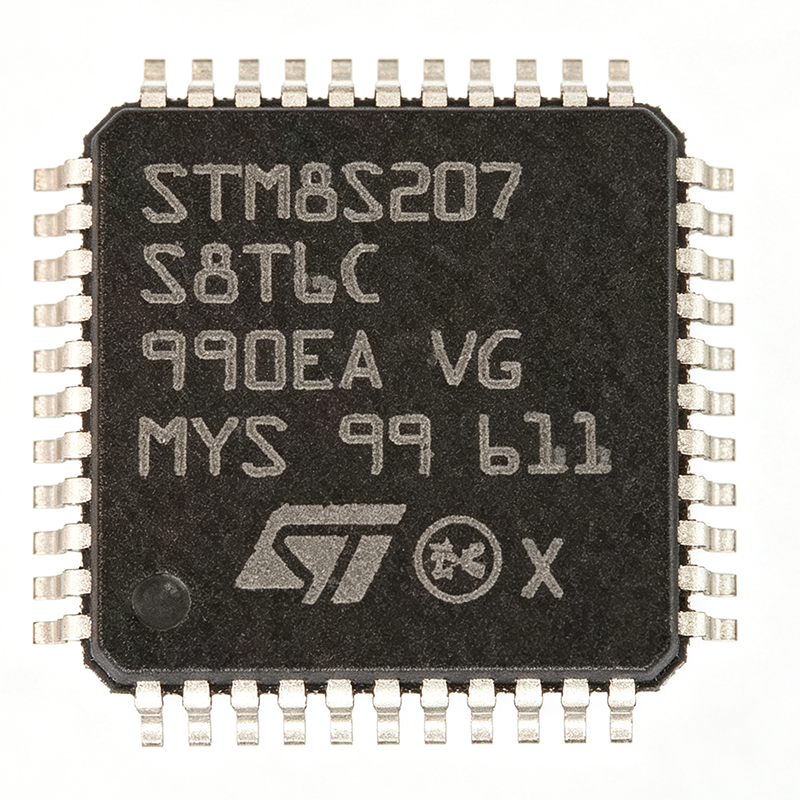
STM8S207S8T6 - 24MHz 8-bit MCU, 64KB Flash | STMicroelectronics
The STM8S207S8T6 is a performance-line 8-bit microcontroller from STMicroelectronics, operating at up to 24 MHz with 64 Kbytes of Flash program memory. It is part of the STM8S20xxx family, which offers from 32 to 128 Kbytes of Flash, and is housed in a 44-pin LQFP package. The device integrates a rich set of peripherals including a 10-bit ADC, multiple timers, two UARTs, SPI, I2C, and CAN, making it suitable for a wide range of industrial and consumer applications. An 8-bit microcontroller (MCU) is a single-chip computer with an 8-bit data bus, executing instructions on 8-bit words. It typically integrates a CPU core, memory (Flash, RAM, EEPROM), and programmable peripherals on a single die. In the system hierarchy, an 8-bit MCU sits below 16-bit and 32-bit counterparts in processing power but offers lower cost, simpler architecture, and adequate performance for control-oriented tasks. The STM8S207S8T6 belongs to the STM8S performance line, which is designed for applications requiring higher clock speeds and richer connectivity than the value line, while maintaining the ease of use and robustness of the STM8 core. Key features of the STM8S207S8T6 include a 24 MHz CPU clock, 64 KB of Flash memory, 2 KB of data EEPROM, and a 10-bit ADC with up to 16 multiplexed channels. It also provides two UARTs, one SPI, one I2C, and a CAN 2.0B interface, enabling flexible communication in industrial networks. The device operates from a 3.3V or 5V supply, with a wide operating temperature range of -40°C to +85°C, and is available in a 44-pin LQFP package with a 10x10 mm body and 0.8 mm pitch. Technically, the STM8S207S8T6 is built on a high-performance 8-bit core with a three-stage pipeline, achieving up to 20 MIPS at 24 MHz. It includes a nested interrupt controller, a clock controller with multiple sources (internal RC, external crystal, or PLL), and a comprehensive set of timers including a 16-bit advanced control timer, two 16-bit general-purpose timers, and an 8-bit basic timer. The device also features a CAN controller with 3 mailboxes, supporting both standard and extended identifiers, which is critical for automotive and industrial networking. Typical applications include industrial control systems, home appliances, power tools, and automotive body electronics. The CAN interface makes it particularly suitable for automotive networks, while the rich timer set and ADC support motor control and sensor interfacing. The 5V tolerance simplifies direct connection to legacy sensors and actuators without level shifting. When designing with this MCU, ensure proper decoupling of the VDD and VDDA pins with 100 nF capacitors placed close to the device. The internal RC oscillator can be used for cost-sensitive designs, but for precise timing, an external crystal is recommended. The STM8S207S8T6 supports in-circuit programming and debugging via the SWIM interface, which requires a single-wire connection and simplifies firmware updates.
STM8S208C8T6 - 8-Bit 24MHz MCU, 64KB Flash | STMicroelectronics
The STM8S208C8T6 is a high-performance 8-bit microcontroller from STMicroelectronics, part of the STM8S Performance line. It operates at a maximum frequency of 24 MHz and features 64 KB of Flash memory, 2 KB of EEPROM, and 4 KB of RAM. The device is housed in a 48-pin LQFP package (7x7 mm) and supports a supply voltage range of 2.95V to 5.5V, making it suitable for a wide range of industrial and consumer applications. An 8-bit microcontroller (MCU) is a single-chip computer with an 8-bit central processing unit (CPU), memory, and peripherals. It is a type of embedded processor used to control electronic systems. In the hierarchy of computing devices, an 8-bit MCU is a subset of microcontrollers, which are a subset of embedded systems, which are a subset of electronic systems. The STM8S208C8T6 is a CISC (Complex Instruction Set Computer) architecture MCU, offering a rich instruction set and efficient code density. Key features of the STM8S208C8T6 include a 10-bit analog-to-digital converter (ADC) with up to 16 channels, multiple timers (including a 16-bit advanced control timer, a 16-bit general-purpose timer, and a basic timer), and a comprehensive set of communication interfaces: two UARTs, one SPI, one I2C, and one CAN interface. The device also includes an integrated EEPROM for data storage, a watchdog timer, and a low-power mode for energy-efficient operation. The STM8S208C8T6 is built on a high-performance 8-bit core with a three-stage pipeline, achieving up to 20 MIPS at 24 MHz. It features a flexible clock control with an internal RC oscillator, an external crystal oscillator, and a phase-locked loop (PLL) for frequency multiplication. The device supports in-circuit programming and debugging via the SWIM (Single Wire Interface Module) interface, simplifying firmware development and field updates. Typical applications include industrial control systems, home automation, consumer electronics, automotive body electronics, and power management. The CAN interface makes it particularly suitable for automotive and industrial networking applications where robust communication is required. The wide operating voltage range and low-power modes enable battery-powered and energy-harvesting designs. When designing with the STM8S208C8T6, ensure proper decoupling of the power supply pins with 100nF capacitors placed close to the VDD and VSS pins. The SWIM interface should be reserved for programming and debugging. For CAN applications, an external CAN transceiver (e.g., TJA1050) is required. The device is RoHS compliant and available in tray packaging.
STM8S208R8T6 - 8-Bit 24MHz 64KB Flash MCU | STMicroelectronics
The STM8S208R8T6 is a high-performance 8-bit microcontroller from STMicroelectronics' STM8S series, featuring a 24 MHz CPU core, 64KB of Flash program memory, and 6KB of RAM. It is housed in a 64-pin LQFP package (10x10 mm) and operates from a 3.3V or 5V supply, making it suitable for a wide range of industrial and consumer applications. An 8-bit microcontroller (MCU) is a single-chip computer with an 8-bit data bus, integrating a CPU, memory, and peripherals. The STM8S series is a family of 8-bit MCUs from STMicroelectronics, positioned between low-end 8-bit devices and 32-bit ARM-based MCUs. It offers a cost-effective solution for applications requiring moderate processing power, rich peripherals, and low power consumption. The STM8S208R8T6 belongs to the performance line, which provides higher clock speeds and more memory compared to access line devices. Key features include a 24 MHz maximum CPU frequency with 0 wait states, 64KB of Flash memory, 6KB of RAM, and 2KB of EEPROM. It integrates a 10-bit ADC with up to 16 channels, multiple 16-bit timers, two UARTs, SPI, I2C, and a CAN interface. The device also includes a watchdog timer, brown-out reset, and low-power modes, enhancing reliability and energy efficiency. The STM8S208R8T6 is built on ST's advanced 8-bit core architecture, which delivers up to 20 MIPS at 24 MHz. It features a Harvard architecture with separate instruction and data buses, allowing simultaneous instruction fetch and data access. The integrated EEPROM enables non-volatile data storage without external components, and the CAN interface supports robust communication in automotive and industrial networks. Typical applications include industrial control systems, home appliances, automotive body electronics, and communication modules. The CAN interface makes it ideal for automotive networks, while the rich timer and ADC peripherals suit motor control and sensor interfacing. The wide operating voltage range (2.95V to 5.5V) ensures compatibility with both 3.3V and 5V logic systems. When designing with this MCU, ensure proper decoupling of the power supply and a stable clock source. The device supports multiple clock sources, including an internal RC oscillator and external crystal. For low-power applications, utilize the halt and active-halt modes to reduce current consumption. The CAN interface requires an external transceiver, such as the TJA1050, for physical layer connectivity.
STM8S903K3T6 - 8-bit MCU, 8KB Flash, 16MHz | STMicroelectronics
The STM8S903K3T6 is an 8-bit microcontroller from STMicroelectronics' STM8S access line, featuring 8 Kbytes of Flash program memory, 1 Kbyte of RAM, and 640 bytes of true data EEPROM. It operates at a clock speed of 16 MHz and is supplied in a 32-pin LQFP package, offering a compact solution for a wide range of embedded control applications. An 8-bit microcontroller (MCU) is a single-chip computer with an 8-bit central processing unit (CPU), memory, and programmable input/output peripherals. It is the foundational building block in the hierarchy of embedded systems, sitting below 16-bit and 32-bit MCUs in processing power but offering lower cost, lower power consumption, and simpler programming. The STM8S903K3T6 belongs to the STM8S family, which is designed for general-purpose industrial and consumer applications, bridging the gap between simple 8-bit controllers and more complex 32-bit processors. Key features of the STM8S903K3T6 include a 10-bit analog-to-digital converter (ADC) with up to 7 multiplexed channels, two 16-bit timers, a UART for serial communication, an SPI interface, and an I2C interface. The device also integrates a true data EEPROM with read-while-write capability, enabling non-volatile data storage without external components. The supply voltage range of 2.95V to 5.5V allows operation from standard 3.3V and 5V power rails, making it versatile for mixed-voltage systems. The STM8S903K3T6 is built on ST's advanced 8-bit core architecture, which delivers up to 16 MIPS at 16 MHz, providing efficient execution of control algorithms. The integrated EEPROM and robust clock management, including an internal RC oscillator and optional external crystal, simplify system design by reducing external component count. The device also features low-power modes, including Active-Halt and Halt modes, to minimize energy consumption in battery-powered applications. Typical applications include industrial control systems, home automation, consumer electronics, and automotive body electronics. The combination of analog and digital peripherals, along with the wide operating voltage range, makes it suitable for sensor interfacing, motor control, and communication bridging tasks. The 32-pin LQFP package provides a good balance between I/O count and board space, supporting compact PCB layouts. When designing with the STM8S903K3T6, ensure proper decoupling of the VDD and VDDA pins with 100nF capacitors placed close to the device. The internal RC oscillator is accurate to ±1% over temperature, but for applications requiring precise timing, an external crystal can be connected to the OSC_IN and OSC_OUT pins. The device's EEPROM endurance is rated for 100,000 write/erase cycles, making it suitable for frequent data logging applications.
TDA4VE88TGAALZRQ1 - 8 TOPS AI SoC | Texas Instruments
The Texas Instruments TDA4VE88TGAALZRQ1 is a high-performance automotive System-on-Chip (SoC) designed for vision perception and analytics. It integrates dual Arm Cortex-A72 processors running at 2 GHz, a Cortex-R5F real-time core at 1 GHz, C66x and C7x DSPs, and an 8 TOPS AI accelerator. The device also includes a GPU for graphics acceleration. It is offered in a 770-pin FCBGA (ALZ) package measuring 23x23 mm, supporting an operating temperature range of -40°C to +125°C. What is a System-on-Chip (SoC)? An SoC is a semiconductor device that integrates multiple computing units, including CPU cores, DSPs, GPU, AI accelerators, and memory interfaces, onto a single chip. It is a higher-level integration than a microprocessor, combining system functionality to reduce board complexity. In the automotive domain, SoCs are the central compute hub for ADAS, autonomous driving, and infotainment. Key features include dual 2 GHz Cortex-A72 cores for application processing, a 1 GHz Cortex-R5F for real-time control, and C66x and C7x DSPs for signal processing. The 8 TOPS AI accelerator enables deep learning inference at the edge, supporting tasks such as object detection and semantic segmentation. The integrated GPU provides 3D rendering capability for surround-view systems. The SoC uses a heterogeneous architecture to optimize power and performance. The A72 cores handle Linux-based automotive stacks, while the DSPs offload real-time sensor processing. The 770-pin FCBGA (ALZ) package offers excellent thermal performance with a 23x23 mm footprint, enabling dense system integration. The AEC-Q100 qualification ensures reliability across the automotive temperature range. Typical applications include ADAS domain controllers, autonomous driving systems, surround-view camera processing, radar signal processing, and in-vehicle infotainment. Its 8 TOPS AI is particularly suited for vision-perception systems where real-time object detection is critical. When designing with this SoC, ensure proper power sequencing using a PMIC like TPS6594-Q1 and adequate thermal management. The high-speed interfaces require careful PCB design with controlled impedance. Refer to TI's Jacinto 7 reference designs for guidance.
TDA4VL21HGAALZRQ1 - 4 TOPS ADAS SoC | Texas Instruments
The Texas Instruments TDA4VL21HGAALZRQ1 is an automotive system-on-chip (SoC) from the Jacinto TDA4VL-Q1 processor family, engineered for vision perception and analytics. It integrates dual Arm Cortex-A72 cores running up to 2 GHz, Arm Cortex-R5F cores up to 1 GHz, C7x and C66x DSPs up to 1 GHz, an integrated GPU, and a deep-learning accelerator delivering 4 TOPS of AI performance. The device is housed in a 770-ball FCBGA (ALZ) package measuring 23 x 23 mm with 0.8 mm terminal pitch and is rated from -40C to +125C for automotive environments. An automotive vision SoC is a single-chip microprocessor (MPU) subsystem that combines a general-purpose application-processor cluster, a real-time MCU island, digital signal processors, dedicated neural-network acceleration, graphics, and rich automotive I/O on one die. Within the semiconductor hierarchy - semiconductor to microprocessor to system-on-chip to ADAS vision processor - the TDA4VL-Q1 represents the cost-optimized tier of TI's Jacinto platform, sharing its architecture, package technology, and software stack with the TDA4VE and TDA4AL family members under one datasheet. Key features begin with the 4 TOPS deep-learning engine, which executes object-detection, classification, and segmentation networks for camera-based ADAS. Heterogeneous compute lets the Cortex-A72 cluster run high-level operating systems while Cortex-R5F cores close real-time safety loops and the C7x/C66x DSPs accelerate vision kernels. Distributor parametric data lists a 0.84 V maximum core supply, 770 terminals, and device marking TDA4VL21 at silicon revision 1.0. Technically, the TDA4VL21HGAALZRQ1 is covered by the 251-page TI datasheet TDA4VE/TDA4AL/TDA4VL Jacinto Processors, Silicon Revision 1.0, confirming that the ball map, board design, and boot configuration are common across the three variants - a significant advantage for platform reuse and mid-cycle cost-downs. DigiKey and Mouser list the part as an automotive system-on-a-chip with AI accelerator in the 770-FCBGA (23x23) package. Typical applications include single front-camera ADAS ECUs using 4 TOPS neural inference, driver and in-cabin monitoring systems, multi-camera surround view, radar-vision sensor fusion with devices such as the AWR2188 mmWave radar, and industrial edge-AI vision nodes. Companion XAIPART listings include the AR0821CS image sensor and TI automotive PMICs. Design consideration: validate silicon revision 1.0 errata before production, implement the power-up sequencing defined in the TI datasheet with an automotive PMIC, and budget thermal relief under the 23 x 23 mm FCBGA, since high-TOPS workloads concentrate heat in the die area.
TDA5-Q1 - 1200 TOPS Edge AI SoC | Texas Instruments
The Texas Instruments TDA5-Q1 is a high-performance compute System-on-Chip (SoC) designed for safe and scalable edge AI applications. As part of the TDA5 family, it delivers up to 1200 TOPS of AI compute with an integrated C7 NPU and a chiplet-ready architecture. The SoC features multiple specialized subsystems, each tailored for high-performance compute across domains, including security, vision processing, edge AI, display rendering, and networking. A System-on-Chip (SoC) integrates multiple processing units, memory, and interfaces onto a single silicon die, enabling complex functions like AI inference in embedded systems. The TDA5-Q1 sits at the top of TI's Jacinto processor line, combining a general-purpose CPU, NPU, and specialized accelerators to handle real-time data from sensors and actuators. Key features of the TDA5-Q1 include up to 1200 TOPS AI performance, an integrated C7 NPU, and a chiplet-ready architecture that allows performance scaling. It also includes hardware accelerators for security, vision, and display, and supports ASIL-D functional safety, making it suitable for automotive and industrial applications. The TDA5-Q1 architecture is designed for cross-domain fusion, enabling simultaneous processing of camera, radar, LiDAR, and other sensor data. Its chiplet-ready design provides flexibility for future upgrades, while the integrated safety mechanisms ensure reliable operation in safety-critical scenarios. Typical applications include advanced driver assistance systems (ADAS), autonomous driving, humanoid and industrial robots, industrial transport, and aerospace and defense systems. The SoC's high AI compute and safety features make it ideal for edge AI workloads requiring low latency and deterministic performance. When designing with the TDA5-Q1, ensure adequate power and thermal management to handle the 1200 TOPS AI engine. The chiplet architecture also requires careful consideration of the inter-chiplet communication design to avoid bottlenecks. For detailed specifications, refer to the TI datasheet.
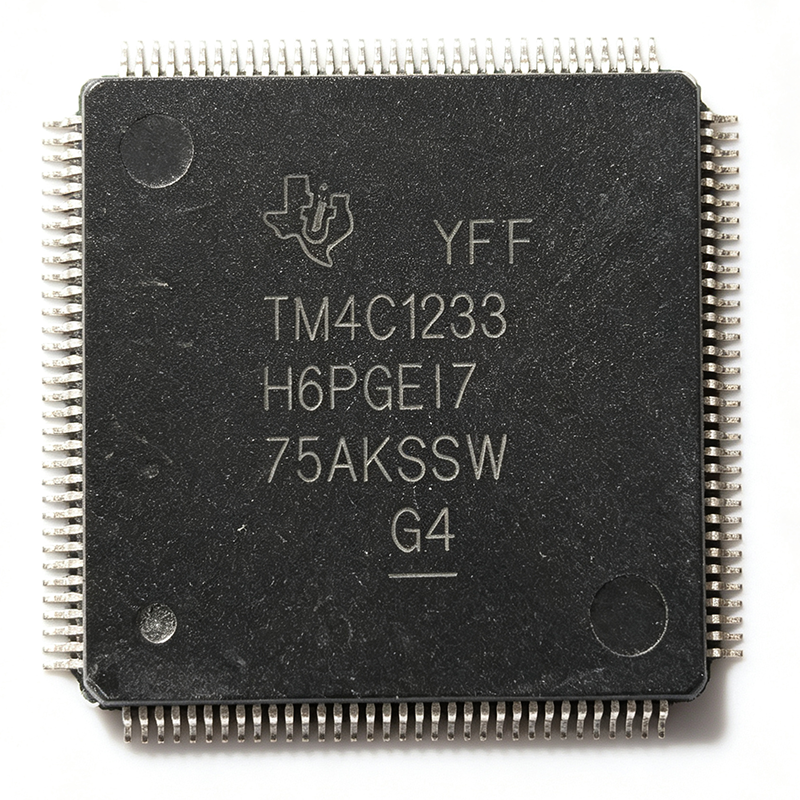
TM4C1233H6PGE - 80MHz Cortex-M4F MCU 256KB | Texas Instruments
The Texas Instruments TM4C1233H6PGE is a 32-bit Arm Cortex-M4F microcontroller running at 80 MHz with 256 KB flash, 32 KB SRAM, dual CAN 2.0 controllers, RTC, and USB device support, housed in a 144-pin LQFP (20x20 mm) package. A microcontroller unit (MCU) is a single-chip computer that integrates a processor core, memory, and peripherals on one die. Within the semiconductor hierarchy, the TM4C1233H6PGE belongs to the 32-bit embedded microcontroller class, part of the Tiva C Series TM4C123x family built on the Arm Cortex-M4F architecture, which adds a hardware single-precision FPU, DSP instructions, and a Memory Protection Unit (MPU) on top of the standard Cortex-M core. Key features include the 80 MHz core with integrated FPU and MPU, 256 KB of on-chip flash with in-system programming support, 32 KB of SRAM, and a rich peripheral set: up to two CAN 2.0 controllers, USB 2.0 device, multiple UART, SSI, and I2C modules, 12-bit ADCs, PWM generators, and a battery-backed hibernate module with real-time clock. This combination makes the device well suited to mixed-signal industrial control where deterministic real-time response and robust fieldbus connectivity are required. Technically, the device uses the Tiva C Series 123x platform with a nested vectored interrupt controller (NVIC), SysTick timer, and both a precision internal oscillator and main oscillator inputs. Flash-based memory supports firmware updates via CAN or UART bootloaders, easing field maintenance in deployed equipment. Typical applications cited by TI include remote monitoring, electronic point-of-sale machines, test and measurement equipment, network appliances and switches, factory automation, HVAC and building control, and fire and security systems. A key design consideration is SRAM budgeting: enabling USB stacks and RTOS middleware can consume several kilobytes of the 32 KB SRAM, so applications needing more headroom should evaluate the TM4C123GH6PGE variant or the TM4C129x class. This page synthesizes verified distributor data, drop-in same-family alternatives, pricing, and practical design notes not found in the manufacturer datasheet alone.