Microcontrollers
Products (422)

MSPM0G5187 - 80MHz Cortex-M0+ MCU, 128KB Flash, NPU | TI
The Texas Instruments MSPM0G5187 is a 32-bit ultra-low-power microcontroller based on an enhanced Arm Cortex-M0+ core operating at up to 80MHz, integrating 128KB of flash memory, 32KB of SRAM, USB 2.0 Full-Speed, I2S, a 12-bit ADC, and the TinyEngine NPU for edge-AI acceleration, housed in a 64-pin LQFP (10x10 mm) package. A microcontroller (MCU) is a single-chip embedded processor that combines a CPU core, memory, and programmable peripherals to govern a dedicated function within a larger system. MCUs sit within the broader hierarchy of semiconductor devices under the microcontroller and embedded processor category, and the MSPM0G5187 belongs to the MSPM0G series within Texas Instruments' long-standing MSP ultra-low-power MCU family, positioned for energy-efficient embedded sensing and on-device machine learning designs. Key differentiating features include the integrated TinyEngine NPU, which delivers up to 90x lower inference latency and more than 120x lower energy per inference compared with MCUs executing neural networks purely on the CPU, enabling always-on edge AI at milliwatt power budgets. The 128KB flash and 32KB SRAM support compact sensor-fusion models, while USB 2.0 FS, I2S, UART, SPI, and I2C interfaces cover connectivity and digital audio needs. Architecturally, the device uses a 32-bit Arm Cortex-M0+ core with a memory protection unit (MPU) and nested vectored interrupt controller (NVIC) for deterministic real-time behavior. The TinyEngine NPU offloads convolutional neural network inference from the CPU, reducing both latency and energy per inference. Cybersecurity enablers and high-performance integrated analog round out the mixed-signal capability. The supply voltage range is 1.62V to 3.6V with a -40C to +125C operating temperature range per TI product documentation. Typical applications include industrial automation and predictive maintenance, smart sensors with anomaly detection, portable medical monitoring devices, and battery-powered edge-AI endpoints where USB host connectivity or I2S digital audio is required alongside low-power inference. When designing, decouple all supply pins with 100nF ceramic capacitors placed close to the device, and budget SRAM carefully for NPU model weights and activations; multiple low-power modes extend battery life. This page synthesizes distributor availability data, drop-in alternative analysis, and practical design notes not found in the manufacturer datasheet.

MSPM0L1305-Q1 - Automotive 32MHz Cortex-M0+ MCU | Texas Instruments
The Texas Instruments MSPM0L1305-Q1 is an automotive-grade 32-bit Arm Cortex-M0+ microcontroller operating at up to 32 MHz. It integrates 32 KB flash memory, 4 KB SRAM, a 12-bit ADC, an operational amplifier (OPA), and LIN communication capability, making it suitable for cost-sensitive automotive mixed-signal applications. The device operates over a supply voltage range of 1.62 V to 3.6 V and is qualified to AEC-Q100 Grade 1, supporting ambient temperatures from -40°C to +125°C. What is an automotive mixed-signal microcontroller? A microcontroller (MCU) is a compact integrated circuit that combines a processor core, memory, and programmable input/output peripherals onto a single chip. The MSPM0 family belongs to the ultra-low-power, highly integrated 32-bit MSPM0 MCU series built around the enhanced Arm Cortex-M0+ core platform. These devices provide high-performance analog peripherals integration, enabling them to interface directly with sensors and actuators while reducing system component count and overall bill-of-materials cost. Key features of the MSPM0L1305-Q1 include a 12-bit analog-to-digital converter (ADC) with up to 1.68 Msps sampling rate, a zero-drift low-power operational amplifier, and a power-on reset/brown-out reset circuit for robust startup. The device also features a comprehensive clock system with an internal 32 MHz oscillator, capable of ±3% accuracy without external timing components. The MCU is offered in a 24-pin VQFN (RGE) package, measuring 4x4 mm, and an ultra-small 16-pin SOT-23-THIN package for space-constrained automotive applications. The MSPM0L1305-Q1 supports a variety of low-power modes, allowing system designers to meet strict automotive power budgets. Its peripherals include multiple timers, a UART, SPI, I2C interfaces, and a LIN transceiver, enabling seamless connectivity in body control modules, sensor interfaces, and battery management systems. For design considerations, it is crucial to decouple the VDD and VDDIO pins with ceramic capacitors to ensure stable operation. The device's internal voltage regulator requires an external bypass capacitor for reliable operation. With its high-temperature operation and robust ESD protection, the MSPM0L1305-Q1 delivers dependable performance in harsh automotive environments.

PIC16F870-I/SP - 8-bit MCU 20MHz 3.5KB Flash 28-SPDIP | Microchip
The Microchip Technology PIC16F870-I/SP is an 8-bit FLASH microcontroller based on the PIC16 mid-range RISC architecture, offering 3.5KB (2K x 14 words) of Flash program memory, 128 bytes of RAM, and 64 bytes of data EEPROM in a 28-pin SPDIP through-hole package. It executes instructions at up to 20 MHz, achieving 200 nanosecond instruction cycle times with only 35 single-word instructions. A microcontroller (MCU) is a single-chip embedded computer combining a processor core, program and data memory, and programmable peripherals. The PIC16F870 belongs to the PIC16 family within Microchip's broader PIC(R) architecture hierarchy (PIC16 -> PIC -> 8-bit MCU -> embedded system), and is upwards compatible with the PIC16C5X, PIC12CXXX, and PIC16C7X families for legacy migration. Key features include a 5-channel 10-bit A/D converter for direct analog sensor interfacing, a Capture/Compare/PWM (CCP) module for timing and motor control, and a Universal Asynchronous Receiver Transmitter (USART) for serial communication. The device also provides self-programming capability for field firmware updates and an In-Circuit Debugger (ICD) interface for development. The wide 2.0V to 5.5V operating range per Microchip documentation supports battery-powered designs. Architecturally, the PIC16F870 uses a Harvard architecture with separate program and data buses, enabling simultaneous instruction fetch and data access. The 22 I/O pins are organized into ports A, B, and C, with the 28-pin device omitting the Parallel Slave Port found on the 40-pin PIC16F871 sibling. Oscillator options include LP, XT, HS, and RC modes. Typical applications include industrial control, appliance control, sensor interfacing, and serial communication bridges. The 10-bit ADC reads temperature and pressure sensors, while PWM drives motors and LEDs. Design tip: decouple VDD with a 0.1uF ceramic capacitor close to the pins and pull MCLR up to VDD through a resistor to prevent spurious resets. Programming requires a PICkit-class tool via the ICD interface. Pricing as of 2026-08-29.
PIC32MK0512MCF064 - 120MHz 32-Bit MCU with FPU | Microchip
The Microchip PIC32MK0512MCF064 is a high-performance 32-bit microcontroller based on the MIPS32 microAptiv core, operating at up to 120 MHz with 512 KB of Flash and 128 KB of SRAM, packaged in a 64-pin TQFP (10x10 mm). A 32-bit MCU combines a processor core, memory, and programmable peripherals on a single integrated circuit. With a 32-bit data path, it delivers greater performance and memory addressing than 8-bit or 16-bit MCUs. The PIC32MK family sits in the microcontroller hierarchy as a general-purpose and motor-control application MCU, positioned for industrial control and IIoT systems. Key features include seven 12-bit ADCs each running at up to 3.75 MSPS, multiple CAN 2.0B controllers, USB FS device support, four I2C and six I2S interfaces, PWM modules, and quadrature encoder interfaces (QEI). The integrated FPU accelerates single-precision floating-point math while DSP instructions speed filtering and control loops. Operating voltage spans 2.3V to 3.6V with industrial temperature grades of -40C to +85C (I suffix) or -40C to +125C (E suffix). The MIPS32 microAptiv core uses a 5-stage pipeline delivering 1.5 DMIPS/MHz, so at 120 MHz the device achieves roughly 180 DMIPS. A DMA controller offloads data movement between ADCs, communication peripherals, and SRAM, keeping the CPU free for control algorithms. In-Circuit Serial Programming (ICSP) via PGECx/PGEDx pin pairs simplifies field programming, and SEGGER debug tools are supported. Typical applications include field-oriented control (FOC) of brushless DC motors, multi-channel CAN gateways, and IIoT edge nodes requiring real-time sensing and control. The high-channel-count ADC plus PWM makes it well suited to closed-loop multi-phase motor drives. Design tip: decouple the 3.3V supply carefully at every VDD pin and pair PGECx/PGEDx pins correctly for programming. Pricing as of 2026-08-29 starts around $11.48 at LCSC.
PIC32MZ2048EFH144 - 252MHz 2MB Flash MCU | Microchip
The Microchip Technology PIC32MZ2048EFH144 is a high-performance 32-bit microcontroller based on the MIPS32 M-Class core running at 200 MHz (up to 252 MHz), with 2 MB of Flash and 512 KB of SRAM in a 144-pin TQFP (16x16 mm) package. A microcontroller (MCU) is a compact integrated circuit combining a processor core, memory, and programmable I/O peripherals to govern a specific operation in an embedded system. The PIC32MZ EF family is part of Microchip's 32-bit PIC32M series, bridging the gap between 8/16-bit PICs and high-end application processors within the broader hierarchy of semiconductor -> integrated circuit -> MCU -> 32-bit MCU. Key features include a MIPS32 M-Class core with hardware floating-point unit (FPU), 2 MB Live-Update Flash for firmware updates without halting the system, and 512 KB SRAM. Peripherals include HS USB, Ethernet, CAN, UART, SPI, I2C, 48-channel 12-bit ADC, comparators, audio and graphics interfaces, plus a cryptographic engine for secure communication and DMA channels for efficient data transfer. Architecturally, the device integrates a high-speed memory bus, a five-stage pipeline, and an FPU for math-intensive tasks. The Live-Update dual-panel Flash architecture is critical for field-upgradeable industrial and IoT devices requiring zero-downtime updates. Typical applications include industrial automation controllers, automotive body electronics, IoT gateways, human-machine interfaces (HMI), and motor control systems, where high clock speed, large memory, and rich connectivity enable complex real-time control. When designing, ensure proper decoupling of power pins and a stable clock source. Multiple low-power modes are supported, but high-speed operation requires careful PCB layout to minimize noise and signal integrity issues.
R7F7016903AFP-C - 32-Bit MCU 120MHz 1MB Flash | Renesas
The R7F7016903AFP-C is a high-end automotive microcontroller from Renesas Electronics, part of the RH850/F1KM-S1 series, designed for body control applications. It features a 32-bit RH850G3KH CPU core running at up to 120 MHz, with 1MB (1M x 8) of internal flash memory and 64-LFQFP (10x10) package. This MCU is engineered for low power consumption while delivering robust performance for automotive electrical body systems. A microcontroller (MCU) is a compact integrated circuit designed to govern a specific operation in an embedded system. It contains a processor core, memory (flash and RAM), and programmable input/output peripherals. In the automotive domain, MCUs like the RH850/F1KM-S1 series are essential for body control modules, gateway modules, and motor control, providing real-time control and communication capabilities. The RH850/F1x series is a family of 32-bit automotive microcontrollers from Renesas, known for their high reliability and functional safety features. Key features of the R7F7016903AFP-C include a 120 MHz RH850G3KH core, 1MB flash memory, and a 64-pin LFQFP package. It supports a wide operating temperature range of -40°C to +125°C, making it suitable for harsh automotive environments. The device is AEC-Q100 qualified, ensuring compliance with automotive quality standards. It also includes a variety of communication interfaces such as CAN, LIN, and SPI, enabling seamless integration into vehicle networks. Technically, the RH850/F1KM-S1 series is built on Renesas' advanced 40nm process technology, offering a balance of performance and power efficiency. The MCU features a floating-point unit (FPU) for enhanced mathematical processing, and a memory protection unit (MPU) for safety-critical applications. It also supports on-chip debugging and flash programming, facilitating development and field updates. Typical applications include automotive body control modules (BCM), central gateway modules, and motor control for power windows, seats, and mirrors. The MCU's robust communication interfaces and low power consumption make it ideal for always-on systems in vehicles. When designing with this MCU, ensure proper decoupling of power supply pins and consider thermal management for high-temperature environments. The 64-LFQFP package requires careful PCB layout to minimize noise and ensure reliable operation.

S32K146 - 112MHz Cortex-M4F 1MB Flash MCU | NXP | Automotive
The NXP S32K146 is a 32-bit Arm Cortex-M4F based microcontroller from the S32K1xx family, operating at up to 112 MHz with 1 MB of flash memory, CAN FD, FlexIO, and CSEc hardware security, targeted at general-purpose automotive and high-reliability industrial applications. What is an automotive MCU? An automotive microcontroller is a specialized IC that manages electronic control units (ECUs) in vehicles, handling engine control, body electronics, and gateway communication. Automotive MCUs must meet stringent reliability, temperature, and safety requirements, typically certified to standards like AEC-Q100. Within the embedded processor hierarchy, the S32K146 sits as a general-purpose MCU for automotive body and gateway applications. Key features include a 112 MHz Arm Cortex-M4F core with single-precision floating-point unit (FPU), 1 MB of program flash, 128 KB of SRAM, multiple FlexCAN modules supporting CAN FD, FlexIO for flexible serial protocol emulation, and CSEc hardware security for secure key storage and cryptographic operations. The device supports low-power modes for energy-efficient operation. Technically, the S32K146 is built on a 40nm process balancing performance and power efficiency. It includes a memory protection unit (MPU) and error-correcting code (ECC) on both flash and SRAM for enhanced reliability. The MCU operates from a 2.7V to 5.5V supply and from -40C to +125C ambient, suitable for under-hood automotive environments. Available packages include LQFP-64, LQFP-100, and LQFP-144, enabling scalability within the S32K1xx family. Typical applications include automotive body control modules, gateway modules, industrial automation controllers, and HVAC/blower control. CAN FD support enables high-speed in-vehicle networking with payloads up to 64 bytes, while FlexIO emulates UART, SPI, I2C, and other serial protocols without CPU overhead. When designing with the S32K146, use the S32K1xx reference manual for register details and the S32 Design Studio IDE for development. Ensure proper decoupling and power supply sequencing; note that S32K146 consumes approximately 10% more power than the S32K144 in both run and low-power modes, affecting thermal design.
S32K344 - 160MHz Arm Cortex-M7 MCU | NXP | Automotive
The NXP S32K344 is a 32-bit Arm Cortex-M7 based microcontroller from the S32K3 family, designed for automotive and industrial applications requiring functional safety and security. It operates over a voltage range of 2.97 V to 5.5 V and an ambient temperature range of -40 °C to 125 °C for all power modes. The device features a single Arm Cortex-M7 core running at up to 160 MHz (with a maximum frequency of 320 MHz in some variants), delivering 2.14 DMIPS/MHz. It is available in a 172-pin High-Density Quad Flat Package (HDQFP) and a 257-ball BGA package, with 4 MB of flash memory and 512 kB of RAM. An Arm Cortex-M7 is a high-performance 32-bit processor core based on the Armv7-M architecture, featuring a 6-stage pipeline, branch prediction, and a floating-point unit (FPU). It is widely used in microcontrollers for applications requiring significant processing power, such as real-time control, digital signal processing, and machine learning at the edge. The S32K344 integrates this core with a rich set of peripherals, including CAN FD, Ethernet, QSPI, and a Hardware Security Engine (HSE), making it suitable for automotive body electronics, gateway modules, and industrial control systems. Key features of the S32K344 include dual-core lockstep configuration for ASIL-D functional safety, a Hardware Security Engine (HSE) for secure boot and key management, and support for firmware over-the-air (FOTA) updates. The device also offers a comprehensive set of communication interfaces, including Ethernet, CAN FD, LIN, SPI, I2C, and UART, along with advanced analog and timer peripherals. The S32K344 is designed to meet ISO 26262 functional safety requirements, with safety mechanisms such as ECC on memories, clock and voltage monitoring, and a lockstep core option. The S32K344 is built on NXP advanced process technology, offering low power consumption and high reliability. It includes a memory protection unit (MPU), a DMA controller for efficient data transfer, and a flexible clocking scheme with internal and external oscillators, plus multiple low-power modes for battery-powered designs. Typical applications for the S32K344 include automotive body control modules, gateway modules, battery management systems, and industrial automation controllers. Its combination of performance, safety, and security makes it ideal for applications requiring real-time control and secure communication. The S32K344 is supported by NXP S32 Design Studio IDE, AUTOSAR-compliant drivers, and a comprehensive SDK. When designing with the S32K344, place 100 nF decoupling capacitors close to each power pin and a bulk capacitor on the main supply. For functional safety applications, enable the lockstep mode and configure safety mechanisms per ISO 26262 guidelines.
SAK-TC297TP-128F300SBCKXUMA1 - 300MHz AURIX MCU | Infineon
The Infineon SAK-TC297TP-128F300SBCKXUMA1 is a high-performance 32-bit TriCore AURIX TC2 microcontroller with three independent 300 MHz TriCore CPUs, 8 MB of embedded Flash, and 728 kByte of SRAM in a PG-LFBGA-292-6 package. A multicore automotive microcontroller (MCU) is a system-on-chip that integrates multiple CPU cores, memory, and peripherals on a single die to execute real-time control, communication, and safety monitoring in parallel. Within the powertrain-to-domain-controller hierarchy, it sits above single-core MCUs and below full application processors, making AURIX TC2 devices a cornerstone of ISO 26262 functional-safety architectures. Key features include a maximum clock frequency of 300 MHz, 8 MB program Flash, 728 kByte SRAM (including cache), 6 CAN nodes, 16 ADC modules, FlexRay support, and Ethernet connectivity. The Generic Timer Module (GTM) generates complex PWM patterns for motor control and engine management, while a dedicated safety management unit supports lockstep-based safety concepts. Architecturally, each TriCore core combines RISC, DSP, and microcontroller capabilities, enabling parallel execution of safety-critical and performance-critical tasks. The device operates over the automotive range of -40C to +125C, is AEC-Q100 qualified, and uses a 3.3V I/O supply with a 1.3V core supply. Typical applications include engine control units (ECUs), transmission control, ADAS domain controllers, battery management systems (BMS), and industrial motor control, where the 300 MHz TriCore cores and rich peripheral set handle real-time control with functional safety. Design consideration: properly decouple the multiple 3.3V and 1.3V rails and observe power-sequencing and layout guidelines in the Infineon datasheet to minimize EMI and ensure reliable operation.
SAK-TC364DP-64F300FAA - 300MHz Dual-Core AURIX MCU | Infineon
The Infineon SAK-TC364DP-64F300FAA is a 32-bit TriCore AURIX TC36xDP automotive microcontroller featuring two TriCore cores running at 300 MHz, 4 MB of flash memory, and a PG-TQFP-144-27 package. It belongs to Infineon's second-generation AURIX (TC3xx) family, which increases performance, memory, and connectivity to address new automotive and industrial trends. A microcontroller unit (MCU) is an integrated circuit that combines a processor core, memory, and programmable peripherals in a single chip, forming the computational heart of embedded systems. Within the MCU hierarchy, the AURIX TC3xx family targets functional-safety applications, positioned above general-purpose MCUs and alongside other automotive safety MCUs such as those meeting ISO 26262 ASIL-D requirements. Key features include 100 Mbit Ethernet connectivity, ISO 26262 ASIL-D functional safety support, hardware ECC memory protection, an integrated LDO voltage regulator, general-purpose timers, a memory protection unit (MPU), and a hardware security module (HSM) for secure boot. The dual-core lockstep architecture enables error detection for safety-critical functions, while the TriCore unified core combines microcontroller, DSP, and RISC capabilities for efficient execution of control code and signal processing algorithms. The device operates from -40C to +125C (automotive temperature grade), requires a 3.3V I/O supply and 1.25V core supply, and can dissipate up to 2W under full load. RoHS compliance and long-term availability support multi-year automotive production programs. Typical applications include ADAS sensor fusion, automotive gateways and domain controllers, engine and transmission control, battery management systems (BMS), and industrial automation. The 100 Mbit Ethernet interface enables high-bandwidth communication in zonal architectures. Design consideration: use the integrated LDO or an external 1.25V regulator for the core rail, and follow Infineon power-supply decoupling guidelines to minimize noise and ensure stable operation at 300 MHz.

SAL-TC277TP-64F200NDC - AURIX TC27xT 200MHz MCU | Infineon
The Infineon SAL-TC277TP-64F200NDC is a high-performance 32-bit TriCore microcontroller from the AURIX TC27xT family, designed for automotive and industrial functional safety applications. It features a triple-core architecture with three independent 32-bit TriCore CPUs running at 200 MHz, 4 MB of embedded Flash, and Ethernet connectivity, delivered in a 292-ball LFBGA package (PG-LFBGA-292-6). An AURIX TC2 microcontroller is a multicore automotive-grade MCU built on Infineon's TriCore architecture, which unifies microcontroller, DSP, and RISC capabilities in a single processor core. Within the power management and embedded control hierarchy, it sits at the top of real-time safety MCUs, classified as a 32-bit multicore microcontroller for ISO 26262 ASIL-D systems. Key features include the innovative multicore architecture with up to three independent 32-bit TriCore CPUs engineered to meet the highest safety standards, a powerful Generic Timer Module (GTM) for precise PWM generation, and an integrated Ethernet controller for high-speed in-vehicle networking. Four CAN nodes support legacy automotive bus communication, and lockstep execution with memory protection units enables safe task isolation. The TC27xT family is designed to reduce system complexity and power consumption while achieving best-in-class real-time performance. Task partitioning across the three cores allows safety-critical functions to run independently from non-critical application software, improving system reliability and reducing certification effort for ASIL-D software development. Typical applications include automotive engine control units (ECUs), transmission control, battery management systems (BMS), electric power steering, and advanced driver assistance systems (ADAS). The Ethernet interface supports vehicle-to-everything (V2X) communication and over-the-air (OTA) software updates, while long-term availability makes it a preferred choice for automotive OEMs and tier-1 suppliers. When designing with this MCU, pay close attention to power supply sequencing between the 3.3V I/O and 1.3V core rails, and use proper decoupling and PCB layout practices to minimize noise on the GTM and Ethernet interfaces.
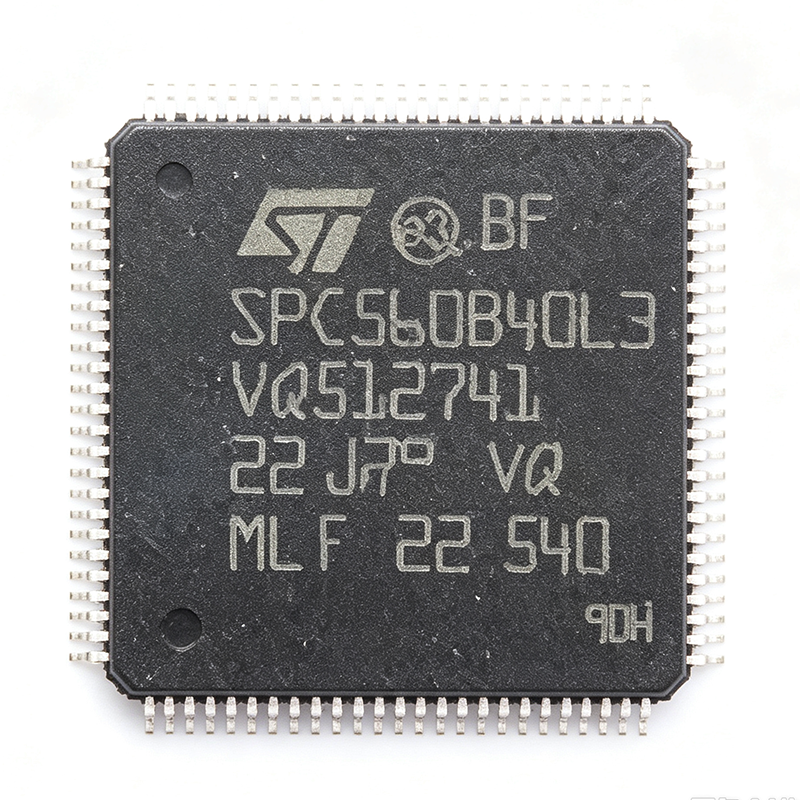
SPC560B40L3 - 32-bit MCU, 512KB Flash, 64MHz | STMicroelectronics
The SPC560B40L3 is a 32-bit microcontroller from STMicroelectronics, part of the SPC560B family based on the Power Architecture® e200z0h core. It operates at a maximum frequency of 64 MHz and features 512 KB of flash memory and 48 KB of RAM, making it suitable for automotive body and gateway applications. The device is housed in a 100-pin LQFP package (LQFP-100) and supports a supply voltage range of 3.3V to 5V. A microcontroller (MCU) is a compact integrated circuit designed to govern a specific operation in an embedded system. It contains a processor core, memory, and programmable input/output peripherals. The SPC560B40L3 belongs to the family of 32-bit automotive microcontrollers, which are a subset of embedded controllers used in vehicle electronics. These MCUs are optimized for real-time control, low power consumption, and high reliability in harsh environments. Key features of the SPC560B40L3 include a 64 MHz e200z0h core, 512 KB flash memory, 48 KB RAM, and a rich set of peripherals such as multiple CAN interfaces, LIN, SPI, and ADC. It also includes a flexible timer module (FTM) and a crossbar switch for efficient data routing. The device is designed to meet AEC-Q100 automotive qualification standards, ensuring reliable operation in automotive temperature ranges from -40°C to +125°C. The SPC560B40L3 utilizes a single-issue, 32-bit Power Architecture core with variable-length encoding (VLE) for code density. It integrates a memory protection unit (MPU) and a cyclic redundancy check (CRC) unit for enhanced safety. The MCU supports low-power modes, including halt and stop modes, to reduce power consumption in battery-powered applications. Typical applications include automotive body control modules, gateway modules, and sensor fusion units. The multiple CAN interfaces make it ideal for in-vehicle networking, while the ADC and timer modules support motor control and signal conditioning. The device's robust design and automotive qualification make it a reliable choice for safety-critical systems. When designing with the SPC560B40L3, ensure proper decoupling of the power supply pins and consider the thermal performance of the LQFP-100 package. The device requires a stable clock source, typically a 4-40 MHz crystal, and supports an internal RC oscillator for cost-sensitive designs.
SPC560B40L3B4E0X - 32-bit MCU, 64MHz, 256KB Flash | STMicroelectronics
The SPC560B40L3B4E0X is a 32-bit automotive microcontroller from STMicroelectronics, built on the Power Architecture embedded category. It features a high-performance e200z0h CPU core running at 64 MHz, with 256KB of Flash memory and 24KB of RAM. The device is housed in a 100-pin LQFP package (14x14 mm) and operates from a 3.3V supply (3.0V to 3.6V). It is designed for automotive body electronics and gateway applications, offering a rich set of peripherals including CAN, LIN, SPI, and ADC interfaces. A microcontroller (MCU) is a compact integrated circuit designed to govern a specific operation in an embedded system. It contains a processor core, memory, and programmable input/output peripherals. The SPC560B40L3B4E0X belongs to the SPC56 family, which is part of STMicroelectronics' automotive-grade microcontroller portfolio. These devices are built on the Power Architecture, a RISC-based instruction set architecture widely used in automotive and industrial applications. The MCU sits at the heart of electronic control units (ECUs), managing functions such as body control, gateway routing, and sensor interfacing. Key features of the SPC560B40L3B4E0X include a 64 MHz e200z0h core, 256KB Flash, 24KB RAM, and a comprehensive set of communication interfaces. It supports up to 45 I/O ports, making it suitable for a wide range of automotive body control applications. The device is AEC-Q100 qualified, ensuring reliability in harsh automotive environments. It also features a flexible clock generation unit, multiple timers, and a 12-bit ADC for analog signal acquisition. From a technical perspective, the SPC560B40L3B4E0X leverages the Power Architecture's efficient instruction set to deliver high performance at low power consumption. The e200z0h core includes a single-precision floating-point unit (FPU) and a memory protection unit (MPU), enhancing its capability for complex control algorithms. The device supports a wide operating temperature range of -40°C to +125°C, making it suitable for under-hood applications. Its 100-pin LQFP package provides a compact footprint while offering ample I/O for peripheral connectivity. Typical applications include automotive body control modules, gateway modules, and sensor fusion units. The SPC560B40L3B4E0X is also used in industrial automation and smart grid systems where robust communication and real-time processing are required. Its CAN and LIN interfaces enable seamless integration into vehicle networks, while its low-power modes help reduce overall system power consumption. When designing with this MCU, it is essential to provide a stable 3.3V power supply with adequate decoupling capacitors near the VDD pins. The device requires an external crystal or oscillator for precise timing, and the reset circuit must be properly configured to ensure reliable startup. Additionally, the ADC reference voltage should be filtered to minimize noise in analog measurements.
SPC560B40L3C6E0X - 32-bit MCU 64MHz 256KB Flash | STMicroelectronics
The SPC560B40L3C6E0X is a 32-bit microcontroller from STMicroelectronics, built on the Power Architecture embedded category. It features a high-performance e200z0h core running at 64 MHz, with 256KB of Flash memory and 24KB of RAM. The device is housed in a 100-pin LQFP package (14x14 mm) and is designed for automotive body and gateway applications. A 32-bit microcontroller is a single-chip computer integrating a processor core, memory, and programmable I/O peripherals. The Power Architecture is a RISC-based instruction set architecture originally developed by IBM, Motorola, and Apple, now widely used in automotive and networking applications. This MCU belongs to the SPC56 family, which is optimized for body electronics, offering a balance of performance, low power, and robust communication interfaces. Key features include a 64 MHz e200z0h core, 256KB Flash, 24KB RAM, and a rich set of peripherals such as multiple CAN, LIN, and SPI interfaces. The device operates from 3.0V to 3.6V supply, with 45 I/O ports. It is AEC-Q100 qualified for automotive use, ensuring reliability in harsh environments. The LQFP-100 package provides a compact footprint with good thermal performance. The SPC560B40L3C6E0X integrates a single-core e200z0h processor with a 32-bit Power Architecture, delivering up to 64 MHz performance. It includes a memory protection unit, DMA controller, and a flexible timer module. The MCU supports a wide range of communication protocols, making it suitable for gateway applications that require multiple bus interfaces. Typical applications include automotive body control modules, gateway modules, and lighting control. Its robust CAN and LIN interfaces enable seamless integration into vehicle networks. The device's low power consumption and wide operating temperature range (-40°C to +125°C) make it ideal for under-hood and cabin electronics. When designing with this MCU, ensure proper decoupling of the power supply and careful layout of the crystal oscillator. The device supports in-circuit programming and debugging via JTAG, facilitating development. For automotive designs, follow AEC-Q100 guidelines and consider using the SPC560B40L3C6E0X for its proven reliability.
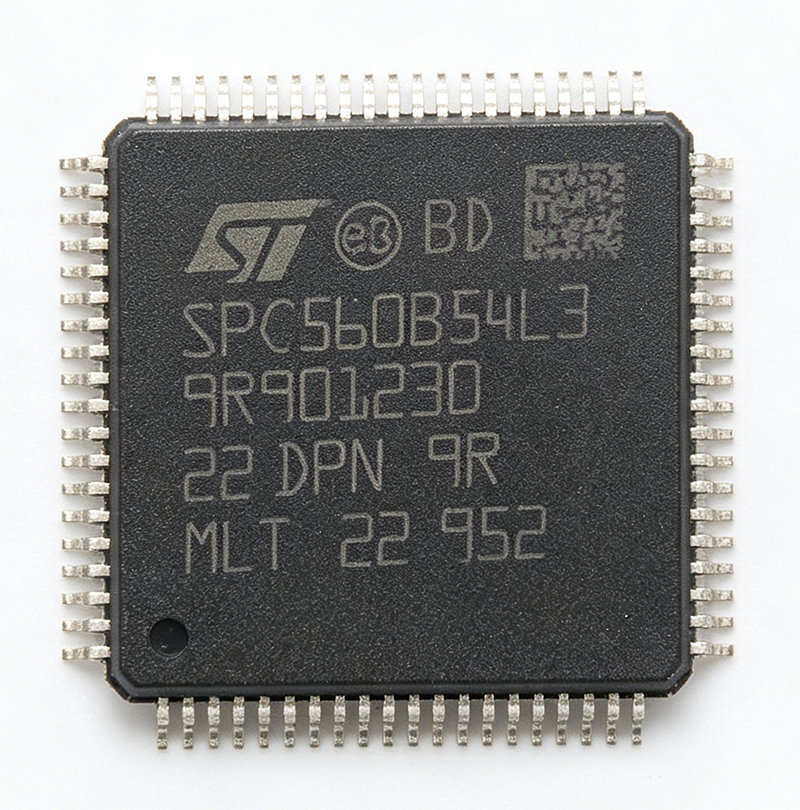
SPC560B54L3 - 32-bit MCU, 1.5MB Flash, 64MHz | STMicroelectronics
The SPC560B54L3 is a 32-bit microcontroller from STMicroelectronics, based on the Power Architecture e200z0h core, operating at up to 64 MHz. It features 1.5 MB of embedded flash memory and 96 KB of RAM, making it suitable for automotive body electronics and industrial control applications. The device is housed in a 100-pin LQFP package (LQFP-100) and operates over a temperature range of -40°C to +125°C. A microcontroller (MCU) is a compact integrated circuit designed to govern a specific operation in an embedded system. It contains a processor core, memory, and programmable input/output peripherals. The SPC560B54L3 belongs to the SPC56 family of automotive microcontrollers, which are part of the broader Power Architecture portfolio. These MCUs are optimized for real-time control, with features like a 10-bit ADC, multiple CAN and LIN interfaces, and a flexible timer module (eTPU). Key features of the SPC560B54L3 include a 64 MHz e200z0h core with single-precision floating-point unit (FPU), 1.5 MB flash with ECC, 96 KB SRAM, and a rich set of communication interfaces: 3x FlexCAN, 3x LIN, and 2x SPI. It also integrates a 10-bit ADC with up to 16 channels, a 16-bit timer, and a watchdog timer. The device supports low-power modes and has a supply voltage range of 3.3V to 5V, making it flexible for various automotive and industrial power rails. The SPC560B54L3 is built on ST's advanced 90nm embedded flash process, providing high reliability and low power consumption. The e200z0h core is a cost-optimized version of the Power Architecture, delivering efficient code execution for control applications. The device includes a memory protection unit (MPU) and a cyclic redundancy check (CRC) unit for enhanced safety and data integrity, aligning with automotive safety standards. Typical applications include automotive body control modules (BCM), gateway modules, HVAC control, and industrial automation controllers. The multiple CAN and LIN interfaces make it ideal for in-vehicle networking, while the robust temperature range and AEC-Q100 qualification support harsh environments. When designing with the SPC560B54L3, ensure proper decoupling of the power supply pins and consider the thermal performance of the LQFP-100 package. The device requires a stable 3.3V or 5V supply and a crystal or oscillator for the system clock. Use the on-chip flash programming interface for firmware updates, and follow ST's application notes for optimal EMC performance.
SPC560D30L1 - 32-bit MCU, 1MB Flash, 64MHz | STMicroelectronics
The SPC560D30L1 is a 32-bit microcontroller from STMicroelectronics, part of the SPC560D family based on the Power Architecture e200z0h core. It operates at a maximum frequency of 64 MHz and features 1 MB of flash memory and 96 KB of RAM, making it suitable for automotive body and gateway applications. The device is available in a 100-pin LQFP package and supports a supply voltage range of 3.3V to 5V. A microcontroller (MCU) is a compact integrated circuit designed to govern a specific operation in an embedded system. It contains a processor core, memory, and programmable input/output peripherals. The SPC560D30L1 belongs to the family of 32-bit automotive microcontrollers, which are part of the broader category of embedded processors used in vehicle control units. These MCUs are optimized for real-time performance, reliability, and low power consumption, often meeting AEC-Q100 automotive qualification standards. Key features of the SPC560D30L1 include a 64 MHz e200z0h Power Architecture core, 1 MB flash memory, 96 KB RAM, and a rich set of communication interfaces such as CAN, LIN, and SPI. It also integrates a 10-bit ADC, multiple timers, and a flexible PWM module. The device supports a wide operating temperature range of -40°C to +125°C, making it suitable for harsh automotive environments. The SPC560D30L1 is built on a highly reliable flash technology with ECC (Error Correction Code) support, ensuring data integrity in safety-critical applications. The MCU includes a Memory Protection Unit (MPU) and a Cyclic Redundancy Check (CRC) unit for enhanced security and data validation. Its low-power modes, including stop and standby, help reduce energy consumption in battery-powered systems. Typical applications include automotive body control modules, gateway modules, and sensor fusion units. The device's robust CAN and LIN interfaces enable seamless communication in vehicle networks, while its high-speed ADC and PWM capabilities support motor control and lighting applications. When designing with the SPC560D30L1, ensure proper decoupling of the power supply pins and a stable clock source. The device requires a 4-40 MHz crystal or external clock for operation. Careful PCB layout is essential to minimize electromagnetic interference, especially in automotive environments.
SPC560D30L3 - 32-bit MCU, 1MB Flash, 64MHz | STMicroelectronics
The SPC560D30L3 is a 32-bit microcontroller from STMicroelectronics, part of the SPC560D family based on the Power Architecture® e200z0h core. It operates at a maximum frequency of 64 MHz and provides 1 MB of flash memory and 96 KB of RAM, making it suitable for automotive body and gateway applications. The device is available in a LQFP-100 package, offering a compact footprint for space-constrained designs. A microcontroller (MCU) is a compact integrated circuit designed to govern a specific operation in an embedded system. It contains a processor core, memory (flash and RAM), and programmable input/output peripherals. The SPC560D30L3 belongs to the class of 32-bit automotive microcontrollers, which are optimized for real-time control, robust communication interfaces, and high reliability under harsh environmental conditions. Within the hierarchy, it is a microcontroller -> automotive MCU -> Power Architecture MCU -> SPC560 family. Key features of the SPC560D30L3 include a 64 MHz e200z0h core with single-precision floating-point unit (FPU), 1 MB flash with ECC, 96 KB SRAM, and a rich set of communication interfaces: 3× FlexCAN, 3× LINFlex, 3× DSPI, and 1× I2C. It also integrates a 10-bit ADC with up to 16 channels, multiple timers (eMIOS, PIT, STM), and a CRC unit. The device supports a supply voltage range of 3.3V to 5V, with an operating temperature range of -40°C to +125°C, meeting AEC-Q100 Grade 1 requirements. Technically, the SPC560D30L3 is built on a 90nm process technology, offering a balance between performance and power consumption. The e200z0h core is a single-issue, 32-bit Power Architecture core with variable-length encoding (VLE) for code density, reducing flash usage by up to 30% compared to traditional PowerPC instructions. The device includes a memory protection unit (MPU) and a memory management unit (MMU) for enhanced safety, and it supports a Nexus class 1 debug interface for real-time trace. Typical applications include automotive body control modules (BCM), gateway modules, smart junction boxes, and industrial control systems. The SPC560D30L3's robust CAN and LIN interfaces make it ideal for in-vehicle networking, while its high-temperature rating and AEC-Q100 qualification ensure reliable operation in under-hood environments. When designing with this device, ensure proper decoupling of the power supply pins with 100nF capacitors placed close to each VDD pin, and a 4.7µF bulk capacitor on the main supply. The device requires a stable clock source; an external 8-40 MHz crystal can be used with the on-chip oscillator, or an external clock can be applied. For safety-critical applications, use the built-in self-test (BIST) and cyclic redundancy check (CRC) modules to enhance diagnostic coverage.
SPC560D40L1 - 32-bit MCU, 1.5MB Flash, 64MHz | STMicroelectronics
The SPC560D40L1 is a 32-bit microcontroller from STMicroelectronics, part of the SPC560D family based on the Power Architecture e200z0h core. It operates at a maximum core frequency of 64 MHz and provides 1.5 MB of embedded flash memory and 96 KB of RAM, making it suitable for automotive body electronics and industrial control applications. The device is offered in a 100-pin LQFP package (LQFP-100) with a 14x14 mm body, supporting surface-mount assembly. A microcontroller (MCU) is a compact integrated circuit designed to govern a specific operation in an embedded system. It contains a processor core, memory (flash and RAM), and programmable input/output peripherals on a single chip. MCUs are the building blocks of modern automotive electronics, industrial automation, and consumer devices, providing the intelligence to control sensors, actuators, and communication interfaces. The SPC560D40L1 sits within the broader hierarchy of embedded processors, specifically as a 32-bit automotive-grade MCU, which offers higher performance and memory than 8-bit or 16-bit counterparts while maintaining real-time responsiveness. Key features of the SPC560D40L1 include a 64 MHz e200z0h core with single-precision floating-point unit (FPU), 1.5 MB flash with error correction code (ECC), 96 KB SRAM, and a rich set of peripherals: two FlexCAN modules for CAN 2.0B communication, multiple eSCI (UART) and DSPI (SPI) interfaces, a 16-channel 12-bit ADC, and a flexible timer module (eMIOS). The device also integrates a crossbar switch (XBAR) for efficient bus arbitration and a memory protection unit (MPU) for enhanced safety. These features enable complex real-time control and communication in automotive body control modules, gateway nodes, and industrial motor control. The SPC560D40L1 is designed for harsh environments, with an operating temperature range of -40°C to +125°C (ambient) and AEC-Q100 qualification, ensuring reliability in automotive applications. It supports low-power modes (HALT, STOP, STANDBY) to reduce energy consumption in battery-powered systems. The MCU is programmed via JTAG or LINFlex (UART) bootloader, and development is supported by ST's SPC5 Studio IDE and third-party tools like IAR and GCC. Typical applications include automotive body control modules (BCM), door and seat control units, HVAC control, industrial PLCs, and motor control for pumps and fans. The combination of CAN, LIN, and rich analog peripherals makes it a versatile choice for distributed automotive networks. When designing with the SPC560D40L1, ensure proper decoupling of the VDD and VDDA pins with 100 nF ceramic capacitors placed close to the pins, and provide a stable 5V or 3.3V supply. The device requires an external crystal or oscillator on the EXTAL/XTAL pins for the main clock; a 8-40 MHz crystal is recommended. For EMI-sensitive designs, use the internal PLL with spread-spectrum modulation if available.
SPC560D40L3 - 32-bit MCU, 1.5MB Flash, 64MHz | STMicroelectronics
The SPC560D40L3 is a 32-bit microcontroller from STMicroelectronics, based on the Power Architecture e200z0h core. It operates at a maximum frequency of 64 MHz and features 1.5 MB of flash memory and 96 KB of RAM. The device is housed in a 100-pin LQFP package, making it suitable for a wide range of automotive and industrial applications. A microcontroller (MCU) is a compact integrated circuit designed to govern a specific operation in an embedded system. It contains a processor core, memory, and programmable input/output peripherals. The SPC560D40L3 belongs to the SPC56 family of automotive microcontrollers, which are part of the broader Power Architecture portfolio. These MCUs are optimized for real-time control, safety-critical applications, and harsh environments, offering a balance of performance, power efficiency, and reliability. Key features of the SPC560D40L3 include a 64 MHz e200z0h core, 1.5 MB flash memory, 96 KB RAM, and a rich set of peripherals such as multiple CAN, LIN, SPI, and I2C interfaces. It also includes advanced timers, ADCs, and a flexible memory protection unit. The device supports a wide operating voltage range of 3.3V to 5V and is designed for extended temperature ranges from -40°C to +125°C, making it ideal for under-the-hood automotive applications. Technically, the SPC560D40L3 is built on a 90nm process technology, offering a good balance of performance and power consumption. The e200z0h core is a single-issue, 32-bit Power Architecture core with a five-stage pipeline, providing efficient execution of control algorithms. The MCU includes a memory protection unit (MPU) and a cyclic redundancy check (CRC) unit for enhanced safety and data integrity. It also features a fail-safe clock monitor and a watchdog timer to ensure reliable operation in safety-critical systems. Typical applications include engine control units (ECUs), transmission control, body control modules, and industrial automation. The SPC560D40L3 is particularly well-suited for automotive body electronics, where its robust communication interfaces and low-power modes are essential. In industrial settings, it can be used for motor control, PLCs, and process control systems. When designing with the SPC560D40L3, it is important to consider proper decoupling of the power supply pins and careful layout of the crystal oscillator circuit. The device supports multiple low-power modes, which can be leveraged to reduce overall system power consumption. Additionally, the flash memory can be programmed in-circuit, simplifying firmware updates in the field.
SPC560P40L3 - 32-bit MCU, 512KB Flash, 64MHz | STMicroelectronics
The SPC560P40L3 is a 32-bit microcontroller from STMicroelectronics' SPC560P family, based on the Power Architecture e200z0h core. It operates at a maximum frequency of 64 MHz and features 512 KB of flash memory and 48 KB of RAM. The device is housed in a 100-pin LQFP package (LQFP-100) and is designed for automotive and industrial applications requiring robust performance and safety features. A microcontroller (MCU) is a compact integrated circuit designed to govern a specific operation in an embedded system. It contains a processor core, memory (flash and RAM), and programmable input/output peripherals. The SPC560P40L3 belongs to the category of 32-bit automotive microcontrollers, which are optimized for real-time control, safety-critical functions, and harsh environments. These MCUs are part of the broader power management and control hierarchy, often used in engine control units (ECUs), body control modules, and industrial automation systems. Key features of the SPC560P40L3 include a 64 MHz e200z0h core with single-precision floating-point unit (FPU), 512 KB flash with ECC, 48 KB SRAM, and a rich set of peripherals: 2x eSCI (UART), 2x DSPI (SPI), 1x FlexCAN, 1x eMIOS (timer), 1x ADC with 16 channels, and up to 64 GPIO pins. It supports a supply voltage range of 3.3V to 5V, with an operating temperature range of -40°C to +125°C, making it suitable for automotive under-hood applications. The device is AEC-Q100 qualified and RoHS compliant. Technically, the SPC560P40L3 is built on a 90nm flash process, offering a balance of performance and power efficiency. The e200z0h core is a Power Architecture v1.1 compliant core with variable-length encoding (VLE) for code density, reducing memory footprint. The MCU includes a memory protection unit (MPU), a cyclic redundancy check (CRC) unit, and a fail-safe protection module, enhancing reliability for safety-critical systems. The FlexCAN module supports CAN 2.0B with up to 32 message buffers, enabling robust communication in automotive networks. Typical applications include automotive body control modules (BCMs), engine management systems, transmission control units, and industrial motor control. The SPC560P40L3's combination of high-speed processing, extensive peripherals, and automotive-grade reliability makes it ideal for real-time control loops and communication-intensive tasks. For example, in a BCM, it manages lighting, door locks, and window lifts, while communicating over CAN bus. When designing with this device, ensure proper decoupling of the power supply pins with 100nF capacitors close to each VDD pin, and a 10uF bulk capacitor. The device requires a stable clock source; an external 8-40 MHz crystal can be used with the on-chip oscillator. For safety-critical applications, use the built-in self-test (BIST) and CRC modules to meet ISO 26262 requirements. Also, consider the thermal dissipation: the LQFP-100 package has a thermal resistance of 45°C/W, so adequate PCB copper area is needed for high ambient temperatures.
SPC560P50L3 - 32-bit MCU, 512KB Flash, 64MHz | STMicroelectronics
The SPC560P50L3 is a 32-bit microcontroller from STMicroelectronics, part of the SPC560P family based on the Power Architecture e200z0h core. It operates at a maximum frequency of 64 MHz and features 512 KB of flash memory and 48 KB of RAM, making it suitable for automotive body and gateway applications. The device is available in a LQFP-100 package and supports a supply voltage range of 3.3V to 5V. A microcontroller (MCU) is a compact integrated circuit designed to govern a specific operation in an embedded system. It contains a processor core, memory, and programmable input/output peripherals on a single chip. MCUs are the backbone of automotive electronics, industrial control, and IoT devices, providing the intelligence to process sensor data, control actuators, and communicate over networks. The SPC560P50L3 belongs to the family of 32-bit automotive microcontrollers, which offer higher performance and memory capacity compared to 8-bit or 16-bit counterparts, enabling complex control algorithms and connectivity. Key features of the SPC560P50L3 include a 64 MHz e200z0h core, 512 KB flash with ECC, 48 KB SRAM, and a rich set of peripherals such as multiple CAN, LIN, SPI, and I2C interfaces. It also integrates a 10-bit ADC with up to 16 channels, PWM timers, and a flexible timer module (FTM) for motor control. The device is AEC-Q100 qualified, ensuring reliability for automotive environments, and supports a wide operating temperature range from -40°C to +125°C. The SPC560P50L3 is built on ST's advanced 90nm process technology, offering a balance of performance and power efficiency. The e200z0h core is a single-issue, 32-bit Power Architecture core with variable-length encoding (VLE) for code density, reducing memory footprint. The MCU includes a memory protection unit (MPU) and a cyclic redundancy check (CRC) unit for enhanced safety and data integrity, aligning with ISO 26262 functional safety requirements. Typical applications include automotive body control modules, gateway modules, and industrial automation. In body control, the SPC560P50L3 manages lighting, wipers, and power windows, while in gateways it routes messages between CAN and LIN networks. Its robust communication interfaces and high-temperature operation make it ideal for under-hood and in-cabin electronics. When designing with this MCU, ensure proper decoupling of the power supply pins and a stable clock source. The device supports both external crystal and internal RC oscillator, with a phase-locked loop (PLL) for frequency multiplication. For safety-critical applications, utilize the built-in self-test (BIST) and watchdog timer to meet ISO 26262 requirements.

SPC560P50L5CEFBY - 32-bit MCU, 512KB Flash, 64MHz | STMicroelectronics
The SPC560P50L5CEFBY is a 32-bit microcontroller from STMicroelectronics, part of the SPC560P family based on the Power Architecture e200z0h core. It operates at a maximum frequency of 64 MHz and provides 512 KB of flash memory and 48 KB of RAM, making it suitable for automotive body and gateway applications. The device is housed in an LQFP-64 package with a 10x10 mm body and 0.5 mm pitch, offering a compact footprint for space-constrained designs. A microcontroller (MCU) is a compact integrated circuit designed to govern a specific operation in an embedded system. It contains a processor core, memory (flash and RAM), and programmable input/output peripherals on a single chip. MCUs are the backbone of automotive electronics, industrial control, and IoT devices, providing the intelligence to process sensor data, control actuators, and communicate over networks. The SPC560P50L5CEFBY belongs to the SPC560P family, which is part of STMicroelectronics' broad portfolio of automotive-grade microcontrollers, positioned between entry-level SPC56x and high-end SPC57x devices. Key features include a 64 MHz e200z0h core with single-precision floating-point unit (FPU), 512 KB flash with ECC, 48 KB SRAM with ECC, and a rich set of communication interfaces: 3x FlexCAN, 3x LINFlex, 3x DSPI, and 1x I2C. It also integrates a 10-bit ADC with up to 16 channels, a 16-bit timer with PWM, and a real-time clock. The device supports a supply voltage range of 3.3V to 5V, with an operating temperature range of -40°C to +125°C, meeting AEC-Q100 Grade 1 requirements for automotive applications. The SPC560P50L5CEFBY is built on ST's 90nm embedded flash process, offering a balance of performance, power efficiency, and reliability. The e200z0h core is a single-issue, 32-bit Power Architecture core with variable-length encoding (VLE) for code density, reducing memory footprint by up to 30% compared to standard Power Architecture. The device includes a memory protection unit (MPU) and a cyclic redundancy check (CRC) unit for enhanced safety, supporting ASIL-B functional safety requirements. Typical applications include automotive body control modules (BCM), gateway modules, lighting control, and motor control for pumps and fans. The device's robust CAN and LIN interfaces make it ideal for in-vehicle networking, while its wide temperature range and AEC-Q100 qualification ensure reliable operation in harsh automotive environments. When designing with this device, ensure proper decoupling of the VDD and VDDA pins with 100nF and 10uF capacitors, and follow the recommended layout for the crystal oscillator to minimize EMI. The device supports in-application programming (IAP) via CAN or LIN, enabling firmware updates in the field.
SPC563M60L7 - 32-bit MCU, 1MB Flash, 80MHz | NXP Semiconductors
The NXP SPC563M60L7 is a 32-bit microcontroller based on the Power Architecture e200z3 core, operating at up to 80 MHz. It features 1 MB of flash memory and 96 KB of RAM, making it suitable for automotive and industrial control applications. The device is housed in a 144-pin LQFP package and supports a supply voltage range of 3.0V to 5.5V. A microcontroller (MCU) is a compact integrated circuit designed to govern a specific operation in an embedded system. It contains a processor core, memory, and programmable input/output peripherals. The SPC563M60L7 belongs to the MPC56xx family, which is part of NXP's broader Power Architecture portfolio, known for its high performance and reliability in safety-critical environments. Key features include a 32-bit e200z3 core with variable-length encoding (VLE) for code density, a 10-bit ADC with up to 32 channels, multiple CAN interfaces for automotive networking, and a flexible timer module (eTPU) for complex timing tasks. The device also includes a memory protection unit (MPU) and a cyclic redundancy check (CRC) unit for enhanced data integrity. The SPC563M60L7 is built on NXP's proven Power Architecture technology, offering a balance of performance and power efficiency. The e200z3 core supports single-precision floating-point operations, enabling complex mathematical computations in real-time control loops. The device's flash memory is organized into multiple blocks, allowing for simultaneous read and write operations, which is critical for over-the-air updates and data logging. Typical applications include engine control units (ECUs), transmission control, body control modules, and industrial automation systems. The multiple CAN interfaces make it ideal for automotive networks, while the eTPU provides precise timing for fuel injection and ignition control. When designing with this device, ensure proper decoupling of the power supply pins and consider the thermal characteristics of the LQFP-144 package. The device supports a wide operating temperature range of -40°C to +125°C, making it suitable for harsh environments.
SPC563M64L5COAR - 32-bit MCU, 1.5MB Flash, 80MHz | NXP
The NXP SPC563M64L5COAR is a 32-bit microcontroller based on the Power Architecture e200z3 core, operating at up to 80 MHz. It features 1.5 MB of flash memory and 94 KB of RAM, making it suitable for automotive and industrial control applications. The device is housed in a 144-pin LQFP package and supports a supply voltage range of 3.0V to 5.5V. A microcontroller (MCU) is a compact integrated circuit designed to govern a specific operation in an embedded system. It contains a processor core, memory, and programmable input/output peripherals. The SPC563M64L5COAR belongs to the SPC56 family of automotive microcontrollers, which are part of the broader Power Architecture portfolio. These MCUs are optimized for real-time control, safety-critical applications, and harsh environments. Key features include a 32-bit e200z3 core with variable-length encoding (VLE) for code density, 1.5 MB of flash with error correction code (ECC), and 94 KB of SRAM. The device integrates multiple communication interfaces such as CAN, LIN, and SPI, along with a 10-bit ADC and a flexible timer module (eTPU). It operates over a temperature range of -40°C to +125°C, making it suitable for under-hood automotive applications. The SPC563M64L5COAR uses a 90nm process technology, balancing performance and power consumption. The e200z3 core supports single-precision floating-point operations, enabling complex control algorithms. The device includes a memory protection unit (MPU) and a cyclic redundancy check (CRC) unit for enhanced safety and data integrity. Typical applications include engine control units (ECUs), transmission control, body control modules, and industrial automation. The rich peripheral set and robust communication interfaces make it ideal for distributed control systems in vehicles and factory floors. When designing with this MCU, ensure proper decoupling of the power supply pins and follow the layout guidelines in the reference manual to minimize noise. The device requires a stable clock source; an external crystal or oscillator can be used, and the internal PLL provides flexible clock multiplication.