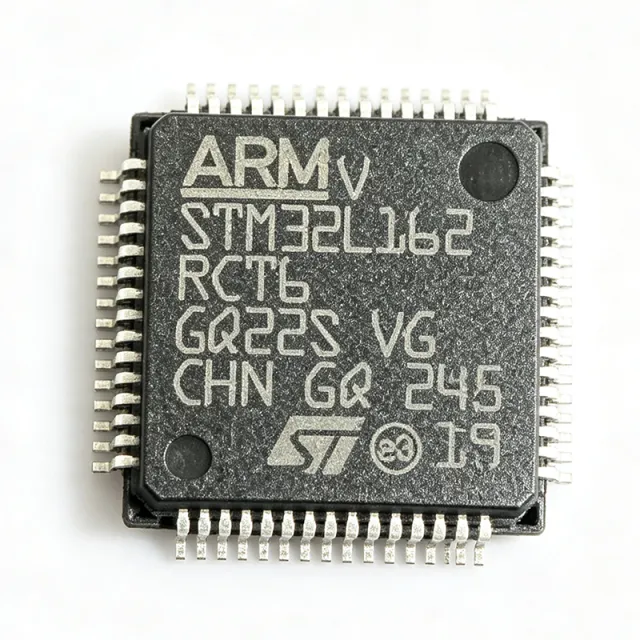
STM32L151C6U6
STM32L151C6U6 - 32-Bit ARM Cortex-M3 Microcontroller | STMicroelectronics
The STMicroelectronics STM32L151C6U6 is a 32-bit ARM Cortex-M3 microcontroller in the STM32L1 series, intended for low-power embedded systems that require efficient processing, compact packaging, and a broad set of serial peripherals. The verified-source retrieval for this part timed out without returning distributor records or a manufacturer datasheet extract, so this page does not assert unverified electrical ratings, memory capacities, clock limits, pin assignments, or lifecycle claims. Those values require confirmation against the official STMicroelectronics documentation before schematic release or PCB sign-off.
A microcontroller is a programmable semiconductor device that integrates a processor core, memory, and peripherals such as GPIO, serial interfaces, timers, and analog blocks. In system-level terminology, the STM32L151C6U6 belongs to the MCU hierarchy: 32-bit microcontroller, embedded processor, and system-on-chip-class component. Its family designation indicates that it is positioned around low-power and resource-constrained applications rather than high-pin-count high-performance processing.
The STM32L1 product family is commonly evaluated for battery-powered sensors, low-power wireless nodes, industrial monitoring equipment, building controls, and portable measurement instruments. Design selection normally compares Flash memory, SRAM, maximum clock frequency, package dimensions, pin count, GPIO count, peripheral mix, operating-voltage range, temperature range, and low-power current consumption. Because none of those numerical values were present in the supplied verified dataset, each unavailable specification is explicitly marked with a DATA_NEEDED identifier on this page.
The MPN suffix identifies a specific ordering configuration. Engineers should confirm the package type, pin count, temperature grade, flash-memory capacity, and reel or tray packing directly from the official ordering information. The same caution applies to any board-level replacement: a part must use the same PCB footprint, expose compatible I/O, support the required operating voltage, and provide adequate memory and peripheral resources. Similar family names alone do not establish drop-in compatibility.
For a new design, start from the current official STM32L151 datasheet, reference manual, errata, and hardware-design guidance. Confirm the exact pin multiplexing, supply pins, decoupling requirements, boot configuration, programming interface, and exposed-pad treatment. Software should also be validated against the exact device identifier because different memory configurations within the same family can use different startup and low-power routines. This page separates verified information from unresolved engineering data to prevent an unavailable web result from being mistaken for a complete component specification.
RFQ
پەیوەندی