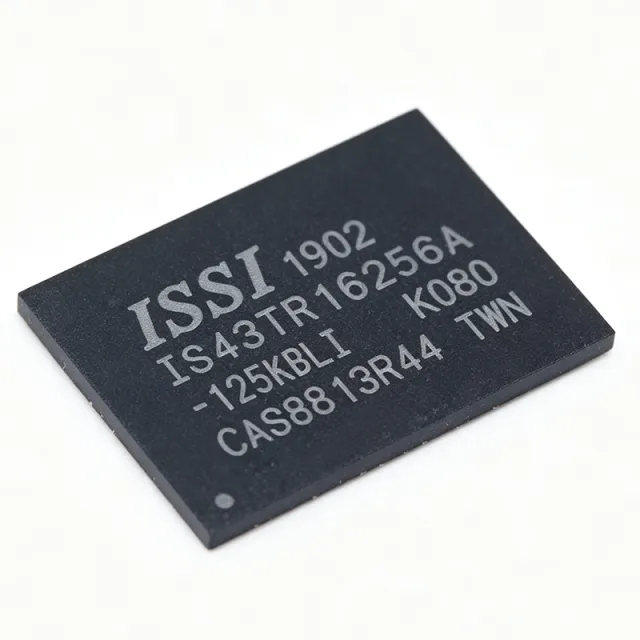
What Is the IS43TR16256AL-125KBLI-TR and Why Does It Matter for Your Design?
The IS43TR16256AL-125KBLI-TR is a 4Gbit DDR3L SDRAM from ISSI (Integrated Silicon Solution Inc), organized as 256M x 16, running at an 800 MHz clock (1600 Mbps data rate) with a CAS latency of 11. It operates at VDD/VDDQ = 1.35V with backward compatibility to 1.5V, is packaged in a 96-ball TWBGA (9x13 mm), and is rated from -40°C to +95°C (TC). The part is actively listed on XAIPART with 99,999 units in stock, MOQ of 1, and volume pricing starting at $8.25 per unit at 1,000 pieces as of 2026-09-11. Its combination of high density, wide 16-bit bus, low-voltage operation, and industrial temperature range makes it a strong fit for industrial automation, networking equipment, embedded computing, automotive infotainment, medical devices, and test and measurement systems.
DDR3L SDRAM transfers data on both edges of the clock, doubling the effective data rate. The 'L' suffix denotes low-voltage operation at 1.35V, which reduces power consumption by about 20% compared to standard DDR3 at 1.5V, while remaining backward compatible with 1.5V DDR3 for flexible system design.
What Are the Key Verified Specifications of the IS43TR16256AL-125KBLI-TR?
| Parameter | Value |
|---|---|
| Memory Type | DDR3L SDRAM |
| Memory Size | 4Gbit (256M x 16) |
| Data Bus Width | 16 bit |
| Clock Frequency | 800 MHz |
| Data Rate | 1600 Mbps |
| CAS Latency | 11 |
| Supply Voltage (VDD/VDDQ) | 1.35V ± 0.1V, -0.067V |
| Backward Compatible Voltage | 1.5V |
| Row Cycle Time (tRC) | 20 ns |
| Row Active Time (tRAS) | 20 ns |
| Operating Temperature | -40°C to +95°C (TC) |
| Package | 96-TWBGA (9x13 mm) |
| Burst Length | 8 |
| On-Die Termination | Yes |
| Refresh Modes | Auto-refresh, Self-refresh |
| RoHS Status | Compliant |
How Do You Design In the IS43TR16256AL-125KBLI-TR? A Practical Technical Guide
Designing with a 4Gbit DDR3L SDRAM at 1600 Mbps requires attention to power, signal integrity, and controller configuration. Follow these verified-guideline steps:
Step 1 — Power supply design. The device requires 1.35V for both VDD (core) and VDDQ (I/O), with tolerance of +0.1V/-0.067V. Place decoupling capacitors near the power pins to minimize noise; the datasheet explicitly recommends this. If your system hosts a 1.5V DDR3 rail, the device's backward compatibility to 1.5V allows shared-rail designs [VERIFY_NEEDED: exact 1.5V tolerance range for DDR3 compatibility mode].
Step 2 — Controller configuration. Program the memory controller for CAS latency 11, burst length 8, and a 1600 Mbps data rate. Respect the 20 ns row cycle time (tRC) and 20 ns row active time (tRAS) when scheduling bank operations. Enable on-die termination (ODT) to simplify routing termination on the flyfly-by address/command bus [VERIFY_NEEDED: ODT termination values].
Step 3 — Clocking and strobes. The differential clock pairs CK/CK# (pins L2/L3) and the two differential data strobes DQS0/DQS0# (pins E3/F2) must be length-matched to their associated data groups to maintain signal integrity at 1600 Mbps. The datasheet recommends careful PCB layout for signal integrity at this data rate.
Step 4 — Reset and refresh. Assert RESET# (pin AC2) during power-up sequencing, and configure the controller's auto-refresh schedule. The device supports both auto-refresh and self-refresh modes; self-refresh is essential for low-power suspend states in portable and battery-backed designs.
Step 5 — Layout for the 96-TWBGA. The 9x13 mm, 96-ball TWBGA footprint offers compact layout with good thermal and electrical performance. The x16 organization means a single device supplies the full 16-bit bus, simplifying routing versus x8-based two-chip solutions.
What Does the Key Pinout of the IS43TR16256AL-125KBLI-TR Look Like?
The 96-ball TWBGA pin map interleaves VDD/VSS and VDDQ/VSSQ power pairs around the data, strobe, clock, and address balls. The functionally critical pins are summarized below; the complete 96-ball table is on the IS43TR16256AL-125KBLI-TR product page.
| Ball | Name | Function |
|---|---|---|
| L2 / L3 | CK / CK# | Differential clock input |
| M2 | CKE | Clock enable |
| M3 | CS# | Chip select |
| N2 / N3 / P2 | RAS# / CAS# / WE# | Command inputs |
| E3 / F2 | DQS0 / DQS0# | Differential data strobe 0 |
| E2 / F3 | DM0 / DM1 | Data masks for byte lanes |
| A2–K3 | DQ0–DQ15 | 16-bit data bus |
| R2–Y3 | A0–A12 | Address inputs |
| AA3–AB3 | BA0–BA2 | Bank address (8 banks) |
| P3 | ODT | On-die termination control |
| AC2 | RESET# | Reset input |
| AC3 | VREF | Reference voltage |
How Much Bandwidth and Capacity Does One IS43TR16256AL-125KBLI-TR Deliver?
With a 16-bit bus at 1600 Mbps per pin, a single device delivers a theoretical peak of 3.2 GB/s (16 bits x 1600 Mbps ÷ 8). The 256M x 16 organization gives 512 MB per device. At burst length 8, each read or write moves 16 bytes per burst. These figures derive directly from the verified specs: data bus width = 16 bit, data rate = 1600 Mbps, memory size = 4Gbit (256M x 16), burst length = 8.
Row access timing matters for random workloads: with tRC = 20 ns, a fully random row-open-to-row-open cycle caps at 50 million row cycles per second per bank group schedule, and tRAS = 20 ns defines the minimum row-active window. Real-world sustained throughput depends on the memory controller's bank interleaving and refresh scheduling [VERIFY_NEEDED: refresh interval (tREFI) from datasheet].
What Are the Drop-In Alternatives and Direct Comparisons for the IS43TR16256AL-125KBLI-TR?
Based on the verified alternative data, three close family variants exist:
| Part Number | Relationship to IS43TR16256AL-125KBLI-TR |
|---|---|
| IS43TR16256AL-125KBLI | Same die and package; supplied in trays instead of tape and reel |
| IS43TR16256A-125KBLI | Standard voltage (1.5V) version, pin-compatible with the low-voltage variant |
| IS43TR16256BL-125KBLI | Newer die revision, same package and pinout |
The best drop-in replacement is the IS43TR16256AL-125KBLI (non-TR): it is functionally identical and pin-compatible, differing only in packaging (tray vs. tape and reel). The '-TR' suffix indicates tape-and-reel packaging for automated assembly; both share the same 4Gbit DDR3L specifications and 96-TWBGA package. The IS43TR16256A-125KBLI can be replaced by this part because they are pin-compatible with the same 256M x 16 organization; note the non-L version operates at 1.5V, while the 'L' version runs at 1.35V and is backward compatible with 1.5V.
The IS43TR16256BL-125KBLI uses a newer die revision with the same package and pinout; verify specific timing differences in the datasheet before substitution. For cross-vendor options, a potential Samsung equivalent is the K4B4G1646E-BYMATCV (4Gbit DDR3L, x16), but package and pinout may differ — verify pin compatibility and timing before using it as a drop-in; they are not guaranteed direct replacements. The IS43TR16256AL-107MBLI-TR is a higher-speed grade (data rate 1866 Mbps); choose the 125KBLI-TR when your system targets 1600 Mbps with CAS latency 11.
What Applications Is This DDR3L SDRAM Best Suited For?
Industrial automation. PLCs, HMI panels, robotics controllers, and industrial PCs benefit from the -40°C to +95°C (TC) range, 4Gbit density, and 1.35V operation that reduces thermal load in sealed enclosures.
Networking equipment. Routers, switches, and firewalls use the 1600 Mbps data rate and 16-bit bus for packet buffering and routing tables, with 4Gbit supporting large forwarding databases in dense line cards where lower heat improves reliability.
Embedded computing. Single-board computers and edge modules use the 512 MB capacity for operating systems and workloads such as image processing and data analytics, with low-voltage operation extending battery life.
Automotive infotainment. The industrial temperature range meets automotive requirements for navigation, multimedia, and telematics units; 4Gbit supports large map databases and media buffers.
Medical devices and test equipment. Patient monitors and imaging systems use the 4Gbit buffer depth, while oscilloscopes and logic analyzers exploit the 1600 Mbps sampling throughput and long recording times.
What Is the Pricing and Stock Situation for the IS43TR16256AL-125KBLI-TR?
Verified XAIPART pricing tiers as of 2026-09-11:
| Quantity | Unit Price |
|---|---|
| 1+ | $12.73 |
| 10+ | $11.50 |
| 100+ | $10.20 |
| 500+ | $9.10 |
| 1000+ | $8.25 |
Stock stands at 99,999 units with MOQ of 1 on the XAIPART product page. Distributor data shows the part available from DigiKey, Mouser, LCSC, and Win Source as of 2026-08-19, with DigiKey listing it as 'ships today'. Volume buyers save 35% at the 1,000-piece tier versus single-unit pricing.
What Is the Lifecycle and Market Position of This Component?
The IS43TR16256AL-125KBLI-TR is verified as an active part in the ISSI DDR3L family. ISSI (Integrated Silicon Solution Inc) holds a strong position in industrial and automotive memory [VERIFY_NEEDED: market share data]. Availability is healthy: 99,999 units in stock on XAIPART as of 2026-09-11, plus multi-distributor availability. [DATA_NEEDED: long-term lifecycle commitment date and last-time-order schedule from ISSI].
What Trends Should Buyers Watch Around 4Gbit DDR3L Memory?
First, DDR3L remains the workhorse for industrial and embedded designs that need the -40°C to +95°C operating range this part provides — newer DDR4/DDR5 generations generally serve different performance tiers. Second, the die revision in the family (IS43TR16256BL-125KBLI) shows ISSI continues to refresh the DDR3L line, supporting long-term supply for active parts. Third, buyers should anchor sourcing decisions to verified specs: 1600 Mbps data rate, CAS latency 11, 1.35V operation with 1.5V backward compatibility, and RoHS compliance. Finally, watch the pricing curve — the verified tier structure ($12.73 at qty 1 down to $8.25 at qty 1,000 as of 2026-09-11) rewards consolidated procurement. For help comparing family variants, see our DDR3L memory selection guide or browse other Memory ICs on XAIPART.
Key Takeaways for Engineers and Buyers
The IS43TR16256AL-125KBLI-TR combines 4Gbit density (256M x 16), 1600 Mbps bandwidth, and 1.35V low-voltage operation in a compact 96-TWBGA (9x13 mm) package rated -40°C to +95°C (TC). It is active, RoHS compliant, widely stocked (99,999 units on XAIPART as of 2026-09-11), and supported by pin-compatible family alternatives for packaging and voltage flexibility.
Kommentare
Seien Sie der Erste, der kommentiert.
🔐 Bitte anmelden um einen Kommentar zu veröffentlichen.
Sie haben noch kein Konto? Registrieren