The Samsung K4A4G165WF-BCTD is a 4Gbit DDR4 SDRAM organized as 256M x 16, running at data rates up to 2666 Mbps from a nominal 1.2V supply (1.14V–1.26V) in a JEDEC-standard 96-ball FBGA (PBGA96) surface-mount package. It supports auto precharge, asynchronous reset, CRC, ZQ calibration, dynamic ODT, and data mask, with an operating range of 0C to +95C. The part is active in lifecycle status and currently available: XAIPART lists 32,000 units in stock with MOQ 1 and tiered pricing from $14.0625 (qty 1) down to $8.2031 (qty 1000) as of 2026-10-13. Its wide x16 organization and JEDEC FBGA-96 footprint make it a practical main-memory choice for industrial controllers, networking line cards, smart TV platforms, and edge-AI modules — and pin-compatible drop-in alternatives exist from Samsung speed variants and Micron, detailed below.
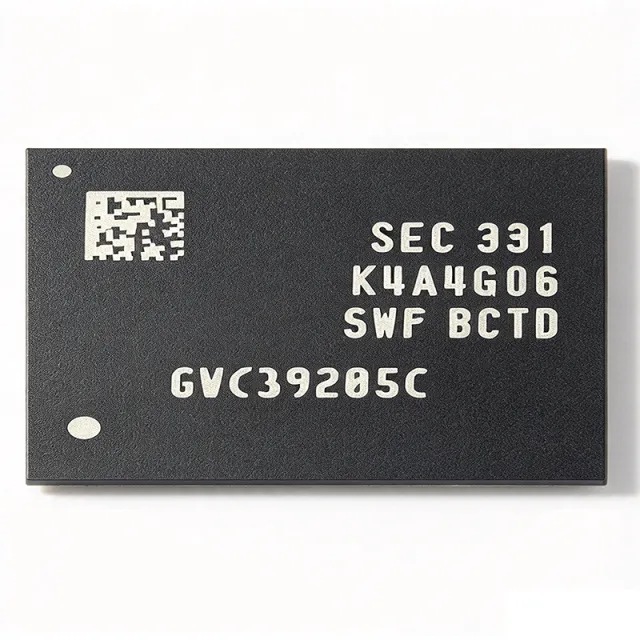
What Is the K4A4G165WF-BCTD and Why Do Engineers Specify It?
The K4A4G165WF-BCTD is Samsung's 4Gb DDR4 SDRAM built on the F-die CMOS process, organized as 256M x 16 on a 16-bit data bus. Engineers specify it when a design needs a single-chip, wide-bus DRAM at DDR4-2666 with minimal BOM complexity: one device delivers the full 16-bit bus, roughly 5.3 GB/s of peak bandwidth (2666 MT/s x 2 bytes) on a single x16 device.
Compared with DDR3, DDR4 drops the operating voltage from 1.5V to 1.2V and doubles bank groups; this device provides 4 bank groups in the x16 configuration. Samsung reports DDR4 consumes roughly 25% less power than equivalent DDR3 at the system level — a figure that matters directly in sealed industrial enclosures and PoE-powered edge devices.
Key verified specifications:
| Parameter | Value |
|---|---|
| Memory Type | DDR4 SDRAM |
| Memory Size | 4 Gbit |
| Organization | 256M x 16 |
| Data Rate | 2666 Mbps (DDR4-2666) |
| VDD | 1.2 V (1.14 V to 1.26 V) |
| VDDQ | 1.2 V |
| Interface | SSTL-12 |
| Package | FBGA-96 (PBGA96), surface mount |
| Operating Temperature | 0C to +95C |
| Bank Groups | 4 (x16 configuration) |
| Features | Auto precharge, asynchronous reset, CRC, ZQ calibration, dynamic ODT, data mask |
| Refresh | Self-refresh and auto-refresh supported |
| RoHS | Compliant |
| Technology | Samsung F-die CMOS |
Takeaway: If your SoC has a 16-bit DDR4 PHY rated at 2666 MT/s and you need 4Gbit in one chip, this part matches on every major electrical and mechanical parameter.
How Do You Design In the K4A4G165WF-BCTD Correctly?
DDR4 design-in succeeds or fails on power, termination, and layout discipline. Follow these verified requirements:
Power rails. Supply VDD and VDDQ separately, both at 1.2V nominal with the 1.14V–1.26V allowed range. Separate rails let you measure and optimize dynamic VDDQ current independently. Use SSTL-12 signaling on the data bus.
ZQ calibration. Connect the ZQ ball to ground through a precision 240-ohm, 1% resistor. This resistor sets the output driver impedance reference; anything looser than 1% degrades ODT accuracy across temperature.
Termination and topology. Route command/address in a length-matched fly-by topology with VTT termination, and use the device's dynamic ODT plus controller training to close timing. Follow your memory controller vendor's layout guide — the FBGA-96 ball map is JEDEC-standardized, so controller reference designs apply directly.
Speed-grade flexibility. DDR4 devices are backward-compatible with lower JEDEC speed grades. The BCTD (2666 Mbps rated) runs at DDR4-2400, 2133, or 1866 using the corresponding JEDEC timing tables and CAS latency settings from the Samsung datasheet. The reverse is not true: a 2400 Mbps BCRC cannot meet 2666 MT/s. Design for the faster grade and you keep second-source freedom across both speed bins.
Thermal envelope. The standard grade covers 0C to +95C (case temperature ceiling). For sealed enclosures or non-safety automotive display modules, run thermal analysis to confirm junction temperatures stay inside that envelope, and verify derated self-refresh specifications in the Samsung datasheet for extended-temperature requirements. This is a commercial-grade part — where AEC-Q100 coverage is contractually required, specify an automotive-qualified DDR4 variant instead.
Data integrity. Enable CRC on the data bus in high-availability designs (networking, test instruments) where silent memory errors corrupt results, and use data mask (DM) for write masking.
Sizing check. 4Gbit organized 256M x 16 gives 256M addressable 16-bit words — 512 MB per device. Two devices on a 32-bit bus yield 1 GB.
Takeaway: Nail the 240-ohm 1% ZQ resistor, separate 1.2V rails, and fly-by routing, and the part trains reliably; use the datasheet timing tables to run it at any JEDEC grade at or below 2666 Mbps.
What Are the Best Drop-In Alternatives to the K4A4G165WF-BCTD?
Because DDR4 component ballouts are JEDEC-standardized per organization, several parts mount on the identical FBGA-96 land pattern. Verified alternatives:
- K4A4G165WF-BCWE — same Samsung 4Gbit 256M x 16 core and FBGA-96 package, DDR4-3200 (3200 Mbps). A faster grade that covers the 2666 timing set; update firmware training tables per the controller's timing configuration.
- K4A4G165WF-BCRC — same core and package, DDR4-2400 (2400 Mbps). Cost-optimized drop-in when your controller runs DDR4-2400; cannot substitute where 2666 MT/s throughput is required.
- Micron MT40A256M16GE-075E:B — 4Gbit DDR4, 256M x 16, 96-ball FBGA, same JEDEC DDR4 ball map. The -075E speed bin corresponds to DDR4-2666-class timing; re-run controller memory training per Micron's datasheet.
- K4A4G085WF-BITD — 8Gbit DDR4 in the same FBGA-96 ballout, so it fits the same land pattern, but density doubles to 512M x 16. Replacement succeeds only if the memory controller supports 8Gbit density addressing; otherwise expect training failures. Its speed grade is not specified in the verified data available here.
| Parameter | K4A4G165WF-BCTD | K4A4G165WF-BCWE | K4A4G165WF-BCRC | MT40A256M16GE-075E:B | K4A4G085WF-BITD |
|---|---|---|---|---|---|
| Manufacturer | Samsung | Samsung | Samsung | Micron | Samsung |
| Density | 4 Gbit | 4 Gbit | 4 Gbit | 4 Gbit | 8 Gbit |
| Organization | 256M x 16 | 256M x 16 | 256M x 16 | 256M x 16 | 512M x 16 |
| Speed Grade | 2666 Mbps | 3200 Mbps | 2400 Mbps | -075E (DDR4-2666-class) | Not specified in verified data |
| Package | FBGA-96 | FBGA-96 | FBGA-96 | FBGA-96 | FBGA-96 |
| Footprint compatibility | Reference | Pin-to-pin | Pin-to-pin | Same JEDEC ball map | Same ballout, different density |
Note also that within the K4A4G165 family, the 'W' versus 'E' die letter distinguishes Samsung die revisions. Both K4A4G165WF-BCTD and K4A4G165WE-BCTD are 4Gbit 256M x 16, 2666 Mbps FBGA-96 parts on the same JEDEC ballout, but die revisions can differ in internal process node and speed-bin granularity — always re-run memory training when switching die letters.
Takeaway: Qualify the BCWE (3200) and MT40A256M16GE-075E:B as second sources on the same footprint; use the BCRC only for DDR4-2400 controllers, and treat the 8Gbit BITD as a capacity upgrade, not a drop-in.
Where Is This Part Used — and What Does the Supply Picture Look Like?
Verified application scenarios from the product database:
- Industrial embedded controllers. PLC, gateway, and HMI platforms with 16-bit DDR4 buses use the 4Gbit capacity for protocol stacks and graphics frame buffers; 1.2V operation cuts memory power roughly 25% versus DDR3, reducing thermal load in sealed enclosures, and 0C to +95C covers factory-floor ambients.
- Networking line cards. 2666 Mbps on a single x16 device delivers approximately 5.3 GB/s peak for packet buffering in access-layer designs; 4 bank groups allow back-to-back column accesses to different bank groups at full bus speed, and CRC plus data mask support high-availability designs. Multiple devices share a fly-by address/command bus with per-device ODT.
- Smart TV and set-top boxes. 4Gbit accommodates 1080p and entry-4K frame buffers plus application memory; a single x16 chip per bus minimizes BOM cost, and the JEDEC footprint lets ODMs alternate Samsung speed grades or Micron equivalents during allocation without hardware changes.
- Automotive infotainment and displays (non-safety). Used in digital clusters and infotainment screens where cabin temperatures stay within 0C to +95C; perform thermal analysis and use automotive-qualified DDR4 where AEC-Q100 coverage is contractually required.
- Test and measurement. Data-acquisition units and entry oscilloscopes use the 4Gbit density for long acquisition records; CRC guards against silent memory errors corrupting measurement results.
- Edge AI and vision modules. 5.3 GB/s peak bandwidth supports quantized CNN workloads on entry NPUs; 4Gbit fits INT8 model payloads plus multi-frame buffers, and the FBGA-96 keeps module height minimal for PoE- and battery-powered devices.
Supply and lifecycle. The K4A4G165WF-BCTD is active in lifecycle status. XAIPART holds 32,000 units in stock with MOQ 1, priced at $14.0625 (qty 1), $10.1563 (qty 10), $8.9844 (qty 100), $8.5938 (qty 500), and $8.2031 (qty 1000) as of 2026-10-13. External pricing references in the database note LCSC at about $2.69 single-piece with 658 units as of 2026-09-04 and roughly 20 distributors aggregated on Octopart — these figures conflict with XAIPART's current tiered pricing and stock, so treat them as historical snapshots; DRAM spot pricing fluctuates weekly and live quotes should govern volume commitments. Samsung's formal phase-out roadmap for the K4A4G165WF family is not included in the verified data available here; confirm long-term availability directly with Samsung or your distributor before locking a multi-year BOM.
Takeaway: With 32,000 units on hand at XAIPART and active status, current supply is healthy — but DRAM pricing moves weekly, so lock volume pricing at the 1000-piece tier ($8.2031) rather than assuming spot rates hold.
What Should Buyers Watch Next for DDR4 x16 Sourcing?
Anchor your sourcing strategy to three verified facts. First, speed-grade substitutability is your buffer: because the BCWE (3200 Mbps) covers the BCTD's 2666 timing set and both share the FBGA-96 footprint, qualifying the faster grade in firmware today protects production against allocation on any single bin. Second, backward compatibility means a 2666 Mbps-rated part covers DDR4-2400 and 2133 designs — buy the faster bin and derate in configuration, never the reverse. Third, second-source qualification is cheap here: the Micron MT40A256M16GE-075E:B uses the same JEDEC ball map, so cross-brand alternates require only a training-table update, not a PCB respin.
Watch three risks. Density upgrades (the 8Gbit K4A4G085WF-BITD) fit the same board but need controller addressing support — verify before committing. Die-letter changes within the K4A4G165 family (W vs. E revisions) demand re-running memory training even when electrical specs look identical. And the 0C to +95C envelope is a hard ceiling for this commercial-grade part; extended-temperature or AEC-Q100 requirements push you to qualified variants. For related Samsung DDR4 reading, see our K4A8G085WC-BCWE 8Gb DDR4-3200 selection guide, and browse the XAIPART component catalog for live stock. Full specifications and current pricing live on the K4A4G165WF-BCTD product page; the manufacturer datasheet is available at https://www.lcsc.com/datasheet/C2803249.pdf.
Takeaway: Qualify BCWE and Micron alternates now, buy the 2666 bin even for 2400 designs, and re-validate training tables on any die-letter change — those three habits de-risk this BOM line for the full product cycle.
Kommentare
Seien Sie der Erste, der kommentiert.
🔐 Bitte anmelden um einen Kommentar zu veröffentlichen.
Sie haben noch kein Konto? Registrieren