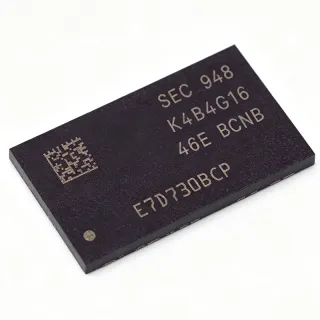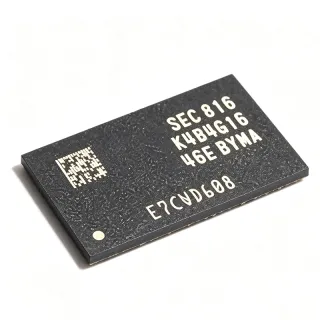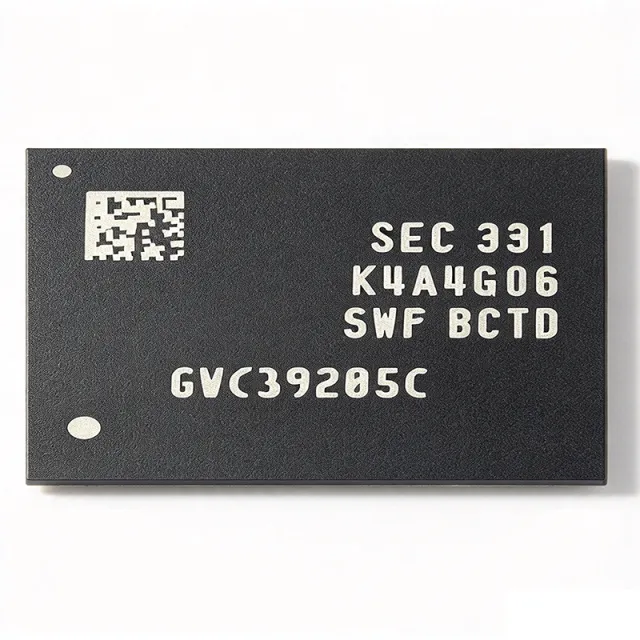
K4A4G165WF-BCTD - 4Gb DDR4 SDRAM 2666Mbps | Samsung
MPN: K4A4G165WF-BCTD ✓ Active| Qty | Unit Price | Extended |
|---|---|---|
| 1 | $14.0625 | $14.06 |
| 10 | $10.1563 | $101.56 |
| 100 | $8.9844 | $898.44 |
| 500 | $8.5938 | $4,296.90 |
| 1,000 | $8.2031 | $8,203.10 |
K4A4G165WF-BCTD Overview
DDR4 SDRAM (Double Data Rate 4 Synchronous Dynamic Random Access Memory) is the fourth generation of the DDR DRAM family, positioned within the broader memory hierarchy as volatile main-memory silicon below storage and above cache in capacity. Compared with DDR3, DDR4 lowers operating voltage from 1.5V to 1.2V, doubles bank groups to improve effective bandwidth, and adds features such as on-die termination refinements and CRC protection on the data bus.
Key features of this device include the 2666 Mbps speed grade (suffix BCTD), auto precharge, asynchronous reset, data mask (DM) support for write masking, CRC and parity-related data integrity functions, ZQ calibration for accurate output driver impedance, and dynamic on-die termination (ODT). The 16-bit data width suits controllers that prefer wide, low-chip-count memory buses.
Architecturally, the K4A4G165WF is built on Samsung's 4Gb F-die DDR4 process, using a CMOS core with bank-group parallelism that allows back-to-back accesses to different bank groups at full bus speed. The 1.2V VDD with separate 1.2V VDDQ rails reduces both static and dynamic power; Samsung reports DDR4 consumes roughly 25% less power than equivalent DDR3 at the system level.
Typical applications include embedded industrial controllers, networking equipment line cards, smart TV and set-top-box platforms, and GPU/display-oriented SoC boards that use a 16-bit DDR4 PHY at 2666 MT/s.
Design consideration: DDR4 routing requires length-matched fly-by command/address topology, ODT calibration, and VTT termination; follow the memory controller vendor's layout guide and set the ZQ resistor (240 ohm, 1%) to ground precisely.
This page synthesizes distributor pricing, same-package alternatives, and practical DDR4 design notes not consolidated in the manufacturer datasheet.
Drop-in alternatives for K4A4G165WF-BCTD — same package, pin-to-pin compatible. Different-package parts requiring PCB rework are excluded.
Variants in this series
Same-series models that are drop-in compatible with K4A4G165WF-BCTD (same form factor and footprint) — differing in Package, RoHS Status, Interface, Operating Temperature, Memory Type.
Quick Comparison Tool — Select alternative parts for side-by-side comparison:
K4A4G165WF-BCWE
✓ In Stock
$10.65 / Unit
View Datasheet →K4A4G165WF-BCRC
✓ In Stock
$17.08 / Unit
View Datasheet →K4A4G165WE-BCTD
✓ In Stock
$11.38 / Unit
View Datasheet →K4A4G085WF-BITD
✓ In Stock
$2.65 / Unit
View Datasheet →MT40A256M16GE-075E:B
✓ In Stock
$3.95 / Unit
View Datasheet →K4A4G165WF-BCTD Maximum Ratings & Electrical Characteristics
| Memory Type | DDR4 SDRAM |
| Memory Size | 4 Gbit |
| Organization | 256M x 16 |
| Speed (Data Rate) | 2666 Mbps (DDR4-2666) |
| Supply Voltage VDD | 1.2 V (1.14 V to 1.26 V) |
| I/O Voltage VDDQ | 1.2 V |
| Interface | SSTL-12 |
| Package | FBGA-96 (PBGA96) |
| Mounting Type | Surface Mount |
| Operating Temperature | 0C to +95C |
| Features | Auto precharge, asynchronous reset, CRC, ZQ calibration, dynamic ODT, data mask |
| Technology | Samsung F-die CMOS |
| Bank Groups | 4 (x16 configuration) |
| Refresh | Self-refresh and auto-refresh supported |
| RoHS Status | Compliant |
K4A4G165WF-BCTD fbga-96 (pbga96) Pin Configuration Guide
Pin configuration for K4A4G165WF-BCTD (fbga-96 (pbga96) package). This digital IC includes GPIO, communication interfaces (UART, SPI, I2C), and power pins. Refer to the manufacturer datasheet for alternate pin functions and configuration options. Essential for embedded system design and PCB layout.

No detailed pinout data available for K4A4G165WF-BCTD.
Refer to the datasheet for full pin configuration.
Typical Applications
K4A4G165WF-BCTD is suitable for 6 applications: Industrial Embedded Controllers, Networking Equipment Line Cards, Smart TV and Set-Top-Box Platforms, Automotive Infotainment and Display Units, Test and Measurement Instruments, Edge AI and Vision Modules.
Industrial Embedded Controllers
The K4A4G165WF-BCTD fits industrial PLC, gateway, and HMI controllers that use 16-bit DDR4 memory buses. Its 4Gbit capacity provides ample buffering for protocol stacks and graphics frame buffers, while the 1.2V operation cuts memory power versus DDR3 by roughly 25%, reducing thermal load in sealed industrial enclosures. The 0C to +95C range covers typical factory-floor ambient conditions. Deployed as the main DRAM behind SoCs with DDR4-2666 16-bit PHYs, the device uses ZQ calibration (240-ohm RZQ resistor) and dynamic ODT to maintain signal integrity across backplane variations. Its FBGA-96 footprint also allows second-sourcing with Micron or Samsung speed-grade variants without PCB respin.
Recommended
Networking Equipment Line Cards
In switches, routers, and NIC buffer memory subsystems, the K4A4G165WF-BCTD's 2666 Mbps rate delivers approximately 5.3 GB/s peak bandwidth on a single x16 device, sufficient for packet buffering in access-layer designs. DDR4 bank-group architecture permits back-to-back column accesses to different bank groups at full bus speed, improving effective throughput under random packet traffic. The CRC and data mask features support data integrity in high-availability designs. Wide 16-bit organization reduces chip count on dense line cards. Multiple devices can be laid out on a shared fly-by address/command bus with per-device ODT, per JEDEC DDR4 multi-drop topology guidance.
Recommended
Smart TV and Set-Top-Box Platforms
Consumer video platforms pair the K4A4G165WF-BCTD with display SoCs requiring 16-bit DDR4 at 2666 MT/s for frame buffering and video decoding workloads. The 4Gbit density accommodates 1080p and entry-4K frame buffers plus application memory, and the wide x16 organization keeps a single chip per bus, minimizing BOM cost for high-volume consumer builds. The 1.2V rail simplifies power-tree design in cost-driven boards. Because FBGA-96 is a JEDEC-standard DDR4 footprint, ODMs can alternate between Samsung speed grades (BCRC/BCWE) or Micron MT40A256M16GE equivalents during supply allocation without hardware changes, only updating memory training tables in firmware.
Recommended
Automotive Infotainment and Display Units
While the standard-grade K4A4G165WF-BCTD targets 0C to +95C, it is used in non-safety automotive display modules - digital instrument clusters and infotainment screens - where cabin temperatures remain within that envelope. The 2666 Mbps bandwidth sustains GPU rendering for multi-display graphics, and 4Gbit capacity holds navigation maps and media caches. The x16 organization matches the 16/32-bit DDR4 controllers common in mid-tier automotive SoCs. Designers should perform thermal analysis to confirm junction temperatures, and consider automotive-qualified DDR4 variants where AEC-Q100 coverage is contractually required rather than using this commercial-grade part.
Recommended
Test and Measurement Instruments
Bench instruments such as data-acquisition units and entry oscilloscopes use the K4A4G165WF-BCTD as main memory for waveform capture. The 4Gbit density enables long acquisition records, while DDR4's burst architecture sustains streaming throughput from front-end ADCs. The device's CRC function adds a data-integrity check on the bus, useful in instruments where silent memory errors corrupt measurement results. The 1.2V operation limits internal heating in compact enclosures with passive cooling. Its availability through distribution with modest minimums suits both NPI prototypes and volume production, and the JEDEC footprint keeps second-source qualification simple.
Recommended
Edge AI and Vision Modules
Camera and edge-AI modules running neural inference use the K4A4G165WF-BCTD to hold model weights and frame pipelines. A single x16 DDR4 device at 2666 MT/s supplies 5.3 GB/s peak bandwidth, adequate for quantized CNN workloads on entry NPUs, while 4Gbit capacity fits INT8 model payloads plus multi-frame buffers. The 1.2V supply aligns with the low-power budgets of battery and PoE-powered edge devices, and the 96-ball FBGA keeps module height and area minimal for compact camera form factors. ZQ calibration and dynamic ODT maintain margins across module-level routing variations, reducing training failures during production programming.
Recommended
Recommended Products Summary
Engineering reference data for K4A4G165WF-BCTD — comparison, design guidance, and compliance information.
Selection Guide
Comparison with Alternatives
| Parameter | This Product | K4A4G165WF-BCWE | K4A4G165WF-BCRC | K4A4G165WE-BCTD | K4A4G085WF-BITD | MT40A256M16GE-075E |
|---|---|---|---|---|---|---|
| Package | FBGA-96 | FBGA-96 - same | FBGA-96 - same | FBGA-96 - same | FBGA-96 - same | B: FBGA-96 - same |
| Brand | Samsung Electronics | Samsung Electronics | Samsung Electronics | Samsung Electronics | Samsung Electronics | B: Micron Technology |
| Density | 4 Gbit | 4 Gbit | 4 Gbit | 4 Gbit | 8 Gbit | B: 4 Gbit |
| Organization | 256M x 16 | 256M x 16 | 256M x 16 | 256M x 16 | 512M x 16 | B: 256M x 16 |
| Data Rate | 2666 Mbps | 3200 Mbps | 2400 Mbps | 2666 Mbps | 2666 Mbps | B: 2666-class (-075E bin) |
| Supply Voltage | 1.2 V | 1.2 V | 1.2 V | 1.2 V | 1.2 V | B: 1.2 V |
| Operating Temperature | 0C to +95C | 0C to +95C | 0C to +95C | 0C to +95C | 0C to +95C | B: 0C to +95C |
Key Differentiators
- Balanced 2666 Mbps speed grade (vs K4A4G165WF-BCRC)
- Lower cost than fastest grade (vs K4A4G165WF-BCWE)
- JEDEC-standard cross-brand second source (vs MT40A256M16GE-075E:B)
Design Notes
Route the DDR4 address/command bus in a fly-by topology terminated to VTT, and length-match data lanes (DQ/DM/DQS) within the controller vendor's specified skew window - typically a few mils per inch of trace at 2666 MT/s. Use 240-ohm 1% RZQ resistor to ground, placed as close to the ZQ ball as possible with a direct return path. Maintain a solid, unbroken reference plane under all DDR4 nets; do not route DDR4 signals across plane splits, as SSTL-12 margins at 2666 Mbps are tight.
Supply VDD and VDDQ from a 1.2V rail within 1.14V-1.26V; the TPS54218RTER buck converter is a common fit for this rail. Provide a VTT termination rail (VDDQ/2 = 0.6V) sized for termination current, with bulk and 0.1uF ceramic decoupling at each FBGA-96 corner. Estimated: a single x16 device at 2666 Mbps draws roughly 300-500 mA peak on VDDQ under active bursts - budget the regulator accordingly and verify against Samsung's IDD specifications for your actual access pattern.
Do not assume speed-grade compatibility is symmetrical: a BCTD (2666) covers DDR4-2400 designs, but a BCRC (2400) cannot meet 2666 MT/s. When mixing die letters (WF vs WE) or second-sourcing Micron MT40A256M16GE, always re-run memory controller training and update the timing table; DDR4 training parameters do not transfer across die revisions. Also confirm controller support before substituting the 8Gbit K4A4G085WF-BITD - density mismatch is a common cause of training failure at boot.
Compliance Information
RoHS compliant per LCSC product page for C2803249. Not an automotive-qualified part; use Samsung AEC-Q100 DDR4 variants for automotive safety applications.