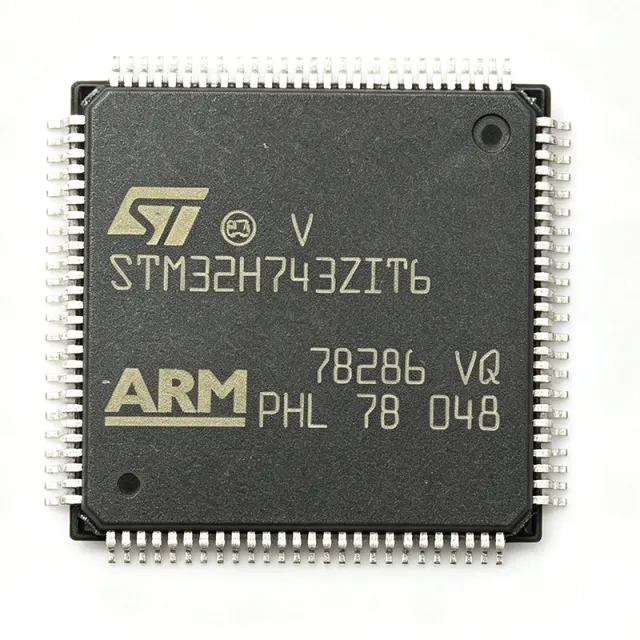
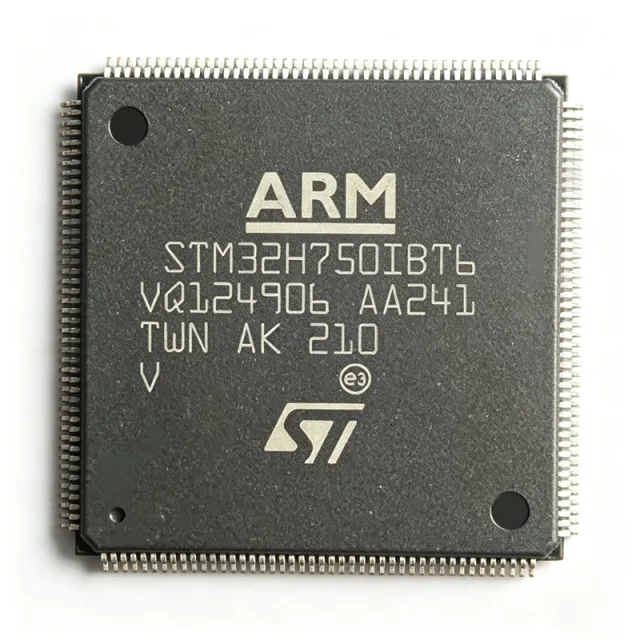
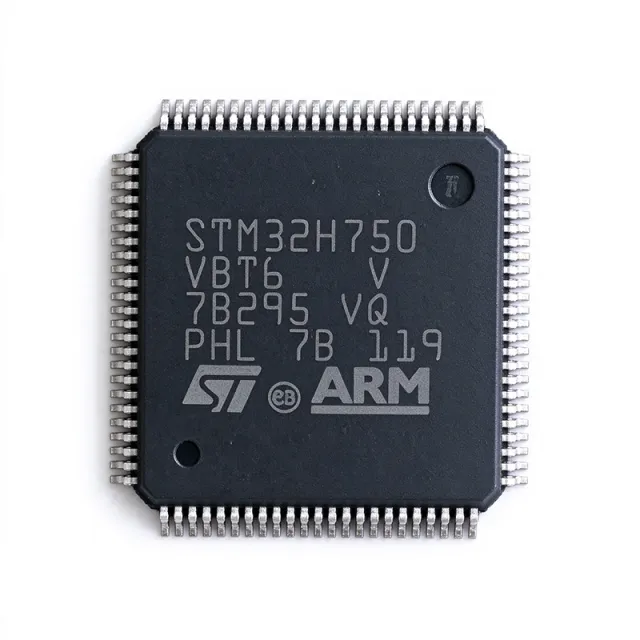
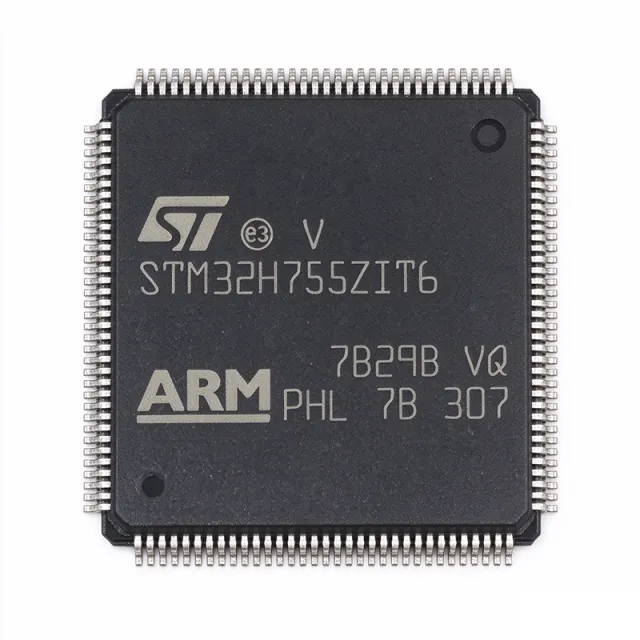
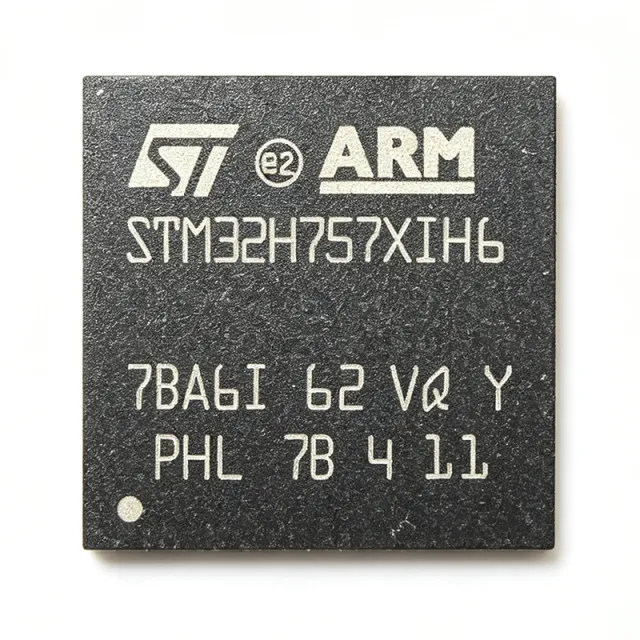
STM32H755ZIT6
STM32H755ZIT6 - Dual-Core Cortex-M7/M4 MCU, 2MB Flash | STMicroelectronics
The STMicroelectronics STM32H755ZIT6 is a high-performance dual-core 32-bit Arm microcontroller combining a Cortex-M7 core operating up to 480 MHz and a Cortex-M4 core up to 240 MHz, with 2 MB of dual-bank flash and 1 MB of SRAM in a 144-pin LQFP (20x20 mm) package. It targets industrial HMI, motor control, audio processing and edge-AI applications where heterogeneous compute partitioning between deterministic real-time control and high-throughput DSP/graphics is required. According to the STMicroelectronics product page, the STM32H755xI line integrates a Chrom-ART Accelerator, hardware crypto/hash accelerators, and a true random number generator.
A microcontroller (MCU) is a compact integrated circuit that combines a processor core, on-chip memory (flash and SRAM), and programmable peripherals used to govern a specific operation in an embedded system. The STM32H755ZIT6 belongs to the STM32H7 family, which sits at the top of the ST Cortex-M portfolio between the mainstream STM32F4/F7 lines and the lower-power STM32L4/U5 lines. Its dual-core architecture enables one core to handle time-critical control while the other runs communication stacks, GUI rendering, or machine-learning inference, with shared access to peripherals through a bus-matrix arbitration scheme.
Key differentiating features include the 480 MHz Cortex-M7 with double-precision FPU and L1 cache, the 240 MHz Cortex-M4 with single-precision FPU, 2 MB flash with read-while-write support, 1 MB SRAM split across DTCM, AXI SRAM and SRAM1/2/3 domains, and an integrated SMPS step-down converter for high-efficiency core supply. The device exposes 114 GPIO, 35 communication interfaces (including Ethernet, USB OTG HS/FS, CAN FD, SPI, I2C, UART, SDMMC), three 16-bit ADCs up to 3.6 MSPS, two 12-bit DACs, two SAI for audio, an LCD-TFT controller, a JPEG codec, and a crypto/hash suite compliant with AES, SHA and RSA.
Built on a 40 nm low-power CMOS process, the part operates from 1.62 V to 3.6 V on VDD and supports an industrial -40 °C to +85 °C temperature range. The dual-bank flash with read-while-write capability simplifies in-field firmware upgrades and A/B partition schemes, while the Chrom-ART accelerator offloads 2D drawing to free the Cortex-M7 for application code. The integrated SMPS reduces core current draw by roughly 30% compared to an external LDO-only supply, easing thermal design in compact enclosures.
Typical applications include industrial HMI panels with TFT LCD, motor-control inverter boards, smart-home gateways, audio DSP front-ends with SAI-to-DAC chains, vision-based edge-AI nodes using the JPEG codec, and medical instrumentation requiring deterministic USB or Ethernet connectivity. The dual-core topology is especially valuable when a real-time control loop must coexist with a Linux-like user interface stack on the same die.
When designing with this device, treat the SMPS inductor selection as critical because ripple directly couples into the core logic rail. Provide a 4.7 µF input bulk plus 100 nF + 1 µF ceramic decoupling near each VDD pin, and follow the ST reference layout for the 240 MHz M7 traces to avoid signal-integrity issues. Boot pins BOOT0 and the option-byte bank must be configured before each power cycle, otherwise the part may revert to system memory bootloader.
This page synthesizes distributor pricing, drop-in alternatives, and practical design notes not found on the ST product page alone.
USD $16,19
Auf Lager