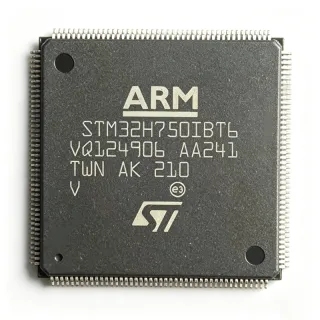
STM32H743IIT6 - 480MHz Cortex-M7 MCU 2MB Flash | STMicroelectronics
Teilenummer: STM32H743IIT6 ✓ Aktiv| Menge | Stückpreis | Gesamt |
|---|---|---|
| 1 | $18.5 | $18,50 |
| 10 | $16.2 | $162,00 |
| 100 | $14.5 | $1.450,00 |
| 500 | $13.1 | $6.550,00 |
| 1.000 | $12 | $12.000,00 |
STM32H743IIT6 Übersicht
Key features include the Cortex-M7 core with 16 KB instruction and 16 KB L1 data caches, delivering up to 1027 DMIPS (2.14 DMIPS/MHz per Dhrystone 2.1), the ART Accelerator for zero-wait-state execution from Flash, and an external memory interface (FMC/QUADSPI) for expansion. Peripherals span Ethernet, USB, CAN, and multiple UART/SPI/I2C ports, with roughly 140 GPIO pins available in the LQFP-176 footprint.
Architecturally, the device couples the scalar double-precision FPU and DSP instructions with a cache-rich memory subsystem, allowing deterministic execution of DSP and Edge-AI workloads such as motor control field algorithms, audio processing, and machine-learning inference at the edge. The large 1 MB SRAM accommodates frame buffers and real-time data pipelines without external DRAM in many designs.
Typical applications include industrial HMI and automation controllers, digital power and motor drives, IoT gateways, and test/measurement instruments. High Flash density and Ethernet make it a natural fit for networked industrial nodes.
Design consideration: confirm the power architecture (integrated LDO versus external SMPS regulator option) early in the design, since it differs from earlier STM32F7 generations and affects both PCB layout and firmware boot code.
This page synthesizes verified distributor data, drop-in alternatives, pricing context, and practical design guidance not found in a single manufacturer source.
Drop-in-Alternativen für STM32H743IIT6 – gleiches Gehäuse, Pin-kompatibel. Bauteile mit anderem Gehäuse, die eine PCB-Überarbeitung erfordern, sind ausgeschlossen.
Varianten dieser Serie
Modelle derselben Serie, die drop-in-kompatibel sind mit STM32H743IIT6 (gleiche Bauform und Footprint) – abweichend in SRAM, ADC, Communication Interfaces, Flash Memory, Operating Temperature.
Schnellvergleichstool – Wählen Sie Alternativbauteile für den Direktvergleich:
STM32H753IIT6
✅ Drop-In✓ Auf Lager
$9.45 / Stück
Datenblatt ansehen →STM32H742IIT6
✅ Drop-In📋 Referenzalternative (nicht im Katalog)
STM32H743IIH6
✅ Drop-In📋 Referenzalternative (nicht im Katalog)
STM32H755ZIT6
✅ Drop-In✓ Auf Lager
$16.19 / Stück
Datenblatt ansehen →STM32H750IBT6
✅ Drop-In✓ Auf Lager
$8.85 / Stück
Datenblatt ansehen →STM32F767IIT6
✅ Drop-In✓ Auf Lager
$11.95 / Stück
Datenblatt ansehen →STM32H743IIT6 Grenzwerte & elektrische Eigenschaften
| Core Architecture | 32-bit ARM Cortex-M7 with double-precision FPU |
| Maximale Taktfrequenz | 480 MHz |
| DMIPS Performance | 1027 DMIPS (2.14 DMIPS/MHz) |
| L1 Instruction Cache | 16 KB |
| L1 Data Cache | 16 KB |
| Flash Memory | 2 MB |
| SRAM | 1 MB |
| Gehäuse | 176-LQFP (24x24 mm) |
| Operating Voltage | 1.62 V to 3.6 V |
| Betriebstemperatur | -40C to +85C (industrial grade) |
| Communication Interfaces | Ethernet, USB, CAN, UART, SPI, I2C |
| External Memory Interface | FMC, QUADSPI |
| GPIO Count | 140 (approx.) |
| ART Accelerator | Yes (zero-wait-state Flash execution) |
| RoHS Compliance | Compliant |
STM32H743IIT6 Pin-Konfiguration
| Pin 1 | PE02 — GPIO PE2, alternate functions |
| Pin 2 | PE03 — GPIO PE3, alternate functions |
| Pin 3 | PE04 — GPIO PE4, alternate functions |
| Pin 4 | PE05 — GPIO PE5, alternate functions |
| Pin 5 | PE06 — GPIO PE6, alternate functions |
| Pin 10 | VSS — Ground reference |
| Pin 11 | VDD — Digital power supply (1.62-3.6V) |
| Pin 20 | OSC_IN — External oscillator input |
| Pin 21 | OSC_OUT — External oscillator output |
| Pin 30 | NRST — Reset input, active low |
| Pin 40 | BOOT0 — Boot mode selection |
| Pin 50 | PA00 — GPIO PA0, WKUP, ADC1_INP0 |
| Pin 60 | PA13 — GPIO PA13, SWDIO for debug |
| Pin 70 | PA14 — GPIO PA14, SWCLK for debug |
| Pin 80 | VREF+ — ADC reference voltage positive |
| Pin 90 | VDDA — Analog power supply |
| Pin 100 | VSSA — Analog ground |
| Pin 120 | USB_DM — USB OTG FS data minus |
| Pin 121 | USB_DP — USB OTG FS data plus |
| Pin 176 | PE01 — GPIO PE1, alternate functions |
Typische Anwendungen
STM32H743IIT6 ist geeignet für 6 Anwendungs: Industrial HMI and Automation Controllers, Motor Control and Digital Power Drives, IoT Gateways and Edge Connectivity, Test and Measurement Instruments, Audio Processing and Consumer Electronics, Edge AI and Machine Learning Inference.
Industrial HMI and Automation Controllers
The STM32H743IIT6's 480 MHz Cortex-M7 core and 1 MB SRAM make it ideal for industrial HMI controllers driving TFT LCD displays with touch input. Its Ethernet, CAN, and USB interfaces support real-time communication with PLCs and sensors, while the ART Accelerator ensures responsive GUI rendering. The 2 MB Flash accommodates full graphical libraries and application code. Engineers pair this MCU with external SDRAM for frame buffers and leverage the Chrom-ART Accelerator for 2D graphics operations.
Empfohlen
Motor Control and Digital Power Drives
The STM32H743IIT6's double-precision FPU and DSP instructions excel in field-oriented control (FOC) algorithms for three-phase motor drives. Its 480 MHz performance enables high PWM resolution and complex control loops with sub-microsecond execution times. The integrated op-amps, comparators, and high-resolution timer (HRTIM) support advanced power conversion topologies. Real-time deterministic execution ensures precise torque and speed regulation in servo and inverter applications.
Empfohlen
IoT Gateways and Edge Connectivity
With integrated Ethernet MAC, USB OTG, and multiple UART/SPI/I2C interfaces, the STM32H743IIT6 serves as a capable IoT gateway bridging field devices to cloud services. The 1 MB SRAM handles MQTT buffers, TLS handshake contexts, and protocol parsing without external memory. The Cortex-M7 performance supports on-device data preprocessing and anomaly detection before transmission, reducing cloud bandwidth costs. Real-time operating systems like FreeRTOS or Azure RTOS run efficiently on this MCU.
Empfohlen
Test and Measurement Instruments
The STM32H743IIT6's high-performance ADC interfaces (up to 16-bit), DSP extensions, and 480 MHz processing enable digital oscilloscopes, data loggers, and spectrum analyzers. The large 1 MB SRAM captures waveform buffers while the 2 MB Flash stores calibration constants and UI assets. Fast signal processing supports real-time FFT, filtering, and statistical analysis. USB OTG enables high-speed data transfer to host PCs for post-processing and visualization.
Empfohlen
Audio Processing and Consumer Electronics
The STM32H743IIT6's DSP instructions and double-precision FPU support real-time audio effects, equalization, and noise cancellation algorithms. Its I2S and SAI interfaces connect to audio codecs and DACs, while the 1 MB SRAM buffers audio streams. The Cortex-M7 performance handles MP3, AAC, and Opus codec processing for portable speakers and headphones. Low-power modes extend battery life in portable audio applications.
Empfohlen
Edge AI and Machine Learning Inference
The STM32H743IIT6's 480 MHz Cortex-M7 core executes TensorFlow Lite Micro models for edge AI inference at the sensor node. The 1 MB SRAM fits moderate-sized neural networks while the 2 MB Flash stores model weights and application code. Typical applications include predictive maintenance, voice command recognition, and image classification for IoT devices. ST's X-CUBE-AI extension pack integrates model conversion and optimization for this MCU.
Empfohlen
Zusammenfassung der empfohlenen Produkte
Technische Referenzdaten für STM32H743IIT6 – Vergleich, Designhinweise und Compliance-Informationen.
Auswahlhilfe
Vergleich mit Alternativen
| Parameter | Dieses Produkt | STM32H753IIT6 | STM32H742IIT6 | STM32H743IIH6 | STM32F767IIT6 |
|---|---|---|---|---|---|
| Package | 176-LQFP (24x24 mm) | 176-LQFP (24x24 mm) - same | 176-LQFP (24x24 mm) - same | 176-LQFP (24x24 mm) - same | 176-LQFP (24x24 mm) - same |
| Brand | STMicroelectronics | STMicroelectronics | STMicroelectronics | STMicroelectronics | STMicroelectronics |
| Core | Cortex-M7 @ 480 MHz | Cortex-M7 @ 480 MHz | Cortex-M7 @ 480 MHz | Cortex-M7 @ 480 MHz | Cortex-M7 @ 216 MHz |
| Flash Memory | 2 MB | 2 MB | 2 MB | 2 MB | 2 MB |
| SRAM | 1 MB | 1 MB | 1 MB | 1 MB | 512 KB |
| Crypto Acceleration | No | Yes (AES, SHA, PKA) | No | No | No (crypto on STM32F769) |
| Ethernet MAC | Yes | Yes | No | Yes | Yes |
| DMIPS Performance | 1027 DMIPS | 1027 DMIPS | 1027 DMIPS | 1027 DMIPS | 462 DMIPS |
Wichtigste Unterscheidungsmerkmale
- Hardware cryptographic engines included (vs. STM32H743IIT6)
- Highest DMIPS performance in LQFP-176 H7 family (vs. STM32F767IIT6)
- Larger SRAM than STM32F7 predecessor (vs. STM32F767IIT6)
Designhinweise
The STM32H743IIT6 supports both integrated LDO and external SMPS voltage regulator modes. When using SMPS mode, firmware must configure the power controller via the PWR registers during startup, unlike STM32F7 which uses a BYPASS_REG pin. Verify the regulator mode selection in hardware design (VCAP pins) and confirm boot code enables the correct path. Incorrect mode selection results in unstable operation or failure to boot.
Place decoupling capacitors (100 nF ceramic) as close as possible to each VDD/VSS pin pair. Add bulk capacitors (4.7 µF to 10 µF) near the MCU power pins. For LQFP-176 packages, route power and ground on inner layers with adequate via stitching. The high-speed interfaces (Ethernet, USB, SDRAM) require controlled impedance routing; consult the ST application note AN5121 for PCB layout guidelines.
Do not assume STM32H743IIT6 is fully drop-in compatible with STM32F7 designs without firmware updates. The clock tree, interrupt priorities, and peripheral register mappings differ between F7 and H7. Use STM32CubeMX to regenerate initialization code when migrating. The ART Accelerator configuration must be explicitly enabled in option bytes or flash latency settings for maximum performance.
Compliance-Informationen
RoHS and REACH compliant per ST product documentation. Industrial temperature grade -40C to +85C. Not AEC-Q100 qualified for automotive applications.