Leistungsmanagement
Unterkategorien
Produkte (2770)

VNH3SP30-E - 30A Automotive H-Bridge Motor Driver | STMicroelectronics
The STMicroelectronics VNH3SP30-E is an automotive-grade fully-integrated H-bridge motor driver in a 30-pin MultiPowerSO-30 package, delivering up to 30 A continuous output current from a 5.5 V to 36 V supply. The IC integrates a dual monolithic high-side driver (HSD), two low-side switches, control logic, charge pump, and protective functions into one package, replacing discrete MOSFET bridges plus gate drivers. According to the ST datasheet, the device is targeted at DC motor control in harsh automotive environments. What is an H-bridge motor driver? An H-bridge is a four-switch topology that can drive a brushed DC motor in both directions by reversing the polarity of the applied voltage. Integrated H-bridge ICs combine the four power switches, gate drivers, current sensing, and protection (over-current, over-temperature, under-voltage, cross-conduction prevention) into a single package. This category sits within the broader taxonomy of motor drivers -> motion control ICs -> power management ICs -> semiconductors. The MultiPowerSO-30 package exposes the power die to a top-side thermal pad so heat can be sunk directly to a heatsink or chassis. Key features include 30 A continuous DC output current, 60 A peak transient capability, very low Rds(on) of approximately 9 mOhm per high-side + low-side leg, integrated PWM current control, and built-in diagnostics. The logic inputs accept 5 V CMOS signals and the device supports PWM frequencies up to 10 kHz for speed/torque regulation. The MultiPowerSO-30 package provides a low thermal resistance path enabling high-current operation without external cooling up to the datasheet rating. Typical applications include automotive DC motor control such as window lifts, seat adjusters, sunroof drives, door locks, wiper systems, and small electric vehicle traction. Industrial uses include robotic actuators, conveyor drives, valve positioning, and battery-powered equipment where a compact, fully-protected H-bridge is required. When designing with the VNH3SP30-E, observe the datasheet SOA at high currents - the junction-to-ambient thermal resistance limits continuous current without a heatsink. Use a low-ESR supply bypass close to VCC, and provide a reverse-battery protection diode or P-MOSFET on the supply line because the IC does not include reverse-polarity protection internally. This page synthesizes distributor pricing, drop-in alternatives, and practical design notes not found in the manufacturer datasheet alone, organized for engineers evaluating the VNH3SP30-E for automotive or industrial motor-drive designs.
VNH3SP30TR-E - 30A H-Bridge Motor Driver MultiPowerSO-30 | STMicroelectronics
The STMicroelectronics VNH3SP30TR-E is an automotive fully integrated H-bridge motor driver intended for a wide range of automotive applications. The device incorporates a dual monolithic high-side driver (HSD) and two low-side switches, all housed in a MultiPowerSO-30 package with an exposed thermal pad. It delivers up to 30 A continuous output current per switch with a 5.5 V to 36 V supply range. An H-bridge motor driver is a four-switch power topology (two high-side, two low-side MOSFETs) that allows a DC motor to be driven in both directions from a single supply rail. The H-bridge sits in the broader power management hierarchy as a motor driver, an integrated power IC that combines the logic interface, gate drivers, protection features, and power FETs in one package. By integrating everything monolithically, the H-bridge IC replaces tens of discrete components and simplifies PCB layout for brushed DC and stepper motor control. Key features of the VNH3SP30TR-E include PWM current control, parallel-mode operation for higher current loads, integrated charge pump for high-side gate drive, built-in thermal shutdown, cross-conduction protection, and a current sense output for closed-loop control. The device can drive two high-side switches in parallel or be configured as a full bridge. The MultiPowerSO-30 package provides a low thermal resistance path for dissipating the heat generated by the power FETs at high motor currents. Typical applications include automotive DC motor control (window lifts, seat adjusters, sliding doors, tailgates, mirrors), industrial robotics and small pumps, HVAC damper actuators, and 24 V brushed servo systems. The wide supply range and integrated protection make it well suited for harsh 12 V/24 V automotive electrical environments with load-dump and cranking transients. When designing with this part, derate the output current according to the PCB copper area used as a heatsink and ambient temperature; the MultiPowerSO-30 package relies on the PCB copper pour for thermal dissipation. Add adequate bulk decoupling on the supply rail and route the power ground separately from the logic ground. Consider the VNH2SP30 for lower-current applications or the VNH5019 for higher-current needs. This page synthesizes verified distributor pricing, drop-in same-package alternatives, application notes, and design guidance not aggregated on the STMicroelectronics datasheet alone, providing engineers with a faster decision-making reference.

VNH5019 - 30A Automotive H-Bridge Motor Driver | STMicroelectronics
The STMicroelectronics VNH5019 is a fully integrated automotive-grade H-bridge motor driver designed for high-current DC motor control. It integrates a dual monolithic high-side driver and two low-side switches using ST's proprietary VIPower M0 technology, which combines a true Power MOSFET with an intelligent signal/protection circuit on the same die. The device is assembled in a MultiPowerSO-30 package with electrically isolated lead-frames, enabling efficient thermal management and high-current operation. An H-bridge motor driver is a power management IC that allows a DC motor to be driven in both directions (forward and reverse) by controlling the polarity of the voltage applied across the motor terminals. It sits between a microcontroller and the motor, translating low-power logic signals into high-current switching actions. The VNH5019 belongs to the broader category of motor drivers, which are essential in robotics, automotive, and industrial automation systems where precise speed and direction control are required. Key features of the VNH5019 include a wide operating voltage range of 5.5V to 24V, a continuous output current of 12A with a peak capability of 30A, and an ultra-low on-resistance of 18mOhm per switch. The device supports PWM frequencies up to 20kHz (ultrasonic), enabling silent motor operation. It also provides a current sense output that delivers an analog voltage proportional to the motor current, facilitating closed-loop control and overcurrent monitoring. The VNH5019 integrates comprehensive protection features, including reverse-voltage protection, over-voltage protection, under-voltage lockout, overcurrent protection, and thermal shutdown. These protections ensure robust operation in harsh automotive and industrial environments. The device operates with logic levels from 2.5V to 5V, making it compatible with both 3.3V and 5V microcontrollers. The MultiPowerSO-30 package provides excellent thermal performance, with a junction-to-ambient thermal resistance of [DATA_NEEDED: thermal resistance] C/W, allowing continuous operation at high currents with appropriate PCB copper area. Typical applications include automotive power windows, seat adjusters, and wiper motors, as well as robotics, automated guided vehicles (AGVs), and industrial actuators. The VNH5019 is also widely used in educational robotics platforms and hobbyist motor driver carriers, such as those from Pololu. Its combination of high current capability, integrated protection, and ease of use makes it a preferred choice for designers requiring a reliable, compact H-bridge solution. When designing with the VNH5019, ensure adequate PCB copper area for thermal dissipation, especially when operating at continuous currents above 6A. The current sense output should be connected to an analog-to-digital converter (ADC) input for accurate motor current monitoring. Additionally, proper decoupling capacitors (e.g., 100nF ceramic and 10uF electrolytic) should be placed close to the VCC and GND pins to suppress voltage transients during PWM switching.

VNH5050A-E - 50A Automotive H-Bridge Driver | STMicroelectronics
The STMicroelectronics VNH5050A-E is a fully integrated H-bridge motor driver designed for high-current automotive and industrial applications. It delivers a continuous output current of 50 A and a peak current of 70 A, operating from a supply voltage range of 5.5 V to 18 V. The device is housed in a 12-pin MultiPowerSO-30 package with an exposed pad for enhanced thermal performance. An H-bridge motor driver is a power integrated circuit that controls the direction and speed of a DC motor by selectively switching four transistors in an H-shaped configuration. It is a type of motor driver IC, which falls under the broader category of power management ICs. The VNH5050A-E integrates the power stage, gate drivers, and protection circuitry in a single package, simplifying PCB design and reducing component count. Key features include a low ON-resistance of 20 mOhm per switch, which minimizes power dissipation and improves efficiency. The device provides a 5 V logic supply output for external circuitry, and includes a current sense output proportional to the motor current, enabling closed-loop control. It also features a diagnostic output for fault reporting, and a PWM input for speed control up to 20 kHz. The VNH5050A-E uses STMicroelectronics' VIPower M0 technology, which integrates a double-diffused MOS (DMOS) power stage with CMOS control logic. This architecture provides robust switching performance and high reliability under harsh automotive conditions. The device includes comprehensive protection features such as undervoltage lockout, overvoltage clamp, thermal shutdown, and load current limitation. Typical applications include automotive power windows, sunroofs, seat adjusters, and DC motor control in industrial automation. The high current capability and wide supply range make it suitable for driving brushed DC motors in body control modules and actuator systems. When designing with this device, ensure adequate PCB copper area for heat dissipation, as the thermal resistance (junction-to-ambient) is 35 C/W. The exposed pad must be soldered to a large copper pour to maintain junction temperature below the maximum rating of 150 C.
VNH5180A-E - 41A Automotive H-Bridge Motor Driver | STMicroelectronics
The STMicroelectronics VNH5180A-E is a fully integrated H-bridge motor driver designed for automotive and industrial DC motor control applications. It delivers a continuous output current of up to 41A and operates from a supply voltage range of 5.5V to 18V, making it suitable for high-power brushed DC motors, actuators, and power steering systems. The device is housed in a 16-pin PowerSSO-36 package with an exposed thermal pad, enabling efficient heat dissipation in compact designs. An H-bridge motor driver is a power management IC that controls the direction and speed of a DC motor by selectively switching four transistors in an H configuration. It allows bidirectional current flow through the motor, enabling forward, reverse, and braking operations. The VNH5180A-E integrates the power stage, gate drivers, and protection circuitry into a single package, simplifying PCB design and reducing component count compared to discrete implementations. Key features include a low on-resistance of 20 mOhm per switch, which minimizes power losses and heat generation at high currents. The device provides a PWM frequency range up to 20 kHz, allowing precise speed control. It includes comprehensive protection features such as undervoltage lockout, overvoltage clamp, thermal shutdown, and load current limitation. The VNH5180A-E also features a diagnostic output that reports fault conditions, enhancing system reliability. The VNH5180A-E utilizes a proprietary VIPower M0-5 technology, which integrates the power MOSFETs and control logic on a single die. This architecture ensures fast switching and robust operation under harsh automotive conditions. The device is AEC-Q100 qualified, meeting the stringent reliability requirements for automotive applications. Its 16-pin PowerSSO-36 package provides excellent thermal performance with a junction-to-ambient thermal resistance of 30 C/W, allowing operation at high ambient temperatures with appropriate PCB copper area. Typical applications include automotive power windows, seat adjusters, wiper motors, and industrial automation systems. The device's high current capability and robust protection make it ideal for driving large brushed DC motors in electric power steering (EPS) and engine cooling fans. In automotive body control modules, the VNH5180A-E simplifies motor control by integrating all necessary functions, reducing board space and improving reliability. When designing with the VNH5180A-E, ensure adequate PCB copper area for heat dissipation, especially at continuous currents above 20A. The PWM input should be driven with a proper dead-time to prevent shoot-through. The diagnostic output can be monitored by a microcontroller to detect faults and implement safe shutdown procedures.
VNH7040AYTR - 35A H-Bridge Motor Driver | STMicroelectronics
The STMicroelectronics VNH7040AYTR is an automotive-grade fully integrated H-bridge motor driver delivering up to 35 A continuous output current, housed in a 36-pin PowerSSO package with exposed thermal pad for surface-mount assembly. It operates across a 4 V to 28 V supply range with a nominal 13 V rail, integrates a dual monolithic high-side driver and two low-side switches built on ST's proprietary VIPower M0 technology, and combines a true Power MOSFET with intelligent signal/power stages on a single die. What is an H-bridge motor driver? An H-bridge motor driver is a power-integrated circuit that uses four switching elements arranged in an H configuration to drive a brushed DC motor bidirectionally from a single supply rail. It sits in the motor-control signal chain between a low-power MCU (logic-level PWM/direction commands) and a brushed DC or stepper motor, handling the high-current switching that the MCU cannot do directly. Within the broader taxonomy: H-bridge driver -> motor driver -> power management IC -> semiconductor. The VNH7040AY adds diagnostic, current-sense and protection features that a discrete MOSFET H-bridge cannot match in the same footprint. Key features include 35 A continuous output current, integrated current sensing with analog feedback, PWM input up to 20 kHz, built-in thermal shutdown, undervoltage and overvoltage protection, cross-conduction prevention (dead-time management), and an operating temperature window of -40 C to +150 C junction. AEC-Q100 qualification makes it suitable for automotive under-hood environments. The PowerSSO-36 package exposes a thermal pad on its bottom surface, achieving a junction-to-case thermal resistance typically below 1 C/W and enabling PCB-direct heat dissipation. The VIPower M0 architecture allows on-die integration of a vertical DMOS power stage and CMOS/BCD signal logic. This co-integration reduces parasitic inductance, dead time, and bill-of-material count versus a discrete H-bridge using four MOSFETs plus a gate driver IC, while still delivering current sensing through the integrated sense-FET topology. Typical applications include automotive brushed DC motor control (window lift, sliding doors, seat adjustment, sunroof drives, fuel pumps, throttle-by-wire backup), industrial 24 V brushed servo drives, AGV/robot traction wheels, and battery-powered e-mobility traction motors in the 5 A to 30 A range. When designing with this device, observe PCB layout guidelines from ST application notes: keep the power ground return path short, place a 100 nF + bulk capacitor directly on the motor supply pin, and ensure the exposed pad is soldered to at least 200 mm squared of copper for thermal performance. This page synthesizes distributor pricing from DigiKey/Mouser/Arrow, AEC-Q100 qualified drop-in alternatives, and application notes that the manufacturer datasheet does not consolidate in a single location.

VNH7070ASTR - 15A Automotive H-Bridge Motor Driver | STMicroelectronics
The STMicroelectronics VNH7070ASTR is a fully integrated H-bridge motor driver delivering up to 15 A continuous output current, operating from a 4 V to 28 V supply range in a 16-pin SO (Multiwatt derivative) package. It uses ST's proprietary VIPower M0-7 technology to integrate a true Power MOSFET half-bridge and intelligent signal/protection circuitry on the same die, supporting PWM control up to 20 kHz for automotive DC motor loads. An H-bridge motor driver is a power integrated circuit that controls the direction and speed of a DC motor by selectively activating four switches in an H-shaped bridge configuration. The architecture sits within the motor driver hierarchy, itself a sub-category of power management ICs. The VNH7070ASTR integrates control logic, gate drivers, and power MOSFETs into a single package, eliminating the need for discrete FET bridges and reducing PCB area, BOM count, and design complexity. Key features include a low ON-state resistance of 40 mOhm per switch (typical), which minimizes conduction losses and improves thermal performance at high current. The device provides an analog current sense output (CS) delivering a proportional voltage for closed-loop torque control and stall detection, and a diagnostic feedback pin (DIAG/SEL0) reporting overcurrent, overtemperature, and open-load fault conditions. PWM inputs INA and INB support forward, reverse, brake-low, brake-high, and high-impedance states for full four-quadrant motor control. Internally, the VNH7070ASTR combines a dual monolithic high-side driver with two low-side switches assembled in SO-16N package on electrically isolated lead-frames. Protection features include undervoltage lockout, overvoltage clamping (Vclamp), thermal shutdown with automatic restart, cross-conduction protection, and short-to-ground/short-to-VBAT detection. The exposed pad and SO-16N lead-frame deliver robust thermal performance suited to automotive underhood and body electronics environments. Typical applications include automotive power windows, power seats, sunroofs, sliding doors, fuel pumps, and HVAC blowers, as well as industrial DC motor control in robotics, actuators, and small pumps. The wide 4 V to 28 V supply range makes it compatible with both 12 V and 24 V automotive battery systems including crank and load-dump transients within the protected envelope. When designing with the VNH7070ASTR, allocate sufficient PCB copper area on the drain tabs and exposed pad to keep junction temperature within SOA at continuous 15 A loads. Decouple VCC and VBS with low-ESR ceramics placed within 5 mm of the IC, route the high-current traces on inner or top-layer pours, and monitor the DIAG pin with the host MCU for graceful fault handling. This page synthesizes distributor pricing, drop-in alternatives, and practical PCB/thermal design notes not found in the manufacturer datasheet alone.
VNH7100ASTR - Automotive H-Bridge Motor Driver 30A | STMicroelectronics
The STMicroelectronics VNH7100ASTR is a fully integrated full-bridge (H-bridge) motor driver intended for a wide range of automotive applications, housed in a 16-pin SO (SOIC-16N) power package with exposed thermal pad. It combines, on a single VIPower M0 die, two monolithic high-side drivers plus two low-side Power MOSFET switches, and provides a current rating up to 30 A continuous / 60 A peak with operating supply voltage from 4 V to 28 V. An H-bridge motor driver is a four-switch power stage that drives a brushed DC motor bidirectionally from a single supply. The IC integrates the four power switches plus their gate drivers, charge pump, protection logic, and diagnostic feedback into one package, eliminating the discrete MOSFET bridge and allowing compact PCB designs for DC motors, fans, pumps, and small actuators in automotive systems. H-bridge drivers belong to the broader category of motor-driver ICs, sitting within the power-management semiconductor family. Key features include very low RDS(on) high-side and low-side MOSFETs (typically in the tens of milliohm range per the VIPower M0 technology), built-in PWM current control up to 20 kHz, integrated charge pump, cross-conduction (shoot-through) protection, undervoltage/overvoltage shutdown, thermal shutdown, and a status flag output. The 16-pin SO package provides a low Rthja through the exposed thermal pad, enabling high continuous current without external heatsinking. The VNH7100ASTR uses ST's proprietary VIPower M0 smart-power technology, which co-integrates analog control logic, charge pump, and vertical Power MOSFETs on a single silicon die. This monolithic integration minimizes parasitic inductance and provides fast, well-matched switching for PWM frequencies up to 20 kHz while protecting against load-dump transients common in 12 V / 24 V automotive buses. Typical applications include automotive DC brushed motors for window lifts, seat adjusters, sliding doors, HVAC blowers, fuel pumps, and water/oil pumps. It is also used in industrial motion control where a robust, protected full-bridge driver is required. The wide 4 V to 28 V supply range covers both 12 V and 24 V bus systems. When designing with the VNH7100ASTR, ensure that the PCB provides a sufficiently large copper pour under the exposed thermal pad to dissipate up to ~5 W continuous load. PWM frequency should stay within the datasheet range to prevent cross-conduction; use an RC network on the inputs to control dV/dt and EMI. Note: this part is currently NRND (Not Recommended for New Designs); for new designs consider VNH7100BASTR (successor) or equivalent cross-brand options. This page synthesizes distributor pricing, drop-in alternatives, application notes, and design guidance not found in the manufacturer datasheet alone.
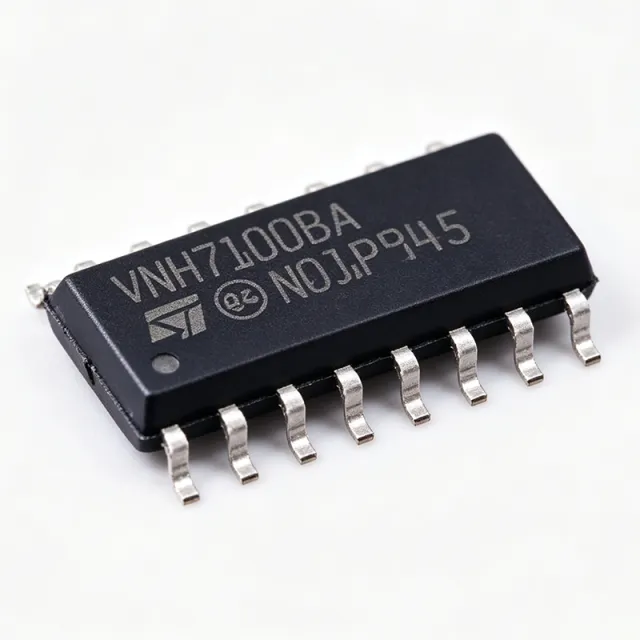
VNH7100BASTR - 12A Automotive H-Bridge Motor Driver | STMicroelectronics
The STMicroelectronics VNH7100BASTR is an automotive-grade fully integrated H-bridge motor driver delivering up to 12 A continuous output current from a 4 V to 28 V supply rail, housed in a 16-pin PowerSSO-16 package with an exposed thermal pad. The device combines a dual monolithic high-side driver and two low-side switches using ST's proprietary VIPower M0 technology, allowing a true power stage and intelligent protection circuitry on the same silicon die. It is qualified to AEC-Q100 standards for harsh automotive environments with an operating junction temperature range of -40 °C to +150 °C. An H-bridge motor driver is a power management IC that controls the direction and speed of a brushed DC motor by selectively activating four switches in an H configuration. It belongs to the broader hierarchy of motor drivers -> motion controllers -> power management ICs -> semiconductors. The VNH7100BASTR integrates the full H-bridge and the gate-drive/protection logic in one package, eliminating the bulk of discrete MOSFET bridges, gate drivers, and current-sense amplifiers. Key features include a 60 mΩ typ. on-resistance per high-side switch that minimizes conduction loss, PWM control up to 20 kHz for precise speed regulation, and a comprehensive protection suite: undervoltage lockout, overvoltage clamp, thermal shutdown with auto-restart, and load current limitation. A dedicated diagnostic feedback pin reports fault conditions to the host MCU. The PowerSSO-16 exposed pad provides a low thermal resistance path, supporting 12 A continuous operation with proper PCB copper. Typical applications include 12 V automotive brushed DC loads such as power window lifters, seat adjusters, mirror fold actuators, HVAC flaps, and door lock motors. The wide 4 V to 28 V supply range also suits industrial 24 V brush DC drives and battery-powered robotics where a single-IC H-bridge simplifies BOM and PCB area. When designing with this device, dedicate at least 1 sq in of top-side copper to the exposed pad and stitch a 4×4 thermal via array to the inner/inner-outer copper planes to keep junction temperature in spec. Place a 100 nF X7R ceramic bypass within 2 mm of the VCC pin and a bulk 47 µF electrolytic at the motor connector. Use a gate resistor or RC snubber on the PWM input if long MCU traces cause ringing above 5 MHz. This page synthesizes distributor pricing, drop-in alternatives, and practical design notes not found in the STMicroelectronics datasheet, giving engineers a single decision-ready resource for selecting and implementing the VNH7100BASTR in automotive and industrial brushed DC motor designs.

VNH9030AQ - 30A Automotive H-Bridge Motor Driver | STMicroelectronics
The STMicroelectronics VNH9030AQ is a fully integrated H-bridge motor driver designed for automotive and industrial DC motor control applications. It delivers a continuous output current of 30A and operates from a supply voltage range of 4V to 28V, making it suitable for a wide variety of brushed DC motor loads. The device is housed in a 32-pin VFQFPN (5x5 mm) package with an exposed pad for enhanced thermal performance. An H-bridge motor driver is a power management IC that allows bidirectional control of a DC motor by selectively enabling four power transistors in a bridge configuration. The VNH9030AQ integrates the power stage, gate drivers, and protection circuitry in a single package, simplifying PCB design and reducing component count compared to discrete implementations. This integration places the VNH9030AQ within the power management IC hierarchy, specifically under motor drivers, which are essential for automotive systems such as power windows, seat adjustment, and cooling fans. Key features of the VNH9030AQ include a low on-resistance of 25 mOhm per switch, which minimizes power dissipation and improves efficiency. The device provides a PWM frequency range up to 20 kHz, enabling precise speed control with minimal audible noise. It also includes comprehensive protection features such as undervoltage lockout, overcurrent protection, thermal shutdown, and a diagnostic output for fault reporting. These features ensure robust operation in harsh automotive environments. The VNH9030AQ utilizes STMicroelectronics' VIPower M0 technology, which integrates the control logic and power MOSFETs on a single die. This architecture reduces parasitic inductance and improves switching performance. The device supports both parallel and bridge operating modes, offering flexibility for different motor control topologies. The integrated current sense output provides real-time motor current monitoring, enabling closed-loop control algorithms. Typical applications include automotive body control modules, DC motor drivers for power seats, window lifts, and HVAC actuators, as well as industrial automation and robotics. The wide supply voltage range and high current capability make it suitable for both 12V and 24V systems. In automotive applications, the VNH9030AQ can be directly interfaced with a microcontroller via its standard logic-level inputs, simplifying system design. When designing with the VNH9030AQ, ensure adequate PCB copper area for thermal dissipation, as the device can dissipate significant power at high currents. The exposed pad must be soldered to a thermal via array to maintain junction temperature within safe limits. Additionally, place a 100nF ceramic capacitor close to the supply pins to suppress high-frequency noise and a bulk electrolytic capacitor to handle current transients.
VNHD7012AY - Automotive H-Bridge Motor Driver | STMicroelectronics
The VNHD7012AY is an automotive-grade H-bridge motor driver from STMicroelectronics, designed for driving DC motors in 12V and 24V automotive systems. It integrates a fully protected dual high-side driver and the drivers and protections for two external power MOSFETs in a low-side configuration, enabling a complete H-bridge with minimal external components. The device is housed in a 36-lead PowerSSO-36 package with an exposed pad for enhanced thermal dissipation. An H-bridge motor driver is a power management IC that controls the direction and speed of a DC motor by selectively switching four transistors in an 'H' configuration. It is a critical component in automotive systems such as power windows, seat adjusters, steering column actuators, and HVAC actuators. The VNHD7012AY belongs to the VIPower M0-7 family, which combines a true PowerMOSFET with intelligent signal and protection circuitry on a single die, simplifying design and improving reliability. Key features include a wide operating voltage range of 4V to 28V, a maximum output current of 38A (as referenced in the EV-VNHD7012AY reference design), and a low ON-state resistance that minimizes power dissipation. The device provides comprehensive protection including load current limitation, overtemperature shutdown, overvoltage clamp, and loss of ground protection. It also features a PWM input for speed control and a diagnostic output for fault detection. The VNHD7012AY uses STMicroelectronics' proprietary VIPower technology, which integrates a vertical power MOSFET with intelligent control circuitry. This architecture enables efficient switching, low quiescent current, and robust protection against automotive transients. The PowerSSO-36 package, with its exposed pad, provides a thermal resistance suitable for high-current applications when properly connected to a PCB copper area. Typical applications include automotive DC motor driving for power windows, sunroofs, seat adjustment, steering column tilt/telescope, and HVAC actuators. The device is also suitable for industrial DC motor control where 12V or 24V supplies are used. Its high current capability and protection features make it ideal for driving motors that require bidirectional control and PWM speed regulation. When designing with the VNHD7012AY, ensure adequate PCB copper area for thermal management, especially at high output currents. The two external low-side MOSFETs must be selected to match the motor's current and voltage requirements, and proper gate drive connections must be made to the device's gate driver outputs.
VNHD7012AYTR - 28V, 12A H-Bridge Motor Driver | STMicroelectronics
The STMicroelectronics VNHD7012AYTR is a monolithic H-bridge motor driver designed for automotive and industrial DC motor control applications. It integrates two half-bridges with a maximum continuous output current of 12A per channel and supports an operating supply voltage range of 4V to 28V. The device is housed in a 36-pin PowerSSO-36 package with exposed thermal pad, enabling efficient heat dissipation in high-current applications. An H-bridge motor driver is a power management IC that controls the direction and speed of a DC motor by selectively turning on four transistors in an H-shaped configuration. It is a type of motor driver, which falls under the broader category of power management ICs. The VNHD7012AYTR integrates the power stage, gate drivers, and protection features, simplifying the design of bidirectional motor control systems. Key features include a low ON-resistance of 25 mOhm per channel, which minimizes power losses and heat generation. The device provides PWM control up to 20 kHz, enabling precise speed regulation. It includes comprehensive protection features such as undervoltage lockout, overvoltage clamp, overcurrent protection, and thermal shutdown, ensuring robust operation in harsh environments. The logic inputs are 3.3V and 5V compatible, allowing direct interface with microcontrollers. The VNHD7012AYTR uses a high-side and low-side driver architecture with integrated bootstrap diodes for the high-side gate drive. It features a current sense output that provides a proportional current signal for closed-loop control. The device is AEC-Q100 qualified, making it suitable for automotive applications. Its PowerSSO-36 package offers a thermal resistance of 30 C/W, allowing operation at high currents with proper PCB copper area. Typical applications include automotive power windows, sunroofs, seat adjustment, and industrial DC motor control. The device's wide voltage range and high current capability make it ideal for driving brushed DC motors in body control modules and industrial actuators. When designing with this device, ensure adequate PCB copper area for thermal management, especially at high output currents. The current sense pin should be connected to a low-value sense resistor for accurate current monitoring. Proper decoupling capacitors on the supply pins are essential to minimize voltage transients during switching.

VNI4140K-32 - Quad High-Side Smart Power SSR 1A PowerSSO-24 | STMicroelectronics
The STMicroelectronics VNI4140K-32 is a monolithic quad high-side smart power solid-state relay manufactured in ST's VIPower technology, designed to drive four independent resistive, capacitive, or inductive loads with one side connected to ground. Each channel delivers up to 1.0 A continuous current and integrates very low on-state resistance (RDS(on) of 0.08 ohm per channel), independent per-channel diagnostic feedback, and fast demagnetization of inductive loads in a 24-pin PowerSSO package with an exposed thermal pad. A high-side smart power switch (also called a high-side driver or smart solid-state relay) sits between the supply rail and the load; it replaces electromechanical relays with a semiconductor switch that can be commanded by logic-level signals. Within the broader taxonomy, the VNI4140K-32 belongs to the family of power management ICs (PMIC), specifically to the load-driver / smart-power-switch subcategory, which sits above discrete MOSFETs in functional integration and below complete PLC output modules in system scope. The IC integrates a vertical power MOSFET, gate driver, current-limit, thermal protection, and open-drain diagnostic on each of four channels in one package. Key specifications include a load current rating of 1.0 A per channel (limited to 0.6 A in the closely-related VNI4140K variant), a maximum supply voltage of 41 V, per-channel RDS(on) of 0.08 ohm, conformal to IEC 61131-2 for industrial PLC outputs, and ESD robustness rated per IEC air-discharge standards at 25 kV. Each channel independently reports open-load, short-to-ground, and over-temperature faults, and the fast demagnetization path handles the back-EMF of inductive loads without external freewheeling diodes. The VIPower M0 technology combines a vertical DMOS output stage with CMOS/bipolar control logic on the same die, allowing the integration of protection and diagnostic features around a power transistor. The exposed-pad PowerSSO-24 package provides a low junction-to-ambient thermal resistance, which is critical when all four channels conduct simultaneously: at full 1 A per channel, the total package dissipation can approach several watts and requires PCB copper-area heatsinking. Typical applications include 24 V PLC digital outputs (IEC 61131-2 compliant), industrial solenoid and valve drivers, automotive body controllers (lighting, relay substitution, ground-referenced loads), and any multi-channel resistive/inductive load switching where diagnostic feedback is required. The four independent channels are well suited to driving lamps, relays, LEDs, heaters, and small DC motors in parallel-bussed architectures. A key design consideration is the proximity between input and output on each channel: use a star-ground topology for the load returns and place the device close to the connector. The diagnostics only function correctly when the channel is fully on or fully off; PWM operation above a few hundred hertz should be validated against the channel's switching-loss budget. The exposed pad MUST be soldered to a sufficiently large copper pour to keep the junction temperature within the safe operating area. This page synthesizes distributor pricing from DigiKey/Mouser/Octopart, drops-in alternatives sourced from ST's VIPower portfolio, and practical design guidance not duplicated in the manufacturer datasheet.
VNI4140KTR-32 - Quad 1A High-Side SSR, 41V, PowerSSO-24 | STMicroelectronics
The STMicroelectronics VNI4140KTR-32 is a monolithic quad-channel high-side solid-state relay (SSR) fabricated in ST's VIPower technology, delivering up to 1 A continuous current per channel in a thermally-enhanced PowerSSO-24 package with an exposed bottom pad. Each of the four channels integrates an N-channel power MOSFET, a charge pump gate driver, per-channel diagnostic logic, and comprehensive protection circuitry. The device operates from a 10.5 V to 36 V supply and features a typical R_DS(on) of 0.08 ohm per channel, enabling direct drive of resistive, inductive, or capacitive loads connected to ground. A high-side solid-state relay is a semiconductor switch that replaces mechanical relays by using power MOSFETs to switch DC loads, offering silent operation, long life, fast switching, and built-in protection. The VNI4140KTR-32 sits in the power distribution hierarchy as a smart high-side driver, which is a category of power management IC that combines a switching element, gate drive, and diagnostic feedback in one device for industrial automation, body electronics, and IEC 61131-2 compliant PLC outputs. Key features include very low on-resistance (0.08 ohm typ), 1 A per-channel continuous current, integrated fast demagnetization of inductive loads, configurable latched or self-resetting thermal shutdown, per-channel open-load detection, short-circuit and overcurrent protection, and under-voltage lockout. The exposed bottom pad delivers a Rth(JA) suitable for 1 A operation on a standard 4-layer PCB without heatsinking. Typical applications include four-channel industrial PLC digital outputs (IEC 61131-2), programmable logic controller field-side switches, industrial sensor power distribution, building automation relay replacement, and multi-channel 24 V solenoid/valve drivers. Each channel can replace an electromechanical relay with PCB-friendly footprint and silent operation. Designers should ensure the charge pump bypass capacitor is placed as close to the VCC and GND pins as possible, route each output channel separately to minimize cross-talk, and use the exposed pad as the primary thermal path. The diagnostic output pin (DIAG) is multiplexed across channels and should be read in time-slotted fashion to identify the faulting channel during commissioning.

VNL5050S5-E - 19A Low-Side OMNIFET III Driver | STMicroelectronics
The STMicroelectronics VNL5050S5-E is a monolithic low-side power switch built on ST's VIPower (Vertical Intelligent Power) technology, delivering up to 19 A continuous drain current in an 8-pin SOIC package. It is the SOIC-8 sibling of the VNL5050N3-E SOT-223 variant and belongs to the OMNIFET III fully protected low-side driver family. The device integrates an N-channel power MOSFET with a 50 mOhm typical on-state resistance and a wide 3.5 V to 5.5 V logic supply range, accepting standard 3.3 V and 5 V microcontroller GPIO inputs without level shifting. A low-side power switch (also called a low-side driver or low-side MOSFET switch) is a discrete-or-circuit building block that sits between the load and ground. By switching the ground return path, it controls current flow through loads whose high side is tied to the battery. Compared with high-side switches, low-side drivers are simpler, lower on-resistance, and cheaper, at the cost of breaking the load's ground reference. The VNL5050S5-E sits in the broader hierarchy: power switch -> load driver -> power management IC -> semiconductor. Key features include ESD protection, integrated overvoltage clamp, thermal shutdown, current and power limitation, very low standby current, and very low electromagnetic susceptibility. Together these protections eliminate the need for external freewheeling diodes on inductive loads and remove most external snubber components, reducing BOM cost and PCB area. The OMNIFET III family is qualified for automotive AEC-Q100 environments, making this part usable in body electronics, junction boxes, and ECU driver stages. The architecture uses a vertical DMOS output stage co-packaged with CMOS logic and analog protection blocks on a single die. The protection chain monitors junction temperature, drain current, and VDS, and latches or cycles the output as needed. Logic inputs are TTL/CMOS compatible and include internal pull-down to keep the output off during MCU reset or floating conditions, simplifying firmware bring-up. Typical applications include automotive body controllers, relay replacement, solenoid and valve drivers, LED string grounding, and small DC motor drivers. The integrated protections make it suitable for harsh environments where discrete MOSFETs would require extensive external circuitry. With the 8-SOIC footprint, the part can be placed on the same pads as many legacy bipolar Darlington switches. When designing with the VNL5050S5-E, ensure the load is truly referenced to battery+ and that ground-referenced sensors downstream are not affected. For inductive loads above 1 mH, verify the internal avalanche clamp energy rating is within SOA using E = 0.5 * L * I^2, and consider an external TVS if load energy exceeds the internal clamp rating. This page synthesizes distributor pricing, drop-in alternatives, and practical design notes not found in the manufacturer datasheet alone.
VNQ500PEP-E - Quad Channel 500mA High-Side Driver | STMicroelectronics
The STMicroelectronics VNQ500PEP-E is a monolithic quad-channel high-side power switch driver fabricated in ST's proprietary VIPower M0-3 technology, housed in a 12-pin PowerSSO-12 (PowerSO-12) package with exposed pad. Each of the four independent channels delivers up to 500 mA continuous load current from a 4.5 V to 36 V supply rail, with CMOS-compatible inputs, integrated current limitation, shorted-load protection, overtemperature shutdown, undervoltage lockout, and loss-of-ground protection. A common chip-enable pin allows all four channels to be switched together for standby control. A high-side driver (HSD) is a type of power switch whose MOSFET drain is tied to the positive supply and source is tied to the load, in contrast to a low-side driver where the switch sits between the load and ground. Within the broader taxonomy, the VNQ500PEP-E belongs to the smart power switch family, which combines a power MOSFET, gate driver, and protection logic into a single monolithic IC. This integration replaces discrete N-channel MOSFETs plus their protection circuitry, simplifying PCB layout and improving diagnostic capability for automotive and industrial loads. Key features highlighted by our separate datasheet include 36 V load-dump tolerant transient capability, 1.0 A typical per-channel current limit, and an on-resistance RDS(on) below the 200 mOhm range for efficient switching of resistive, inductive, and capacitive loads. The exposed thermal pad (EP) on the PowerSSO-12 package delivers theta-JA around 50 C/W on a standard 4-layer JEDEC EIA/JESD51 board, allowing all four channels to operate at rated current without external heatsinking in most automotive body-control applications. Typical applications include automotive body control modules driving lamps, relays, solenoids, and small motors, as well as industrial PLC output cards, HVAC actuator drivers, and any multi-channel low-power DC load control. Designers choose the VNQ500PEP-E when they need four independently-protected high-side channels in a single compact package with full diagnostic feedback. When laying out the PCB, tie the exposed pad (pin 2 on PowerSSO-12) to a continuous ground copper pour for lowest thermal resistance, and keep the logic inputs short and bypassed to avoid false triggering from load transients. Always verify the channel's per-pin current limit behavior against your worst-case inrush load, especially for capacitive or lamp loads.
VNQ500PEPTR-E - 4-Ch High-Side 36V Driver | STMicroelectronics
The STMicroelectronics VNQ500PEPTR-E is a quad-channel high-side MOSFET power switch driver built on the company's VIPower M0-3 smart-power process, housed in a 12-pin PowerSSO-12 (PowerLSOP with exposed pad) package. It is rated for a 5.5 V to 36 V supply input range, delivers up to 400 mA continuous current per channel (0.9 A peak per Arrow listing), and integrates a 0.5 ohm typical on-resistance (Ron) per output. A high-side driver (also known as a high-side switch) is a power-distribution topology in which the load is connected between the switch output and ground, while the switch sits between the positive supply rail and the load. This contrasts with low-side switching, which returns the load to the positive rail and switches the ground return. High-side switching is preferred wherever the load must remain at a defined ground potential (for safety, EMI, or fault-detection reasons) and is the canonical building block of automotive body modules, industrial PLCs, and USB/eFuse power rails. Key feature highlights include four independently controlled outputs, internal current-limit and thermal-shutdown protection, very low quiescent current in standby, and CMOS/TTL-compatible logic inputs. Each output is protected against overload, short-circuit, and ESD events per AEC-Q100 stress profiles. According to the STMicroelectronics VNQ500 product page, the part is designed for "driving any kind of load with one side connected to ground," which captures the broad applicability of the device across resistive, inductive, and capacitive loads. Typical applications include automotive body-control modules (lighting, door locks, mirror heaters), industrial PLC and sensor-driver stages, USB port power switching, relay replacement, and any system that requires multiple protected 12 V/24 V loads on one PCB. With 36 V load-dump tolerance, the device is well-suited to 12 V automotive rails that routinely see transient overvoltage events. When designing with this device, ensure the PCB thermal layout uses the exposed pad (EP) as the primary heat-dissipation path. For >200 mA continuous outputs, a copper-pour area of at least 1 square inch under the EP is recommended, since Ron losses scale with I² and rise rapidly above 300 mA per channel.
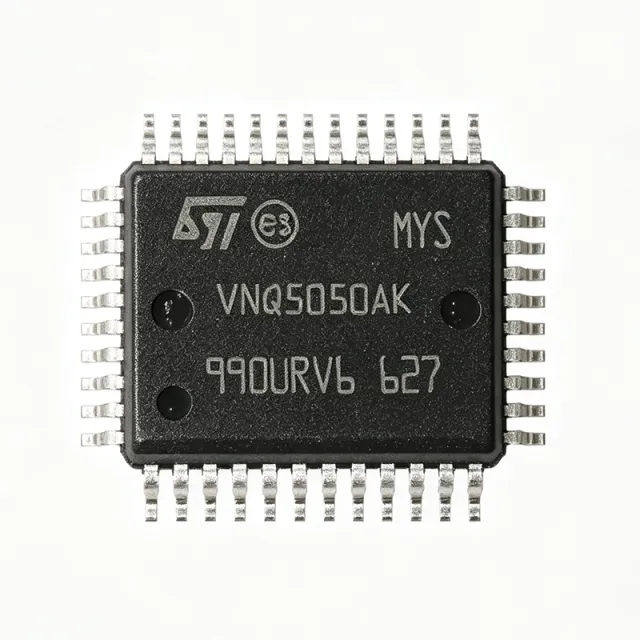
VNQ5050AKTR - 13A High-Side Driver | STMicroelectronics | Automotive
The VNQ5050AKTR is a monolithic high-side driver from STMicroelectronics, designed for automotive and industrial applications requiring robust power switching. It integrates a 13A (typical) high-side switch with an embedded N-channel power MOSFET, providing protection against overcurrent, overtemperature, and short-circuit conditions. The device operates from a supply voltage range of 4.5V to 36V, making it suitable for 12V and 24V automotive systems. It is housed in a PowerSSO-36 package, which offers excellent thermal performance and is optimized for surface-mount assembly. A high-side driver is a power management IC that connects a load to the positive supply rail, enabling safe and controlled switching of inductive, resistive, or capacitive loads. In automotive systems, high-side drivers are essential for driving lamps, solenoids, relays, and motors, providing diagnostic feedback and protection features that enhance system reliability. The VNQ5050AKTR belongs to the VIPower M0-5 family, which is known for its advanced protection and diagnostic capabilities. Key features of the VNQ5050AKTR include a very low ON-state resistance (RDS(on)) of 50 mOhm typical, which minimizes power dissipation and supports high current handling. It offers a wide operating voltage range, a standby current of only 5 uA, and a comprehensive set of protection features including load current limitation, thermal shutdown with auto-restart, and loss of ground protection. The device also provides a status output for diagnostic feedback, enabling real-time monitoring of load conditions. From a technical perspective, the VNQ5050AKTR utilizes ST's VIPower M0-5 technology, which integrates the power MOSFET with control and protection circuitry on a single chip. This integration reduces external component count and improves system reliability. The device supports PWM control up to 1 kHz, allowing for dimming or proportional control of loads. Its thermal shutdown feature protects the device and load from overtemperature conditions, while the current limitation prevents damage from short circuits. Typical applications include automotive lighting (headlamps, tail lamps, interior lights), resistive and inductive loads such as relays and solenoids, and motor control in body control modules. The device's robust protection and diagnostic features make it ideal for safety-critical automotive systems. In industrial settings, it can be used for PLC outputs, factory automation, and general-purpose power switching. When designing with the VNQ5050AKTR, ensure adequate PCB copper area for thermal dissipation, especially when driving high currents. The exposed pad on the PowerSSO-36 package should be connected to a large ground plane to improve thermal performance. Additionally, place a suitable capacitor close to the VCC pin to suppress voltage transients and ensure stable operation. This page synthesizes distributor pricing, drop-in alternatives, and practical design notes not found in the STMicroelectronics datasheet, providing engineers with a comprehensive resource for selecting and implementing the VNQ5050AKTR.
VNQ5050KTR-E - 13A Quad High-Side Driver | ST | Automotive
The STMicroelectronics VNQ5050KTR-E is a monolithic quad-channel high-side driver delivering up to 13A per channel in a PowerSSO-24 exposed-pad package, designed for automotive and industrial loads. It operates across a 4.5V to 36V supply range with 3.0V CMOS-compatible logic inputs, integrating four N-channel power MOSFETs with vertical current-flow structures on a single die. A high-side driver is a power switch that connects a load to the positive supply rail rather than to ground, providing protection, diagnostics, and PWM capability. In the taxonomy of semiconductor switches, this places it under power MOSFET drivers -> smart power switches -> power management ICs -> semiconductor. High-side configuration is preferred in automotive body electronics because it allows the load to be referenced to chassis ground, simplifying wiring and enabling direct short-to-ground detection. Key features include a typical 13.5A per-channel current limit, 0.5 µA standby current for battery-saving key-off operation, very fast demagnetization of inductive loads via integrated freewheeling, and on-state / off-state open-load detection. The device also includes reverse-battery protection, loss-of-ground protection, overload protection with active power limitation, and thermal shutdown. The status flag pin multiplexes diagnostic information back to the host MCU. Built on ST's VIPower M0-5 technology, the VNQ5050KTR-E combines vertical power MOSFETs with bipolar/CMOS/DMOS control and protection circuitry monolithically. The embedded charge pump drives the gate above VCC, supporting 100% duty-cycle operation at low battery voltages. The architecture is engineered for harsh automotive environments including load-dump transients (tested per ISO 7637) and jump-start conditions. Typical applications include automotive lighting (headlamps, tail lamps, turn signals), body control modules driving solenoids and DC motors, and industrial programmable logic controllers switching relays. The quadruple channel fits the four-lamp-per-rear-lamp-cluster topology used widely in passenger cars. The exposed thermal pad of the PowerSSO-24 package must be soldered to a substantial PCB copper area to maintain junction temperature under full-load conditions, especially when all four channels are active simultaneously.
VNQ5160KTR-E - Quad High-Side Driver, 16A, 36V | STMicroelectronics
The STMicroelectronics VNQ5160KTR-E is a monolithic quad high-side driver designed for automotive and industrial resistive, inductive, and capacitive loads. It integrates four independent high-side switches with a 16A maximum output current per channel and an operating voltage range of 4.5V to 36V. The device is housed in a PowerSSO-24 package, providing a compact solution for multi-channel load switching. A high-side driver is a power management IC that connects a load to the positive supply rail, providing protection and diagnostic functions. In automotive systems, high-side drivers are essential for controlling lamps, solenoids, motors, and heaters while offering short-circuit, over-temperature, and load-dump protection. The VNQ5160KTR-E belongs to the VIPower M0-5 family, which is known for its robustness and advanced protection features. Key features include a very low standby current of 0.5 uA, making it suitable for battery-powered applications. Each channel has an open-load detection, over-temperature shutdown with auto-restart, and a current-limited output. The device also provides a status output for diagnostic feedback, enabling microcontroller-based fault monitoring. The PowerSSO-24 package offers excellent thermal performance with a thermal resistance of 40 C/W, allowing high current operation without external heatsinking in many applications. The VNQ5160KTR-E uses a vertical P-channel MOSFET technology, which eliminates the need for a charge pump, reducing system complexity. The device is AEC-Q100 qualified, ensuring reliability in harsh automotive environments. Its 16A output capability and 36V maximum supply voltage make it suitable for driving high-power loads such as headlamps, DC motors, and heating elements. Typical applications include automotive body control modules, lighting control, motor control, and industrial PLC output stages. The device's built-in protection features reduce the need for external components, simplifying PCB design and improving system reliability. When designing with this device, ensure adequate PCB copper area for thermal dissipation, especially when driving multiple channels at high current. The status output should be connected to a microcontroller input for fault monitoring, and the input pins should be protected with series resistors to limit inrush current.
VNQ6004SA-E - Quad High-Side Driver, 4x 60mOhm | STMicroelectronics
The STMicroelectronics VNQ6004SA-E is a monolithic quad-channel high-side driver designed for automotive and industrial resistive, inductive, and capacitive loads. It integrates four 60 mOhm (typical) high-side switches with full protection and diagnostic features in a 24-pin PowerSSO-24 package. The device operates from a 4.5V to 36V supply voltage, making it suitable for 12V and 24V automotive systems. Each channel can deliver up to 8A of output current (limited by package thermal constraints), with a typical on-state resistance of 60 mOhm at 25°C. A high-side driver is a power management IC that connects a load to the positive supply rail, providing switching, protection, and diagnostic functions. It is a key component in automotive body control modules, industrial PLCs, and smart power distribution systems. The VNQ6004SA-E belongs to the VIPower M0-5 family, which integrates power MOSFETs with control logic and protection circuits on a single chip, reducing external component count and improving reliability. Key features include overcurrent protection with programmable current limitation, thermal shutdown with automatic restart, undervoltage and overvoltage lockout, and open-load detection in both on and off states. The device also provides a status feedback pin for each channel, enabling real-time diagnostics. The PowerSSO-24 package offers excellent thermal performance with an exposed pad, allowing efficient heat dissipation in high-current applications. The VNQ6004SA-E uses ST's VIPower M0-5 technology, which combines a vertical power MOSFET with CMOS control logic. This architecture provides low on-resistance, fast switching, and robust protection. The device is AEC-Q100 qualified, ensuring reliability in harsh automotive environments. It also complies with RoHS and REACH directives, making it suitable for global markets. Typical applications include automotive body control modules (lighting, wipers, heaters), industrial PLC output stages, and smart power distribution in trucks and buses. The wide input voltage range and robust protection make it ideal for driving lamps, solenoids, relays, and DC motors. In automotive lighting, the VNQ6004SA-E can drive LED modules with PWM dimming, while its diagnostic features enable fault detection in safety-critical systems. When designing with this device, ensure adequate PCB copper area for thermal management, especially when driving high currents. The exposed pad must be soldered to a thermal via array to maximize heat dissipation. Also, consider the inrush current of capacitive loads and set the current limit accordingly to avoid false triggering.
VNQ6008SA-E - 8-Channel High-Side Driver | STMicroelectronics
The VNQ6008SA-E is a monolithic 8-channel high-side driver from STMicroelectronics, designed for automotive and industrial resistive, inductive, and capacitive loads. It integrates eight power MOSFETs with a 60V breakdown voltage and a typical on-state resistance of 60 mΩ per channel, enabling efficient switching of loads up to 1A per channel. The device is housed in a PowerSSO-36 package, providing a compact solution for multi-channel switching applications. A high-side driver is a type of power switch that connects a load to the positive supply rail, providing protection and diagnostic features. In automotive systems, high-side drivers are essential for controlling lamps, relays, solenoids, and other actuators while offering short-circuit, over-temperature, and over-voltage protection. The VNQ6008SA-E belongs to the VIPower M0-5 family, which is known for its robustness and advanced protection features. Key features of the VNQ6008SA-E include an 8-bit serial peripheral interface (SPI) for control and diagnostics, a 60V operating voltage range, and a low quiescent current of 5 µA in standby mode. Each channel has independent over-current, over-temperature, and open-load detection, with a diagnostic output that can be read via SPI. The device also features a dedicated current sense output for analog load monitoring, enabling precise current measurement without additional components. The VNQ6008SA-E utilizes ST's VIPower M0-5 technology, which combines vertical current flow with a smart power IC architecture. This technology provides high current density, low on-resistance, and fast switching, while integrating protection and diagnostic circuits on the same die. The device is AEC-Q100 qualified, making it suitable for automotive applications, and is RoHS compliant. Typical applications include automotive body control modules, lighting control (LED and incandescent lamps), relay and solenoid drivers, and industrial PLC output stages. The SPI interface allows for easy integration with microcontrollers, enabling real-time diagnostics and fault management. The device's ability to drive both resistive and inductive loads makes it versatile for various switching tasks. When designing with the VNQ6008SA-E, ensure proper thermal management by providing adequate copper area on the PCB for heat dissipation. The PowerSSO-36 package has a thermal resistance of 35 °C/W, so for high-current applications, consider the power dissipation and ambient temperature. Additionally, use appropriate decoupling capacitors on the supply and logic pins to minimize noise and ensure reliable operation.

VNQ660SP - 6A Quad High-Side Solid State Relay, PowerSO-10 | STMicroelectronics
The STMicroelectronics VNQ660SP is a monolithic quad-channel high-side solid state relay built on ST's VIPower M0-3 technology, delivering 6 A continuous current per channel in a 10-pin PowerSO-10 package. Each of the four independent N-channel MOSFET outputs exhibits a typical RDS(on) of 50 mΩ and is rated for a supply voltage (VCC) up to 36 V, with CMOS-compatible logic inputs driving the gates directly. A high-side solid state relay (also called a high-side driver or smart power switch) is an integrated power switch that sits between the supply rail and the load. Unlike a low-side switch that returns current to ground, a high-side switch delivers battery or bus voltage to the load, providing short-to-ground protection and removing the need for chassis-ground returns. Within the broader power semiconductor hierarchy, the VNQ660SP belongs to: smart power switch -> high-side driver -> power management IC -> semiconductor. The device integrates comprehensive protection features per channel, including off-state open-load detection, undervoltage and overvoltage shutdown, overvoltage clamping (active avalanche), thermal shutdown with auto-recovery, and current limitation. These diagnostics make it suitable for safety-critical automotive body electronics, where the part must survive load-dump transients and harsh wiring faults without external fuses. Architecturally, the VNQ660SP uses four independent vertical DMOS power stages with charge-pump gate drives that are powered from VCC. The charge pump keeps the gate enhanced at low VCC and during PWM operation, while the diagnostic block monitors load current and supply conditions to feed back to the microcontroller. The PowerSO-10 package exposes a metal pad that drops thermal resistance to a typical 1.5 °C/W, allowing the four channels to share heat dissipation when not all outputs are loaded simultaneously. Typical applications include automotive body control modules (BCM), door lock and window lift drivers, seat and mirror controllers, LED lighting modules, and industrial 24 V solenoid/valve banks. The combination of four channels, 6 A per channel, and integrated diagnostics is especially attractive in BCMs where PCB area is constrained and harness simplification matters. When designing with the VNQ660SP, derate per-channel current when more than two channels are conducting concurrently and follow PowerSO-10 land-pattern guidelines with thermal vias under the exposed pad. Always observe the maximum VCC of 36 V and add an external TVS if the upstream supply can produce larger transients. This page consolidates distributor pricing, true drop-in alternatives, and practical design notes that are not found in the manufacturer datasheet, giving engineers a single source for sourcing, replacement, and layout decisions on the VNQ660SP.
VNQ660SP-E - 36V Quad High-Side Solid State Relay | STMicroelectronics
The STMicroelectronics VNQ660SP-E is a quad-channel high-side solid-state relay built on VIPower M0-3 technology, delivering 6 A continuous output per channel in a 10-pin PowerSO exposed-pad package. It is designed for driving resistive or inductive loads with one side connected to ground, integrating four independent high-side switches with CMOS-compatible inputs. A high-side switch (also called a high-side driver or solid-state relay) is a semiconductor switch placed between the supply rail and the load, sourcing current rather than sinking it. Unlike a low-side switch (placed between the load and ground), a high-side topology allows ground-referenced loads, simplifies fault detection, and eliminates the need for chassis grounding. High-side drivers belong to the broader power-switch IC family within power-management semiconductors, commonly used in automotive body electronics, industrial automation, and programmable logic controllers. Key features of the VNQ660SP-E include a 6 V to 36 V supply range, 40 mOhm on-state resistance per channel, 6 A continuous current rating, CMOS-compatible logic inputs, off-state open-load detection, undervoltage and overvoltage shutdown, overvoltage clamp, thermal shutdown, and current limitation. The exposed bottom pad of the PowerSO-10 package provides a low thermal resistance path, allowing reliable operation at high ambient conditions. Architecturally, the VNQ660SP-E uses STMicroelectronics' proprietary VIPower M0-3 process, which co-integrates vertical power MOSFETs with CMOS control logic on a single die. This monolithic integration enables compact PCB designs while delivering built-in protection features typically requiring external circuitry in discrete solutions. The device also includes diagnostic feedback and protection functions that meet automotive-grade reliability expectations. Typical applications include automotive body control modules, lighting drivers, solenoid and relay drivers, industrial PLC outputs, and home appliance controls. Its quad-channel configuration suits multi-load systems requiring independent switching of lamps, motors, valves, and resistive heaters from a single MCU. When designing with this device, calculate power dissipation as P_D = I^2 x R_DS(on) per channel and ensure the exposed pad receives adequate copper area for thermal management. The off-state open-load detection requires specific load impedance thresholds; review the datasheet carefully when driving LED or low-current loads. This page synthesizes distributor pricing, drop-in alternatives in the same PowerSO-10 footprint, and practical design notes for fault-protected high-side switching - information not found in the manufacturer datasheet alone.