Sensoren
Unterkategorien
Produkte (525)

MPX2202AP - 200 kPa Absolute Pressure Sensor, 4-SIP | NXP
The NXP MPX2202AP is a 200 kPa on-chip temperature-compensated silicon piezoresistive absolute pressure sensor housed in a 4-lead Single In-line Package (4-SIP) module with a male 0.19" (4.93 mm) tube port. It delivers a linear differential analog output of 0 mV to 40 mV at a 10 V excitation supply, covering a pressure range of 0 to 29.01 PSI (0 to 200 kPa). The MPX2202AP belongs to NXP's legacy MPXx2202 family of monolithic silicon diaphragm sensors. An absolute pressure sensor is a transducer that measures pressure relative to a sealed vacuum reference inside the die, rather than to ambient atmospheric pressure. The category hierarchy is: pressure sensor -> transducer -> sensor -> electronic component. Within NXP's MPX series, the MPX2202AP is the absolute-pressure variant, distinct from gauge (MPX2202GP) and differential (MPX2202DP) versions in the same family. The on-chip thin-film resistor network and laser-trimmed calibration provide factory-set span and offset correction, while integrated temperature compensation keeps the output stable across the operating temperature range. Key features include a 0 mV to 40 mV full-scale output (40 mV span at 10 V excitation), ±0.25% typical linearity, ±1.0% maximum pressure hysteresis, and on-chip temperature compensation from 0 °C to +85 °C. The 4-SIP top-port package simplifies tube/port integration, and the piezoresistive bridge delivers a ratiometric output proportional to supply voltage, which simplifies system-level analog-to-digital conversion. Typical applications include medical infusion pumps, blood-pressure monitors, industrial process control, HVAC transmitters, altimeters, barometers, and level measurement. The 200 kPa range comfortably covers physiological pressure ranges as well as low-pressure industrial processes. When designing with the MPX2202AP, note that the output is ratiometric: it scales linearly with the excitation voltage, so a stable, low-noise 10 V reference is required to maintain absolute pressure accuracy. Add a low-offset differential amplifier downstream for signal conditioning, and provide adequate PCB thermal management to keep the die within the calibrated temperature window. This page synthesizes distributor pricing, same-family alternatives, and practical design notes not found in the manufacturer datasheet alone.
MPX2202ASX - 200 kPa Absolute Pressure Sensor | NXP
The NXP MPX2202ASX is a 200 kPa absolute pressure sensor in a 4-SIP through-hole module with a male 0.19 inch (4.93 mm) barbed pressure port, delivering a linear differential analog voltage directly proportional to applied pressure. The device uses a silicon piezoresistive sensing element with on-chip thin-film temperature compensation and laser-trimmed calibration, producing 0 mV to 40 mV output when excited with 10 V. It covers 0 kPa to 200 kPa (0 PSI to 29.01 PSI) operating pressure with up to 58.02 PSI (400 kPa) maximum overpressure capability. Originally developed by Motorola and transferred through Freescale to NXP, the MPX2202 series remains a long-standing reference for low-cost analog pressure sensing. What is an absolute pressure sensor? An absolute pressure sensor measures pressure relative to a sealed vacuum reference built into the die, rather than relative to ambient atmospheric pressure. Absolute pressure sensors sit within the broader sensor hierarchy as a subset of piezoresistive silicon pressure sensors, which are themselves a category of MEMS (micro-electromechanical systems) transducers. The piezoresistive effect describes the change in resistance of a strained silicon resistor; modern on-chip compensation networks make these sensors usable directly with an analog ADC, without external linearization circuitry. Key features of the MPX2202ASX include a typical full-scale span of 40 mV at 10 V excitation, temperature compensation from 0 C to +85 C, and a maximum combined linearity and pressure hysteresis error of approximately 1.0 %VFSS. The integrated temperature compensation network and calibration are trimmed at the wafer level, removing the need for external signal conditioning. The 4-lead SIP module accepts a single barbed port input and outputs a Wheatstone-bridge differential voltage, simplifying interface to instrumentation amplifiers and 16-bit SAR ADCs. Technologically, the MPX2202 family pioneered the use of Xducer-on-chip temperature calibration, where polysilicon resistors are laser-trimmed during final test to cancel the piezoresistive temperature coefficient. The die is mounted on a ceramic substrate inside a ported plastic housing with silicone gel isolation, allowing it to interface with non-corrosive media such as air and dry gases while rejecting humidity-related drift. The differential bridge configuration rejects common-mode excitation noise, allowing low-cost unregulated supplies to be used with little loss of accuracy. Typical applications for the MPX2202ASX include barometric pressure measurement in weather stations and altimeters, HVAC duct pressure monitoring, process control pressure transmitters, manifold absolute pressure (MAP) signal conversion, and medical respiratory equipment. Designers also use it in pneumatic control loops and vacuum-system leak detection, where a calibrated 0 to 200 kPa reference is required. A primary design consideration is that the 40 mV full-scale output is small; an instrumentation amplifier with high CMRR (such as the INA128 or AD8421) is normally placed immediately adjacent to the sensor output. Drive the bridge with a low-noise, low-drift 10 V reference to preserve the factory calibration; a typical 12-bit ADC will not fully resolve the 40 mV span, so most users pair the sensor with a 16-bit or 24-bit sigma-delta converter.
MPX2202D - 200 kPa Differential Pressure Sensor | NXP
The NXP MPX2202D is a 200 kPa on-chip temperature compensated and calibrated silicon piezoresistive pressure sensor housed in a 4-SIP through-hole unibody package. It provides a highly accurate and linear analog voltage output directly proportional to the applied differential pressure, with a full-scale span of 0 mV to 40 mV at a 10 V supply. A pressure sensor is a transducer that converts an applied physical pressure into a reproducible electrical signal. The MPX2202D belongs to the piezoresistive sensor family, in which diffused silicon strain gauges form a Wheatstone bridge on a monolithic diaphragm. When pressure deflects the diaphragm, the gauges change resistance unbalancing the bridge and producing a pressure-proportional differential output. This category sits within MEMS sensors -> transducers -> signal conditioning chains in industrial and medical instrumentation. Key specifications include a maximum operating pressure of 29.01 PSI (200 kPa), a supply voltage of 10 V to 16 V, and a typical Wheatstone bridge output of 0 mV to 40 mV at 10 V. On-chip temperature compensation keeps the span and offset stable over the operating range, eliminating the need for external analog trimming in many designs. The unibody 4-SIP package integrates the sensing die and port into a single molded housing for through-hole PCB mounting. Architecturally, the MPX2202D uses a monolithic silicon die with a chemically etched diaphragm and four piezoresistors in a Wheatstone bridge arrangement. The on-chip compensation network nullifies temperature-induced span and offset shifts, which simplifies the downstream instrumentation amplifier stage. The result is a calibrated, ratiometric analog output that scales linearly with applied differential pressure across 0 to 200 kPa. Typical applications include HVAC airflow and differential pressure monitoring, medical respiratory equipment such as spirometers and ventilators, process control instrumentation, altitude and barometric measurement, and industrial pneumatic system monitoring. The differential port style makes it well suited to measuring pressure drop across filters, valves, or HVAC duct restrictions. When designing with the MPX2202D, ensure the instrumentation amplifier input common-mode range accommodates the sensor's bridge bias, and use a stable low-noise supply to avoid corrupting the millivolt-level output. Add protection against condensation and overpressure spikes to extend sensor life in humid or pulsating environments. This page synthesizes distributor pricing, pinout, drop-in NXP and competitor equivalents, and practical application guidance not found in the manufacturer datasheet alone.
MPX2202DP - 200kPa Differential Pressure Sensor | NXP/ST
The NXP MPX2202DP is a 200 kPa on-chip temperature-compensated and calibrated silicon piezoresistive pressure sensor in a 4-SIP module (Case 867C) with a differential dual-port tube inlet (Sensor 4 configuration). It delivers a highly accurate, linear voltage output directly proportional to applied pressure, with a full-scale span of 40 mV at 10 V supply. A piezoresistive pressure sensor is a MEMS device in which a silicon diaphragm flexes under applied pressure, changing the resistance of strain gauges integrated into the diaphragm. A Wheatstone-bridge network converts the strain into a differential voltage output. Piezoresistive sensors fall within the broader category of MEMS pressure sensors, which itself is part of the sensor hierarchy: pressure sensor -> transducer -> sensor IC -> semiconductor device. The MPX2202DP sits in this hierarchy as a low-cost, calibrated, temperature-compensated analog-output pressure transducer suitable for industrial and medical instrumentation. Key features include a 0 to 200 kPa (0 to 29.01 PSI) pressure range, 40 mV full-scale output at 10 V excitation, differential dual-port (tube inlet) pressure input, on-chip laser-trimmed temperature compensation over 0 to 85 C, a 1.0% (typical) linearity, and a 2.0% (maximum) pressure hysteresis. The monolithic single-chip construction co-locates the strain gauge and thin-film resistor network, which together achieve the precise span and offset calibration. The architecture relies on a single monolithic silicon diaphragm with piezoresistors in a Wheatstone-bridge topology. The thin-film resistor network performs laser trimming during wafer-level calibration to set span and offset against reference pressures, while the package geometry (dual-port tube inlet) accepts differential pressure across two ports - one for the high-pressure reference, the other for the low-pressure reference. Typical applications include medical instrumentation (blood pressure monitors, ventilators, infusion pumps), industrial process control (HVAC pressure sensing, pneumatic gauges, hydraulic monitoring), and consumer appliances (washing machine water level, electronic altimeters). The dual-port configuration makes this sensor particularly well suited to closed-loop pressure systems where a differential measurement is required. Designers should note that the differential output requires differential amplification to interface to ADC or microcontrollers. The 4-SIP module package style accommodates through-hole PCB mounting; for surface-mount designs the equivalent MPXV2202GP/GS port may be preferred. RoHS compliance is confirmed per the manufacturer datasheet.
MPX2202GP - 200 kPa Gauge Pressure Sensor, 4-SIP, 10V | NXP
The NXP MPX2202GP is a 200 kPa on-chip temperature-compensated silicon piezoresistive pressure sensor in a 4-SIP top-port module, delivering a linear 0 mV to 40 mV output scaled to the 10V excitation supply. It is a gauge-type sensor with a male 0.19" (4.93 mm) tube port and is targeted at medical, industrial, and consumer pressure measurement up to 29.01 PSI (200 kPa). A piezoresistive pressure sensor is a MEMS device in which a diaphragm with embedded strain gauges changes resistance proportionally to applied differential pressure; the MPX2202GP integrates on-chip signal conditioning and temperature compensation so the user only applies 10 V DC excitation and reads a ratiometric millivolt signal. Within the broader sensor taxonomy, this part sits in the hierarchy: pressure sensor -> piezoresistive pressure sensor -> silicon strain-gauge sensor -> MEMS sensor -> transducer, and the 4-SIP package belongs to the through-hole SIP (Single Inline Package) family used predominantly for legacy and industrial pneumatic interfaces. Key features include 0 mV to 40 mV full-scale output (10 V supply), 0 to 200 kPa operating range, on-chip temperature compensation and calibration, gauge (vented) reference, and linear response directly proportional to applied pressure. The integrated compensation network eliminates the need for external trim circuitry, simplifying host-microcontroller or A/D front-end designs. The device is built on a silicon die using a diffused piezoresistive Wheatstone-bridge topology, with the four bridge resistors laser-trimmed during wafer-level test. The 4-SIP top-port housing routes incoming pressure through a tube stub to the diaphragm side of the die while the back side vents to the reference (ambient) via the package's secondary port, producing a true gauge output. Typical applications include medical patient monitoring (blood pressure, respiratory), HVAC air-flow and duct pressure sensing, industrial pneumatic control, altimeters and barometric instruments, and consumer appliance pressure monitoring. The 4-SIP top-port geometry suits manifolds and enclosures where pressure tubing enters vertically. A key design consideration is that the output is ratiometric with the 10 V supply: any supply noise directly couples into the output, so a low-noise, low-drift excitation regulator is required to realize the datasheet accuracy. Dry air or non-corrosive gases are the only verified media; aggressive media require factory consultation. This page synthesizes distributor pricing, drop-in alternatives (MPX2202DP, MPX2202AP, MPX2102GP), and practical design notes not found in the standalone datasheet.
MPX4080D - 0 to 80 kPa Differential Pressure Sensor | NXP / ST
The NXP MPX4080D (also offered by STMicroelectronics) is an integrated silicon piezoresistive pressure sensor that measures differential pressure from 0 to 80 kPa (0 to 11.6 PSI) and outputs a conditioned analog voltage of approximately 0.6 V to 4.9 V in a through-hole 6-SIP module. A pressure sensor is a transducer that converts an applied mechanical pressure into a proportional electrical output. Within the broader sensor hierarchy it belongs to MEMS (micro-electro-mechanical systems) devices, specifically the piezoresistive family, which uses silicon strain gauges whose resistance changes with applied stress. Integrated pressure sensors add on-chip signal conditioning, temperature compensation, and factory calibration, so the user does not have to design an instrumentation amplifier or trim resistors. The output is a ratiometric, single-ended analog voltage that can be read directly by a microcontroller ADC or a comparator, making these parts a staple in low-cost pressure measurement. Key features of the MPX4080D include a 0 to 80 kPa differential pressure range, 5.1 V typical supply voltage, 0.6 V to 4.9 V analog output span, on-chip temperature compensation and calibration, monolithic single-element transducer design, and bipolar processing with thin-film metallization for long-term stability. The output is essentially linear with applied pressure, simplifying firmware-side conversion. The MPX4080D combines micromachined silicon, thin-film metallization, and bipolar signal-conditioning circuitry on one die. This single-element patented architecture eliminates the mismatch errors that plague two-element bridge sensors and gives excellent offset and full-scale repeatability. The 6-SIP through-hole package exposes the backside pressure port while routing the six electrical pins through a standard PCB footprint. Typical applications include HVAC blower and air-handling pressure monitoring, barometric correction for engine control, blood pressure and medical instrumentation, weather stations, altimeters, manifold absolute pressure sensing, and any MCU-based system that needs a calibrated analog pressure signal. The differential configuration is well suited to measuring pressure drop across a filter, orifice, or fan. When designing with this part, ensure the media is dry air (or compatible gas/liquid per the datasheet), add a 0.01 uF decoupling capacitor close to the supply pin, and protect the port from condensing moisture. The output is ratiometric to the supply, so a stable 5.0 V reference improves absolute accuracy. This page synthesizes distributor pricing, drop-in alternatives, and practical design notes not found in the manufacturer datasheet alone.
MPX4100A - 20-105 kPa Absolute MAP Pressure Sensor | NXP
The NXP MPX4100A is a monolithic, signal-conditioned, temperature-compensated and calibrated silicon absolute pressure sensor in a 6-pin SIP through-hole package, designed to deliver an analog output voltage proportional to applied absolute pressure from 20 kPa to 105 kPa (2.9 PSI to 15.23 PSI). The on-chip signal conditioning combines piezoresistive sensing elements with thin-film metallization and bipolar signal-path circuitry to produce a ratiometric 0.3 V to 4.9 V output swing over a 4.85 V to 5.35 V supply range with a typical sensitivity of 54 mV/kPa. This part is part of the MPX4100 series originally introduced by Motorola and now produced by NXP for manifold absolute pressure (MAP) sensing. An absolute pressure sensor is a transducer that outputs a signal referenced to a sealed vacuum rather than to ambient atmospheric pressure, which makes it ideal for applications where the absolute pressure of a gas must be measured - such as engine intake manifolds, barometric instruments, and sealed enclosures. Within the broader taxonomy, the MPX4100A is a piezoresistive absolute pressure sensor -> pressure sensor -> transducer -> sensor -> semiconductor device. Its monolithic integration of mechanical diaphragm and analog front-end sets it apart from hybrid modules that combine a bare sensor element with an external op-amp trim circuit. Key differentiating specifications include a 20 kPa to 105 kPa absolute pressure operating range, an accuracy of ±1.8% across the calibrated band, a typical full-scale output of 4.81 V to 4.97 V (4.9 V nominal), and a supply current in the single-digit mA range that makes the device directly compatible with 5 V microcontroller ADC inputs. The output is ratiometric to Vcc, which allows the MCU ADC reference to be tied to the same 5 V rail for intrinsic cancellation of supply-voltage drift. Technically, the MPX4100A uses a single-chip silicon diaphragm with implanted piezoresistors arranged in a Wheatstone bridge. An integrated op-amp stage buffers, temperature-compensates and calibrates the bridge output to give the calibrated 0.3 V to 4.9 V swing. This single-chip integration reduces BOM count, eliminates the need for external passive linearization networks, and improves long-term stability compared to multi-component sensor designs. Typical applications include automotive manifold absolute pressure (MAP) sensing for engine control units (ECUs), barometric pressure measurement for altimeters and weather instruments, industrial sealed-system pressure monitoring, HVAC duct pressure measurement, and vacuum system supervision. In each of these cases the absolute (rather than gauge) reference allows the system to operate irrespective of changes in ambient barometric pressure. When designing with the MPX4100A, place 100 nF decoupling as close to Vcc (pin 3) as possible and reference the host ADC reference to the same 5 V rail as the sensor to preserve ratiometric accuracy. The single-port axial SIP package must be mounted with the pressure inlet unobstructed and protected from condensation and direct water exposure. This page synthesizes distributor pricing, drop-in alternative MPNs, and practical design notes not found in the manufacturer datasheet.
MPX4100AP1 - 20-105kPa Absolute MAP Pressure Sensor | NXP
The NXP Semiconductors MPX4100AP1 is an integrated silicon manifold absolute pressure (MAP) sensor with on-chip signal conditioning, temperature compensation, and calibration, delivering a 0.3 V to 4.9 V ratiometric analog output over a 20 kPa to 105 kPa (2.9 PSI to 15.23 PSI) absolute pressure range and housed in a 6-pin SIP (Case 867B-04) through-hole module. According to the manufacturer datasheet, the device features a 5.10 V nominal supply, 54 mV/kPa typical sensitivity, and ±2.5% maximum pressure error over 0 C to 85 C, making it suitable for automotive engine control and industrial instrumentation. A manifold absolute pressure sensor is a piezoresistive transducer that measures the absolute pressure inside the intake manifold of an internal combustion engine or in any sealed gas system. The on-chip ASIC converts the bridge output into a temperature-compensated, calibrated, ratiometric voltage proportional to pressure. MAP sensors belong to the wider category of pressure sensors (sensor ICs), which are themselves a sub-class of transducers and MEMS-based semiconductor devices used in measurement and control electronics. Key features of the MPX4100AP1 include a robust 6-SIP through-hole package with an integrated male pressure port (4.93 mm / 0.19 inch tube), 5.0 V to 5.35 V supply compatibility, and 1.5 ms response time. The ratiometric analog output simplifies ADC interfacing because the output voltage scales with VCC, eliminating the need for a precision reference. Built-in temperature compensation over 0 C to +85 C ensures stable readings across typical automotive under-hood environments without external calibration. The MPX4100AP1 uses a single-chip silicon strain-gauge bridge plus bipolar ASIC signal path, monolithically integrated for long-term stability and low hysteresis. The hardened epoxy housing and stainless-steel port are designed to withstand automotive under-hood thermal cycling and vibration. The combination of on-chip signal conditioning and ratiometric output eliminates the external op-amp and precision reference typically required for discrete bridge sensors. Typical applications include automotive engine control (MAP sensing for fuel injection), HVAC pressure monitoring, industrial pneumatic systems, barometric altimeters, and medical respiratory equipment. The wide 20 kPa-105 kPa range covers full sea-level-to-altitude operation in engine control and HVAC systems. When designing with this part, place a 0.05 uF bypass capacitor directly across the supply pins with traces as short as possible to avoid digital switching noise coupling into the analog output. The tube port must be sealed against moisture and contamination to preserve long-term accuracy. This page synthesizes distributor pricing, drop-in alternatives, and practical design notes not found in the manufacturer datasheet alone.
MPX4100API - 20-105kPa Absolute Pressure Sensor | NXP
The NXP MPX4100API is an integrated silicon Manifold Absolute Pressure (MAP) sensor designed for engine control applications, providing a calibrated 0.3 V to 4.9 V analog output for absolute pressures from 20 kPa to 105 kPa (2.9 PSI to 15.23 PSI) in a 6-pin SIP (Case 867A) module. It includes on-chip signal conditioning, temperature compensation, and factory calibration, eliminating the need for external compensation circuitry in most intake-manifold designs. What is a MAP sensor? A Manifold Absolute Pressure sensor is a piezoresistive silicon device that measures the absolute pressure inside an engine's intake manifold. The measurement lets the engine control unit (ECU) compute air mass and therefore the fuel quantity required per cylinder, which is why MAP sensors sit at the heart of every speed-density engine management strategy. MAP sensors belong to the wider class of absolute pressure sensors and pressure transducers used throughout automotive, industrial, and HVAC systems. Key features of the MPX4100API include a maximum pressure rating of 400 kPa (proof pressure), 54 mV/kPa typical sensitivity, ±1.5 %V_FSS typical accuracy, and 5.0 V typical supply voltage. The device operates from -40 °C to +125 °C, uses a precision Wheatstone bridge with thin-film on-chip trimming, and is AEC-Q100 qualified for under-hood automotive deployment. The integrated design replaces several discrete parts (sensor + op-amp + reference + temp-comp network), reducing BOM cost and PCB footprint. The architecture relies on a single-crystal silicon diaphragm with diffused piezoresistors arranged in a Wheatstone bridge. Laser-trimmed resistors cancel offset and span at 25 °C, while the on-board ASIC applies second-order compensation across the full -40 °C to +125 °C automotive range. The output is a ratiometric analog voltage that swings roughly from 0.3 V at 20 kPa up to 4.9 V at 105 kPa. Typical applications include automotive engine control (MAP sensing for fuel injection), industrial pressure monitoring, HVAC systems, altimeter/barometer instrumentation, and pneumatic control systems. Because it is factory-calibrated and laser-trimmed, the MPX4100API is well suited for production designs where per-unit calibration is impractical. When designing with the MPX4100API, route the analog output through an anti-alias RC filter before the ECU ADC to suppress RF noise from the ignition system. The sensor's case must be sealed to the manifold using an O-ring and a port that does not expose the gel-coated die to direct airflow; mounting orientation matters because the gel is gravity-sensitive. This page synthesizes distributor pricing, drop-in same-package alternatives, and practical design notes not collected in the manufacturer datasheet alone.
MPX4105A - 15-105kPa Absolute Pressure Sensor | NXP | MAP Sensor
The NXP MPX4105A is an integrated silicon piezoresistive pressure sensor for manifold absolute pressure (MAP) sensing, operating from 15 kPa to 105 kPa (2.18 PSI to 15.23 PSI) and delivering a calibrated analog output of 0.3 V to 4.9 V in a 6-SIP through-hole module. The monolithic sensor combines advanced micromachining, thin-film metallization, and bipolar signal conditioning to provide a temperature-compensated, laser-trimmed analog voltage directly proportional to absolute pressure. A Manifold Absolute Pressure (MAP) sensor is a specialized pressure transducer used in engine control systems to measure the absolute pressure inside the intake manifold. The output voltage correlates to engine load, allowing the ECU to compute the precise amount of fuel required per cylinder. MAP sensors fall under the broader hierarchy of pressure sensors -> transducers -> sensors -> electronic components, and the MPX4105A specifically uses piezoresistive technology within the silicon-based sensor category. Key features include on-chip signal conditioning that eliminates the need for external amplification, factory calibration that delivers a typical accuracy of 1.5% over 0C to 85C, and a ratiometric analog output referenced to the 5 V supply. The 6-SIP package with female port accepts a 3.4544 mm barbed hose fitting for sealed pneumatic connection, and the through-hole mounting provides robust mechanical attachment suitable for harsh under-hood automotive environments. Typical applications include automotive engine control MAP sensing, barometric pressure measurement in HVAC and weather stations, industrial pneumatic pressure monitoring, altitude measurement for drones and UAVs, and medical respiratory equipment requiring low-pressure differential sensing. The calibrated output can be fed directly to an ADC without additional analog front-end circuitry. When designing with this sensor, decouple the VCC pin with a 100 nF ceramic capacitor placed within 5 mm of the device, and route the analog signal over a guarded ground trace. The sensor is ratiometric, so supply noise on VCC directly couples into the output - use a clean, well-regulated 5 V analog rail.
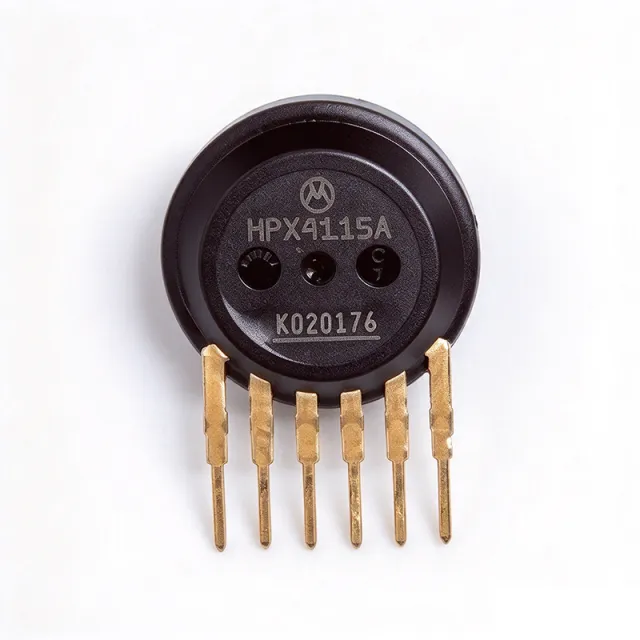
MPX4115A - 15-115 kPa Absolute Pressure Sensor | NXP
The NXP MPX4115A is an integrated silicon pressure sensor designed for manifold absolute pressure, altimeter, and barometer (BAP) applications, providing an analog output proportional to absolute air pressure over a 15 kPa to 115 kPa range (2.18 PSI to 16.68 PSI) in a 6-pin SIP Module package. Its headline parameters are 0.2 V to 4.8 V analog output swing from a single 5.1 V supply, on-chip signal conditioning, factory calibration, and integrated temperature compensation. An absolute pressure sensor is a MEMS-based transducer whose output is referenced to a sealed internal vacuum rather than to ambient, so it directly measures the local atmospheric or system absolute pressure regardless of weather or altitude variation. Within the sensor taxonomy, the MPX4115A sits below general environmental sensors and alongside gauge and differential pressure sensors, but it is distinguished by its integrated bipolar op-amp signal chain, thin-film resistor network, and factory calibration that together eliminate the need for external analog front-end components. This integration places it within the broader category of analog-output ICs that convert a physical stimulus into a ready-to-read voltage. Key features of the MPX4115A include high-level analog output (0.2 V to 4.8 V) directly readable by an MCU ADC, calibrated accuracy of ±1.5% over 0°C to +85°C, on-chip temperature compensation from -40°C to +125°C, and media-resistant packaging variants within the same MPxx4115 family. The device is specifically designed for dry air applications; media compatibility for other gases should be confirmed with the manufacturer, as water, oils, and corrosive chemicals can damage the silicon sensing element. The MPX4115A uses a piezoresistive silicon diaphragm whose strain gauge resistance changes with applied pressure. Freescale/NXP's bipolar op-amp and laser-trimmed thin-film resistor network convert that resistance change into a high-level linear voltage. The factory trim calibrates the output transfer function VOUT = VS * (0.01059 * P - 0.1518) ± error across the 15-115 kPa range, eliminating device-to-device spread and removing the need for system-level software compensation. Typical applications include automotive engine control manifold absolute pressure (MAP) sensing, weather station barometric pressure measurement, altitude estimation for handheld GPS and outdoor navigation, HVAC and appliance pressure monitoring, and industrial pneumatic system monitoring. The wide temperature range and small unibody package suit both automotive and industrial environments. When designing with this sensor, add RC low-pass filtering on the output to reject high-frequency electrical noise and protect the device port from condensation, dust, and direct water exposure.
MPX4115A117 - 15-115 kPa Absolute Pressure Sensor | NXP
The NXP MPX4115A117 is an integrated silicon piezoresistive absolute pressure sensor with on-chip signal conditioning, temperature compensation, and calibration, housed in a 6-pin SIP (Case 867-08) through-hole package. It measures absolute air pressure from 15 kPa to 115 kPa (2.18 PSI to 16.68 PSI) and provides a ratiometric analog output voltage of 0.2 V to 4.8 V nominally proportional to applied pressure. The device operates from a 5 V DC supply drawing a typical supply current of 8 mA, with an operating temperature range of -40 °C to +125 °C. What is an absolute pressure sensor? An absolute pressure sensor measures pressure referenced to a sealed vacuum reference inside the die, so its output indicates true absolute pressure regardless of ambient barometric changes. Absolute sensors sit within the broader category of pressure transducers and IC-based environmental sensors, used wherever a system needs ambient atmospheric or sealed-cavity pressure data rather than gauge (relative-to-atmosphere) or differential (between two ports) readings. Key features of the MPX4115A117 include 1.5% maximum accuracy over 0 °C to 85 °C, integrated bipolar op-amp signal conditioning plus thin-film resistor networks on the same silicon die, and a typical response time of 1.0 ms. The on-chip calibration eliminates the need for external trimming components, simplifying board-level implementation. Media-resistant construction and gel isolation protect the sensing element from humid and dirty air streams. Typical applications include automotive engine control unit (ECU) manifold absolute pressure (MAP) sensing, altimeters and barometric pressure measurement in weather stations and GPS modules, industrial vacuum monitoring, HVAC altitude compensation, and consumer wearables that require barometric pressure data. The wide temperature range and calibrated analog output also make it suitable for drone altitude hold and handheld instruments. When designing with the MPX4115A117, ensure the supply is well-decoupled with a 10 µF bulk and 0.1 µF ceramic capacitor near the VCC pin. The ratiometric output requires an ADC reference tied to the same 5 V rail for accurate conversion. For best long-term accuracy, keep the inlet port vertical and shield the device from direct sunlight to minimize thermal gradients. This page synthesizes distributor pricing, cross-reference alternatives, application notes, and design guidance that complement the manufacturer datasheet, giving engineers a single decision-ready reference rather than scattered PDF fragments.
MPX4115AP - 15-115 kPa Absolute Pressure Sensor | NXP | 6-SIP
The NXP MPX4115AP is an integrated silicon piezoresistive absolute pressure sensor with on-chip signal conditioning, temperature compensation, and factory calibration, housed in a 6-lead Single In-line Package (SIP, Case 867B-04) with a male 0.19" (4.93 mm) tube pressure port. It measures absolute pressure from 15 kPa to 115 kPa (2.18 to 16.68 psi) and provides a ratiometric analog output of 0.2 V to 4.8 V from a 5.1 V typical supply. An absolute pressure sensor is a transducer that measures pressure referenced to a sealed vacuum rather than ambient atmosphere, which makes it ideal for barometric and altitude applications where the absolute atmospheric pressure must be known regardless of weather or altitude. Absolute pressure sensors belong to the broader class of piezoresistive pressure sensors, which are themselves a subset of MEMS (Micro-Electro-Mechanical Systems) sensors. The MPX4115 family integrates a Wheatstone-bridge strain-gauge network with bipolar op-amp signal conditioning and laser-trimmed thin-film calibration resistors, producing a high-level linear analog output directly usable by an ADC or microcontroller without external amplification. Key features of the MPX4115AP include a sensitivity of 45.9 mV/kPa, 5.1 V typical supply voltage with 4.85 V to 5.35 V operating range, 6 mA typical supply current, an output range of 0.20 V to 4.80 V, and a maximum operating temperature of 125 C with a minimum of -40 C. The device is also notable for its 0.2% to 1.5% linearity, temperature-compensated output over 0 C to 85 C, and low error band across the compensated range. Architecturally, the MPX4115AP uses a diffused silicon diaphragm that flexes proportionally to applied absolute pressure. The resulting strain changes the resistance of an on-die piezoresistive Wheatstone bridge, which is then amplified by an on-chip bipolar op-amp stage and scaled by laser-trimmed thin-film resistors to produce the factory-calibrated 0.2-4.8 V output. This integrated approach eliminates the need for external signal conditioning, op-amps, or calibration lookup tables in the host MCU for non-precision use cases. Typical applications include altimeters and barometers for weather stations, drones and aviation, MAP (Manifold Absolute Pressure) sensing in engine control units, HVAC pressure monitoring, weather instruments, medical respirators and ventilators, and consumer altitude/weather meters. Its 15 kPa lower bound (roughly the pressure at 11 km altitude) makes it suitable for high-altitude avionics as well as surface barometric readings. When designing with this part, ensure the supply voltage is well regulated and low-noise because the output is ratiometric to VCC. Decouple VCC with a 100 nF ceramic capacitor close to the supply pin and route analog signals away from high-current switching traces to preserve the 0.2-4.8 V output's 1% accuracy band. This page consolidates distributor pricing, calibrated output curves, parametric alternatives, and practical design guidance not collected in any one place in the manufacturer datasheet.
MPX4115AS - 15-115kPa Absolute Pressure Sensor | NXP Semiconductors
The NXP Semiconductors MPX4115AS is an integrated silicon piezoresistive pressure sensor designed for absolute pressure measurement in altimeter and barometer (BAP) applications, housed in a 6-SIP through-hole module with a 0.19 inch (4.93 mm) tube port. The device delivers a calibrated analog output voltage of 0.2 V to 4.8 V that is linearly proportional to applied absolute pressure over the 15 kPa to 115 kPa range, corresponding to approximately 2.18 PSI to 16.68 PSI or sea level to high-altitude atmospheric pressure variations. A barometric pressure sensor, often abbreviated as BAP sensor, is a transducer that converts atmospheric absolute pressure into a measurable electrical signal. In the broader sensor taxonomy, the MPX4115AS belongs to the class of MEMS (Micro-Electro-Mechanical Systems) piezoresistive transducers, which sit within the pressure sensor family of physical sensors. These devices typically integrate on-chip signal conditioning, temperature compensation, and calibration to provide a high-level analog output suitable for direct connection to an ADC input. Key features of the MPX4115AS include on-chip bipolar op-amp signal conditioning that eliminates the need for external analog front-end components, factory calibration across the full operating range, and integrated thin-film resistor networks for temperature compensation. The nominal transfer function delivers approximately 45.9 mV/kPa sensitivity with a 5.1 V supply, and the output ratiometricity with the supply voltage simplifies ADC interfacing. The through-hole 6-SIP module provides a rugged package suitable for portable and outdoor equipment where the tube port admits ambient air directly to the sensing element. The MPX4115A and MPXA4115A series uses advanced micromachining, thin-film metallization, and bipolar semiconductor processing to create a monolithic sensing element with a Wheatstone-bridge piezoresistor network. The integrated op-amp and calibration resistors convert the small bridge differential into a precise, ratiometric, high-level output, removing drift concerns that affect discrete-bridge pressure sensors. Typical applications include handheld altimeters and barometers for hiking and weather stations, automotive manifold absolute pressure (MAP) sensing in legacy engine control units, weather data loggers, and avionics altitude reference systems. The wide operating temperature range and on-chip temperature compensation make it suitable for outdoor and automotive environments where uncompensated sensors would drift. When designing with the MPX4115AS, the supply should be regulated at 5.1 V nominal to obtain the calibrated transfer function; deviation from this supply scales the output proportionally. The tube port must be oriented to avoid moisture ingress and contamination, and a low-impedance ADC input with an anti-aliasing filter is recommended for accurate altitude conversion. This page synthesizes distributor pricing, drop-in alternatives, and practical design notes not found in the manufacturer datasheet, providing an AEO-optimized reference for engineers evaluating the MPX4115AS for new designs or legacy replacements.
MPX4200A - 20-200kPa MAP Absolute Pressure Sensor | NXP
The NXP MPX4200A is a manifold absolute pressure (MAP) sensor that delivers a linear analog voltage output proportional to absolute air pressure from 20 kPa to 200 kPa (2.9 PSI to 29.01 PSI), housed in a 6-pin SIP through-hole module with an integrated pressure port. It is built for engine control units (ECUs) that compute fuel injection and ignition advance from intake-manifold pressure, and it produces a ratiometric 0.3 V to 4.9 V output over a 5.1 V nominal supply with on-chip signal conditioning, temperature compensation, and factory calibration. A MAP sensor is a piezoresistive silicon transducer that converts an applied absolute pressure into a strain-gauge bridge resistance change; the on-chip ASIC then amplifies, temperature-compensates, and normalizes that bridge signal into a single-ended analog voltage the ECU's ADC can read directly. It sits hierarchically between bare strain-gauge elements and full ECU front-ends, and within the broader sensor category it is one of the most common automotive-grade pressure sensors, alongside gauge and differential variants. Because the output is ratiometric to VCC, any drift in supply voltage scales both the reference and the output together, simplifying ECU software calibration. Key features include a 0.3 V to 4.9 V ratiometric analog output (4.65 V nominal full-scale at 200 kPa), 1.5 % maximum pressure error over 0 °C to +85 °C, a -40 °C to +125 operating range, and integrated EMC protection on the supply and output pins. The on-chip bipolar signal conditioner uses a thin-film resistor network laser-trimmed at production to remove offset and span errors, which is why no external calibration components are required. Through-hole 6-SIP mounting keeps the pressure port isolated from the PCB, allowing the manifold to be sealed with an O-ring without contaminating the electronics. Typical applications include turbo-boost engine control, automotive MAP sensing, industrial pneumatic pressure monitoring, barometric correction for engine management, and altitude-compensation in motorcycle and small-engine ECUs. It is also used as a general-purpose calibrated absolute pressure transducer where a clean analog output is preferred over an I2C/SPI digital sensor. When designing with the MPX4200A, place a 47 nF decoupling capacitor close to VCC and provide a stable, low-noise 5.1 V supply; ripple on VCC couples directly into the output because the signal is ratiometric. Shield the analog output trace from switching noise and use the device only in media compatible with silicon gel and plastic housing.
MPX4250A - 250 kPa MAP Pressure Sensor, On-Chip Conditioned | NXP
The NXP MPX4250A is an integrated silicon manifold absolute pressure (MAP) sensor with on-chip signal conditioning, temperature compensation, and calibration, delivered in a 6-lead SIP module. It measures absolute pressure from 20 to 250 kPa (2.9 to 36.3 PSI) and produces a ratiometric analog output of approximately 0.2 V to 4.9 V proportional to the applied pressure and the supply voltage. A manifold absolute pressure sensor is a piezoresistive transducer that converts an absolute pressure referenced to a sealed internal vacuum into a calibrated voltage. MAP sensors sit at the boundary between physical sensing and electronic signal conditioning, providing a high-level analog output that connects directly to an ECU's analog-to-digital input. They form a key subcategory of board-mount pressure sensors within the broader sensor hierarchy: pressure sensor -> transducer -> sensor IC -> signal conditioning IC -> semiconductor. Key features of the MPX4250A include a maximum pressure rating of 1000 kPa, supply voltage range of 4.85 V to 5.35 V (typically 5.0 V), sensitivity of approximately 18.4 mV/kPa, response time of 1.0 ms, and a full operating temperature range of -40 C to +125 C. The monolithic silicon die uses piezoresistive bridges fabricated with bipolar-compatible thin-film metallization and micromachined diaphragms. The output transfer function is approximately VOUT = VSUPPLY x (0.004 x P - 0.04) - 0.04 V + VSUPPLY x 0.04 with the supplied transfer function Vout = Vsup x (0.01058 x P - 0.1518), where P is pressure in kPa. At 5.0 V supply, 0 kPa produces nominally 0.25 V, 100 kPa produces about 2.45 V, 200 kPa produces about 4.65 V, and 250 kPa produces 4.90 V. The on-chip temperature compensation holds accuracy within the datasheet-specified error band across the full -40 C to +125 C automotive-grade window. Typical applications include automotive engine control units, where the MAP sensor feeds the ECU for air-mass calculation and fuel injection timing, motorcycle and small-engine fuel injection, industrial vacuum monitoring, altitude-corrected barometric pressure measurement, and HVAC blower-pressure feedback loops. The wide 250 kPa span aligns naturally with naturally-aspirated gasoline intake manifolds and the 1.0 atmosphere operating point of sealed-vacuum-referenced MAP designs. When designing with this part, place a small RC low-pass filter at the Vout pin to suppress high-frequency EMC artifacts, and ensure the pneumatic port is sealed against moisture. Because the part uses a sealed vacuum reference and absolute pressure measurement, no altitude correction at installation is required - which differs from gauge-pressure sensors requiring vent tubes. The datasheet provides a complete transfer function polynomial plus worst-case error band including nonlinearity, temperature hysteresis, and pressure hysteresis. This page synthesizes distributor pricing, drop-in package-same alternatives from the MPX4250 family, and design considerations not consolidated in the manufacturer datasheet.
MPX4250AP - 250 kPa Absolute Pressure Sensor | NXP | 6-SIP
The NXP MPX4250AP is a Manifold Absolute Pressure (MAP) sensor that measures absolute pressure from 20 kPa to 250 kPa with on-chip signal conditioning, temperature compensation and calibration, housed in a 6-SIP through-hole module with 0.19 inch (4.93 mm) tube inlet. It delivers a ratiometric analog output of 0.2 V to 4.9 V from a 5 V supply, suited for engine control and HVAC applications. An absolute pressure sensor is a transducer that converts applied pressure (with an internal vacuum reference) into a calibrated analog voltage proportional to absolute pressure rather than gauge pressure. As a member of the MAP sensor family, it sits within the broader pressure sensor -> sensor -> transducer hierarchy and is commonly integrated into engine control units (ECUs), industrial pneumatic controllers, and barometric instrumentation. Key features include a 20 kPa to 250 kPa (2.9 psi to 36.26 psi) absolute pressure range, 5.0 V nominal supply, ratiometric 0.2 V to 4.9 V analog output, on-chip temperature compensation across -40C to +125C, and EMC robustness for automotive electrical environments. The integrated signal chain eliminates the need for external op-amps or trims. The MPX29951 family uses a piezoresistive silicon strain gauge on a diaphragm. When pressure deflects the diaphragm, the integrated Wheatstone bridge produces a differential voltage that is amplified, temperature-compensated and calibrated on-chip to produce a linear, ratiometric output (VOUT/VCC proportional to P/PIN). This produces a robust, calibrated analog signal directly usable by an MCU ADC without further linearization. Typical applications include automotive engine manifold absolute pressure sensing for fuel injection control, barometric pressure compensation, industrial vacuum measurement, HVAC pressure monitoring, and altitude correction in motorcycle/powersport ECUs. The wide 20-250 kPa range covers naturally aspirated and moderately boosted engines. When designing with this sensor, observe the tube inlet geometry (0.19 inch / 4.93 mm OD) and avoid sharp bends that could cause turbulence. Apply a 5.0 V regulated supply and decouple with a 100 nF capacitor near the VCC pin. Mount away from heat sources such as exhaust manifolds to limit thermal drift. This page synthesizes distributor pricing, drop-in same-package alternatives from the NXP MPX family and cross-brand references from Honeywell/SSI, plus practical design notes not assembled in any single manufacturer datasheet.
MPX4250D - 250 kPa Differential Pressure Sensor 0.2-4.9 V | NXP/ST
The MPX4250D is a state-of-the-art monolithic silicon piezoresistive pressure sensor delivering a calibrated differential analog output of 0.2 V to 4.9 V for pressures from 0 kPa to 250 kPa (0 to 36.26 psi). It integrates on-chip signal conditioning, temperature compensation, and calibration, and is supplied in a 6-lead SIP (Single In-line Package) module designed for through-hole or vertically-mounted PCB insertion. A pressure sensor of this type is a transducer that converts an applied differential pressure into a proportional analog voltage. Within the broader sensor taxonomy, the MPX4250D sits in the piezoresistive silicon pressure sensor family, a sub-class of MEMS sensors, which itself belongs to the wider group of analog transducers used for physical-parameter measurement in industrial, automotive, and consumer systems. The on-chip signal conditioning eliminates the need for external amplification or trimming, allowing direct connection to a microcontroller ADC input. Key specifications include a 0.2 V to 4.9 V ratiometric analog output over 5.0 V typical supply, a 4.7 ms response time, a 1.0 % full-scale error over 0 to 85 °C, and a typical full-scale span of 4.7 V. The sensor is temperature-compensated across -40 °C to +125 °C, making it suitable for under-hood automotive environments as well as industrial process monitoring. It uses dual longitudinal pressure ports for differential measurement referenced to atmospheric or vacuum pressure. Internally, the MPX4250D uses a thin-film metallization layer on a micromachined silicon diaphragm whose resistance changes with strain. The Wheatstone bridge formed by the diffused piezoresistors is laser-trimmed during manufacture for span and offset, so the device needs no user calibration. The bipolar signal-conditioning path then amplifies the differential bridge voltage to the calibrated 0.2-4.9 V swing at 5.0 V supply. Typical applications include automotive manifold absolute pressure (MAP) sensing for turbo-boost and engine control, HVAC differential pressure measurement, industrial pneumatics, altimeters and barometric instruments, and consumer appliance pressure feedback. In automotive engine control units (ECUs) the calibrated linear output maps directly to manifold pressure for fuel-injection timing. A key design consideration is that the output is ratiometric to the supply voltage: with a stable 5.000 V reference, the output scales linearly; if the supply drifts ±5 %, the output error is roughly ±5 %. Using an ADC reference derived from the same 5 V rail preserves ratiometric accuracy and avoids calibration drift. This page synthesizes distributor pricing for the MPX4250D cross-listed by both NXP Semiconductors and STMicroelectronics, drop-in alternatives in the same 6-SIP footprint, and practical design guidance not found in the brief datasheet excerpts.
MPX4250DP - 0-250 kPa Differential Pressure Sensor | NXP
The NXP MPX4250DP is an integrated silicon piezoresistive pressure sensor delivering a calibrated, temperature-compensated analog output from 0 kPa to 250 kPa (0 to 36.3 psi) in a 6-lead SIP (Single In-line Package) module with dual pressure ports (differential). It produces a ratiometric analog output of 0.2 V to 4.91 V (typical) proportional to applied pressure, operates from a single 4.85 V to 5.35 V supply, and is designed for direct connection to a microcontroller A/D input. A piezoresistive pressure sensor is a transducer that converts an applied mechanical pressure into an electrical signal by exploiting the change in resistance of silicon strain gauges implanted in a diaphragm. Within the broader sensor taxonomy, the MPX4250DP belongs to the analog output pressure sensor family, which sits under MEMS sensors and alongside digital I2C/SPI pressure sensors, force sensors, and strain gauges. The on-chip signal conditioning, calibration, and temperature compensation distinguish this part from raw sensor elements that require external instrumentation amplifiers and reference design correction. Key features include ±1.5% maximum pressure error over 0-85°C, an output voltage swing from 0.2 V to 4.91 V for maximum A/D resolution on a 5 V rail, on-chip temperature compensation from -40°C to +125°C, and EMI hardening. The dual-port (DP) differential configuration allows measurement across two pressure sources rather than against sealed reference. The 6-SIP through-hole package is compatible with automotive wiring harnesses and industrial manifolds. The MPX4250DP combines micromachined silicon diaphragm technology with thin-film metallization and bipolar signal conditioning on a single monolithic die. This integration yields a calibrated transfer function (typically VOUT = VS × (0.004 × P - 0.04), where P is pressure in kPa) and eliminates the need for external temperature lookup tables, making it well suited for cost-sensitive engine control units. Typical applications include automotive engine manifold absolute pressure (MAP) sensing, barometric correction for fuel injection, industrial pneumatic pressure monitoring, HVAC duct pressure measurement, and consumer appliance pressure feedback. The wide temperature range and ratiometric output make it a fit for under-hood automotive ECU environments. When designing with this device, route supply and ground with low-impedance traces and decouple VCC with a 100 nF ceramic capacitor placed within 5 mm of the supply pin to limit switching noise on the ratiometric output. Limit exposure to humidity and condensing media by mounting the ports vertically downward or by adding a hydrophobic vent membrane. This page synthesizes distributor pricing, drop-in alternatives, and practical design notes not found in the manufacturer datasheet alone, including a cross-vendor pin-compatible listing for engineers who must qualify a second source in light of the reported MPX4250 family end-of-life status.
MPX4250GP - 250kPa Vented Gauge Pressure Sensor | NXP Semiconductors
The NXP Semiconductors MPX4250GP is a piezoresistive silicon pressure sensor rated for a 250 kPa (36.26 PSI) vented-gauge pressure range, housed in a 6-SIP module with a 4.93 mm (0.19 inch) barbed tube inlet and ratiometric analog output from 0.2 V to 4.9 V. It delivers on-chip signal conditioning, calibration, and temperature compensation, producing 18.8 mV/kPa nominal sensitivity across a 4.85 V to 5.35 V supply range, designed primarily for automotive engine control. A vented-gauge pressure sensor is a transducer that converts an applied pressure (relative to a vented reference, typically atmosphere) into an electrical signal; the silicon die uses piezoresistive strain gauges whose resistance changes with membrane deflection. Modern integrated pressure sensors like the MPX4250GP place the strain-gauge bridge, signal amplifier, temperature-compensation network, and calibration EEPROM on a single monolithic die, eliminating the external compensation circuit required by earlier raw-bridge sensors. In a typical engine-control ECU the device sits downstream of the inlet manifold, providing one of two key inputs (the other being air temperature) to the speed-density air-mass calculation. Key features include 0.2 V to 4.9 V ratiometric output, 18.8 mV/kPa sensitivity, 0 to 250 kPa (36.26 PSI) operating range, and integrated ASIC signal conditioning. The package is a 6-pin SIP (Single Inline Package) module with a vertical port for tube-mounting and a barbed pressure inlet. Typical applications include automotive manifold absolute pressure (MAP) sensing, turbo boost pressure monitoring, industrial process pressure measurement, and HVAC duct pressure sensing. The wide 0-250 kPa range supports both naturally aspirated and boosted engines. When designing with this device, ensure the 5V supply is well-regulated, decouple VCC with 100 nF ceramic close to the pin, and protect the port from water and debris ingress; the vented-gauge design requires the rear vent to remain unobstructed for accurate atmospheric reference.
MPX5010D - 10kPa Differential Pressure Sensor | NXP Semiconductors
The NXP Semiconductors MPX5010D is a monolithic silicon piezoresistive pressure sensor with on-chip signal conditioning, temperature compensation and calibration, providing a linear analog output proportional to applied differential pressure from 0 kPa to 10 kPa (0 to 1.45 PSI) in a 6-pin SIP Module (Case 867-08). A piezoresistive transducer is a solid-state sensor that converts applied mechanical pressure into a proportional change in resistance of diffused silicon strain gauges arranged in a Wheatstone bridge. The MPX5010D belongs to the pressure-sensor / transducer family in the broader Sensors hierarchy, which itself sits within MEMS (Micro-Electro-Mechanical Systems). The integration of signal conditioning, temperature compensation and calibration directly on-chip distinguishes this part from raw Wheatstone-bridge sensing elements that require external amplifiers and trimming. Key features include a 0.2 V to 4.7 V ratiometric analog output proportional to 5 V supply, a 4.75 V to 5.25 V supply range, a typical full-scale span of 4.5 V at 10 kPa, and a measured accuracy suitable for medical, industrial and consumer flow or level sensing applications. The device is engineered to interface directly with microcontrollers or microprocessors equipped with A/D inputs, eliminating the need for additional front-end analog circuitry in most designs. At the architecture level the sensor combines advanced surface micromachining, thin-film metallization for the strain-gauge network, and bipolar signal-conditioning circuitry fabricated on the same silicon die. Temperature compensation and span calibration are laser-trimmed at the wafer level, so each part delivers a closely-matched transfer function across the 0C to +85C operating range. The differential pressure port geometry routes positive pressure to the top side of the diaphragm and reference pressure to the underside. Typical applications include HVAC duct airflow measurement, medical respirator and ventilator flow paths, liquid level detection in non-corrosive reservoirs, industrial process control loops, barometric baseline correction in altimetry modules, and appliance water-level feedback. The differential configuration enables bidirectional flow sensing across an orifice or venturi element. When designing with the MPX5010D, place a 0.1 uF decoupling capacitor within a few millimeters of the supply pin and use a stable 5 V reference for the ADC if absolute pressure accuracy beyond the ratiometric spec is required. Avoid exposure to harsh media - the silicon diaphragm is exposed through the port and should be protected with a compatible media-isolating cap in liquid applications. This page synthesizes distributor pricing, drop-in alternatives and practical design notes beyond the manufacturer datasheet, organized for AEO citation. Pricing references are stated as of 2026-10-15.
MPX5010DP - 10kPa Differential Pressure Sensor, 5V | NXP/ST
The NXP MPX5010DP is an integrated silicon piezoresistive pressure sensor delivering a precise differential pressure measurement from 0 to 10 kPa (0 to 1.45 PSI) with on-chip signal conditioning, temperature compensation and calibration, housed in a 6-lead SIP module with dual 4.93 mm pressure ports. A piezoresistive pressure transducer is a solid-state sensor that converts applied gas or air pressure into a strain-induced change in resistance, which is then conditioned on-chip into a ratiometric analog output voltage proportional to pressure. The MPX5010DP belongs to the MPxx5010 family of monolithic silicon pressure sensors, situated in the broader hierarchy: pressure sensor -> MEMS sensor -> transducer -> sensor IC -> semiconductor. It is intended for systems employing a microcontroller or microprocessor with an A/D converter, where it replaces discrete bridge amplifiers and trimming circuits with a single calibrated device. Key specifications include a full-scale span of 10 kPa, a sensitivity of 450 mV/kPa typical, an output range of 0.2 V to 4.7 V at 5 V supply, and a 5 V typical supply voltage (4.75 V to 5.25 V). The integrated bipolar signal chain delivers better than +/-1.5% linearity over the compensated temperature range of 0 to 85 C, while factory calibration removes the need for external passive trim networks. The dual-port (DP) mechanical configuration supports differential measurement between two air or non-corrosive gas sources. Architecturally, the device combines a micromachined silicon diaphragm with thin-film metallization and bipolar signal processing on a single die. This monolithic integration is what enables its calibrated, temperature-compensated output without external components. The 6-SIP package provides two axial ports for differential pressure connection and four through-hole leads for power, ground, and analog output, simplifying PCB assembly. Typical applications include HVAC variable-air-volume controllers, medical respiratory and CPAP monitors, industrial process control, water-level / liquid-level sensing via trapped air columns, altitude and barometric measurement, and consumer appliance pressure feedback. The differential topology is particularly suited to measuring pressure drop across filters, ducts, orifices, and small fans. When designing with the MPX5010DP, decouple the supply with a 100 nF ceramic capacitor placed within 5 mm of the VCC pin and provide a stable 5 V rail, since the output is ratiometric. Keep both pressure ports free of moisture, particulates, and corrosive media; for liquid sensing, isolate the sensor via an air column or use the MPVZ5010 family with media-resistant gel. This page synthesizes distributor pricing, drop-in alternatives within the MPxx5010 family, and practical design notes not collected in any single manufacturer datasheet.
MPX5010GP - 0-10kPa Vented Gauge Pressure Sensor | NXP
The NXP MPX5010GP is an integrated silicon piezoresistive pressure sensor that delivers a calibrated, temperature-compensated analog output for gauge pressures from 0 to 10 kPa (0 to 1.45 PSI). Housed in a 6-SIP through-hole module with a 0.19" (4.93 mm) male tube port for vented gauge measurements, it accepts a 5 V supply and produces a ratiometric output spanning approximately 0.2 V to 4.7 V, providing 4.5 V of useful dynamic range that maps directly onto the input range of most 5 V ADCs. What is a gauge pressure sensor? A gauge pressure sensor measures pressure referenced to ambient atmospheric pressure through a vent port, distinguishing it from absolute sensors (which reference a sealed vacuum) and differential sensors (which measure between two ports). Within the broader sensor hierarchy, the MPX5010GP sits as a pressure transducer in the sensors category, where piezoresistive MEMS technology dominates low-pressure applications due to its high sensitivity, small size, and CMOS-compatible signal conditioning. Key features include on-chip signal conditioning that eliminates the need for external amplification, factory calibration that reduces part-to-part variation to approximately ±1.5% per the datasheet, and integrated temperature compensation from 0 °C to 85 °C. The 0.2 V to 4.7 V ratiometric output is referenced to the 5 V supply, ensuring noise immunity and accurate conversion when paired with a 5 V ADC reference. The sensor combines advanced micromachining, thin-film metallization, and bipolar semiconductor processing on a single monolithic die. A piezoresistive bridge etched into the silicon diaphragm converts mechanical strain into a millivolt-level differential signal, which the on-chip ASIC amplifies, calibrates, and linearizes to produce the final analog output with minimal user-side conditioning. Typical applications include medical respiratory monitoring such as CPAP and spirometry, HVAC differential pressure sensing, industrial process control, vacuum cleaner and appliance load sensing, and altitude estimation in drones and portable instruments. The combination of low-pressure sensitivity and analog ratiometric output makes the MPX5010GP especially useful where ADC integration is straightforward and battery life is not the primary constraint. When designing with this part, take care to mount the SIP package vertically on the PCB so the port faces downward or sideways, matching the recommended manifold geometry in the datasheet to avoid pressure measurement errors caused by port orientation. Decouple the 5 V supply with a 100 nF ceramic capacitor placed close to the sensor supply pin to suppress switching noise from downstream digital circuitry. This page synthesizes distributor pricing, drop-in pin-compatible alternatives, application-grade recommendations, and practical design notes not found in a single source on the manufacturer datasheet.
MPX5010GS - 10kPa Gauge Pressure Sensor, 5V, 6-SIP | NXP
The NXP Semiconductors MPX5010GS is an integrated silicon piezoresistive pressure sensor with on-chip signal conditioning, temperature compensation, and calibration, delivering a 0.2 V to 4.7 V analog output proportional to applied pressure over a 0 to 10 kPa (0 to 1.45 PSI) gauge range. It operates from a single 5 V supply, draws 5 mA typical current, and is housed in a 6-pin axial SIP (Case 867E-03) module with a male 0.19" (4.93 mm) tube pressure port for external hose connection. The transducer combines a monolithic silicon sensing diaphragm, a custom ASIC amplifier, and factory calibration coefficients to provide a ratiometric analog output ready to feed directly into an MCU ADC input. A pressure sensor is a transducer that converts an applied pressure into a proportional electrical signal, typically for display, control, or data-acquisition purposes. The MPX5010GS belongs to the piezoresistive pressure sensor family - meaning the sensing element changes its electrical resistance when mechanically strained by pressure - within the broader sensor hierarchy of pressure transducers -> pressure sensors -> sensors -> electronic components. The on-chip signal chain converts the millivolt-level bridge output into a low-impedance, ground-referenced 0.2 V-4.7 V signal, so engineers do not need to add external instrumentation amplifiers or temperature compensation circuits. Key features include a maximum pressure rating of 75 kPa, an accuracy of +/-2.5% of full-scale span over 0 C to +85 C, and a typical response time of 1.0 ms. The ratiometric analog output (Vout = VS * (0.092 * P + 0.072) where P is kPa and VS is the 5 V supply) ties the output directly to the supply voltage, so ADC readings remain stable as VDD fluctuates. The 6-SIP axial package and integral tube port simplify tubing and chassis-mount integration in medical, HVAC, and consumer appliance designs. The internal architecture uses a single-chip silicon strain-gauge bridge diffused into a diaphragm, then laser-trimmed at the factory so each MPX5010GS ships pre-calibrated to the published transfer function. Temperature compensation is also baked in across the 0 C to +85 C compensated range, eliminating the need for software-based temperature lookup tables in most designs. The amplifier stage is designed for low noise (1 mV RMS typical) and high immunity to supply ripple. Typical applications include medical respiratory and continuous positive airway pressure (CPAP) monitors, HVAC duct-pressure sensing, appliance water-level/flow measurement, industrial process control loops, and barometric reference for weather stations. The wide supply tolerance (4.75 V to 5.25 V) makes the part tolerant of loosely regulated rails, and the standard 5 V analog output simplifies integration with both 5 V MCUs and 3.3 V MCUs via a simple resistor divider. When designing with the MPX5010GS, ensure the PCB layout isolates the analog ground return from noisy digital grounds to prevent switching-noise injection into the high-impedance bridge. Use a 470 nF to 1 uF decoupling capacitor close to the supply pin, and route the output through a low-pass RC filter (10 kHz corner) if the MCU ADC is exposed to broadband noise. Do not exceed 75 kPa or the part will saturate and may be permanently damaged. This page synthesizes distributor pricing, drop-in NXP family alternatives, and practical analog conditioning notes not found in the manufacturer datasheet.