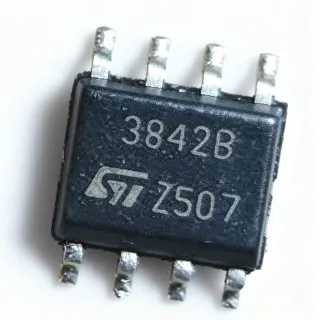
BD7690FJ-E2 - 220kHz BCM PFC Controller | ROHM
Teilenummer: BD7690FJ-E2 ✓ Aktiv| Menge | Stückpreis | Gesamt |
|---|---|---|
| 1 | $1.7171 | $1,72 |
| 10 | $1.7171 | $17,17 |
| 100 | $1.7171 | $171,71 |
| 500 | $1.7171 | $858,55 |
| 1.000 | $1.7171 | $1.717,10 |
BD7690FJ-E2 Übersicht
A power-factor-correction controller is a specialized power-management IC used between an AC input and a DC power-conversion stage. The BD7690FJ-E2 controls the switching behavior of the PFC stage in boundary conduction mode, which supports high-frequency operation while helping reduce conduction-related loss and electromagnetic interference. Its 220 kHz switching frequency is a central design parameter for inductor selection, switching-device selection, and layout planning.
Key verified features include boundary-conduction-mode operation, a 220 kHz switching frequency, a 10 V to 26 V supply range, 65 µA startup current, a -40 °C to +105 °C operating-temperature range, and an 8-SOP-J package. These figures make the device relevant to AC/DC power supplies, power-factor-correction stages, industrial power conversion, and other applications where input-current shaping and active PFC are required.
The controller's Zero Current Detection function is intended to identify the switching-current zero-crossing condition and support reduced switching loss and noise. Designers should still validate the complete power stage against the datasheet, including gate-drive timing, current-sense limits, inductor ripple, startup behavior, protection settings, and the selected switching MOSFET. The supplied evidence confirms the package, operating class, voltage range, temperature range, and nominal switching frequency, but does not provide every electrical limit needed for a complete power-conversion design.
Typical implementations place the controller in a boost-derived PFC stage that rectifies the AC input and raises the DC bus voltage while shaping line current. The same topology can support industrial power supplies and other AC/DC equipment requiring active power-factor correction. The compact 8-SOP-J package helps reduce board area, but high-frequency power conversion still requires careful layout around the high-current switch node, current-sense path, gate drive, and power ground.
When selecting a replacement, verify the manufacturer pinout, switching frequency, supply range, control method, protection behavior, package dimensions, and thermal requirements rather than relying on the BC700 family name alone. This page synthesizes the supplied distributor and manufacturer references, available commercial data, application guidance, and design considerations for engineers evaluating the BD7690FJ-E2.
Drop-in-Alternativen für BD7690FJ-E2 – gleiches Gehäuse, Pin-kompatibel. Bauteile mit anderem Gehäuse, die eine PCB-Überarbeitung erfordern, sind ausgeschlossen.
Schnellvergleichstool – Wählen Sie Alternativbauteile für den Direktvergleich:
BD7696FJ-E2
✅ Drop-In📋 Referenzalternative (nicht im Katalog)
BD7690FJ-E2 Grenzwerte & elektrische Eigenschaften
| Product Type | Power Factor Correction Controller IC |
| Control Mode | Boundary Conduction Mode (BCM) |
| Schaltfrequenz | 220 kHz |
| Supply Voltage Range | 10 V to 26 V |
| Startup Current | 65 µA |
| Zero Current Detection | Yes |
| Betriebstemperaturbereich | -40 °C to +105 °C |
| Gehäuse | 8-SOP-J (8-SOIC, 3.90 mm width) |
| Montageart | Surface Mount |
| Input Power Factor | PFC correction |
| Switching Loss Reduction | Supported by Zero Current Detection |
| Noise Reduction | Supported by Zero Current Detection |
| Application Category | AC/DC supplies |
| Part Status | Active |
| Manufacturer | ROHM Semiconductor |
| Manufacturer Product Family | BD7690FJ |
| Price Reference | $1.7171 starting price as of 2026-10-21 |
BD7690FJ-E2 8-sop-j (8-soic, 3.90 mm width) Pinbelegungsleitfaden
Pinbelegung für BD7690FJ-E2 (8-sop-j (8-soic, 3.90 mm width)-Gehäuse). Dieses Leistungsbauteil verfügt über Gate-, Drain- und Source-Anschlüsse. Bei nicht gepolten Gehäusen entnehmen Sie die genaue Ausrichtung von Pin 1 und Footprint-Details dem Herstellerdatenblatt. Typische Anwendungen sind Netzteilentwurf, Motoransteuerung und Lastschaltung.

Keine detaillierten Pinbelegungsdaten verfügbar für BD7690FJ-E2.
Siehe die Datenblatt für die vollständige Pin-Konfiguration.
Typische Anwendungen
BD7690FJ-E2 ist geeignet für 6 Anwendungs: Industrial AC/DC Power Supply, Boost PFC Stage for AC/DC Conversion, Power-Supply Line Current Shaping, High-Frequency Offline Power Conversion, Rectified AC Front End, PFC for Power-Supply Modules.
Industrial AC/DC Power Supply
BD7690FJ-E2 fits an industrial AC/DC power supply that requires active input power-factor correction. Its verified 220 kHz BCM control and 10 V to 26 V supply range suit a high-frequency PFC stage, while Zero Current Detection is intended to reduce switching loss and noise. The controller should drive a separately selected MOSFET, inductor, rectifier, and current-sense network. The final design must verify line transient response, output bus voltage, inductor saturation current, MOSFET losses, thermal rise, and safety isolation. The 8-SOP-J package helps reduce PCB area, but the power stage still requires a high-current layout and carefully controlled current-sense path.
Empfohlen
Boost PFC Stage for AC/DC Conversion
The BD7690FJ-E2 is appropriate for the controller section of a boost-derived PFC stage in which AC input current is shaped toward a higher power factor. Its 220 kHz switching frequency is a concrete selection point for the inductor and switching MOSFET, while BCM operation can reduce unnecessary conduction intervals. Zero Current Detection provides a mechanism for switching-loss and noise reduction. Designers must still calculate inductor ripple, peak current, MOSFET voltage stress, diode or rectifier reverse voltage, and control-loop compensation using the manufacturer datasheet and application information.
Empfohlen
Power-Supply Line Current Shaping
Use BD7690FJ-E2 when an AC/DC power supply must improve input power factor rather than relying on passive correction alone. The controller's BCM operation and ZCD function support controlled switch-current behavior, potentially reducing switching-related loss and noise in a correctly designed PFC stage. This is important in equipment with a front-end rectifier and bulk capacitor, where nonlinear charging current can create poor power factor. The controller is not a complete power factor measurement system; system performance depends on line voltage, load, inductor selection, MOSFET control, feedback design, and the downstream bus converter.
Empfohlen
High-Frequency Offline Power Conversion
BD7690FJ-E2 supports high-frequency offline power-conversion architectures because its specified switching frequency is 220 kHz. That frequency can reduce magnetic-component size but increases the importance of switching loss, parasitic inductance, EMI control, and layout quality. The controller's 8-SOP-J package is suitable for surface-mount assembly, provided the manufacturer pinout and thermal requirements are followed. Validate the complete design across line and load corners, including startup, overload, short circuit, thermal conditions, and control-loop stability. The supplied sources do not provide a complete protection threshold list.
Empfohlen
Rectified AC Front End
BD7690FJ-E2 can serve as the PFC controller in a rectified AC front end feeding a downstream DC/DC stage. Its 10 V to 26 V operating-supply range allows it to be powered from an auxiliary winding or regulated control rail in suitable offline systems. Boundary Conduction Mode and Zero Current Detection are relevant to reducing switch-transition loss and noise, while the controller's 220 kHz frequency defines the power-stage switching point. The actual boost inductor, current sensor, switch, rectifier, and safety components are not specified by the supplied data and must be selected independently.
Empfohlen
PFC for Power-Supply Modules
BD7690FJ-E2 is relevant to power-supply modules that require active power-factor correction in an AC/DC front end. The 8-SOP-J surface-mount package helps support compact module designs, and the verified -40 °C to +105 °C operating range provides a defined environmental envelope for industrial and commercial environments. A module designer should account for the controller's 10 V minimum supply, 65 µA startup-current specification, 220 kHz switching frequency, and external power-stage losses. Validate conducted emissions, thermal performance, hold-up behavior, and fault response in the final module rather than relying only on the IC specification.
Empfohlen
Zusammenfassung der empfohlenen Produkte
Technische Referenzdaten für BD7690FJ-E2 – Vergleich, Designhinweise und Compliance-Informationen.
Auswahlhilfe
Vergleich mit Alternativen
| Parameter | Dieses Produkt | BD7696FJ-E2 |
|---|---|---|
| Brand | ROHM Semiconductor | ROHM Semiconductor |
Wichtigste Unterscheidungsmerkmale
- Explicit 220 kHz BCM operating class (vs. BD7696FJ-E2)
- Documented Zero Current Detection function (vs. BD7696FJ-E2)
- Defined auxiliary supply and environmental range (vs. BD7696FJ-E2)
Designhinweise
Use the 220 kHz switching frequency as a starting point for PFC inductor selection, MOSFET selection, gate-drive design, and snubber design. The inductor must meet the required ripple-current and saturation-current levels for the target output power. The MOSFET and rectifier must be rated for the highest expected bus voltage with suitable transient margin. Do not treat the BD7690FJ-E2's 10 V to 26 V specification as the high-voltage bus rating; it is the controller supply range.
Route the switch node with a short and compact path to reduce parasitic inductance and EMI. Keep the controller's supply decoupling close to its supply and ground pins, and place the current-sense network where its signal is not materially disturbed by the high-current switch node. Use a low-loop gate-drive connection and maintain controlled grounding between the signal and power sections. Validate the layout against the manufacturer's recommended application circuit.
The controller IC itself does not dissipate the total PFC-stage loss; most thermal design work belongs to the MOSFET, inductor, rectifier, current-sense components, and surrounding power stage. Estimate conduction loss, switching loss, ripple loss, and temperature rise at worst-case line, load, and ambient conditions. Keep the 8-SOP-J device within its manufacturer-specified operating temperature of -40 °C to +105 °C and provide copper area and thermal paths appropriate to the assembly.
Compliance-Informationen
The supplied web results do not provide explicit RoHS, REACH, AEC-Q100, lead-free, halogen-free, or conflict-minerals statements. The ABC-Semi result describes the part as active, but this is not a substitute for formal compliance documentation.