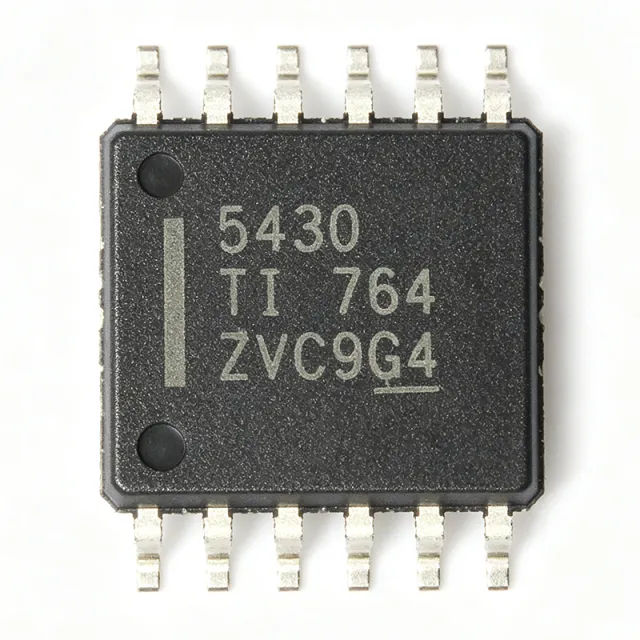
TPS5430DDAR - 3A, 36V Step-Down Converter | Texas Instruments
Teilenummer: TPS5430DDAR ✓ Aktiv| Menge | Stückpreis | Gesamt |
|---|---|---|
| 1 | $2.15 | $2,15 |
| 10 | $1.93 | $19,30 |
| 100 | $1.62 | $162,00 |
| 500 | $1.38 | $690,00 |
| 1.000 | $1.19 | $1.190,00 |
TPS5430DDAR Übersicht
Ein Buck-Konverter ist eine Art Schaltspannungsregler, der eine höhere Gleichspannung mithilfe eines Schalt-MOSFET, einer Induktivität und Ausgangskondensatoren effizient auf eine niedrigere Spannung herunterregelt. Im Gegensatz zu Linearreglern überschreiten Schaltregler routinemäßig einen Wirkungsgrad von 90 % und bilden damit die Grundlage moderner Hierarchien von Power-Management-ICs (DC-DC-Wandler -> Schaltregler -> Point-of-Load-Konverter). Der TPS5430 gehört zur SWIFT-Familie der DC-DC-Wandler von TI.
Zu den wichtigsten Merkmalen gehören der Eingangsbereich von 5,5V bis 36V, der 12V- und 24V-Industrie- und Automotive-Busse direkt akzeptiert, ein kontinuierlicher Ausgangsstrom von 3A, der feste Betrieb mit 500kHz, der kleine Induktivitäten ermöglicht, ein integrierter High-Side-N-Kanal-MOSFET, interne Schleifenkompensation, Soft-Start, zyklische Strombegrenzung und thermische Abschaltung. Das thermisch optimierte SO-8-PowerPAD-Gehäuse bietet einen niedrigen Wärmewiderstand für den Volllastbetrieb ohne externen Kühlkörper.
Das Bauteil verwendet PWM-Spannungsmodusregelung mit einer internen 1,221V-Bandgap-Referenz; die Ausgangsspannung wird durch einen externen Spannungsteiler am VSENSE-Pin eingestellt. Ein Bootstrap-Kondensator zwischen BOOT und PH treibt das Gate des High-Side-MOSFET über VIN. Der Festfrequenzbetrieb vereinfacht das Design von EMI-Filtern im Vergleich zu Frequenzumrichtern.
Typische Anwendungen sind Point-of-Load-Versorgungen für FPGAs, DSPs und Mikrocontroller, 24V-Industriebus-Stromversorgung, Telekom-Zwischenschienen, 12V-Automotive-Zubehörstromversorgung und verteilte 5V/3,3V-Stromversorgungssysteme.
Design-Tipp: Platzieren Sie Ein-/Ausgangskondensatoren und den Bootstrap-Kondensator nahe am IC, löten Sie das PowerPAD auf eine Kupferfläche mit thermischen Vias und halten Sie den PH-Schaltknoten und die Leistungsschleifen kurz, um Ringing und EMI zu minimieren.
Drop-in-Alternativen für TPS5430DDAR – gleiches Gehäuse, Pin-kompatibel. Bauteile mit anderem Gehäuse, die eine PCB-Überarbeitung erfordern, sind ausgeschlossen.
Varianten dieser Serie
Modelle derselben Serie, die drop-in-kompatibel sind mit TPS5430DDAR (gleiche Bauform und Footprint) – abweichend in Topology, Output Voltage Range, Package, Input Voltage Range, Control Method.
Schnellvergleichstool – Wählen Sie Alternativbauteile für den Direktvergleich:
TPS5430DDA
✅ Drop-In📋 Referenzalternative (nicht im Katalog)
TPS5430DDAG4
✅ Drop-In📋 Referenzalternative (nicht im Katalog)
TPS5430QDDARQ1
✅ Drop-In✓ Auf Lager
$1.95 / Stück
Datenblatt ansehen →TPS5450DDAR
✅ Drop-In✓ Auf Lager
$2.55 / Stück
Datenblatt ansehen →TPS54331DR
⚡ Gleiches Gehäuse✓ Auf Lager
$0.85 / Stück
Datenblatt ansehen →MP1584EN
⚡ Gleiches Gehäuse📋 Referenzalternative (nicht im Katalog)
RT8279GSP
⚡ Gleiches Gehäuse📋 Referenzalternative (nicht im Katalog)
TPS5430DDAR Grenzwerte & elektrische Eigenschaften
| Topologie | Step-Down (Buck) |
| Eingangsspannungsbereich | 5.5 V to 36 V |
| Ausgangsspannung | Adjustable, 1.221 V to near VIN |
| Maximaler Ausgangsstrom | 3 A |
| Schaltfrequenz | 500 kHz (fixed) |
| Referenzspannung | 1.221 V |
| Control Topology | Voltage-mode PWM |
| MOSFET | Integrated high-side N-channel |
| Protection Features | Cycle-by-cycle current limit, thermal shutdown, soft-start |
| Anzahl der Ausgänge | 1 |
| Gehäuse | 8-PowerSOIC (DDA), PowerPAD, 0.154 in / 3.90 mm width |
| Montageart | Surface Mount |
| Packaging | Tape & Reel (R suffix) |
| RoHS-Status | Compliant |
| Family | TI SWIFT DC-DC converters |
TPS5430DDAR Pin-Konfiguration
| Pin 1 | BOOT — Bootstrap capacitor connection to PH for high-side gate drive |
| Pin 2 | NC/GND — No connect / ground per datasheet layout |
| Pin 3 | VSENSE — Feedback input from output voltage divider (1.221V reference) |
| Pin 4 | ENA — Enable input, active high |
| Pin 5 | SS/TR — Soft-start / tracking programming pin |
| Pin 6 | GND — Ground reference (PowerPAD also ground) |
| Pin 7 | VIN — Input supply, 5.5V to 36V |
| Pin 8 | PH — Phase / switch node to inductor |
Typische Anwendungen
TPS5430DDAR ist geeignet für 6 Anwendungs: 24V Industrial Bus Point-of-Load, 12V Automotive Accessory Power, FPGA/DSP Point-of-Load Supply, Telecom Intermediate Rail Conversion, Distributed 5V/3.3V Power Systems, Battery-Powered and Portable Instrumentation.
24V Industrial Bus Point-of-Load
The TPS5430DDAR's 5.5V to 36V input range directly accepts 24V industrial control buses with transient headroom, eliminating a pre-regulator stage. Delivering 3A at a fixed 500kHz, it powers PLC I/O modules, sensors, and motor-drive logic rails. Internal compensation and fixed-frequency PWM simplify EMI filter design, while cycle-by-cycle current limit protects against shorted loads on long factory wiring. Its 1.221V reference allows any intermediate rail from 1.22V upward.
Empfohlen
12V Automotive Accessory Power
For 12V automotive accessory rails, the 36V maximum input covers load-dump-adjacent conditions in protected front ends, and the automotive-qualified TPS5430QDDARQ1 variant (same footprint) supports AEC-Q100 programs. The 3A output supplies infotainment sub-rails, telematics, and body-electronics processors at 5V or 3.3V with efficiency above 90%, reducing thermal load in sealed enclosures. Fixed 500kHz switching keeps inductors small for space-constrained modules.
Empfohlen
FPGA/DSP Point-of-Load Supply
The TPS5430DDAR provides 3A core and I/O rails for FPGAs, DSPs, and microcontrollers from 5V or 12V intermediates. Its soft-start pin enables controlled inrush for high ceramic capacitance, and the 500kHz fixed frequency allows inductors in the 10-15uH class with fast transient response for logic load steps. The 1.221V reference supports modern low-voltage cores, and the PowerPAD package dissipates conversion losses without a heatsink at typical 2-3A loads.
Empfohlen
Telecom Intermediate Rail Conversion
In telecom and networking equipment, the TPS5430DDAR converts intermediate distribution voltages down to point-of-load rails with 90%+ efficiency. The 36V input tolerates -48V-derived rails after a step-down front end, and the wide input range allows one BOM across 12V, 15V, and 24V shelves. The thermal shutdown and hiccup-style current limit protect against fan-failure thermal events common in telecom cabinets, while the SO-8 PowerPAD suits high-density line-card layouts.
Empfohlen
Distributed 5V/3.3V Power Systems
For distributed power architectures, the TPS5430DDAR generates 5V or 3.3V logic rails from upstream intermediates at a fixed 500kHz, so ripple falls in a predictable band that standard LC filters attenuate easily. Voltage-mode PWM with internal compensation reduces external component count to an inductor, two divider resistors, and input/output capacitors, cutting BOM cost. The adjustable output and 3A capacity cover backplane-fed subsystems, industrial gateways, and test-instrument auxiliaries.
Empfohlen
Battery-Powered and Portable Instrumentation
Portable instruments powered by 12V lead-acid or multi-cell Li-ion packs benefit from the TPS5430DDAR's wide 5.5V-36V input that spans battery discharge curves. Fixed-frequency 500kHz operation keeps the converter out of audible bands and enables magnetics small enough for handheld enclosures, while better than 90% efficiency extends runtime. Thermal shutdown protects against blocked ventilation, and the SS pin can sequence the analog front end after the digital core.
Empfohlen
Zusammenfassung der empfohlenen Produkte
Technische Referenzdaten für TPS5430DDAR – Vergleich, Designhinweise und Compliance-Informationen.
Auswahlhilfe
Vergleich mit Alternativen
| Parameter | Dieses Produkt | TPS5430DDA | TPS5430QDDARQ1 | TPS5450DDAR | TPS54331DR |
|---|---|---|---|---|---|
| Package | 8-PowerSOIC (DDA) | 8-PowerSOIC (DDA) - same | 8-PowerSOIC (DDA) - same | 8-PowerSOIC (DDA) - same | SOIC-8 - different pinout |
| Brand | Texas Instruments | Texas Instruments | Texas Instruments | Texas Instruments | MPS |
| Input Voltage Range | 5.5V to 36V | 5.5V to 36V | 5.5V to 36V | 5.5V to 36V | 4.5V to 28V |
| Output Current | 3 A | 3 A | 3 A | 5 A | 1.5 A |
| Switching Frequency | 500 kHz | 500 kHz | 500 kHz | 500 kHz | 1.5 MHz (adjustable) |
| Automotive Grade | No | No | Yes (AEC-Q100) | No (Q1 version available) | No |
| Reference Voltage | 1.221 V | 1.221 V | 1.221 V | 1.221 V | 0.8 V |
| Approx. Price (1 pc, as of 2026-08-29) | $2.15 | $2.15 | $2.50 | $3.10 | $0.60 |
Wichtigste Unterscheidungsmerkmale
- Weitester Eingangsbereich in der klassischen SWIFT-SO-8-Familie (vs. TPS54331DR)
- Pin-kompatibler 5A-Upgrade-Pfad (vs. TPS5450DDAR)
- Höherer Ausgangsstrom als markenübergreifende Äquivalente (vs. MP1584EN)
- Automotive-qualifizierte Variante verfügbar (vs. TPS5430DDA)
Designhinweise
Das SO-8 PowerPAD ist entscheidend für die thermische Leistung: Löten Sie das Pad auf eine Massefläche mit einer Anordnung thermischer Vias (typischerweise 3x3 bei 1,0mm Raster) zur internen Lage. Bei 12Vin auf 3,3V/3A Ausgang beträgt die Verlustleistung etwa 2W; ohne solide PowerPAD-Anbindung kann die Sperrschichttemperatur die Grenzwerte überschreiten. Befolgen Sie das thermische Layout des TI-Datasheet-EVMs.
Halten Sie die Masseschleife von Eingangskondensator, PH-Pin und Freilaufdiode so kurz und breit wie möglich – dies ist die Hot-Loop mit hohem di/dt. Platzieren Sie den BOOT-Kondensator (0,01uF) direkt zwischen den Pins BOOT und PH. Führen Sie die VSENSE-Rückkopplungsleitung fern von PH und der Induktivität, um zu vermeiden, dass Schaltrauschen die Regelung beeinträchtigt.
Der PH-Pin schaltet während der Totzeit zwischen VIN und unter Masse – verwenden Sie eine ausreichende externe Schottky-Diode und überschreiten Sie nicht das absolute Maximum von 36V an VIN. Legen Sie die Soft-Start-Kapazität entsprechend der Lastkapazität fest, um ein Zurückfalten der Strombegrenzung während des Anlaufs mit großen keramischen Ausgangskondensatorbänken zu verhindern. Überprüfen Sie die Toleranz des Spannungsteilers (1 %), um den Ausgang innerhalb der Spezifikation zu halten.
Der feste 500kHz-Betrieb erzeugt vorhersehbare Harmonische – fügen Sie einen kleinen RC-Snubber von PH nach Masse hinzu, wenn das Ringing die Bauteilgrenzwerte überschreitet. Ein Pi-Eingangsfilter kann erforderlich sein, um die leitungsgebundenen Emissionen auf 24V-Industriebussen einzuhalten; die feste Frequenz (im Gegensatz zu Frequenzumrichtern wie MP1584EN) macht die Filterauslegung unkompliziert.
Compliance-Informationen
RoHS compliant per DigiKey product listing (non-G4 suffix indicates standard RoHS-compliant TI ordering). AEC-Q100 not applicable to standard part - use TPS5430QDDARQ1 for automotive qualification.