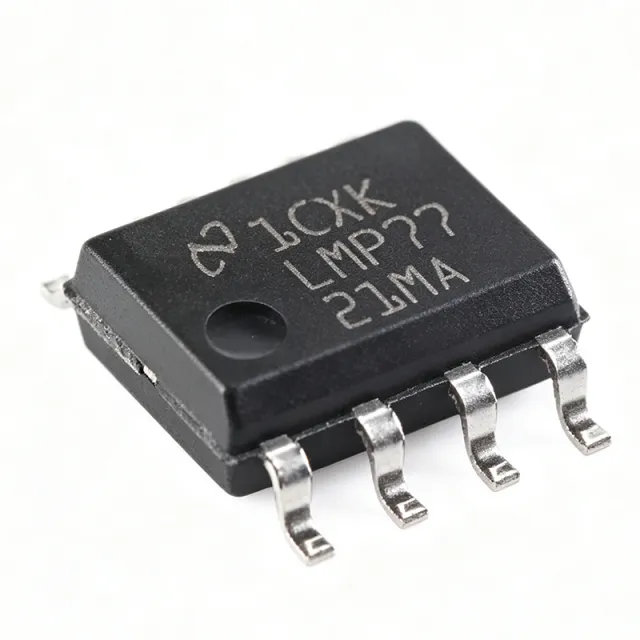
LMP7721MA/NOPB-Q1 - 3fA Input Bias Precision Op Amp | Texas Instruments
Teilenummer: LMP7721MA/NOPB ✓ Aktiv| Menge | Stückpreis | Gesamt |
|---|---|---|
| 1 | $0 | $0,00 |
| 10 | $0 | $0,00 |
| 100 | $0 | $0,00 |
| 500 | $0 | $0,00 |
| 1.000 | $0 | $0,00 |
LMP7721MA/NOPB Übersicht
An operational amplifier (op amp) is a high-gain voltage amplifier with differential inputs, forming the foundation of analog signal conditioning within the amplifier IC hierarchy: operational amplifier -> precision amplifier -> analog front end -> signal chain IC. Precision amplifiers are distinguished by near-zero DC error terms - input bias current, offset voltage, and drift.
The LMP7721 achieves its femtoampere-class input bias current through patent-pending input bias current cancellation circuitry, which maintains ultra-low bias current over temperature. Critically, the 8-pin SOIC uses a special pinout that isolates the amplifier inputs from the power supply and output pins. With proper board layout techniques, this unique pinout prevents PCB leakage current from reaching the input pins - a decisive advantage over conventional op amp pinouts when guarding is required.
As a rail-to-rail input and output amplifier, it maximizes dynamic range in low-voltage systems while drawing low supply current, suiting battery-operated instruments. The wide supply range and high GBW allow use with electrochemical cells, photodiodes, and high-impedance sensors where even picoampere loading corrupts measurements.
Typical applications include ionization chamber and electrochemical sensor front ends, photodiode transimpedance amplifiers for low-light detection, pH and dissolved-gas probe buffers, and picoammeter instrumentation.
Design tip: to fully exploit the 3 fA bias current, use guard rings connected to the input-following low-impedance node and clean the PCB after assembly - flux residue and moisture can leak picoamperes that dwarf the amplifier's own bias current.
Drop-in-Alternativen für LMP7721MA/NOPB – gleiches Gehäuse, Pin-kompatibel. Bauteile mit anderem Gehäuse, die eine PCB-Überarbeitung erfordern, sind ausgeschlossen.
Varianten dieser Serie
Modelle derselben Serie, die drop-in-kompatibel sind mit LMP7721MA/NOPB (gleiche Bauform und Footprint) – abweichend in Amplifier Type, Package, RoHS Status, Supply Voltage Range.
Schnellvergleichstool – Wählen Sie Alternativbauteile für den Direktvergleich:
LMP8350MA/NOPB-Q1
✓ Auf Lager
$2.53 / Stück
Datenblatt ansehen →AD8628ARZ
✓ Auf Lager
$1.49 / Stück
Datenblatt ansehen →OPA365AID
📋 Referenzalternative (nicht im Katalog)
OPA356AID
📋 Referenzalternative (nicht im Katalog)
LMP7721MA/NOPB Grenzwerte & elektrische Eigenschaften
| Amplifier Type | Precision, General Purpose |
| Number of Channels | 1 |
| Input Bias Current (typ) | 3 fA |
| Input Bias Current Limit at 25C | ±20 fA |
| Input Bias Current Limit at 85C | ±900 fA |
| Gain Bandwidth Product | 17 MHz |
| Slew Rate | 12.8 V/us |
| Supply Voltage Range | 1.8 V to 5.5 V |
| Ausgangstyp | Rail-to-Rail |
| Input Type | Rail-to-Rail |
| Gehäuse | 8-SOIC (3.90 mm width) |
| Montageart | Surface Mount |
| Packaging | Tube |
| Input Bias Cancellation | Patent-pending cancellation circuitry |
| Special Pinout | Inputs isolated from supply/output pins for leakage prevention |
| RoHS-Status | Compliant (NOPB = no lead, RoHS) |
LMP7721MA/NOPB Pin-Konfiguration
| Pin 1 | TRIM1 — Input pin 1 isolated from supply/output (special leakage-isolating pinout) |
| Pin 2 | IN- — Inverting input |
| Pin 3 | IN+ — Non-inverting input |
| Pin 4 | GND / V- — Negative supply or ground |
| Pin 5 | TRIM2 — Input pin 2 isolated from supply/output |
| Pin 6 | OUT — Rail-to-rail output |
| Pin 7 | V+ — Positive supply, 1.8 V to 5.5 V |
| Pin 8 | NC/ISO — Isolated pin (see datasheet for exact function) |
Typische Anwendungen
LMP7721MA/NOPB ist geeignet für 6 Anwendungs: Electrochemical Sensor Front End, Photodiode Transimpedance Amplifier, Ionization Chamber Instrumentation, pH and Chemical Probe Buffering, Battery-Operated Portable Instrumentation, Picoammeter and Electrometer Circuits.
Electrochemical Sensor Front End
Electrochemical gas sensors and ion-selective electrodes produce currents in the picoampere range, demanding amplifiers whose input bias current is orders of magnitude lower. The LMP7721's 3 fA typical bias current and ±20 fA limit at 25C ensure the amplifier loads the cell by less than a few percent of the signal current. Its special SOIC-8 pinout isolates inputs from supply and output traces, and paired with guard rings keeps PCB leakage negligible. Operated from a single 1.8V to 5.5V rail with rail-to-rail I/O, it buffers the sensing electrode directly for battery-powered safety and environmental monitors.
Empfohlen
Photodiode Transimpedance Amplifier
Low-light detection with photodiodes requires a transimpedance amplifier whose input bias current does not mask the photocurrent. With 3 fA typical input bias and 17 MHz GBW, the LMP7721 supports megohm-scale feedback resistors while maintaining useful closed-loop bandwidth, enabling optical power detection down to femtoampere signal levels. The isolated input pinout, combined with a guard ring driven by the amplifier output, minimizes surface leakage across the feedback path. A feedback capacitor of 0.1 pF to 1 pF stabilizes the circuit at high transimpedance gains in optical instruments and flame sensors.
Empfohlen
Ionization Chamber Instrumentation
Ionization chambers in radiation monitoring and smoke detection generate sub-picoampere currents that only femtoampere-class front ends can measure accurately. The LMP7721's ±20 fA maximum bias at 25C and ±900 fA at 85C guarantee measurement error far below typical chamber currents, while its 12.8 V/us slew rate handles transient events. Configured as a current-to-voltage converter with guard-ring PCB layout, it preserves accuracy even in high-humidity environments. The wide 1.8V to 5.5V supply range allows operation from lithium cells in portable dosimetry and industrial radiation survey instruments.
Empfohlen
pH and Chemical Probe Buffering
Glass pH electrodes present source impedances of hundreds of megohms, so any input bias current creates a direct DC voltage error. The LMP7721's 3 fA bias current produces only nanovolt-scale error even across 1 GOhm sources, preserving pH accuracy to 0.01 pH. Its rail-to-rail input stage accommodates the electrode's full millivolt-range output near supply rails on single 3.3V or 5V rails, and rail-to-rail output drives downstream ADCs directly. The isolated input pinout plus conformal-coated guard layout keeps leakage stable across cleaning cycles in chemical process monitoring.
Empfohlen
Battery-Operated Portable Instrumentation
Portable field instruments need precision analog performance from a single lithium cell. The LMP7721 operates from 1.8V to 5.5V and draws low supply current while delivering 17 MHz GBW and 12.8 V/us slew, so a single stage can buffer high-impedance sensors without multiple gain blocks. Rail-to-rail input and output maximize usable signal swing on a 3V coin cell or single Li-ion cell. Its femtoampere bias means sensors are not discharged by the amplifier during storage or duty-cycled operation, extending battery life and calibration intervals in handheld meters and environmental loggers.
Empfohlen
Picoammeter and Electrometer Circuits
Picoammeter front ends require the lowest possible amplifier input current and careful leakage management. The LMP7721, specified at 3 fA typical bias, enables measurement ranges starting near tens of femtoamperes when used in a feedback ammeter topology with high-value (10 to 100 GOhm) resistors. The dedicated input-isolated pinout allows short, guarded input traces that never run near supply or output copper, which is the dominant leakage source on conventional op amp pinouts. Combined with PTFE standoffs and post-assembly board cleaning, it forms the core of compact laboratory-grade current measurement modules.
Empfohlen
Zusammenfassung der empfohlenen Produkte
Technische Referenzdaten für LMP7721MA/NOPB – Vergleich, Designhinweise und Compliance-Informationen.
Auswahlhilfe
Vergleich mit Alternativen
| Parameter | Dieses Produkt | LMP8350MA/NOPB-Q1 | OPA365AID | OPA356AID | AD8628ARZ |
|---|---|---|---|---|---|
| Package | 8-SOIC (3.90 mm) | 8-SOIC - same body | 8-SOIC - same body | 8-SOIC - same body | 8-SOIC - same body, different pinout |
| Brand | Texas Instruments | Texas Instruments | Texas Instruments | Texas Instruments | Analog Devices |
| Automotive Grade Option | Yes (-Q1) | Yes (-Q1) | Standard | Standard | Standard |
Wichtigste Unterscheidungsmerkmale
- Industry's lowest guaranteed input bias current (vs. OPA365AID)
- Leakage-isolating special pinout (vs. AD8628ARZ)
- Automotive-grade Q1 variant availability (vs. OPA365AID)
Designhinweise
Exploit the LMP7721's special SOIC-8 pinout: route the input traces (pins 2, 3) on the inner layer or through guard rings on the top layer, driven by a low-impedance potential matching the input common-mode voltage. Keep inputs physically far from pins 6 (OUT) and 7 (V+), which the isolated pinout is specifically designed to permit. TI documents this technique as the primary method to prevent PCB leakage current from reaching the input pins.
Board contamination dominates femtoampere measurements. No-clean flux residue and moisture can leak picoamperes - hundreds of times the 3 fA typical bias current. Clean the assembly with isopropyl alcohol and bake dry, use conformal coating on the input area, and avoid FR4-only isolation; consider PTFE standoffs for sub-100 fA measurements. Verify achieved performance by measuring offset with inputs shorted through a GOhm resistor.
In transimpedance configurations, stability is set by the feedback capacitor: CF must satisfy CF >= sqrt(Cj/(2*pi*Rf*GBW)) where Cj is the total input capacitance and GBW is 17 MHz. Start with 0.5 pF at 10 MOhm feedback and reduce empirically. High-value resistors (GOhm class) add significant Johnson noise, which often exceeds amplifier noise - size Rf against your resolution target, not just gain.
Compliance-Informationen
NOPB suffix indicates no-Pb (lead-free) RoHS-compliant packaging. Q1 suffix indicates AEC-Q100 automotive qualification per TI naming convention; REACH and halogen-free status not stated in retrieved data.







