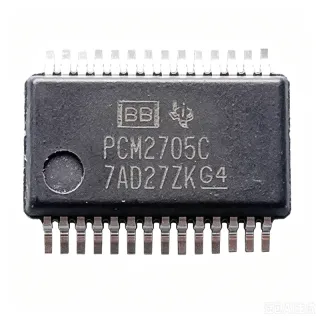
PCM3006TG - 16-Bit Stereo Audio Codec | Texas Instruments
Teilenummer: PCM3006TG ✓ AktivPCM3006TG Übersicht
An audio codec is an interface IC that converts between analog audio and digital audio data. Its internal ADC accepts analog voltage signals, converts them into digital samples, and transfers those samples to a digital audio processor through a digital serial interface. The internal DAC performs the reverse path, accepting digital audio data and producing a single-ended analog output. This integrated ADC/DAC arrangement reduces component count and simplifies mixed-signal board layouts compared with separate converter ICs.
The PCM3006TG's principal identified characteristics are 16-bit resolution, stereo operation, single-ended analog input and output, and a 24-pin package. These features make the codec applicable to consumer audio equipment, digital recording products, and embedded audio systems where two audio channels must cross the analog-to-digital boundary. Its integrated conversion functions also allow a design to use the same codec for playback, capture, or bidirectional signal conversion when the surrounding system provides suitable clocks and digital interfaces.
The PCM3006 family is described by Texas Instruments as a low-cost, single-chip stereo audio codec. Integrating both conversion directions into one package reduces board area and the number of external conversion devices. The digital side must still be connected to a processor, controller, or audio transport capable of supporting the codec's interface format and required clocking. Analog board design also requires careful grounding and layout control to prevent converter noise from coupling into either the input or output signal path.
Typical uses include compact stereo playback and recording modules, multimedia appliances, USB or network audio peripherals, industrial control panels with sound capture, and consumer products with local audio output. The 16-bit format provides a defined sample width for digital audio pipelines, while the stereo architecture supports independent or paired left and right channels according to the system configuration.
Designers should follow the pin-description and typical-application circuits in the Texas Instruments PCM3006 datasheet when assigning signals. Place analog and digital return paths carefully, provide local bypassing at the supply pins, and route high-speed digital traces away from sensitive analog inputs. Confirm the required master-clock, serial-data, and control connections before finalizing the PCB footprint.
This product page combines the confirmed PCM3006TG characteristics with a searchable compatibility comparison and practical implementation guidance. It is intended to help engineers identify the correct codec, understand its documented architecture, and plan a robust analog and mixed-signal layout before release to manufacturing.
Drop-in-Alternativen für PCM3006TG – gleiches Gehäuse, Pin-kompatibel. Bauteile mit anderem Gehäuse, die eine PCB-Überarbeitung erfordern, sind ausgeschlossen.
Varianten dieser Serie
Modelle derselben Serie, die drop-in-kompatibel sind mit PCM3006TG (gleiche Bauform und Footprint) – abweichend in Analog Input Type, Analog Output Type, Conversion Functions, Package, Product Type.
PCM3006T
✅ Drop-InPreis auf Anfrage
Datenblatt ansehen →PCM3006TG Technische Daten
| Product Type | Stereo audio codec |
| ADC/DAC Resolution | 16 bit |
| Audio Channel Configuration | Stereo |
| Analog Input Type | Single-ended voltage input |
| Analog Output Type | Single-ended voltage output |
| Conversion Functions | Integrated ADC and DAC |
| Device Category | Interface IC |
| Gehäuse | 24-pin SSOP/TSSOP-24 |
| Montageart | Surface mount |
| Manufacturer | Texas Instruments |
PCM3006TG 24-pin ssop/tssop-24 Pinbelegungsleitfaden
Pinbelegung für PCM3006TG (24-pin ssop/tssop-24-Gehäuse). Pin-Nummerierung, Funktionen und Anschlussdiagramme sind im Herstellerdatenblatt definiert. Entnehmen Sie diesem den genauen Footprint und Lötrichtlinien.

Keine detaillierten Pinbelegungsdaten verfügbar für PCM3006TG.
Siehe die Datenblatt für die vollständige Pin-Konfiguration.
Typische Anwendungen
PCM3006TG ist geeignet für 6 Anwendungs: Stereo Digital Recording, Compact Audio Playback Module, USB Audio Peripheral, Network Audio Terminal, Industrial Sound Monitor, Consumer Multimedia Appliance.
Stereo Digital Recording
PCM3006TG fits compact stereo recording because its 16-bit ADC accepts single-ended analog voltage inputs and converts two audio channels into digital data. Place the codec near the input connector and analog conditioning network so the signal reaches the ADC through a short, controlled path. Provide the required master clock and serial interface from the recording processor, and use the datasheet's analog and digital grounding arrangement to limit converter noise in captured audio.
Empfohlen
Compact Audio Playback Module
The integrated 16-bit DAC and single-ended analog output of PCM3006TG support compact stereo playback modules without requiring separate ADC and DAC packages. A digital audio source can send decoded data to the codec, while the analog outputs feed the next amplification or output stage. Confirm the required data format and clocking in the Texas Instruments PCM3006 datasheet, and keep the analog output routing short to reduce susceptibility to board noise and coupling.
Empfohlen
USB Audio Peripheral
PCM3006TG can serve as the analog conversion section of a USB audio peripheral when the USB controller or digital audio interface supplies compatible clock and serial data. Its stereo ADC supports two-channel capture, while its stereo DAC supports two-channel playback through single-ended outputs. The main design constraints are clock-domain support, supported sample rates, digital signal integrity, and a clean analog return path; each must be verified against the exact system requirements and manufacturer datasheet.
Empfohlen
Network Audio Terminal
A network audio terminal can use PCM3006TG for local two-channel capture and playback after network audio data has been decoded by a suitable processor. The 16-bit stereo codec provides a unified conversion device, reducing board area compared with separate converters. Because network audio endpoints may operate at several clock rates, the design must validate every required sample rate and clock arrangement rather than assuming continuous-mode or slave-mode support. Analog filtering and grounding also affect perceived channel balance.
Empfohlen
Industrial Sound Monitor
PCM3006TG is suitable for an industrial sound-monitoring module that acquires two analog channels and presents them to a digital controller. Its 16-bit ADC provides the conversion path, while the integrated DAC can support monitoring or test-signal playback when the system design requires it. Keep sensor and transducer inputs away from digital switching nodes, use stable references and suitable input conditioning, and verify the codec's operating limits against the industrial temperature and supply requirements.
Empfohlen
Consumer Multimedia Appliance
PCM3006TG supports playback, capture, or bidirectional audio functions in a consumer multimedia appliance where a compact stereo codec is preferred. Its integrated ADC and DAC avoid two separate converter packages, while the 16-bit resolution provides a consistent digital sample width. The audio processor must accommodate the documented serial format and clocking, and the PCB must separate analog input/output routing from processor buses and display-related switching circuitry to maintain usable audio performance.
Empfohlen
Zusammenfassung der empfohlenen Produkte
Technische Referenzdaten für PCM3006TG – Vergleich, Designhinweise und Compliance-Informationen.
Auswahlhilfe
Vergleich mit Alternativen
| Parameter | Dieses Produkt | PCM3006T |
|---|---|---|
| Product Type | Stereo audio codec | Stereo audio codec |
| Brand | Texas Instruments | Texas Instruments |
| Package | 24-pin SSOP/TSSOP-24 | 24-pin SSOP/TSSOP-24 |
| ADC/DAC Resolution | 16 bit | 16 bit |
| Channel Configuration | Stereo | Stereo |
| Analog Input | Single-ended voltage input | Single-ended voltage input |
| Analog Output | Single-ended voltage output | Single-ended voltage output |
Wichtigste Unterscheidungsmerkmale
- Single-package stereo capture and playback (vs. PCM3006T)
- Single-ended analog interface alignment (vs. PCM3006T)
- Shared 24-pin package format (vs. PCM3006T)
Designhinweise
Follow the Texas Instruments PCM3006 datasheet's typical application layout and keep analog input, analog output, and reference-related routes away from processor buses and clock signals. Use a deliberate analog and digital ground strategy at the codec, and connect return currents so they do not share a noisy path beneath the analog pins. Place input filtering and output coupling components near the associated pins or signal source to minimize pickup and board-area exposure.
Provide the supply voltage and decoupling specified by the manufacturer datasheet, with local bypass capacitors positioned close to the codec's supply and ground pins. Confirm startup, clock, and shutdown behavior in the selected operating mode. Because the package exposes analog and digital functions on one 24-pin device, stable reference and supply behavior directly affect both capture and playback quality.
Route digital clock and data traces as controlled-impedance or otherwise appropriately terminated interconnects when the connected processor requires it. Keep the digital interface away from the single-ended analog input and output nets, maintain short clock routes, and provide a continuous ground reference beneath the interface. Validate timing margins at the intended clock frequency because the codec and host controller must operate within one common timing specification.
Do not assume that all PCM3006 orderable suffixes have identical environmental, marking, or production requirements. Confirm the exact suffix, clocking mode, digital format, analog levels, and package dimensions before schematic release. For PCM3006T substitution, verify every pin and timing parameter against the Texas Instruments PCM3006 datasheet rather than relying only on the shared 24-pin package name.
Compliance-Informationen
Distributor snippets contain conflicting RoHS indications, so RoHS status is left unknown until confirmed through the manufacturer product page or datasheet.