STMicroelectronics

STM32H743IIT6 - 480MHz Cortex-M7 MCU 2MB Flash | STMicroelectronics

N.º da peça: STM32H743IIT6 ✓ Ativo
Em estoque Enviado em 1 a 3 dias úteis
1.62 V to 3.6 V Vdss 176-LQFP (24x24 mm) Package 480 MHz Speed 2 MB Memory
A partir de $12 USD / unidade
MOQ: 1 |
Preço atualizado: 2026-10-10
Preços por volume
Qtd. Preço unitário Total
1 $18.5 $18,50
10 $16.2 $162,00
100 $14.5 $1.450,00
500 $13.1 $6.550,00
1.000 $12 $12.000,00
ℹ️ Todos os preços estão em USD

STM32H743IIT6 Visão geral

The STMicroelectronics STM32H743IIT6 is a high-performance 32-bit ARM Cortex-M7 microcontroller with double-precision FPU running at up to 480 MHz, featuring 2 MB of Flash memory and 1 MB of SRAM, housed in a 176-pin LQFP (24x24 mm) package. A microcontroller (MCU) is a single-chip computer that integrates a processor core, memory, and programmable peripherals on one die. Within the semiconductor hierarchy, the STM32H743IIT6 belongs to the STM32H7 family of high-performance MCUs, which sits above general-purpose lines such as STM32F4/F7 in ST's portfolio and serves as the processing heart of embedded systems where heavy computation, rich connectivity, and real-time control must coexist.

Key features include the Cortex-M7 core with 16 KB instruction and 16 KB L1 data caches, delivering up to 1027 DMIPS (2.14 DMIPS/MHz per Dhrystone 2.1), the ART Accelerator for zero-wait-state execution from Flash, and an external memory interface (FMC/QUADSPI) for expansion. Peripherals span Ethernet, USB, CAN, and multiple UART/SPI/I2C ports, with roughly 140 GPIO pins available in the LQFP-176 footprint.

Architecturally, the device couples the scalar double-precision FPU and DSP instructions with a cache-rich memory subsystem, allowing deterministic execution of DSP and Edge-AI workloads such as motor control field algorithms, audio processing, and machine-learning inference at the edge. The large 1 MB SRAM accommodates frame buffers and real-time data pipelines without external DRAM in many designs.

Typical applications include industrial HMI and automation controllers, digital power and motor drives, IoT gateways, and test/measurement instruments. High Flash density and Ethernet make it a natural fit for networked industrial nodes.

Design consideration: confirm the power architecture (integrated LDO versus external SMPS regulator option) early in the design, since it differs from earlier STM32F7 generations and affects both PCB layout and firmware boot code.

This page synthesizes verified distributor data, drop-in alternatives, pricing context, and practical design guidance not found in a single manufacturer source.

Alternativas drop-in para STM32H743IIT6 — mesmo encapsulamento, compatível pino a pino. Peças de encapsulamento diferente que exigem retrabalho na PCB são excluídas.

Variantes desta série

Modelos da mesma série compatíveis como drop-in com STM32H743IIT6 (mesmo formato e footprint) — diferindo em SRAM, ADC, Communication Interfaces, Flash Memory, Operating Temperature.

STMicroelectronics
Communication Interfaces: Ethernet, USB, CAN-FD, SPI, I2C, UART
Comparar com STM32H743IIT6 →
STMicroelectronics
SRAM: 512 KB total (368 KB SRAM + 16 KB ITCM + 16 KB DTCM)
ADC: 3 x 12-bit ADC up to 2.4 MSPS
Flash Memory: 1 MB (1 Mbyte), dual-bank with read-while-write
Comparar com STM32H743IIT6 →
STMicroelectronics
SRAM: 512 KB
ADC: 3x 12-bit, up to 2.4 MSPS
Operating Temperature: -40 C to +85 C
Comparar com STM32H743IIT6 →
STMicroelectronics
SRAM: 1 MB (includes 64 KB DTCM + AXI SRAM)
ADC: 3x 12-bit, up to 3.6 MSPS
Communication Interfaces: USART, SPI, I2C, CAN FD, USB OTG, Ethernet MAC, SDMMC
Comparar com STM32H743IIT6 →
STMicroelectronics
ADC: 16-bit ADC (3.6 MSPS) + two 12-bit ADCs
Communication Interfaces: USB OTG FS+HS, 2 × CAN FD, Ethernet MAC, SDMMC, 2 × OctoSPI, FMC, USART/UART/SPI/I2C/LPUART
Flash Memory: 2 MB (dual-bank, with secure sector)
Comparar com STM32H743IIT6 →
STMicroelectronics
Flash Memory: 128 KB
Operating Temperature: -40C to +85C
Comparar com STM32H743IIT6 →
STMicroelectronics
SRAM: 1 MB (256 KB DTCM + 256 KB AXI SRAM + 64 KB ITCM + backup SRAM)
ADC: 3 x 12-bit, 3.6 MSPS each
Communication Interfaces: USB OTG FS+HS, 2x CAN FD, 2x SDMMC, UART, SPI, I2C, ETH, FMC
Comparar com STM32H743IIT6 →
STMicroelectronics
SRAM: 1 MB (DTCM + AXI + SRAM1/2/3)
ADC: 3 x 16-bit, up to 3.6 MSPS
Communication Interfaces: Ethernet, USB OTG HS/FS, 2x CAN FD, 6x SPI, 4x I2C, USART/UART, SDMMC, SAI
Comparar com STM32H743IIT6 →

Ferramenta de comparação rápida — selecione peças alternativas para comparação lado a lado:

STM32H753IIT6

✅ Drop-In
STMicroelectronics
📦 176-LQFP (24x24 mm)
ARM Cortex-M7 with DP-FPU and DSP · 480 MHz · 1027 DMIPS · 2424 CoreMark · 2 MB · 1 MB (256 KB DTCM + 256 KB AXI SRAM + 64 KB ITCM + backup SRAM) · 16 KB I-cache + 16 KB D-cache · 1.62 V to 3.6 V (3.3 V typical I/O)

✓ Em estoque

$9.45 / unidade

Ver ficha técnica →

STM32H742IIT6

✅ Drop-In
📦 176-LQFP (24x24 mm)
same pinout, reduced peripheral set (no ETH/USB OTG FS), 480MHz/2MB Flash/1MB SRAM

📋 Alternativa de referência (fora do catálogo)

STM32H743IIH6

✅ Drop-In
📦 176-LQFP (24x24 mm)
same die, industrial -40C to +85C temp range vs standard grade, pin-to-pin compatible

📋 Alternativa de referência (fora do catálogo)

STM32H755ZIT6

✅ Drop-In
STMicroelectronics
📦 144-LQFP (20x20 mm)
Dual-core Arm Cortex-M7 + Cortex-M4 · 480 MHz · 240 MHz · 2 MB (dual-bank) · 1 MB (DTCM + AXI + SRAM1/2/3) · LQFP-144 (20x20 mm) · 114 · 1.62 V to 3.6 V

✓ Em estoque

$16.19 / unidade

Ver ficha técnica →

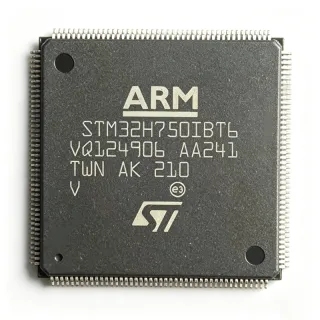
STM32H750IBT6

✅ Drop-In
STMicroelectronics
📦 176-LQFP (24x24 mm)
ARM Cortex-M7 (32-bit) · 32-bit · 480 MHz · 128 KB · 1 MB · 1.62 V to 3.6 V · -40C to +85C · Yes (single and double precision)

✓ Em estoque

$8.85 / unidade

Ver ficha técnica →

STM32F767IIT6

✅ Drop-In
STMicroelectronics
📦 176-LQFP (24x24 mm)
ARM Cortex-M7 32-bit RISC with FPU · 216 MHz · 462 DMIPS / 2.14 DMIPS/MHz (Dhrystone 2.1) · Yes (single-precision SIMD) · 16 KB I-cache + 16 KB D-cache · Yes (0-wait-state Flash execution) · 2 MB · 512 KB

✓ Em estoque

$11.95 / unidade

Ver ficha técnica →

STM32H743IIT6 Classificações máximas e características elétricas

Core Architecture 32-bit ARM Cortex-M7 with double-precision FPU
Frequência máxima de clock 480 MHz
DMIPS Performance 1027 DMIPS (2.14 DMIPS/MHz)
L1 Instruction Cache 16 KB
L1 Data Cache 16 KB
Flash Memory 2 MB
SRAM 1 MB
Encapsulamento 176-LQFP (24x24 mm)
Operating Voltage 1.62 V to 3.6 V
Temperatura de operação -40C to +85C (industrial grade)
Communication Interfaces Ethernet, USB, CAN, UART, SPI, I2C
External Memory Interface FMC, QUADSPI
GPIO Count 140 (approx.)
ART Accelerator Yes (zero-wait-state Flash execution)
RoHS Compliance Compliant

Configuração de pinos do STM32H743IIT6

Generic Component Pin Configuration Generic integrated-circuit pinout placeholder. Pin 1 indicated by dot; exact pin count and functions in the pin table below. 1 N 2 N-1 3 N-2 4 N-3 Pin Configuration See pin table below for pin functions Package-specific diagram not available
Pino 1 PE02 — GPIO PE2, alternate functions
Pino 2 PE03 — GPIO PE3, alternate functions
Pino 3 PE04 — GPIO PE4, alternate functions
Pino 4 PE05 — GPIO PE5, alternate functions
Pino 5 PE06 — GPIO PE6, alternate functions
Pino 10 VSS — Ground reference
Pino 11 VDD — Digital power supply (1.62-3.6V)
Pino 20 OSC_IN — External oscillator input
Pino 21 OSC_OUT — External oscillator output
Pino 30 NRST — Reset input, active low
Pino 40 BOOT0 — Boot mode selection
Pino 50 PA00 — GPIO PA0, WKUP, ADC1_INP0
Pino 60 PA13 — GPIO PA13, SWDIO for debug
Pino 70 PA14 — GPIO PA14, SWCLK for debug
Pino 80 VREF+ — ADC reference voltage positive
Pino 90 VDDA — Analog power supply
Pino 100 VSSA — Analog ground
Pino 120 USB_DM — USB OTG FS data minus
Pino 121 USB_DP — USB OTG FS data plus
Pino 176 PE01 — GPIO PE1, alternate functions

Aplicações típicas

STM32H743IIT6 é adequado para 6 aplicaçãos: Industrial HMI and Automation Controllers, Motor Control and Digital Power Drives, IoT Gateways and Edge Connectivity, Test and Measurement Instruments, Audio Processing and Consumer Electronics, Edge AI and Machine Learning Inference.

🏭

Industrial HMI and Automation Controllers

The STM32H743IIT6's 480 MHz Cortex-M7 core and 1 MB SRAM make it ideal for industrial HMI controllers driving TFT LCD displays with touch input. Its Ethernet, CAN, and USB interfaces support real-time communication with PLCs and sensors, while the ART Accelerator ensures responsive GUI rendering. The 2 MB Flash accommodates full graphical libraries and application code. Engineers pair this MCU with external SDRAM for frame buffers and leverage the Chrom-ART Accelerator for 2D graphics operations.

⚡

Motor Control and Digital Power Drives

The STM32H743IIT6's double-precision FPU and DSP instructions excel in field-oriented control (FOC) algorithms for three-phase motor drives. Its 480 MHz performance enables high PWM resolution and complex control loops with sub-microsecond execution times. The integrated op-amps, comparators, and high-resolution timer (HRTIM) support advanced power conversion topologies. Real-time deterministic execution ensures precise torque and speed regulation in servo and inverter applications.

🌐

IoT Gateways and Edge Connectivity

With integrated Ethernet MAC, USB OTG, and multiple UART/SPI/I2C interfaces, the STM32H743IIT6 serves as a capable IoT gateway bridging field devices to cloud services. The 1 MB SRAM handles MQTT buffers, TLS handshake contexts, and protocol parsing without external memory. The Cortex-M7 performance supports on-device data preprocessing and anomaly detection before transmission, reducing cloud bandwidth costs. Real-time operating systems like FreeRTOS or Azure RTOS run efficiently on this MCU.

📺

Test and Measurement Instruments

The STM32H743IIT6's high-performance ADC interfaces (up to 16-bit), DSP extensions, and 480 MHz processing enable digital oscilloscopes, data loggers, and spectrum analyzers. The large 1 MB SRAM captures waveform buffers while the 2 MB Flash stores calibration constants and UI assets. Fast signal processing supports real-time FFT, filtering, and statistical analysis. USB OTG enables high-speed data transfer to host PCs for post-processing and visualization.

🎧

Audio Processing and Consumer Electronics

The STM32H743IIT6's DSP instructions and double-precision FPU support real-time audio effects, equalization, and noise cancellation algorithms. Its I2S and SAI interfaces connect to audio codecs and DACs, while the 1 MB SRAM buffers audio streams. The Cortex-M7 performance handles MP3, AAC, and Opus codec processing for portable speakers and headphones. Low-power modes extend battery life in portable audio applications.

🧩

Edge AI and Machine Learning Inference

The STM32H743IIT6's 480 MHz Cortex-M7 core executes TensorFlow Lite Micro models for edge AI inference at the sensor node. The 1 MB SRAM fits moderate-sized neural networks while the 2 MB Flash stores model weights and application code. Typical applications include predictive maintenance, voice command recognition, and image classification for IoT devices. ST's X-CUBE-AI extension pack integrates model conversion and optimization for this MCU.

What is the maximum clock frequency of the STM32H743IIT6?
The STM32H743IIT6 operates at up to 480 MHz on its ARM Cortex-M7 processor. According to the STMicroelectronics datasheet, this delivers 1027 DMIPS (2.14 DMIPS/MHz per Dhrystone 2.1), with the ART Accelerator enabling zero-wait-state execution from Flash memory. This makes it suitable for high-performance DSP and real-time control applications.
How much Flash and SRAM does the STM32H743IIT6 have?
The STM32H743IIT6 integrates 2 MB of Flash memory and 1 MB of SRAM on-chip. The large SRAM allows frame buffers and data pipelines to reside entirely in internal memory for many designs, reducing the need for external DRAM. This combination supports complex firmware with over-the-air update partitions and edge-AI inference workloads.
What package does the STM32H743IIT6 use?
The STM32H743IIT6 is housed in a 176-pin LQFP package measuring 24x24 mm. This package provides approximately 140 GPIO pins and supports ST's standard pinout for the H7 family, enabling compatibility with STM32H753IIT6 and other LQFP-176 H7 variants. The LQFP-176 is suitable for hand-soldering and prototyping.
Where can I buy the STM32H743IIT6 online?
The STM32H743IIT6 is available from authorized distributors including DigiKey, Mouser, and Arrow. As of 2026-10-10, the part shows active stock status with unit pricing starting around $18.50 at quantity 1. Lead times for volume orders typically range from 4-12 weeks depending on distributor inventory and production schedules.
What is the price of the STM32H743IIT6?
As of 2026-10-10, the STM32H743IIT6 lists at approximately $18.50 per unit at quantity 1 from major distributors. Volume pricing drops to around $14.50 at 100 pieces and $12.00 at 1000 pieces. Pricing varies by distributor and reel quantity; contact authorized channels for current quotes and bulk discounts.
What is the lead time for STM32H743IIT6?
The STM32H743IIT6 typically ships within 1-3 days from major distributors when in stock. For volume orders exceeding 1000 pieces, lead times may extend to 4-12 weeks depending on production schedules. The part has historically experienced allocation periods; check distributor inventory directly for real-time availability.
Is the STM32H743IIT6 in stock?
According to distributor listings as of 2026-10-10, the STM32H743IIT6 shows active inventory at multiple authorized distributors. However, stock levels fluctuate due to high demand in industrial and automotive sectors. For confirmed availability, check DigiKey and Mouser directly or request a quote from STMicroelectronics authorized channels.
STM32H743IIT6 vs STM32H753IIT6 - which is better?
The STM32H753IIT6 includes additional cryptographic acceleration (AES, SHA, PKA) and is often considered a drop-in replacement for the STM32H743IIT6. Both share the same Cortex-M7 core at 480 MHz, 2 MB Flash, 1 MB SRAM, and LQFP-176 package. Choose STM32H753IIT6 if you need hardware crypto acceleration; otherwise STM32H743IIT6 is the cost-optimized choice.
What is the difference between STM32H743IIT6 and STM32H750VBT6?
The STM32H750VBT6 is a lower-cost variant with 128 KB Flash and 1 MB SRAM in a 64-pin LQFP package, while the STM32H743IIT6 offers 2 MB Flash in a 176-pin LQFP. The H750 is suited for applications requiring external memory expansion and reduced pin count, while the H743 provides more internal memory and GPIO for self-contained designs.
When should I choose STM32H743IIT6 over STM32F767IIT6?
Choose the STM32H743IIT6 when you need higher CPU performance (480 MHz vs 216 MHz), more SRAM (1 MB vs 512 KB), and larger Flash (2 MB vs 2 MB). The STM32F767IIT6 remains a solid choice for cost-sensitive designs where the Cortex-M7 performance and extra SRAM are not required. Both share similar peripheral sets and are pin-compatible in LQFP-176.
What is the best drop-in replacement for STM32H743IIT6?
The STM32H753IIT6 is the primary drop-in alternative, sharing identical pinout, Flash (2 MB), SRAM (1 MB), and 480 MHz Cortex-M7 core, with the addition of hardware cryptographic accelerators. The STM32H742IIT6 is also pin-compatible but has reduced peripheral sets. All three share the LQFP-176 (24x24 mm) package for direct PCB replacement.
Where to download STM32H743IIT6 datasheet PDF?
The official STM32H743IIT6 datasheet is available as a PDF from STMicroelectronics at st.com. The document covers the STM32H742xI/G and STM32H743xI/G series and includes electrical characteristics, pinout diagrams, peripheral descriptions, and package dimensions. Registration with my.st.com may be required for the latest revision.
Where to find STM32H743IIT6 pinout information?
The complete pinout for the STM32H743IIT6 (LQFP-176 package) is documented in the STMicroelectronics reference manual (RM0433) and datasheet. Each pin's alternate functions, GPIO capabilities, and peripheral mappings are listed in the pin definition tables. STM32CubeMX tool can generate pinout diagrams and verify pin assignments interactively.
What are the key specifications of the STM32H743IIT6 that engineers should know?
Key STM32H743IIT6 specifications: 480 MHz ARM Cortex-M7 core with double-precision FPU, 1027 DMIPS performance, 2 MB Flash, 1 MB SRAM, 16 KB instruction and 16 KB data L1 cache, ART Accelerator for zero-wait-state Flash execution, LQFP-176 package (24x24 mm), Ethernet/USB/Quad-SPI interfaces, 1.62-3.6V operating voltage, -40C to +85C industrial temperature range, and approximately 140 GPIO pins.

Dados de referência de engenharia para STM32H743IIT6 — comparação, orientação de projeto e informações de conformidade.

Guia de seleção

Choose the STM32H743IIT6 when you need maximum Cortex-M7 performance (480 MHz), 2 MB Flash, and 1 MB SRAM in a 176-pin LQFP package for industrial, motor control, or audio applications. For designs requiring hardware cryptographic acceleration (TLS, secure boot), select the STM32H753IIT6 which adds AES/SHA/PKA engines at the same pinout. The STM32F767IIT6 is a cost-optimized alternative at 216 MHz when the extra performance is unnecessary. All three share the LQFP-176 footprint, allowing PCB reuse across product variants.

Comparação com alternativas

Parâmetro Este produto STM32H753IIT6 STM32H742IIT6 STM32H743IIH6 STM32F767IIT6
Package 176-LQFP (24x24 mm) 176-LQFP (24x24 mm) - same 176-LQFP (24x24 mm) - same 176-LQFP (24x24 mm) - same 176-LQFP (24x24 mm) - same
Brand STMicroelectronics STMicroelectronics STMicroelectronics STMicroelectronics STMicroelectronics
Core Cortex-M7 @ 480 MHz Cortex-M7 @ 480 MHz Cortex-M7 @ 480 MHz Cortex-M7 @ 480 MHz Cortex-M7 @ 216 MHz
Flash Memory 2 MB 2 MB 2 MB 2 MB 2 MB
SRAM 1 MB 1 MB 1 MB 1 MB 512 KB
Crypto Acceleration No Yes (AES, SHA, PKA) No No No (crypto on STM32F769)
Ethernet MAC Yes Yes No Yes Yes
DMIPS Performance 1027 DMIPS 1027 DMIPS 1027 DMIPS 1027 DMIPS 462 DMIPS

Principais diferenciais

  • Hardware cryptographic engines included (vs STM32H743IIT6)
  • Highest DMIPS performance in LQFP-176 H7 family (vs STM32F767IIT6)
  • Larger SRAM than STM32F7 predecessor (vs STM32F767IIT6)

Notas de projeto

The STM32H743IIT6 supports both integrated LDO and external SMPS voltage regulator modes. When using SMPS mode, firmware must configure the power controller via the PWR registers during startup, unlike STM32F7 which uses a BYPASS_REG pin. Verify the regulator mode selection in hardware design (VCAP pins) and confirm boot code enables the correct path. Incorrect mode selection results in unstable operation or failure to boot.

Place decoupling capacitors (100 nF ceramic) as close as possible to each VDD/VSS pin pair. Add bulk capacitors (4.7 µF to 10 µF) near the MCU power pins. For LQFP-176 packages, route power and ground on inner layers with adequate via stitching. The high-speed interfaces (Ethernet, USB, SDRAM) require controlled impedance routing; consult the ST application note AN5121 for PCB layout guidelines.

Do not assume STM32H743IIT6 is fully drop-in compatible with STM32F7 designs without firmware updates. The clock tree, interrupt priorities, and peripheral register mappings differ between F7 and H7. Use STM32CubeMX to regenerate initialization code when migrating. The ART Accelerator configuration must be explicitly enabled in option bytes or flash latency settings for maximum performance.

Informações de conformidade

RoHS
Compliant
REACH
Compliant
AEC-Q100
Not Qualified
Sem chumbo
Yes
Sem halogênios
Yes
Minerais de conflito
Compliant

RoHS and REACH compliant per ST product documentation. Industrial temperature grade -40C to +85C. Not AEC-Q100 qualified for automotive applications.
Dados verificados em: 2026-10-10 — dados verificados e curados pela equipe de engenharia de componentes da XAIPART

Buscas relacionadas

STM32H743IIT6 datasheet STM32H743IIT6 price STM32H743IIT6 buy STM32H743IIT6 pinout STM32H743IIT6 LQFP-176 STM32H743IIT6 motor control STM32H743IIT6 vs STM32H753IIT6 STM32H743IIT6 replacement STMicroelectronics Cortex-M7 480MHz STM32H743IIT6 industrial HMI what is STM32H743IIT6 STM32H743IIT6 lead time

Componentes & termos relacionados

STMicroelectronics STM32H743IIT6 STM32H753IIT6 STM32H742IIT6 STM32F767IIT6 ARM Cortex-M7 LQFP-176 FPU DSP ART Accelerator Ethernet MAC USB OTG RoHS REACH FreeRTOS STM32CubeMX X-CUBE-AI DMIPS I2S CAN bus Chrom-ART
RFQ de cotação rápida
Preencha todos os detalhes — nossa equipe de vendas responderá em até 24 horas
Part number Fabricante Encapsulamento QTY Preço-alvo Total
Total: $0.00 USD
✓
Cotação enviada!

Responderemos seu e-mail em até 24 horas

1
RFQ enviada
2
Cotação recebida
3
Pedido realizado
4
Pagamento
5
Enviado
6
Entregue
Ver detalhes da RFQ