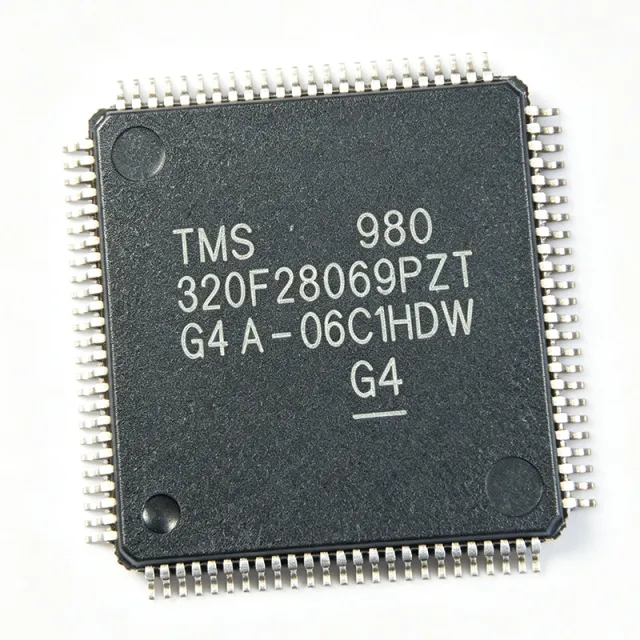
TMS320F28069PZT - 90MHz C2000 MCU 256KB Flash | TI
Teilenummer: TMS320F28069PZT ✓ Aktiv| Menge | Stückpreis | Gesamt |
|---|---|---|
| 1 | $21.13 | $21,13 |
| 10 | $19.55 | $195,50 |
| 100 | $17.9 | $1.790,00 |
| 500 | $16.4 | $8.200,00 |
| 1.000 | $15.2 | $15.200,00 |
TMS320F28069PZT Übersicht
A microcontroller (MCU) is a compact integrated circuit that combines a processor core, memory, and programmable peripherals to govern a specific embedded function. The TMS320F28069PZT belongs to the C2000 real-time control MCU family, positioned within TI's broader digital signal controller taxonomy: C28x core -> Piccolo DSP -> digital signal controller -> microcontroller -> semiconductor. C2000 devices are purpose-built for closed-loop control where deterministic interrupt latency and fast math matter more than general-purpose throughput.
Key features include native single-precision floating-point operations (FPU32), a programmable Control Law Accelerator (CLA) that executes control loops in parallel with the main CPU, a Viterbi Complex Unit (VCU) for complex arithmetic, and a 6-channel DMA. An internal voltage regulator enables single-rail 3.3 V operation with no power-sequencing requirement, simplifying power supply design.
Architecturally, the device uses a Harvard bus structure with separate program and data buses. The CLA is an independent 32-bit floating-point processor running at the same 90 MHz clock, offloading time-critical control loops from the C28x. Peripherals include a 12-bit ADC, ePWM modules, USB 2.0, CAN, SPI, I2C, and UART, supporting both sensing and actuation in one chip.
Typical applications are field-oriented motor control for BLDC and AC induction machines, digital power conversion such as solar inverters and server power supplies, and industrial automation requiring fast deterministic control loops.
Design consideration: decouple all VDD and VDDIO pins with 100 nF capacitors placed close to the pins; the on-chip oscillator supports a 10 MHz crystal, or an external clock source can be used.
This page synthesizes distributor pricing, drop-in alternatives, and practical design notes not found in the manufacturer datasheet.
Drop-in-Alternativen für TMS320F28069PZT – gleiches Gehäuse, Pin-kompatibel. Bauteile mit anderem Gehäuse, die eine PCB-Überarbeitung erfordern, sind ausgeschlossen.
Varianten dieser Serie
Modelle derselben Serie, die drop-in-kompatibel sind mit TMS320F28069PZT (gleiche Bauform und Footprint) – abweichend in Package, Flash Memory, Communication Interfaces, Core Processor, JTAG.
Schnellvergleichstool – Wählen Sie Alternativbauteile für den Direktvergleich:
TMS320F28069PZPS
✅ Drop-In📋 Referenzalternative (nicht im Katalog)
TMS320F28069MPZT
✅ Drop-In ⚠️ Spezifikationen ungeprüft📋 Referenzalternative (nicht im Katalog)
TMS320F28069UPZPS
✅ Drop-In📋 Referenzalternative (nicht im Katalog)
TMS320F28069FPZPQ
✅ Drop-In📋 Referenzalternative (nicht im Katalog)
TMS320F28062PZT
✅ Drop-In✓ Auf Lager
$6.4 / Stück
Datenblatt ansehen →TMS320F2808PZA
✅ Drop-In ⚠️ Spezifikationen ungeprüft✓ Auf Lager
$8.1 / Stück
Datenblatt ansehen →TMS320F28069PZT Grenzwerte & elektrische Eigenschaften
| Core Processor | C28x Piccolo with CLA |
| Core Size | 32-Bit |
| CPU Frequency | 90 MHz |
| Flash Memory | 256 KB (128K x 16) |
| RAM | 100 KB |
| Coprocessors | FPU, CLA, VCU |
| DMA Channels | 6 |
| ADC Resolution | 12-bit |
| Connectivity | USB 2.0, CAN, I2C, SPI, UART |
| Supply Voltage (I/O) | 3.3 V |
| Supply Voltage (Core) | 1.8 V (internal regulator) |
| Gehäuse | 100-LQFP (14x14 mm) PZ |
| Betriebstemperatur | -40C to +105C |
| Montageart | Surface Mount |
| Oscillator | On-chip crystal oscillator (10 MHz crystal) or external clock |
| Power Sequencing | Not required (internal VREG) |
TMS320F28069PZT 100-lqfp (14x14 mm) pz Pinbelegungsleitfaden
Pinbelegung für TMS320F28069PZT (100-lqfp (14x14 mm) pz-Gehäuse). Dieser digitale IC umfasst GPIO, Kommunikationsschnittstellen (UART, SPI, I2C) und Versorgungspins. Alternative Pin-Funktionen und Konfigurationsoptionen entnehmen Sie dem Herstellerdatenblatt. Unverzichtbar für Embedded-System-Design und PCB-Layout.

Keine detaillierten Pinbelegungsdaten verfügbar für TMS320F28069PZT.
Siehe die Datenblatt für die vollständige Pin-Konfiguration.
Typische Anwendungen
TMS320F28069PZT ist geeignet für 6 Anwendungs: Field-Oriented Motor Control, Digital Power Conversion, Solar and Renewable Energy Inverters, Industrial Automation and Robotics, Automotive and E-Mobility Control Units, Embedded Sensing and Communication Gateways.
Field-Oriented Motor Control
The TMS320F28069PZT is purpose-built for field-oriented control (FOC) of BLDC, PMSM, and AC induction motors. Its 90 MHz C28x core with FPU32 executes single-precision Clarke/Park transforms and PI current loops natively, while the independent CLA runs at the same clock to parallelize speed and position loops, effectively doubling real-time throughput versus a CPU-only design at 90 MIPS each (180 MIPS total). The 12-bit ADC samples phase currents synchronously with ePWM trigger points, minimizing measurement latency. Integrated CAN and UART enable networked drive communication. Using the same silicon in single- and multi-axis drives simplifies firmware reuse across product lines.
Empfohlen
Digital Power Conversion
In solar inverters, server power supplies, and telecom rectifiers, the TMS320F28069PZT executes multi-rate digital control loops with deterministic latency. The CLA offloads the fast inner current loop while the C28x CPU manages supervisory control, MPPT algorithms, and communication protocols such as CAN and PMBus-over-I2C. High-resolution ePWM outputs drive phase-shifted full-bridge or LLC topologies, and the 12-bit ADC captures voltage/current feedback with programmable trip-zone protection for cycle-by-cycle current limiting. The internal voltage regulator enables single-rail 3.3 V designs, reducing power-tree complexity in dense converter boards. 256 KB flash accommodates firmware plus instrumentation logging.
Empfohlen
Solar and Renewable Energy Inverters
Grid-tied solar microinverters and string inverters benefit from the TMS320F28069PZT's combination of fast control and rich connectivity. The FPU accelerates grid synchronization math (SOGI/PLL) implemented in floating point, while the VCU speeds harmonic-analysis and Viterbi-based signal processing used in power-line communication schemes. Dual control paths (C28x + CLA) allow simultaneous DC-DC MPPT and DC-AC grid-current loops on one chip at 90 MHz. The 12-bit ADC with multiple sample-and-holds measures PV voltage, grid voltage, and current simultaneously. CAN and USB interfaces support monitoring, commissioning, and firmware updates in the field. Trip-zone PWM protection guards against grid faults within microseconds.
Empfohlen
Industrial Automation and Robotics
For industrial automation nodes, servo drives, and robot joint controllers, the TMS320F28069PZT provides deterministic real-time control plus the communication fabric to integrate into factory networks. Six DMA channels move ADC and SPI data without CPU intervention, keeping loop jitter minimal. The 90 MHz CPU with FPU runs kinematics and trajectory interpolation, while the CLA handles joint-level current control. Encoder interfaces (QEP over GPIO multiplexing) and CAN/Ethernet-adjacent UART stacks support multi-axis synchronization. The -40C to +105C industrial temperature rating and 100-pin LQFP with abundant GPIO (up to 60+ multiplexed) simplify wiring dense I/O into a single controller footprint.
Empfohlen
Automotive and E-Mobility Control Units
The F2806x platform extends to automotive-grade orderable variants (F/Q/M suffixes sharing the same 100-LQFP pinout), making the TMS320F28069PZT an industrial-development path into e-mobility subsystems such as auxiliary inverter control, pumps and fans, and actuator control. The FPU and CLA execute FOC and sensorless observers with sufficient margin, and the VCU accelerates complex math for resolver decoding and sensor signal processing. CAN connectivity integrates with vehicle buses; LIN-over-UART covers lower-cost nodes. The internal voltage regulator tolerates board-level 3.3 V-only supply designs common in ECUs. Development done on PZT parts transfers to qualified variants without PCB redesign thanks to pin compatibility.
Empfohlen
Embedded Sensing and Communication Gateways
The TMS320F28069PZT also serves as a smart sensor hub and protocol gateway where real-time signal processing meets connectivity. The VCU accelerates Viterbi decoding and complex arithmetic for software-defined radio front ends, power-line communication, and wireless sensor conditioning, while the 12-bit ADC and DMA stream measurement data with low jitter. USB 2.0 provides a direct high-speed link to host PCs for instrumentation and data logging; CAN, SPI, I2C, and UART bridge legacy industrial protocols. 256 KB flash stores protocol stacks plus local data processing code, and the 100 KB RAM buffers burst traffic. The 3.3 V single-rail design keeps bill-of-materials simple in compact gateways.
Empfohlen
Zusammenfassung der empfohlenen Produkte
Technische Referenzdaten für TMS320F28069PZT – Vergleich, Designhinweise und Compliance-Informationen.
Auswahlhilfe
Vergleich mit Alternativen
| Parameter | Dieses Produkt | TMS320F28069PZPS | TMS320F28069MPZT | TMS320F28062PZT | TMS320F2808PZA |
|---|---|---|---|---|---|
| Package | 100-LQFP (PZ, 14x14 mm) | 100-LQFP (PZ, 14x14 mm) - same | 100-LQFP (PZ, 14x14 mm) - same | 100-LQFP (PZ, 14x14 mm) - same | 100-LQFP (PZ, 14x14 mm) - same |
| Brand | Texas Instruments | Texas Instruments | Texas Instruments | Texas Instruments | Texas Instruments |
| CPU Frequency | 90 MHz | 90 MHz | 90 MHz | 90 MHz | 100 MHz |
| Flash Memory | 256 KB | 256 KB | 256 KB | 128 KB | 128 KB |
| FPU / CLA / VCU | Yes / Yes / Yes | Yes / Yes / Yes | Yes / Yes / Yes | Yes / Yes / No | No / No / No |
Wichtigste Unterscheidungsmerkmale
- Triple coprocessor architecture (FPU + CLA + VCU) (vs. TMS320F28062PZT)
- Double the memory of pin-compatible lower parts (vs. TMS320F28062PZT)
- Single-rail operation without sequencing (vs. TMS320F2808PZA)
Designhinweise
The TMS320F28069PZT integrates a voltage regulator that generates the 1.8 V core rail from the 3.3 V I/O supply, so a single 3.3 V rail powers the whole device with no sequencing requirement. In thermally constrained designs, supplying external 1.8 V (disabling the internal regulator path per datasheet guidance) reduces on-chip dissipation. Decouple every VDD and VDDIO pin with 100 nF ceramic capacitors placed within 2-3 mm of the pins, plus bulk 10 uF capacitance per supply domain. Source: TI TMS320F28069 datasheet and internal design data.
Use a solid ground plane under the 100-LQFP and fan out VDDIO/VSS pairs symmetrically to minimize ground bounce during simultaneous ADC sampling and ePWM switching. Keep the 10 MHz crystal traces short, guarded by ground, and away from PWM output traces that switch amps of gate-drive current. Route ADC inputs (ADCINA0/VREFHI shared pin noted in TI E2E forum thread 918121) away from high dV/dt PWM nets; add RC anti-alias filters sized for the 12-bit ADC input impedance.
Many PZ pins are triple-multiplexed (GPIO/peripheral/ADC) - configure the GPIO mux registers before assuming pin function, and verify the VREFHI/ADCINA0 sharing on your schematic. When substituting ordering suffixes (PZT, PZPS, MPZT, UPZPS), confirm the exact attribute encoded in the suffix with TI before production, per TI E2E forum discussions (threads 1005650 and 1128293). Do not omit the flash programming voltage provision in test fixtures even though flash is 3.3 V on this family.
Compliance-Informationen
RoHS/REACH status not present in provided data; confirm via TI product compliance portal for the exact orderable part number. Automotive-quality variants (FPZPQ etc.) exist in the same package; the standard PZT is not an AEC-Q100 orderable.







