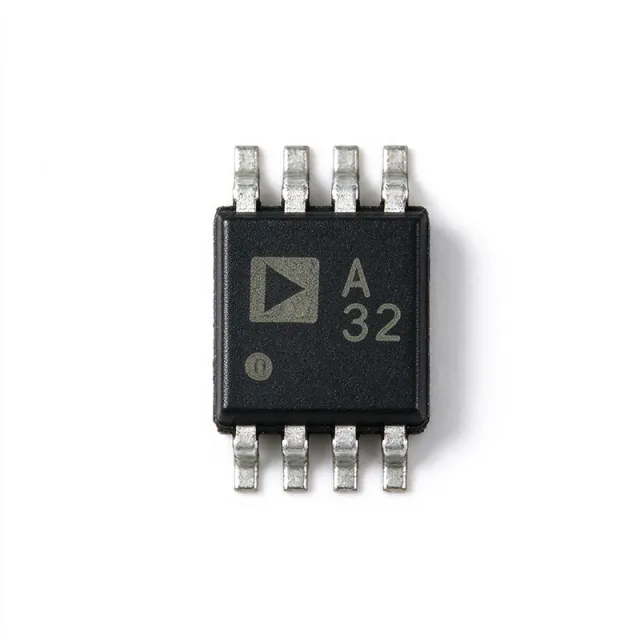
ADA4528-2ARMZ - Zero-Drift Dual Op Amp | Analog Devices
N.º de pieza: ADA4528-2ARMZ ✓ Activo| Cant. | Precio unitario | Total |
|---|---|---|
| 1 | $4.72 | $4,72 |
| 10 | $4.25 | $42,50 |
| 100 | $3.43 | $343,00 |
| 500 | $3.12 | $1.560,00 |
| 1.000 | $2.8 | $2.800,00 |
ADA4528-2ARMZ Descripción general
What is a zero-drift op amp? A zero-drift amplifier is a precision operational amplifier that continuously corrects its input offset voltage and offset drift using auto-zero or chopping techniques. Within the op amp hierarchy (operational amplifier -> precision amplifier -> zero-drift amplifier), these devices combine the low offset of a chopper with usable wideband performance. They are used where small DC signals must be amplified without adding drift or low-frequency noise.
Key features include ultralow input voltage noise density of 5.6 nV/√Hz, maximum input offset voltage of 2.5 µV (family specification), excellent CMRR and PSRR, rail-to-rail input and output swing, and true zero-drift operation. The dual-channel ADA4528-2ARMZ saves board space in multi-channel precision chains and the MSOP-8 package fits compact sensor modules.
The internal architecture combines a high-gain main amplifier with a continuously running nulling amplifier that corrects offset errors in the background. This provides 3.4 MHz gain-bandwidth product together with the low-frequency precision of a chopper. The result is an amplifier that can amplify microvolt-scale bridge outputs without auto-zero settling transients.
Typical applications include position and pressure sensors, strain gages, medical instrumentation, load-cell/weigh-scale front ends, battery-powered portable instruments, and IoT sensor nodes. The 2.2 V minimum supply allows operation from single Li-ion cells or 3.3 V regulated rails, while the RRIO output maximizes ADC input full-scale range.
Design consideration: add 0.1 µF and 10 µF decoupling capacitors close to the supply pins, and use a low-pass RC filter at the non-inverting input to minimize aliased noise when driving a sigma-delta ADC. Avoid placing the feedback network near high-impedance input traces to maintain the specified drift and noise performance.
Alternativas directas para ADA4528-2ARMZ — mismo encapsulado, compatible pin a pin. Se excluyen las piezas de otro encapsulado que requieren retrabajo de la PCB.
Variantes de esta serie
Modelos de la misma serie compatibles directamente con ADA4528-2ARMZ (mismo factor de forma y huella) — difiere en Slew Rate, Amplifier Type, Gain Bandwidth Product, Package, RoHS Status.
Herramienta de comparación rápida — seleccione piezas alternativas para compararlas lado a lado:
ADA4522-2ARMZ
📋 Alternativa de referencia (no en el catálogo)
LTC2051CMS8#PBF
📋 Alternativa de referencia (no en el catálogo)
MCP6V27-E/MS
📋 Alternativa de referencia (no en el catálogo)
OPA2333AIDGKR
📋 Alternativa de referencia (no en el catálogo)
OPA2188AIDGKR
📋 Alternativa de referencia (no en el catálogo)
OPA2180AIDGKR
📋 Alternativa de referencia (no en el catálogo)
ADA4528-2ARMZ Valores máximos y características eléctricas
| Amplifier Type | Zero-Drift (auto-zero/chopper-stabilized) |
| Number of Circuits | 2 (Dual) |
| Supply Voltage Range | 2.2 V to 5.5 V |
| Bandwidth (-3 dB) | 3.4 MHz |
| Slew Rate | 0.5 V/µs |
| Rail-to-Rail Input/Output | Yes (RRIO) |
| Maximum Input Offset Voltage | 2.5 µV (family datasheet; verify dual) |
| Voltage Noise Density | 5.6 nV/√Hz (from AN-1114; verify) |
| Rango de temperatura de funcionamiento | -40°C to +125°C |
| Encapsulado / Carcasa | 8-MSOP (RM-8), 0.118" / 3.00mm Width |
| Tipo de montaje | Surface Mount |
| Número de pines | 8 |
| Estado RoHS | unknown (not specified in verified web data) |
Configuración de pines de ADA4528-2ARMZ
| Pin 1 | OUT A — Output of amplifier A |
| Pin 2 | -IN A — Inverting input of amplifier A |
| Pin 3 | +IN A — Non-inverting input of amplifier A |
| Pin 4 | V- — Negative supply (ground in single-supply operation) |
| Pin 5 | +IN B — Non-inverting input of amplifier B |
| Pin 6 | -IN B — Inverting input of amplifier B |
| Pin 7 | OUT B — Output of amplifier B |
| Pin 8 | V+ — Positive supply, 2.2 V to 5.5 V |
Aplicaciones típicas
ADA4528-2ARMZ es adecuado para 6 aplicacións: Industrial Pressure Sensor Signal Conditioning, Medical Instrumentation Front End, Battery-Powered Portable Instruments, IoT Smart Sensor Nodes, Precision Current Sensing, Test & Measurement Equipment.
Industrial Pressure Sensor Signal Conditioning
ADA4528-2ARMZ is used in bridge-type pressure sensor front ends because its 2.5 µV max offset and zero-drift architecture prevent sensor offset errors from being amplified into measurement errors. The RRIO output drives the differential input of a 24-bit sigma-delta ADC such as AD7799BRUZ directly. Supply current is low enough for 2-wire loop-powered transmitters; with 2.2 V minimum supply, it can run from a 3.3 V regulator with 1 V headroom. For best noise, place a 1 kHz RC filter before the ADC and use twisted-pair shield grounding to reject industrial EMI.
Recomendado
Medical Instrumentation Front End
ADA4528-2ARMZ is suitable for ECG, PPG and bio-impedance signal chains where electrode offset and drift would otherwise saturate a conventional amplifier. Its 5.6 nV/√Hz noise density and 2.5 µV offset allow a front-end gain of 100 to be applied before an ADC such as the AD7124-4BRUZ without introducing baseline wander. The rail-to-rail output sets the ADC common-mode at mid-supply. Medical safety demands appropriate isolation and defibrillation protection; the op amp itself should be placed after the protection network. The small MSOP-8 package supports multi-channel wearable designs.
Recomendado
Battery-Powered Portable Instruments
Battery-powered handheld meters and data loggers benefit from ADA4528-2ARMZ's 2.2 V to 5.5 V supply range, which enables direct operation from a single 3.7 V Li-ion cell or 3.3 V rail. The dual amplifier integrates chopper-stabilized precision in a 3 mm MSOP-8, reducing PCB area and BOM count. When interfacing to a 16-bit SAR ADC like AD7980ARMZ, the op amp's low output impedance and 3.4 MHz bandwidth settle the ADC input in a single acquisition period. For long battery life, use a low-dropout regulator to power the op amp and disable unneeded channels in the ADC.
Recomendado
IoT Smart Sensor Nodes
IoT sensor nodes collect temperature, humidity, and vibration signals that need stable offset over months. The ADA4528-2ARMZ's zero-drift architecture keeps offset error below 2.5 µV across the industrial temperature range, allowing a node to run uncalibrated for long field deployments. The 2.2 V minimum supply lets the sensor node operate from two alkaline cells or a small solar harvester. Outputs connect directly to a low-power sigma-delta ADC such as AD7798BRUZ; the ADC's internal PGA can be bypassed when high input impedance is available. The MSOP-8 package permits dense layout on a 4-layer IoT module.
Recomendado
Precision Current Sensing
ADA4528-2ARMZ can amplify the small differential voltage across a current-sense resistor with high CMRR. Because it is a zero-drift amplifier, the input offset does not create a fixed error term in the measured current. The dual channel allows one amplifier to buffer the sense voltage while the second provides a reference or gain stage for a downstream ADC. With a supply range of 2.2-5.5 V, it suits 3.3 V and 5 V systems. Pair with a precision current-sense amplifier such as AD8210YRZ for bidirectional monitoring; the op amp's rail-to-rail output clears the ADC input range near ground.
Recomendado
Test & Measurement Equipment
Benchtop multimeters, data acquisition systems, and precision calibrators need amplifiers that contribute negligible offset and noise. ADA4528-2ARMZ's 5.6 nV/√Hz voltage noise, 3.4 MHz bandwidth, and RRIO output make it a strong input buffer or gain stage before high-resolution ADCs. In a DAQ front end, the second channel can be used to drive the ADC reference buffer or to create a differential inverting stage. To preserve accuracy, guard the input traces with a low-impedance shield ring and use a precision reference such as AD780BRZ for the ADC VREF.
Recomendado
Resumen de productos recomendados
Datos de referencia de ingeniería para ADA4528-2ARMZ — comparación, orientación de diseño e información de cumplimiento.
Guía de selección
Comparación con alternativas
| Parámetro | Este producto | ADA4522-2ARMZ | MCP6V27-E/MS | OPA2333AIDGKR |
|---|---|---|---|---|
| Package | 8-MSOP (RM-8, 3.00mm Width) | 8-MSOP (RM-8) | 8-MSOP (RM-8) | 8-VSSOP (DGK, 3.00mm Width) |
| Brand | Analog Devices | Analog Devices | Microchip Technology | Texas Instruments |
| Channel Count | 2 (Dual) | 2 (Dual) | 2 (Dual) | 2 (Dual) |
| Zero-Drift Architecture | Yes | Yes | Yes | Yes |
| Rail-to-Rail I/O | Yes | Yes | Yes | Yes |
Diferenciadores clave
- Higher bandwidth for a zero-drift amplifier (frente a OPA2333AIDGKR)
- Lower supply voltage minimum (frente a LTC2051CMS8#PBF)
- Lower voltage noise density in the family (frente a OPA2188AIDGKR)
Notas de diseño
Decouple the V+ pin with a 0.1 µF ceramic capacitor in parallel with a 10 µF low-ESR capacitor, placed as close as possible to pin 8. If the input supply can exceed 5.5 V, add a precision LDO before the op amp; the ADA4528-2's 2.2 V minimum supply means a 3.3 V rail provides sufficient headroom. In single-supply circuits, connect pin 4 to a quiet ground plane. Avoid sharing the supply trace with digital logic that could inject switching noise into the amplifier's PSRR limits.
For AC-coupled precision circuits, use a guard ring around the non-inverting input (pin 3) and feedback network to reduce leakage-induced offset. Match the CMOS/bias currents by using similar-value resistors on both inputs. Because the ADA4528-2ARMZ is a zero-drift amplifier, it is sensitive to clock noise from nearby microcontrollers; keep the MLCC decoupling caps within 2 mm of the supply and ground pins. Use a ground plane under the MSOP-8 package and minimize loop area on the feedback path to reduce crosstalk.
Do not exceed the 5.5 V absolute maximum supply voltage; otherwise the input ESD diodes may conduct and damage the part. Verify that the input common-mode voltage stays within the rail-to-rail input range, especially in single-supply circuits. When driving a sigma-delta ADC, add a low-pass RC filter (for example, 1 kΩ / 1 nF) between the op amp output and ADC input to suppress out-of-band noise and clock aliasing. Avoid placing high-impedance traces near the output traces, which can inject charge into the precision input stage.
Información de cumplimiento
No RoHS/REACH/lead-free statements were present in the verified web data. Verify compliance through the Analog Devices datasheet or sales office before using in regulatory-sensitive products.







