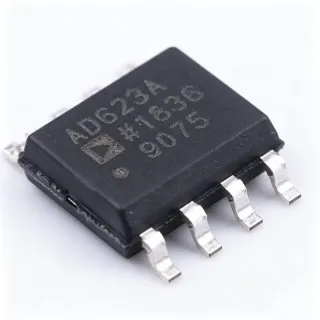
BUF634U - 250mA, 180MHz High-Speed Buffer | Texas Instruments
N.º de pieza: BUF634U ✗ Fin de vida| Cant. | Precio unitario | Total |
|---|---|---|
| 1 | $15.55 | $15,55 |
| 10 | $14.6 | $146,00 |
| 100 | $13.75 | $1.375,00 |
| 500 | $12.9 | $6.450,00 |
| 1.000 | $11.95 | $11.950,00 |
BUF634U Descripción general
A buffer amplifier is a unity-gain voltage follower that isolates a high-impedance source from a low-impedance load while delivering substantial output current. Within the power-management and signal-chain hierarchy, buffers sit between amplifiers and loads, extending the drive capability of operational amplifiers, ADCs, and filters. Buffers trade voltage gain for current gain, and the BUF634 is a classic open-loop buffer architecture in which the output stage is driven directly by the input, minimizing transient distortion.
Key features include 250 mA of output current, a 2000 V/us slew rate that preserves fast edges, a wide supply range of +/-2.25 V to +/-18 V (4.5 V to 36 V total), and a low 1.5 mA quiescent current when operated in the 30 MHz low-power bandwidth mode selected via the bandwidth pin. Internal current limiting and thermal shutdown protection guard the device against overload faults.
Technically, the BUF634 combines a high-speed bipolar input stage with a push-pull class-AB output stage. The pin-selected bandwidth (30 MHz or 180 MHz) lets designers trade quiescent power for speed: low-power mode suits battery and portable designs, while full-bandwidth mode supports fast pulse and video signal chains. Because it is open-loop, phase reversal is not an issue and it can be placed inside an op-amp feedback loop to boost output current, eliminate thermal feedback on the input stage, and improve capacitive load drive.
Typical applications include op-amp output current boosting in instrumentation amplifiers, line drivers for video and communications, headroom-limited audio headphone amplifiers, and capacitive-load driving in data-acquisition front ends.
A key design consideration: the bandwidth-select pin must be tied appropriately (to V- for 180 MHz or open with capacitor for 30 MHz); leaving it floating can produce unpredictable frequency response. Note that the BUF634U is designated not recommended for new designs (NRND); TI recommends the BUF634A as a pin-compatible upgrade.
This page synthesizes distributor pricing, drop-in alternatives, application guidance, and lifecycle information not consolidated in the manufacturer datasheet.
Alternativas directas para BUF634U — mismo encapsulado, compatible pin a pin. Se excluyen las piezas de otro encapsulado que requieren retrabajo de la PCB.
Variantes de esta serie
Modelos de la misma serie compatibles directamente con BUF634U (mismo factor de forma y huella) — difiere en Package, Mounting Type, Bandwidth, Protection Features, Quiescent Current.
Herramienta de comparación rápida — seleccione piezas alternativas para compararlas lado a lado:
BUF634AIDR
✅ Sustitución directa✓ En stock
$1.56 / unidad
Ver hoja de datos →BUF634AIDDAR
✅ Sustitución directa✓ En stock
$2.15 / unidad
Ver hoja de datos →BUF634UE4
✅ Sustitución directa📋 Alternativa de referencia (no en el catálogo)
BUF634U Valores máximos y características eléctricas
| Amplifier Type | Open-Loop Buffer (unity gain) |
| Number of Channels | 1 |
| Output Current | 250 mA |
| Slew Rate | 2000 V/us |
| Bandwidth | 180 MHz (full) / 30 MHz (low power, pin-selected) |
| Corriente en reposo | 1.5 mA (30 MHz BW mode) |
| Supply Voltage Range | +/-2.25 V to +/-18 V (4.5 V to 36 V total) |
| Voltage Gain | Unity (buffer) |
| Protection Features | Internal current limit, thermal shutdown |
| Bandwidth Selection | Pin-selectable (BW pin) |
| Encapsulado | 8-SOIC (0.154 in, 3.90 mm width) |
| Tipo de montaje | Surface Mount |
| Polarity | Single / Dual Supply |
| Product Status | Not recommended for new designs (NRND); BUF634A recommended |
| Datasheet Revision | BUF634 datasheet (Rev. C) |
Guía de configuración de pines de BUF634U 8-soic (0.154 in, 3.90 mm width)
Configuración de pines para BUF634U (encapsulado 8-soic (0.154 in, 3.90 mm width)). Este componente analógico presenta pines de entrada, salida y alimentación. Consulte la hoja de datos del fabricante para conocer las configuraciones de los pines de ajuste de offset, compensación y habilitación. Ideal para circuitos de acondicionamiento de señal y amplificadores.

No hay datos detallados de patillaje disponibles para BUF634U.
Consulte la hoja de datos para ver la configuración completa de patillas.
Aplicaciones típicas
BUF634U es adecuado para 6 aplicacións: Op-Amp Output Current Boosting, Audio Headphone Amplifiers, Video and Communications Line Drivers, Capacitive Load Driving in Data Acquisition, Industrial Instrumentation and Control, Portable and Battery-Powered Equipment.
Op-Amp Output Current Boosting
The BUF634U's defining application is placement inside an op-amp's feedback loop to raise output current from tens of milliamps to 250 mA while preserving the op-amp's precision. According to the TI datasheet, this technique also eliminates thermal feedback to the op-amp input stage and improves capacitive load drive. Because the buffer runs open-loop inside the loop, the composite remains unity-gain stable, and the 2000 V/us slew rate ensures the buffer never limits the op-amp's transient response. The wide +/-18 V supply range covers standard +/-15 V analog rails, making it a direct fit for instrumentation and control loops that must drive cables, actuators, or low-impedance sensor loads.
Recomendado
Audio Headphone Amplifiers
In headphone amplifiers, the BUF634U drives low-impedance headphones directly with its 250 mA output capability, while the pin-selected 30 MHz low-power mode draws only 1.5 mA quiescent current for portable, battery-powered designs. Community designs such as the Head-Fi Pimeta amplifier established the BUF634 as a de facto standard output stage. Placed inside the feedback loop of a low-noise op-amp, the composite stage achieves low output impedance and low distortion across the audio band, while the 180 MHz full-bandwidth mode removes any dynamic-range concern for demanding transients and wideband sources.
Recomendado
Video and Communications Line Drivers
The 2000 V/us slew rate and 180 MHz bandwidth allow the BUF634U to preserve fast video edges and drive 75-ohm coaxial loads with clean transients. In communications test equipment and video distribution, the buffer isolates sensitive sources from cable capacitance; the datasheet specifically cites improved capacitive load drive when the part is looped with an op-amp. The wide supply range supports +/-5 V to +/-15 V video rails, and internal current limit protects the output against shorted cable faults, an important robustness feature in rack-mounted distribution and broadcast environments.
Recomendado
Capacitive Load Driving in Data Acquisition
Sample-and-hold nodes, ADC input networks, and long shielded cables present significant capacitive loads that destabilize ordinary op-amps. The TI datasheet recommends the BUF634 explicitly to improve capacitive load drive, and its open-loop output stage remains stable where closed-loop amplifiers would oscillate. With 250 mA peak current, the buffer rapidly charges and discharges large capacitances, minimizing acquisition settling error. Designers should allocate headroom for the buffer's dropout and use the 30 MHz mode when settling time permits, halving quiescent power in multichannel acquisition systems.
Recomendado
Industrial Instrumentation and Control
Industrial loops often demand driving heavy loads - solenoid drivers, long 4-20 mA wiring interfaces, and piezo actuators - from +/-15 V analog rails. The BUF634U's +/-18 V maximum supply, 250 mA current limit, and thermal shutdown protection give robust fault tolerance in electrically noisy factory environments. Buffered precision references and setpoint signals stay accurate because the buffer's open-loop topology adds no gain error beyond its small output resistance. Integrators typically pair it with precision op-amps and instrumentation amplifiers to form high-current, high-accuracy analog output channels for process control.
Recomendado
Portable and Battery-Powered Equipment
In portable test instruments, battery-powered audio gear, and handheld communicators, the BUF634U's 1.5 mA quiescent current in the 30 MHz bandwidth mode extends battery life without sacrificing the 250 mA peak output needed for load transients. The +/-2.25 V minimum supply allows operation from low-voltage single-cell stacks, and thermal shutdown plus current limiting protect against accidental short circuits in field conditions. The pin-selected bandwidth lets firmware-free hardware designs trade speed for power simply by wiring the BW pin, a convenient one-component power-management lever in battery-constrained products.
Recomendado
Resumen de productos recomendados
Datos de referencia de ingeniería para BUF634U — comparación, orientación de diseño e información de cumplimiento.
Guía de selección
Comparación con alternativas
| Parámetro | Este producto | BUF634AIDR | BUF634AIDDAR | BUF634UE4 |
|---|---|---|---|---|
| Package | 8-SOIC (3.90 mm width) | 8-SOIC (3.90 mm width) - same | 8-SOIC (3.90 mm width) - same | 8-SOIC (3.90 mm width) - same |
| Brand | Texas Instruments | Texas Instruments | Texas Instruments | Texas Instruments |
| Output Current | 250 mA | 250 mA | 250 mA | 250 mA |
| Slew Rate | 2000 V/us | 2000 V/us | 2000 V/us | 2000 V/us |
| Bandwidth | 180 MHz / 30 MHz (pin-selectable) | 180 MHz / 30 MHz (pin-selectable) | 180 MHz / 30 MHz (pin-selectable) | 180 MHz / 30 MHz (pin-selectable) |
| Supply Voltage Range | +/-2.25 V to +/-18 V | +/-2.25 V to +/-18 V | +/-2.25 V to +/-18 V | +/-2.25 V to +/-18 V |
| Lifecycle Status | NRND (not recommended for new designs) | Active - TI recommended upgrade | Active | NRND / lead-free variant |
| Quiescent Current (30 MHz mode) | 1.5 mA | 1.5 mA | 1.5 mA | 1.5 mA |
Diferenciadores clave
- Active lifecycle support (frente a BUF634UE4)
- TI-verified functional equivalence (frente a BUF634U)
- Pin-selected bandwidth/power trade (frente a BUF634AIDDAR)
Notas de diseño
The BW (bandwidth-select) pin must be tied per the datasheet connection scheme: one configuration yields the 180 MHz full-bandwidth mode, the other the 30 MHz low-power mode (1.5 mA quiescent). Leaving it floating produces unpredictable frequency response and possible instability. Decide at schematic capture time which mode the application needs and document it on the BOM, since a miswired BW pin is the most common bring-up failure reported on BUF634 designs.
Estimated: at a 250 mA continuous output into a low-impedance load with a 12 V headroom (e.g., +/-15 V rails driving a resistive load), internal dissipation can reach several watts. The 8-SOIC package offers limited theta_JA, so verify junction temperature using the SOIC-8 thermal resistance from the datasheet. TI added thermal shutdown protection, but relying on it as a routine operating mode degrades reliability; reduce duty cycle or increase copper pour on the SOIC-8 thermal lands to manage sustained high-current loads.
Place a 0.1 uF ceramic decoupling capacitor at each supply pin, within a few millimeters of the SOIC-8 pads, plus bulk capacitance (10 uF) nearby. Because the BUF634 delivers 250 mA load steps, supply leads with high inductance cause rail bounce and ringing at the output; use short, wide traces or ground-plane vias for the ground return. When looping the buffer with an op-amp, keep the feedback path away from the buffer's high di/dt output node to prevent injected transients.
Información de cumplimiento
Compliance status was not included in the verified web data. The BUF634UE4 variant is TI's Pb-free (lead-free) designation for RoHS-driven designs; confirm current RoHS/REACH status on TI.com product page before ordering.