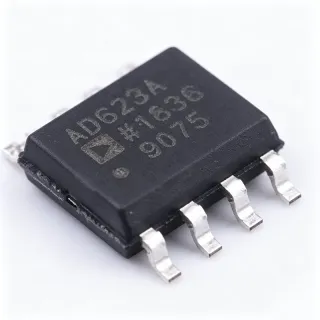
BUF634AIDR - 210MHz, 250mA High-Speed Buffer | Texas Instruments
MPN: BUF634AIDR ✓ ActiveBUF634AIDR Overview
A buffer amplifier (also called a unity-gain amplifier or voltage follower) is a signal-conditioning stage that isolates a high-impedance source from a low-impedance load while preserving voltage amplitude. Within the analog signal-chain hierarchy, buffers sit between operational amplifiers and power drivers, providing the high output-current capability that general-purpose op amps lack, without adding closed-loop gain or instability.
Key differentiating specifications of the BUF634AIDR include its 250 mA push-pull output-current capability, 36-V supply rating (suitable for dual-supply rails up to +/-18 V), and the user-adjustable 35 MHz to 210 MHz bandwidth. The bandwidth pin allows designers to trade bandwidth for quiescent power, an unusual and valuable feature in a monolithic buffer. The device operates as a standalone open-loop driver or inside an op-amp feedback loop to boost output drive current.
Technically, the BUF634A is a high-fidelity, open-loop bipolar buffer. Because it operates open-loop, it adds no phase shift typical of compensated amplifiers, making it stable when placed inside the feedback loop of high-speed op amps such as the TLE207x or TL082 families, which the manufacturer identifies as common companions. The push-pull output stage sources and sinks current symmetrically, improving linearity under reactive loads.
Typical applications include high-speed line drivers, video signal distribution, ADC input driving, and audiophile headphone-amplifier output stages, where the combination of 250 mA drive and wide bandwidth maintains signal fidelity. Industrial test instrumentation also benefits from its robust supply range.
A key design consideration is bandwidth selection: setting the external BW resistor for just enough bandwidth minimizes quiescent current and high-frequency noise pickup, while the full 210 MHz setting maximizes slew-driven transient performance at higher power.
This page synthesizes distributor pricing, verified drop-in replacement data from TI engineering forums, and practical design guidance not found in the manufacturer datasheet alone.
Drop-in alternatives for BUF634AIDR — same package, pin-to-pin compatible. Different-package parts requiring PCB rework are excluded.
Variants in this series
Same-series models that are drop-in compatible with BUF634AIDR (same form factor and footprint) — differing in Package, Amplifier Type, Mounting Type, Bandwidth, Function.
BUF634U
✅ Drop-InContact for price
View Datasheet →XBUF634AIDR
✅ Drop-In📋 Reference alternative (not in catalog)
BUF634AIDR Maximum Ratings & Electrical Characteristics
| Function | High-speed open-loop buffer amplifier |
| Supply Voltage Rating | 36 V |
| Output Current | 250 mA |
| Bandwidth | 35 MHz to 210 MHz (adjustable via BW pin) |
| Bandwidth Adjustment Method | External resistor between V- and BW pins |
| Number of Channels | 1 |
| Output Architecture | Push-Pull |
| Package | 8-SOIC (0.154 in, 3.90 mm width) |
| Mounting Type | Surface Mount |
| RoHS Status | Compliant |
| Lead Free | Yes (Pbfree code: Yes) |
| Part Life Cycle Code | Active |
BUF634AIDR 8-soic (0.154 in, 3.90 mm width) Pin Configuration Guide
Pin configuration for BUF634AIDR (8-soic (0.154 in, 3.90 mm width) package). This analog component features input, output, and power supply pins. Refer to the manufacturer datasheet for offset null, compensation, and enable pin configurations. Ideal for signal conditioning and amplifier circuits.

No detailed pinout data available for BUF634AIDR.
Refer to the datasheet for full pin configuration.
Typical Applications
BUF634AIDR is suitable for 6 applications: High-Speed Line Driver, ADC Input Buffer, Audiophile Headphone Amplifier Output Stage, Video Signal Distribution, Op-Amp Feedback-Loop Current Booster, Instrumentation and Test Equipment Output Drivers.
High-Speed Line Driver
The BUF634AIDR excels as a line driver because its 250 mA push-pull output stage drives long cables and low-impedance terminated loads (50 ohm or 75 ohm) that general-purpose op amps cannot sustain. The 210 MHz maximum bandwidth preserves fast signal edges, while the adjustable 35-210 MHz bandwidth lets designers limit wideband noise on longer runs. Placed after an op-amp gain stage, the open-loop buffer adds no closed-loop phase lag, keeping the composite system stable. On dual +/-15 V industrial rails the 36 V rating provides comfortable headroom, and the symmetric source/sink capability prevents waveform asymmetry on reactive cable capacitance.
Recommended
ADC Input Buffer
High-speed, high-resolution ADCs require a driver that settles quickly and supplies transient charging current to the sample-and-hold capacitor. The BUF634AIDR's 250 mA output current rapidly refills the ADC input charge bucket during acquisition, while its open-loop topology contributes minimal additional phase shift in the signal path. Setting the BW pin resistor near the signal bandwidth limits integrated noise at the converter input, protecting SNR. The 8-SOIC footprint sits close to the ADC on typical layouts, shorting the transient current loop. Pairing the buffer with a precision front-end amplifier yields a composite driver that combines DC accuracy with 210 MHz-class dynamic drive capability.
Recommended
Audiophile Headphone Amplifier Output Stage
Community amplifier-upgrade documentation identifies the SOIC-8 BUF634A as a proven output-stage upgrade over op-amp-only outputs such as TL082 and TLE207x configurations. The 250 mA push-pull output directly drives 16-600 ohm headphones without current limiting or slew-induced distortion, while the high-fidelity open-loop architecture preserves harmonic integrity. The adjustable bandwidth feature is valuable in audio: setting approximately 35 MHz bandwidth minimizes wideband noise and RF rectification artifacts without affecting the 20 Hz-20 kHz audio band. Its 36 V supply rating supports high-voltage op-amp front ends on +/-15 V rails for maximum output swing into low-impedance loads.
Recommended
Video Signal Distribution
Video distribution requires buffering one source to multiple 75-ohm terminated loads with minimal differential gain and phase error. The BUF634AIDR's wide 210 MHz bandwidth comfortably covers standard-definition through high-definition video bandwidths, and its 250 mA drive capability handles fan-out to several back-terminated outputs. The push-pull output stage maintains DC symmetry across sync tips and picture levels. Operating on +/-5 V to +/-15 V rails, the device integrates into standard video supply domains, and the BW pin allows bandwidth trimming to suppress out-of-band ringing on long coaxial runs. Its SOIC-8 package simplifies multi-channel video boards with repeated buffer cells.
Recommended
Op-Amp Feedback-Loop Current Booster
TI documents that the BUF634A can be used inside the feedback loop of a conventional op amp to multiply its output-current capability from tens of milliamps up to 250 mA. The buffer is placed between the op-amp output and the feedback node, so the op amp's loop gain still corrects the buffer's offset and nonlinearity, preserving DC precision while adding drive. Because the buffer is open-loop and fast (35-210 MHz adjustable), it adds negligible phase shift below the composite crossover for most stable op amps. This composite technique upgrades existing TL082 or TLE207x designs without redesigning the gain stage, and is the primary retro-fit use case cited in TI's own upgrade guidance.
Recommended
Instrumentation and Test Equipment Output Drivers
Bench instruments, arbitrary waveform generators, and sensor excitation circuits demand output stages that combine DC accuracy with fast transient response and robust current delivery. The BUF634AIDR's 36 V supply range and 250 mA output support 50-ohm signal-generator outputs on +/-15 V rails, while the adjustable bandwidth lets calibration engineers suppress ringing for slow precision waveforms or enable full 210 MHz speed for fast pulses. SOIC-8 packaging withstands industrial assembly flows, and the RoHS-compliant, active-lifecycle status secures long-term sourcing for multi-year instrument production runs, as confirmed by the Active part-life-cycle code in distributor component databases.
Recommended
Recommended Products Summary
Engineering reference data for BUF634AIDR — comparison, design guidance, and compliance information.
Selection Guide
Comparison with Alternatives
| Parameter | This Product | BUF634U | XBUF634AIDR |
|---|---|---|---|
| Package | 8-SOIC (3.90 mm width) | 8-SOIC - same footprint | 8-SOIC (PDSO8) - same footprint |
| Brand | Texas Instruments | Texas Instruments | Texas Instruments |
| Drop-in Compatibility with BUF634AIDR | Reference part | Yes - pin-to-pin (TI E2E confirmation) | Yes - listed as compatible alternative |
Key Differentiators
- Newer generation with higher slew rate and bandwidth (vs BUF634U)
- Adjustable 35-210 MHz bandwidth via single BW pin resistor (vs BUF634U)
- Active lifecycle and multi-distributor availability (vs BUF634U)
Design Notes
Size supply decoupling for the buffer's transient current: the 250 mA push-pull output stage can step-load the rails in nanoseconds. Place at least 100 nF ceramic directly at the V+ and V- pins plus 4.7-10 uF bulk per device. On shared rails, this prevents ground-bounce coupling into neighboring analog stages. Estimated: driving 250 mA steps into a 50-ohm load on +/-15 V rails yields up to 3.75 W peak device dissipation under sustained DC conditions - verify thermal margins for DC-output applications.
Do not confuse package suffixes: BUF634AIDR is 8-SOIC, while BUF634AIDRBR is 8-SON 3x3 mm - they are electrically equivalent but NOT footprint-compatible. Also remember the BW pin resistor must always be present (tied toward V-); leaving the bandwidth pin floating is an undefined condition. When replacing an original BUF634U, confirm the BW resistor value suits the BUF634A's higher-bandwidth characteristic per the datasheet Rev. F scaling.
When using the BUF634AIDR inside an op-amp feedback loop as a current booster, keep the buffer inside the feedback node (op-amp output to buffer input, feedback taken from the buffer output). Choose the BW pin resistor for a buffer bandwidth comfortably above the op-amp's closed-loop bandwidth to avoid adding phase shift that erodes loop-phase margin. A small series output resistor (10-25 ohm) isolates capacitive cable loads and damps peaking in line-driver applications.
Route the input trace short and guard it from output-trace capacitance to prevent high-frequency feedthrough at the 210 MHz bandwidth setting. Use a solid ground plane under the SOIC-8 and keep the BW resistor loop (V- to BW) compact to minimize parasitic inductance, which can perturb the bandwidth-setting network at full-speed settings. For audio builds, orient the device to keep power and signal grounds star-connected at a single point.
Compliance Information
Distributor component database reports Pbfree code Yes and RoHS code Yes for BUF634AIDR, with Part Life Cycle Code Active. REACH and conflict-minerals declarations should be confirmed via TI product eco documents.