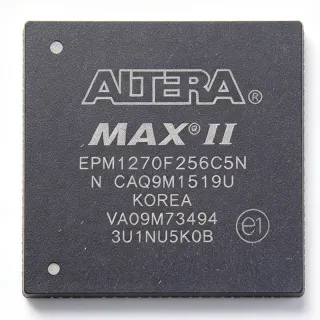
EPF6024AFI256-2 - 24K Gates FLEX 6000 FPGA, 256-BGA | Intel
N.º de pieza: EPF6024AFI256-2 ✗ Fin de vida| Cant. | Precio unitario | Total |
|---|---|---|
| 1 | $38.5 | $38,50 |
| 10 | $32.75 | $327,50 |
| 100 | $26.1 | $2.610,00 |
| 500 | $21.45 | $10.725,00 |
| 1.000 | $18.2 | $18.200,00 |
EPF6024AFI256-2 Descripción general
A field programmable gate array (FPGA) is a semiconductor device built around an array of configurable logic blocks (CLBs) interconnected by a programmable routing matrix; FPGAs are widely used to implement custom digital logic, glue logic, and prototyping for ASIC designs. The FLEX 6000 family sits at the low-cost, register-rich end of the Altera/Intel FPGA portfolio, well suited to applications where high gate count and low unit cost are both required. Within the broader taxonomy, the EPF6024AFI256-2 belongs to: FLEX 6000 family -> Altera/Intel FPGA -> programmable logic device (PLD) -> integrated circuit -> semiconductor.
Key specifications include 24,000 typical gates, 1,960 logic elements (LEs), 196 user I/Os, 5.0V nominal core supply, and pin compatibility across the FLEX 6000 family package options. The 'I' suffix in the package code indicates an industrial temperature grade, supporting -40°C to +85°C ambient operation. The device is supported by the Altera Quartus design toolchain (legacy MAX+PLUS II is also compatible for older designs), enabling schematic, VHDL, and Verilog entry. MultiVolt I/O compatibility allows interfacing with 3.3V and 5.0V peripherals on the same die.
The OptiFLEX architecture combines a continuous routing matrix with fine-grained logic cells, providing high utilization and predictable timing closure for control-logic and datapath designs. Embedded memory and dedicated clock networks are not available in the FLEX 6000 family; designers needing these features migrate to FLEX 10K or Cyclone families. The 256-pin FBGA package supports board-level manufacturing with standard surface-mount processes and reflow soldering.
Typical applications for the EPF6024AFI256-2 include industrial control logic, communication protocol bridging, glue logic between microcontrollers and peripherals, custom state machines for instrumentation, and legacy design maintenance in telecom and test equipment. Designers commonly pair it with EPROM-based configuration memory to store the SRAM configuration bitstream.
When designing with this device, ensure that the configuration memory and clock distribution support the target frequency and that the I/O bank voltages match the connected peripherals. For modern designs, engineers should evaluate migration to FLEX 10K, MAX II, or Cyclone families for higher density and lower power. The device is mature and may be sourced primarily through authorized distributors and franchised brokers as new production is limited.
This page synthesizes distributor pricing, drop-in alternatives, and practical design notes not found in the manufacturer datasheet.
Alternativas directas para EPF6024AFI256-2 — mismo encapsulado, compatible pin a pin. Se excluyen las piezas de otro encapsulado que requieren retrabajo de la PCB.
Variantes de esta serie
Modelos de la misma serie compatibles directamente con EPF6024AFI256-2 (mismo factor de forma y huella) — difiere en Operating Temperature, Process Technology, Package, Logic Elements / Cells, RoHS Status.
Herramienta de comparación rápida — seleccione piezas alternativas para compararlas lado a lado:
EPF6024AFI256-3
✅ Sustitución directa📋 Alternativa de referencia (no en el catálogo)
EPF6024AFC256-2AA
✅ Sustitución directa✓ En stock
$25.6 / unidad
Ver hoja de datos →EPF6024AFC256-3
✅ Sustitución directa✓ En stock
$15.6 / unidad
Ver hoja de datos →EPF6024AFC256-1
✅ Sustitución directa✓ En stock
$24.95 / unidad
Ver hoja de datos →EPF6024ABC256-2N
✅ Sustitución directa✓ En stock
$22.1 / unidad
Ver hoja de datos →EPF6024AFI256-2 Valores máximos y características eléctricas
| Family | FLEX 6000 |
| Series | FLEX 6000 |
| Typical Gates | 24,000 |
| Logic Elements (LEs) | 1,960 |
| User I/Os | 196 |
| Core Voltage | 5.0 V |
| Process Technology | 0.42 µm CMOS |
| Maximum Frequency | 166.67 MHz |
| Encapsulado | 256-FBGA |
| Tipo de montaje | Surface Mount |
| Temperatura de funcionamiento | -40 °C to +85 °C (Industrial) |
| Architecture | OptiFLEX (LUT-based) |
| Configuration | SRAM (volatile, requires config device) |
| I/O Compatibility | MultiVolt (3.3V / 5.0V) |
| Estado RoHS | Not RoHS compliant (SnPb) |
Guía de configuración de pines de EPF6024AFI256-2 256-fbga
Configuración de pines para EPF6024AFI256-2 (encapsulado 256-fbga). Este CI digital incluye GPIO, interfaces de comunicación (UART, SPI, I2C) y pines de alimentación. Consulte la hoja de datos del fabricante para conocer las funciones alternativas de los pines y las opciones de configuración. Esencial para el diseño de sistemas embebidos y el diseño de PCB.

No hay datos detallados de patillaje disponibles para EPF6024AFI256-2.
Consulte la hoja de datos para ver la configuración completa de patillas.
Aplicaciones típicas
EPF6024AFI256-2 es adecuado para 6 aplicacións: Industrial Control Logic, Communication Protocol Bridging, Glue Logic Replacement for Microcontrollers, Custom State Machines for Test & Measurement, Legacy Design Maintenance in Telecom Equipment, ASIC Prototyping and Design Verification.
Industrial Control Logic
The EPF6024AFI256-2 fits industrial control logic with its 1,960 logic elements, 196 user I/Os, and industrial temperature grade (-40 °C to +85 °C) operating reliably inside factory enclosures. The device is placed between a microcontroller and motor-driver/PLC I/O to implement fast custom state machines, encoder decoding, and timing-critical sequencing that the host CPU cannot handle in software. Designers benefit from the 24,000-gate capacity and MultiVolt I/O, which lets 5V sensors and 3.3V logic share the same board without level shifters. The 256-FBGA package supports compact PCB layouts typical of PLC backplanes.
Recomendado
Communication Protocol Bridging
Communication protocol bridging is a strong fit for the EPF6024AFI256-2 because the 1,960 LEs and 196 I/Os can implement multi-protocol bridges (UART, SPI, I2C, parallel bus, custom legacy links) on a single device, replacing discrete glue logic. The 166.67 MHz internal max frequency allows the FPGA to keep up with high-rate serial converters and provide deterministic latency for time-sensitive protocols. The MultiVolt I/O bank lets 3.3V PHY chips and 5V bus transceivers coexist without external level translation. Industrial-grade operation supports outdoor telecom and base-station deployments.
Recomendado
Glue Logic Replacement for Microcontrollers
Glue logic replacement is a classic EPF6024AFI256-2 use case because the device consolidates dozens of 74-series logic chips, latches, and bus-arbitration circuits into a single reprogrammable part. Designers benefit from 196 I/Os to fan out to address/data buses, peripheral selects, and interrupt controllers around the host microcontroller, and from in-system programmability via the JTAG chain. The 5.0V core with MultiVolt I/O allows direct interface to legacy 5V peripherals while the MCU runs on 3.3V. Re-spinning PCB logic now means re-programming the FPGA rather than re-routing traces.
Recomendado
Custom State Machines for Test & Measurement
Test and measurement instruments commonly use the EPF6024AFI256-2 to implement custom timing generators, sequencers, and DSP front-end controllers that require deterministic parallel processing. The 196 user I/Os drive dozens of analog switches, ADCs, and DACs in parallel, while the 1,960 LEs deliver the fan-out for complex trigger sequences. The -40 °C to +85 °C industrial temperature range is well-suited to laboratory and field test equipment. MultiVolt I/O enables direct interface with both 5V analog front-ends and 3.3V digital control sections.
Recomendado
Legacy Design Maintenance in Telecom Equipment
Legacy telecom equipment maintenance is a continued fit for the EPF6024AFI256-2 because it powers line cards, switching fabrics, and protocol converters still deployed in regional central offices and access networks. The industrial temperature grade and 5.0V core match the legacy -48V-rectified, 5V-rail architecture of telecom backplanes, and the 256-FBGA footprint preserves original PCB land patterns. The device's 24K gates and 196 I/Os handle TDM bus concentration, framing, and alarm scanning without redesign. Authorized franchised brokers like Rochester Electronics supply production quantities for spares.
Recomendado
ASIC Prototyping and Design Verification
ASIC prototyping and design verification is a strong fit because the EPF6024AFI256-2's SRAM-based configuration lets designers iterate RTL changes in minutes rather than weeks. The 24K-gate capacity and 1,960 LEs emulate mid-complexity ASIC blocks such as DMA engines, custom peripherals, and bus bridges at real-time clock rates up to 166.67 MHz. Quartus II and MAX+PLUS II flows provide synthesis, place-and-route, and post-layout timing simulation that map cleanly to the target ASIC library. Industrial-grade operation supports pre-silicon verification in lab and field environments.
Recomendado
Resumen de productos recomendados
Datos de referencia de ingeniería para EPF6024AFI256-2 — comparación, orientación de diseño e información de cumplimiento.
Guía de selección
Comparación con alternativas
| Parámetro | Este producto | EPF6024AFI256-3 | EPF6024AFC256-2 | EPF6024AFC256-3 | EPF6024AFC256-1 | EPF6024ABC256-2 |
|---|---|---|---|---|---|---|
| Brand | Intel (Altera) | Intel (Altera) | Intel (Altera) | Intel (Altera) | Intel (Altera) | Intel (Altera) |
| Package | 256-FBGA | 256-FBGA | 256-FBGA | 256-FBGA | 256-FBGA | 256-BGA |
| Typical Gates | 24,000 | 24,000 | 24,000 | 24,000 | 24,000 | 24,000 |
| Logic Elements | 1,960 | 1,960 | 1,960 | 1,960 | 1,960 | 1,960 |
| User I/Os | 196 | 196 | 196 | 196 | 196 | 196 |
| Core Voltage | 5.0 V | 5.0 V | 5.0 V | 5.0 V | 5.0 V | 5.0 V |
| Speed Grade | -2 (166.67 MHz max) | -3 (faster) | -2 | -3 | -1 (slower) | -2 |
| Temperature Grade | Industrial (-40C to +85C) | Industrial | Commercial (0C to +70C) | Commercial | Commercial | Commercial |
| Architecture | OptiFLEX (LUT-based) | OptiFLEX | OptiFLEX | OptiFLEX | OptiFLEX | OptiFLEX |
| Lifecycle Status | NRND | NRND | NRND | NRND | NRND | NRND |
Diferenciadores clave
- Industrial temperature grade in the same 256-FBGA footprint (frente a EPF6024AFC256-2)
- Balanced speed-grade for the same die (frente a EPF6024AFI256-3)
- Mid-density FLEX 6000 with abundant user I/Os (frente a EPF6010ATC100)
Notas de diseño
The EPF6024AFI256-2 requires a stable 5.0V VCCINT supply with at least 10% tolerance; bulk decoupling of 100 µF plus 10 µF and 0.1 µF ceramic capacitors placed within 1 cm of the BGA supply balls is required per the FLEX 6000 datasheet. Each VCCIO bank should be decoupled independently because I/O switching transients can corrupt adjacent banks if shared. Designers targeting industrial deployments should add input fuse and reverse-polarity protection on the 5V rail.
The 256-FBGA package exhibits a junction-to-ambient thermal resistance on the order of [DATA_NEEDED: theta_JA] C/W depending on PCB copper area; the datasheet recommends at least four thermal vias under the center balls and a 2 oz copper pour on inner PCB layers to keep Tj below 125 °C. Estimated: at 5.0V core, 24,000-gate utilization and ~166 MHz clock, the part typically dissipates 0.8-1.5W, requiring adequate airflow or copper spreading in enclosed industrial cabinets.
Because the 256-FBGA uses a fine-pitch BGA with 1.0 mm ball pitch (per the FLEX 6000 datasheet), PCB fabrication must specify laser-drilled microvias and ENIG or OSP surface finish to ensure reliable solder joints. Place series damping resistors on high-speed clock outputs within 5 mm of the FPGA balls to limit overshoot. Keep at least 4 PCB layers with a dedicated ground plane directly beneath the BGA to provide low-inductance returns for I/O switching currents.
Do not power the EPF6024AFI256-2 without a valid configuration bitstream loaded: the SRAM cells are uninitialized and the I/O pins will float, potentially driving bus contention. Use an Altera EPC2 configuration PROM or a microcontroller-driven passive serial configuration to ensure deterministic power-up. The 'I' industrial temperature grade is NOT drop-in to a 'C' commercial grade design with no thermal derating; verify operating temperature requirements before substituting.
For designs running clocks above 100 MHz, route clock traces on inner stripline layers with controlled impedance (50 ohm single-ended per the FLEX 6000 datasheet), and keep clock-to-output delays matched across banks to minimize skew. Use IBIS models for SI simulation; the device does not have built-in termination, so source-series 33 ohm resistors on clock outputs are recommended to dampen reflections on long traces to peripherals.
Información de cumplimiento
Standard EPF6024AFI256-2 is non-RoHS SnPb; lead-free variants may be available under specific order codes. Not AEC-Q100 qualified - this is an industrial-grade FPGA not intended for automotive safety-critical applications.