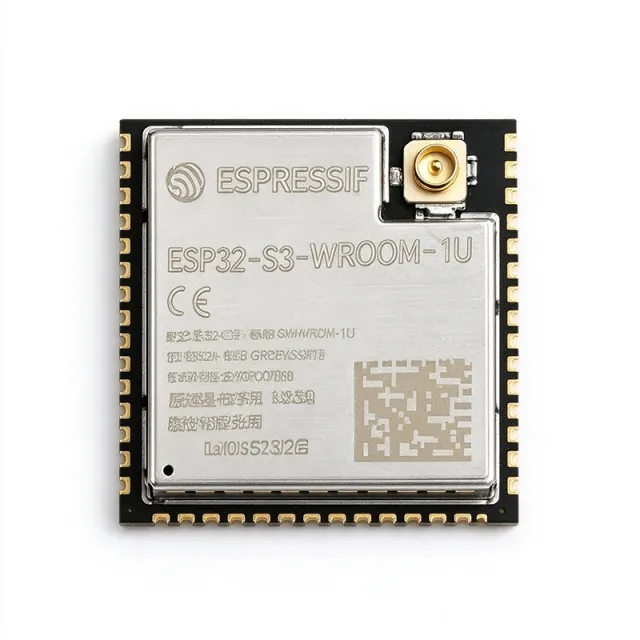
ESP32-S3-WROOM-1U-N16R2 - WiFi/BLE 5 Module 16MB Flash | Espressif
N.º de pieza: ESP32-S3-WROOM-1U-N16R2 ✓ Activo| Cant. | Precio unitario | Total |
|---|---|---|
| 1 | $4.7813 | $4,78 |
| 10 | $3.4531 | $34,53 |
| 100 | $3.0547 | $305,47 |
| 500 | $2.9219 | $1.460,95 |
| 1.000 | $2.7891 | $2.789,10 |
ESP32-S3-WROOM-1U-N16R2 Descripción general
A Wi-Fi + Bluetooth LE MCU module is a system-in-package device that integrates a wireless SoC, flash memory, crystal oscillator, RF matching network, and power management into a single surface-mount unit. Within the embedded hierarchy, it sits above bare microcontrollers and below finished boards, functioning as the wireless connectivity and compute heart of an Internet of Things (IoT) node, edge-AI endpoint, or connected industrial device.
Key differentiating features include the N16R2 memory configuration (16 MB flash + 2 MB PSRAM), the external-antenna U.FL footprint that lets designers place the antenna optimally inside a metal or RF-constrained enclosure, and the ESP32-S3 SoC's vector instructions for neural network computing and signal processing acceleration. The module supports Wi-Fi 802.11 b/g/n in the 2.4 GHz band and Bluetooth 5 LE, and exposes a rich peripheral set including SPI, I2C, I2S, UART, PWM, and native USB OTG.
The underlying ESP32-S3R2 integrates the 2 MB PSRAM die inside the module stack, allowing quad SPI PSRAM access for memory-hungry workloads such as voice buffers, image frames, and TinyML models. The dual-core LX7 architecture lets one core handle the wireless protocol stack while the second executes application code, improving real-time determinism.
Typical applications include wake word detection and speech command recognition, AIoT gateways, face recognition terminals, smart-home controllers, and industrial sensors where the external antenna connector simplifies certification and enclosure integration.
Design consideration: because the RF path is external, keep the U.FL-to-antenna cable loss below approximately 1 dB and follow Espressif's RF layout guidance for the keep-out area near the connector; also respect the strapping pin states (GPIO0, GPIO45, GPIO46) at power-up for correct boot mode.
This page synthesizes distributor pricing, same-family drop-in alternatives, practical design notes, and AI-optimized technical FAQs not found in the manufacturer datasheet alone. Pricing shown is as of 2026-10-11.
Alternativas directas para ESP32-S3-WROOM-1U-N16R2 — mismo encapsulado, compatible pin a pin. Se excluyen las piezas de otro encapsulado que requieren retrabajo de la PCB.
Herramienta de comparación rápida — seleccione piezas alternativas para compararlas lado a lado:
ESP32-S3-WROOM-1U-N16R8
📋 Alternativa de referencia (no en el catálogo)
ESP32-S3-WROOM-1U-N8R2
📋 Alternativa de referencia (no en el catálogo)
ESP32-S3-WROOM-1U-N8R8
📋 Alternativa de referencia (no en el catálogo)
ESP32-S3-WROOM-1U-N4R2
📋 Alternativa de referencia (no en el catálogo)
ESP32-S3-WROOM-1-N16R2
📋 Alternativa de referencia (no en el catálogo)
ESP32-S3-WROOM-1U-N16R2 Especificaciones (publicadas por el fabricante)
| Core Processor | Dual-core Xtensa LX7 (ESP32-S3R2 SoC) |
| Maximum CPU Frequency | 240 MHz |
| Flash Memory | 16 MB quad SPI |
| PSRAM | 2 MB quad SPI (die integrated in module) |
| Wi-Fi Standard | 802.11 b/g/n, 2.4 GHz |
| Bluetooth | Bluetooth 5.0 LE |
| Antenna Type | External via U.FL (IPEX) connector, antenna not included |
| Tensión de alimentación | 3.0 V to 3.6 V (3.3 V typical) |
| Package Dimensions | 19.2 mm x 18 mm (SMD) |
| Tipo de montaje | Surface Mount |
| Peripheral Interfaces | GPIO, SPI, I2C, I2S, UART, PWM, native USB OTG |
| AI Acceleration | Neural network computing and signal processing vector instructions |
| Typical Applications | AIoT, wake word detection, speech command recognition |
| Module Series | ESP32-S3-WROOM-1U |
Interfaces y conectores de ESP32-S3-WROOM-1U-N16R2
ESP32-S3-WROOM-1U-N16R2 expone las siguientes interfaces y conectores según lo publicado por el fabricante: Inalámbrico, Bluetooth, Entrada de potencia. El patillaje de la cabecera de expansión, la numeración de pines de los conectores y los límites eléctricos se definen en la documentación del fabricante.
| Inalámbrico | 802.11 b/g/n, 2.4 GHz |
| Bluetooth | Bluetooth 5.0 LE |
| Entrada de potencia | 3.0 V to 3.6 V (3.3 V typical) |
Consulte la documentación del fabricante para ver el patillaje completo del conector de expansión y la numeración de pines del conector.
Características de potencia y térmicas
| Entrada de potencia | 3.0 V to 3.6 V (3.3 V typical) |
Parámetros de entrada de potencia y térmicos para ESP32-S3-WROOM-1U-N16R2 según lo publicado por el fabricante.
Aplicaciones típicas
ESP32-S3-WROOM-1U-N16R2 es adecuado para 6 aplicacións: Wake Word Detection and Speech Commands, AIoT Camera and Face Recognition Endpoints, Smart Home Hubs and Matter Devices, Industrial Wireless Sensor Nodes, Wi-Fi + BLE Gateways and Bridges, Portable and Battery-Powered HMI Devices.
Wake Word Detection and Speech Commands
The ESP32-S3-WROOM-1U-N16R2 is purpose-built for far-field voice interaction: its dual-core LX7 cores execute Espressif's ESP-SR wake word and multi-command recognition models using the SoC's neural network vector instructions, while the 2 MB PSRAM holds the audio ring buffer and model weights. Audio enters through an I2S digital microphone such as the INMP441 or ES7210 ADC, keeping the analog path short and noise-free. The 16 MB flash stores the recognition models, acoustic features, and OTA update images simultaneously. Typical end products include smart plugs, voice-controlled appliances, and automotive hands-free nodes where the U.FL antenna allows clean RF placement inside plastic enclosures away from the microphone.
Recomendado
AIoT Camera and Face Recognition Endpoints
In camera-based AIoT nodes, the module pairs with the OV2640 or OV3660 DVP image sensor, with the 2 MB PSRAM serving as the frame buffer for QVGA/VGA streams processed on-device for face detection. The dual-core architecture lets one core run the image pipeline and CNN inference while the other manages Wi-Fi 802.11n upload or Bluetooth 5 LE control, avoiding the latency spikes typical of single-core designs. The 16 MB flash accommodates larger quantized models and firmware A/B partitions for reliable over-the-air updates. Because the U.FL connector decouples the antenna from the camera module's ground plane, designers can place the antenna to minimize RF interference with the sensor's clock circuitry, improving both image quality and wireless range.
Recomendado
Smart Home Hubs and Matter Devices
Smart-home controllers benefit from the module's simultaneous Wi-Fi station/soft-AP operation and Bluetooth 5 LE provisioning: users commission the device over BLE, then the hub switches to Wi-Fi for cloud and LAN traffic. The 16 MB flash hosts the Matter stack, OTA slots, and local automation rules, while 2 MB PSRAM supports TLS session buffers for multiple concurrent secure connections. GPIO headroom covers relays, buttons, RGB status LEDs, and I2C environmental sensors on one board. The external U.FL antenna is valuable here because hubs often sit inside metal-rich AV cabinets or near routers; repositioning the antenna by a short pigtail recovers the 10-20 dB of link budget otherwise lost to enclosure shielding.
Recomendado
Industrial Wireless Sensor Nodes
For factory and building-automation sensor nodes, the module's 3.0-3.6 V supply range matches standard industrial 3.3 V rails, and deep-sleep modes (a few tens of microamps, per Espressif family characteristics) enable multi-year battery life in periodic-report topologies. Sensors such as pressure, vibration, or current transducers connect via I2C/SPI/ADC, with data rate-limited over Wi-Fi or BLE. The 19.2 x 18 mm castellated-pad SMD footprint supports standard pick-and-place and wave-compatible assembly for volume production. The U.FL antenna solves a common industrial pain point: DIN-rail and metal control cabinets attenuate PCB antennas severely, so routing an external antenna to the cabinet wall preserves reliable 2.4 GHz connectivity without redesigning the enclosure.
Recomendado
Wi-Fi + BLE Gateways and Bridges
As a protocol gateway, the ESP32-S3-WROOM-1U-N16R2 bridges BLE peripherals (beacons, health sensors, asset tags) to a Wi-Fi backhaul or MQTT broker. The LX7 dual cores split the workload cleanly: one scans and maintains multiple BLE connections with the 2 MB PSRAM caching connection contexts, while the other runs TLS-encrypted Wi-Fi uplinks. The 16 MB flash stores buffering queues so telemetry survives network outages and syncs on reconnect. Gateways are often deployed near metal server racks or in ceiling enclosures where the U.FL connector lets the integrator fit a higher-gain external antenna (with certification compliance) to extend BLE scan radius and Wi-Fi uplink reliability simultaneously.
Recomendado
Portable and Battery-Powered HMI Devices
The module drives SPI TFT displays (for example 320x240 ILI9341 panels) with LVGL-based GUIs; the 2 MB PSRAM acts as a framebuffer so UI animations remain smooth while Wi-Fi and Bluetooth LE run concurrently. The 240 MHz dual-core CPU handles touch processing, graphics rendering, and secure cloud synchronization without an external application processor, reducing BOM cost for products such as smart thermostats, handheld scanners, and medical data loggers. Deep sleep between user interactions extends battery life, and native USB OTG simplifies both charging/data and firmware updates. The external antenna keeps the RF radiator at the device's top edge, away from the display FPC and touch controller whose ground planes would otherwise detune a PCB antenna.
Recomendado
Resumen de productos recomendados
Datos de referencia de ingeniería para ESP32-S3-WROOM-1U-N16R2 — comparación, orientación de diseño e información de cumplimiento.
Guía de selección
Comparación con alternativas
| Parámetro | Este producto | ESP32-S3-WROOM-1U-N16R8 | ESP32-S3-WROOM-1U-N8R2 | ESP32-S3-WROOM-1U-N8R8 | ESP32-S3-WROOM-1-N16R2 |
|---|---|---|---|---|---|
| Package | SMD module 19.2 x 18 mm, U.FL connector | SMD 19.2 x 18 mm, U.FL - same | SMD 19.2 x 18 mm, U.FL - same | SMD 19.2 x 18 mm, U.FL - same | SMD 19.2 x 18 mm, PCB antenna |
| Brand | Espressif Systems | Espressif Systems | Espressif Systems | Espressif Systems | Espressif Systems |
| CPU | Dual-core Xtensa LX7, up to 240 MHz | Dual-core LX7, 240 MHz | Dual-core LX7, 240 MHz | Dual-core LX7, 240 MHz | Dual-core LX7, 240 MHz |
| Flash | 16 MB quad SPI | 16 MB | 8 MB | 8 MB | 16 MB |
| PSRAM | 2 MB quad SPI | 8 MB octal | 2 MB quad | 8 MB octal | 2 MB quad |
| GPIO35-37 Availability | Yes (quad PSRAM does not use them) | No (octal PSRAM uses them) | Yes | No (octal PSRAM uses them) | Yes |
| Antenna | External U.FL (IPEX) | External U.FL (IPEX) | External U.FL (IPEX) | External U.FL (IPEX) | Onboard PCB antenna |
| Wireless | Wi-Fi 802.11 b/g/n + Bluetooth 5.0 LE, 2.4 GHz | Same | Same | Same | Same |
| Best For | Balanced AIoT with GPIO35-37 free | Large edge-AI models, camera buffers | Cost-optimized connected devices | AI workloads on a flash budget | BOM-cost-sensitive plastic enclosures |
Diferenciadores clave
- GPIO35-37 remain available for application use (frente a ESP32-S3-WROOM-1U-N16R8)
- Double the flash of the N8R2 for OTA and assets (frente a ESP32-S3-WROOM-1U-N8R2)
- External antenna placement flexibility (frente a ESP32-S3-WROOM-1-N16R2)
Notas de diseño
Power the module from a 3.3 V LDO rated at 500 mA or more, since Wi-Fi 802.11n TX bursts can draw several hundred milliamps in microseconds. Place a 10 uF bulk capacitor within 5 mm of the 3V3 pin plus a 100 nF ceramic directly at the pad. Enable Espressif's brownout detector and set the threshold around 2.8-2.9 V; nuisance resets during RF bursts are the most common first-bring-up failure on this module family per Espressif hardware design guidelines.
Because RF is external on the 1U variant, keep the U.FL pigtail as short as possible (ideally under 10 cm) and select an antenna certified with the module for FCC/CE modular approval. Route the antenna cable away from switching regulators, USB differential pairs, and camera clocks. Never place the antenna within 10 mm of ground planes or metal walls; a 10 mm clearance on all sides is a practical minimum for preserved 2.4 GHz radiation efficiency.
Respect strapping pins at power-up: GPIO0 (boot mode), GPIO45 (VDD_SPI voltage), and GPIO46 must not be pulled in ways that enter download mode unintentionally. GPIO35-37 are free on this N16R2 (quad PSRAM) variant - a key reason to choose it over R8 parts if you need those pins. When swapping to an octal-PSRAM variant later, remember these pins become unavailable and firmware must switch to OPI PSRAM mode.
Información de cumplimiento
Compliance statuses were not stated in the provided web data; verify on Espressif's official product page or distributor compliance documents.


