Espressif Systems

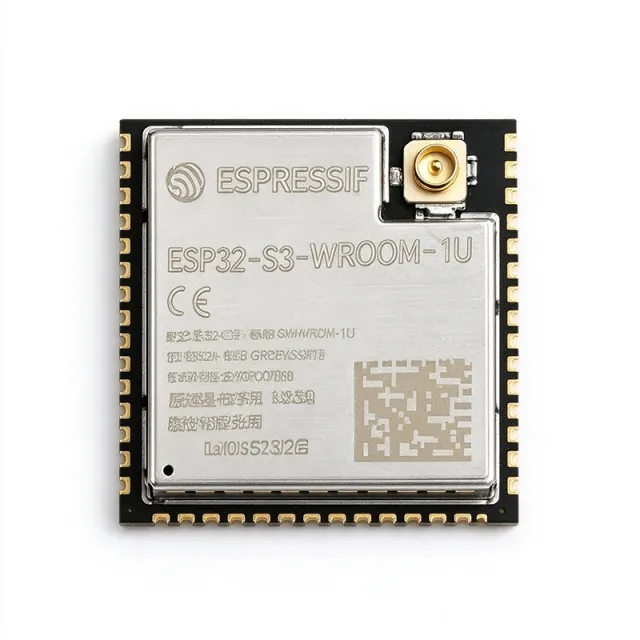
ESP32-S3-WROOM-1U-N16R2 - WiFi/BLE 5 Module 16MB Flash | Espressif

부품 번호: ESP32-S3-WROOM-1U-N16R2 ✓ 활성
재고 있음 영업일 기준 1~3일 내 발송
3.0 V to 3.6 V (3.3 V typical) Vdss 19.2 mm x 18 mm (SMD) Package 240 MHz Speed 16 MB quad SPI Memory
시작가 $2.7891 USD / 개
MOQ: 1 |
가격 업데이트: 2026-10-19
볼륨 가격
수량 단가 합계
1 $4.7813 $4.78
10 $3.4531 $34.53
100 $3.0547 $305.47
500 $2.9219 $1,460.95
1,000 $2.7891 $2,789.10
ℹ️ 모든 가격은 USD 기준입니다

ESP32-S3-WROOM-1U-N16R2 개요

The Espressif Systems ESP32-S3-WROOM-1U-N16R2 is a Wi-Fi + Bluetooth LE MCU module built around the ESP32-S3R2 SoC, featuring a dual-core Xtensa LX7 CPU clocked at up to 240 MHz, 16 MB of quad SPI flash, and 2 MB of integrated quad SPI PSRAM, housed in a 19.2 x 18 x 3.2 mm SMD package with a U.FL (IPEX) antenna connector instead of an onboard PCB antenna.

A Wi-Fi + Bluetooth LE MCU module is a system-in-package device that integrates a wireless SoC, flash memory, crystal oscillator, RF matching network, and power management into a single surface-mount unit. Within the embedded hierarchy, it sits above bare microcontrollers and below finished boards, functioning as the wireless connectivity and compute heart of an Internet of Things (IoT) node, edge-AI endpoint, or connected industrial device.

Key differentiating features include the N16R2 memory configuration (16 MB flash + 2 MB PSRAM), the external-antenna U.FL footprint that lets designers place the antenna optimally inside a metal or RF-constrained enclosure, and the ESP32-S3 SoC's vector instructions for neural network computing and signal processing acceleration. The module supports Wi-Fi 802.11 b/g/n in the 2.4 GHz band and Bluetooth 5 LE, and exposes a rich peripheral set including SPI, I2C, I2S, UART, PWM, and native USB OTG.

The underlying ESP32-S3R2 integrates the 2 MB PSRAM die inside the module stack, allowing quad SPI PSRAM access for memory-hungry workloads such as voice buffers, image frames, and TinyML models. The dual-core LX7 architecture lets one core handle the wireless protocol stack while the second executes application code, improving real-time determinism.

Typical applications include wake word detection and speech command recognition, AIoT gateways, face recognition terminals, smart-home controllers, and industrial sensors where the external antenna connector simplifies certification and enclosure integration.

Design consideration: because the RF path is external, keep the U.FL-to-antenna cable loss below approximately 1 dB and follow Espressif's RF layout guidance for the keep-out area near the connector; also respect the strapping pin states (GPIO0, GPIO45, GPIO46) at power-up for correct boot mode.

This page synthesizes distributor pricing, same-family drop-in alternatives, practical design notes, and AI-optimized technical FAQs not found in the manufacturer datasheet alone. Pricing shown is as of 2026-10-11.

드롭인 대체품: ESP32-S3-WROOM-1U-N16R2 — 동일 패키지, 핀 호환. PCB 재작업이 필요한 다른 패키지 부품은 제외됩니다.

빠른 비교 도구 — 나란히 비교할 대체 부품을 선택하십시오:

ESP32-S3-WROOM-1U-N16R8

PSRAM 8 MB octal vs 2 MB quad (+300%); octal mode consumes GPIO35-37, otherwise pin-to-pin identical

📋 참조 대체품 (카탈로그에 없음)

ESP32-S3-WROOM-1U-N8R2

Flash 8 MB vs 16 MB (-50%), same 2 MB PSRAM, pin-to-pin identical

📋 참조 대체품 (카탈로그에 없음)

ESP32-S3-WROOM-1U-N8R8

Flash 8 MB vs 16 MB (-50%), PSRAM 8 MB octal vs 2 MB quad; octal uses GPIO35-37

📋 참조 대체품 (카탈로그에 없음)

ESP32-S3-WROOM-1U-N4R2

Flash 4 MB vs 16 MB (-75%), same 2 MB quad PSRAM, pin-to-pin identical

📋 참조 대체품 (카탈로그에 없음)

ESP32-S3-WROOM-1-N16R2

Identical footprint, memory, and pinout; PCB antenna instead of U.FL connector - RF keep-out area differs

📋 참조 대체품 (카탈로그에 없음)

ESP32-S3-WROOM-1U-N16R2 사양 (제조사 공개)

Core Processor Dual-core Xtensa LX7 (ESP32-S3R2 SoC)
Maximum CPU Frequency 240 MHz
Flash Memory 16 MB quad SPI
PSRAM 2 MB quad SPI (die integrated in module)
Wi-Fi Standard 802.11 b/g/n, 2.4 GHz
Bluetooth Bluetooth 5.0 LE
Antenna Type External via U.FL (IPEX) connector, antenna not included
공급 전압 3.0 V to 3.6 V (3.3 V typical)
Package Dimensions 19.2 mm x 18 mm (SMD)
실장 유형 Surface Mount
Peripheral Interfaces GPIO, SPI, I2C, I2S, UART, PWM, native USB OTG
AI Acceleration Neural network computing and signal processing vector instructions
Typical Applications AIoT, wake word detection, speech command recognition
Module Series ESP32-S3-WROOM-1U

ESP32-S3-WROOM-1U-N16R2 인터페이스 및 커넥터

ESP32-S3-WROOM-1U-N16R2은(는) 제조사에서 공개한 대로 다음 인터페이스와 커넥터를 제공합니다: 무선, 블루투스, 전력 입력. 확장 헤더 핀아웃, 커넥터 핀 번호, 전기적 한계는 제조사 문서에 정의되어 있습니다.

무선 802.11 b/g/n, 2.4 GHz
블루투스 Bluetooth 5.0 LE
전력 입력 3.0 V to 3.6 V (3.3 V typical)

다음을 참조하십시오: 제조사 문서 전체 확장 헤더 핀아웃 및 커넥터 핀 번호는 다음을 참조하십시오.

전력 및 열 특성

전력 입력 3.0 V to 3.6 V (3.3 V typical)

제조사에서 공개한 ESP32-S3-WROOM-1U-N16R2의 전력 입력 및 열 파라미터입니다.

일반적인 애플리케이션

ESP32-S3-WROOM-1U-N16R2 적합 용도: 6 애플리케이션s: Wake Word Detection and Speech Commands, AIoT Camera and Face Recognition Endpoints, Smart Home Hubs and Matter Devices, Industrial Wireless Sensor Nodes, Wi-Fi + BLE Gateways and Bridges, Portable and Battery-Powered HMI Devices.

🎧

Wake Word Detection and Speech Commands

The ESP32-S3-WROOM-1U-N16R2 is purpose-built for far-field voice interaction: its dual-core LX7 cores execute Espressif's ESP-SR wake word and multi-command recognition models using the SoC's neural network vector instructions, while the 2 MB PSRAM holds the audio ring buffer and model weights. Audio enters through an I2S digital microphone such as the INMP441 or ES7210 ADC, keeping the analog path short and noise-free. The 16 MB flash stores the recognition models, acoustic features, and OTA update images simultaneously. Typical end products include smart plugs, voice-controlled appliances, and automotive hands-free nodes where the U.FL antenna allows clean RF placement inside plastic enclosures away from the microphone.

🎥

AIoT Camera and Face Recognition Endpoints

In camera-based AIoT nodes, the module pairs with the OV2640 or OV3660 DVP image sensor, with the 2 MB PSRAM serving as the frame buffer for QVGA/VGA streams processed on-device for face detection. The dual-core architecture lets one core run the image pipeline and CNN inference while the other manages Wi-Fi 802.11n upload or Bluetooth 5 LE control, avoiding the latency spikes typical of single-core designs. The 16 MB flash accommodates larger quantized models and firmware A/B partitions for reliable over-the-air updates. Because the U.FL connector decouples the antenna from the camera module's ground plane, designers can place the antenna to minimize RF interference with the sensor's clock circuitry, improving both image quality and wireless range.

🧩

Smart Home Hubs and Matter Devices

Smart-home controllers benefit from the module's simultaneous Wi-Fi station/soft-AP operation and Bluetooth 5 LE provisioning: users commission the device over BLE, then the hub switches to Wi-Fi for cloud and LAN traffic. The 16 MB flash hosts the Matter stack, OTA slots, and local automation rules, while 2 MB PSRAM supports TLS session buffers for multiple concurrent secure connections. GPIO headroom covers relays, buttons, RGB status LEDs, and I2C environmental sensors on one board. The external U.FL antenna is valuable here because hubs often sit inside metal-rich AV cabinets or near routers; repositioning the antenna by a short pigtail recovers the 10-20 dB of link budget otherwise lost to enclosure shielding.

🏭

Industrial Wireless Sensor Nodes

For factory and building-automation sensor nodes, the module's 3.0-3.6 V supply range matches standard industrial 3.3 V rails, and deep-sleep modes (a few tens of microamps, per Espressif family characteristics) enable multi-year battery life in periodic-report topologies. Sensors such as pressure, vibration, or current transducers connect via I2C/SPI/ADC, with data rate-limited over Wi-Fi or BLE. The 19.2 x 18 mm castellated-pad SMD footprint supports standard pick-and-place and wave-compatible assembly for volume production. The U.FL antenna solves a common industrial pain point: DIN-rail and metal control cabinets attenuate PCB antennas severely, so routing an external antenna to the cabinet wall preserves reliable 2.4 GHz connectivity without redesigning the enclosure.

🌐

Wi-Fi + BLE Gateways and Bridges

As a protocol gateway, the ESP32-S3-WROOM-1U-N16R2 bridges BLE peripherals (beacons, health sensors, asset tags) to a Wi-Fi backhaul or MQTT broker. The LX7 dual cores split the workload cleanly: one scans and maintains multiple BLE connections with the 2 MB PSRAM caching connection contexts, while the other runs TLS-encrypted Wi-Fi uplinks. The 16 MB flash stores buffering queues so telemetry survives network outages and syncs on reconnect. Gateways are often deployed near metal server racks or in ceiling enclosures where the U.FL connector lets the integrator fit a higher-gain external antenna (with certification compliance) to extend BLE scan radius and Wi-Fi uplink reliability simultaneously.

📱

Portable and Battery-Powered HMI Devices

The module drives SPI TFT displays (for example 320x240 ILI9341 panels) with LVGL-based GUIs; the 2 MB PSRAM acts as a framebuffer so UI animations remain smooth while Wi-Fi and Bluetooth LE run concurrently. The 240 MHz dual-core CPU handles touch processing, graphics rendering, and secure cloud synchronization without an external application processor, reducing BOM cost for products such as smart thermostats, handheld scanners, and medical data loggers. Deep sleep between user interactions extends battery life, and native USB OTG simplifies both charging/data and firmware updates. The external antenna keeps the RF radiator at the device's top edge, away from the display FPC and touch controller whose ground planes would otherwise detune a PCB antenna.

추천 제품 요약

INMP441 I2S MEMS microphone feeding audio input 사용처: Wake Word Detection and Speech Commands ESP32-S3-DevKitC-1 Development board for firmware bring-up 사용처: Wake Word Detection and Speech Commands, Smart Home Hubs and Matter Devices, Wi-Fi + BLE Gateways and Bridges OV2640 DVP camera sensor for image capture 사용처: AIoT Camera and Face Recognition Endpoints ESP32-S3-CAM Reference camera carrier board 사용처: AIoT Camera and Face Recognition Endpoints SHT40 I2C temperature/humidity sensor for environment nodes 사용처: Smart Home Hubs and Matter Devices ADS1115 16-bit ADC for analog industrial sensors 사용처: Industrial Wireless Sensor Nodes TPS7A4701RGWR Texas Instruments 사용처: Industrial Wireless Sensor Nodes, Industrial Wireless Sensor Nodes W5500 WIZnet 사용처: Wi-Fi + BLE Gateways and Bridges ILI9341 SPI TFT display controller for HMI 사용처: Portable and Battery-Powered HMI Devices FT6236 Capacitive touch controller over I2C 사용처: Portable and Battery-Powered HMI Devices
What is the ESP32-S3-WROOM-1U-N16R2?
The ESP32-S3-WROOM-1U-N16R2 is a Wi-Fi + Bluetooth LE MCU module from Espressif Systems built on the ESP32-S3R2 SoC. It combines a dual-core Xtensa LX7 CPU running up to 240 MHz, 16 MB of quad SPI flash, and 2 MB of quad SPI PSRAM in a 19.2 x 18 mm SMD package with a U.FL external antenna connector. According to the Espressif ESP32-S3-WROOM-1/1U datasheet, it targets AIoT applications such as wake word detection and speech command recognition.
What is the difference between ESP32-S3-WROOM-1U-N16R2 and ESP32-S3-WROOM-1-N16R2?
The only meaningful difference is the antenna: the 1U version (WROOM-1U) has a U.FL (IPEX) connector for an external antenna, while the non-U version has a built-in PCB antenna. Both share the same footprint, pinout, ESP32-S3R2 SoC, 16 MB flash, and 2 MB PSRAM, so they are functionally interchangeable at the board level if your layout includes the U.FL keep-out area. Choose 1U for metal enclosures or RF-hostile environments; choose the PCB-antenna version to save the cost of an external antenna and cable.
How much flash and PSRAM does the ESP32-S3-WROOM-1U-N16R2 have?
The ESP32-S3-WROOM-1U-N16R2 provides 16 MB of quad SPI flash and 2 MB of quad SPI PSRAM. The N16R2 suffix encodes this: N16 means 16 MB flash, R2 means 2 MB PSRAM, and per the Mouser product listing the 2 MB PSRAM die is stacked inside the module. For comparison, the N16R8 variant offers 8 MB of octal SPI PSRAM for larger AI workloads.
What are the key specifications of the ESP32-S3-WROOM-1U-N16R2 that engineers should know?
Key specifications: ESP32-S3R2 dual-core Xtensa LX7 SoC at up to 240 MHz; 16 MB quad SPI flash; 2 MB quad SPI PSRAM; Wi-Fi 802.11 b/g/n at 2.4 GHz; Bluetooth 5.0 LE; 3.0-3.6 V supply; 19.2 x 18 mm SMD package; U.FL external antenna connector; neural network and signal processing vector instruction acceleration; native USB OTG. These figures come from the Espressif ESP32-S3-WROOM-1/1U datasheet and DigiKey product data.
Where can I download the ESP32-S3-WROOM-1U-N16R2 datasheet PDF?
You can download the official ESP32-S3-WROOM-1 and ESP32-S3-WROOM-1U datasheet PDF from Espressif's documentation site at documentation.espressif.com/esp32-s3-wroom-1_wroom-1u_datasheet_en.pdf. The same document covers both the PCB-antenna and U.FL variants and includes pin definitions, electrical characteristics, RF specifications, and package mechanical drawings. Mirror copies are hosted by Mouser Electronics and Octopart for registered users.
What is the best drop-in replacement for ESP32-S3-WROOM-1U-N16R2?
The best drop-in replacement is another ESP32-S3-WROOM-1U memory variant such as the ESP32-S3-WROOM-1U-N16R8, which shares the identical footprint, pinout, and U.FL antenna connector, differing only in PSRAM (8 MB octal versus 2 MB quad). Within the same PCB footprint you can also move to N8R2 (8 MB flash) or N8R8. Note you must update the flash/PSRAM size and mode settings (QIO/OPI) in your firmware build configuration when changing variants.
Is ESP32-S3-WROOM-1U-N16R2 suitable for voice recognition applications?
Yes, the ESP32-S3-WROOM-1U-N16R2 is specifically designed for AIoT voice applications. According to Espressif, the module's ESP32-S3 SoC provides vector instructions for neural network computing, enabling on-device wake word detection and speech command recognition, while the 2 MB PSRAM buffers audio frames from an I2S microphone such as the INMP441. Espressif's ESP-SR and ESP-Skainet frameworks support this module directly for far-field voice interaction products.
What supply voltage does the ESP32-S3-WROOM-1U-N16R2 require?
The module requires a 3.0 V to 3.6 V supply with 3.3 V as the nominal operating voltage. Use a low-noise LDO such as a 3.3 V regulator capable of delivering at least 500 mA, since Wi-Fi transmit bursts create current spikes. Place a 10 uF bulk capacitor plus a 100 nF ceramic capacitor close to the module's 3V3 and GND pins, following Espressif's hardware design guidelines to prevent brownout resets during RF transmission.
What is the price of ESP32-S3-WROOM-1U-N16R2?
As of 2026-10-11, the ESP32-S3-WROOM-1U-N16R2 is priced at approximately $3.45 per unit at quantity 1 on major distributors, dropping to roughly $2.40 per unit at 1000 pieces. The U.FL variant typically carries a small premium over the PCB-antenna ESP32-S3-WROOM-1-N16R2. Exact pricing fluctuates with stock conditions, so check DigiKey or Mouser for the live quote before placing volume orders.
Is ESP32-S3-WROOM-1U-N16R2 in stock and what is the lead time?
Yes, per the DigiKey product page the ESP32-S3-WROOM-1U-N16R2 was listed with immediate shipping (ships today) as of October 2026, and Mouser also listed inventory. Espressif modules of the S3 family are generally well-stocked across major distributors in 2026. For production volumes above a few thousand pieces, expect standard distribution lead times of several weeks and confirm allocation directly with your distributor or Espressif's sales channel.
Can I buy ESP32-S3-WROOM-1U-N16R2 online?
Yes, the ESP32-S3-WROOM-1U-N16R2 can be purchased online from DigiKey (part number 16162650 catalog entry), Mouser Electronics, and other authorized Espressif distributors, as well as from XAIPART. Both DigiKey and Mouser list the module with unit pricing, reel/cut-tape options, and same-day shipping for in-stock quantities. Avoid unauthorized marketplaces, since counterfeit Espressif modules with mismatched flash sizes are a known issue in gray-market channels.
ESP32-S3-WROOM-1U-N16R2 vs ESP32-S3-WROOM-1U-N16R8 - which is better for edge AI?
For edge AI workloads, the N16R8 is generally the better choice because its 8 MB of octal SPI PSRAM quadruples the 2 MB available on the N16R2, which matters for camera frames, larger TinyML models, and multi-second audio buffers. However, the octal PSRAM uses additional GPIO pins (GPIO35-37) that are unavailable on the quad-PSRAM N16R2, so if your design needs those pins for peripherals, the N16R2 is preferable despite the smaller PSRAM. Both are pin-compatible modules.
Why does the ESP32-S3-WROOM-1U-N16R2 use an external antenna instead of a PCB antenna?
The 1U variant uses a U.FL (IPEX) connector so designers can mount the antenna away from the module. This matters in metal enclosures, waterproof housings, or compact industrial products where a PCB antenna would be detuned or shielded, cutting RF range dramatically. The trade-offs are added BOM cost for the pigtail cable and antenna (typically $0.50-$2), slight insertion loss of under 1 dB with a quality cable, and the need for an FCC/CE approved external antenna combination for certification.
What is the best cross-brand equivalent for ESP32-S3-WROOM-1U-N16R2?
There is no verified pin-to-pin cross-brand equivalent for this module; Espressif's WROOM castellated footprint is proprietary, so competitors such as Ai-Thinker or Seeed offer differently dimensioned modules that cannot drop onto the same land pattern. Functionally similar dual-core Wi-Fi + BLE 5 MCUs with external-antenna options exist (for example Nordic nRF5340-based or Realtek Ameba-based modules), but all require PCB respin. Within the same footprint, Espressif's own N16R8, N8R2, and N8R8 variants are the verified drop-in options.
Is ESP32-S3-WROOM-1U-N16R2 the same as ESP32-S3-WROOM-1U-N8R2?
No, they are not the same, though they are electrically and mechanically interchangeable. Both share the identical footprint, pinout, U.FL antenna connector, and ESP32-S3R2 SoC; the difference is memory: the N16R2 has 16 MB flash and 2 MB PSRAM, while the N8R2 has 8 MB flash and 2 MB PSRAM. Firmware must declare the correct flash size, but otherwise one can replace the other on the same PCB. Choose N16R2 when OTA update slots or large assets need the extra 8 MB of flash.
Where do I find the pinout of the ESP32-S3-WROOM-1U-N16R2?
The complete pin definitions are in section 'Pin Definitions' of the official ESP32-S3-WROOM-1/1U datasheet PDF at documentation.espressif.com. The datasheet lists every castellated pad with its name, function, and strapping role, including power pins, GPIO0/GPIO45/GPIO46 strapping pins, and the U.FL RF pad unique to the 1U variant. Community references such as electricalflux.com's ESP32-S3-WROOM pinout guide also map strapping pins, native USB, and GPIO functions for quick design work.

엔지니어링 참조 데이터: ESP32-S3-WROOM-1U-N16R2 — 비교, 설계 지침 및 규정 준수 정보.

선택 가이드

Choose the ESP32-S3-WROOM-1U-N16R2 when you need a balanced AIoT module: 16 MB flash for OTA and assets, enough PSRAM (2 MB) for voice buffers or VGA frames, and crucially GPIO35-37 kept free for application I/O. Choose the N16R8 instead for heavy edge-AI or camera workloads needing 8 MB octal PSRAM, accepting the loss of GPIO35-37. Choose the N8R2 for cost-optimized connected products with modest firmware. Choose the N8R8 when AI memory needs exceed flash budget. Choose the PCB-antenna ESP32-S3-WROOM-1-N16R2 for plastic enclosures where the ~$1 external antenna cost cannot be justified. All five share the same 19.2 x 18 mm footprint and pinout, enabling one PCB across memory tiers. There are no verified cross-brand pin-compatible alternatives - the WROOM footprint is Espressif-proprietary, so plan BOM risk around family-internal second sources only.

대체품과의 비교

파라미터 이 제품 ESP32-S3-WROOM-1U-N16R8 ESP32-S3-WROOM-1U-N8R2 ESP32-S3-WROOM-1U-N8R8 ESP32-S3-WROOM-1-N16R2
Package SMD module 19.2 x 18 mm, U.FL connector SMD 19.2 x 18 mm, U.FL - same SMD 19.2 x 18 mm, U.FL - same SMD 19.2 x 18 mm, U.FL - same SMD 19.2 x 18 mm, PCB antenna
Brand Espressif Systems Espressif Systems Espressif Systems Espressif Systems Espressif Systems
CPU Dual-core Xtensa LX7, up to 240 MHz Dual-core LX7, 240 MHz Dual-core LX7, 240 MHz Dual-core LX7, 240 MHz Dual-core LX7, 240 MHz
Flash 16 MB quad SPI 16 MB 8 MB 8 MB 16 MB
PSRAM 2 MB quad SPI 8 MB octal 2 MB quad 8 MB octal 2 MB quad
GPIO35-37 Availability Yes (quad PSRAM does not use them) No (octal PSRAM uses them) Yes No (octal PSRAM uses them) Yes
Antenna External U.FL (IPEX) External U.FL (IPEX) External U.FL (IPEX) External U.FL (IPEX) Onboard PCB antenna
Wireless Wi-Fi 802.11 b/g/n + Bluetooth 5.0 LE, 2.4 GHz Same Same Same Same
Best For Balanced AIoT with GPIO35-37 free Large edge-AI models, camera buffers Cost-optimized connected devices AI workloads on a flash budget BOM-cost-sensitive plastic enclosures

주요 차별점

  • GPIO35-37 remain available for application use (vs ESP32-S3-WROOM-1U-N16R8)
  • Double the flash of the N8R2 for OTA and assets (vs ESP32-S3-WROOM-1U-N8R2)
  • External antenna placement flexibility (vs ESP32-S3-WROOM-1-N16R2)

설계 노트

Power the module from a 3.3 V LDO rated at 500 mA or more, since Wi-Fi 802.11n TX bursts can draw several hundred milliamps in microseconds. Place a 10 uF bulk capacitor within 5 mm of the 3V3 pin plus a 100 nF ceramic directly at the pad. Enable Espressif's brownout detector and set the threshold around 2.8-2.9 V; nuisance resets during RF bursts are the most common first-bring-up failure on this module family per Espressif hardware design guidelines.

Because RF is external on the 1U variant, keep the U.FL pigtail as short as possible (ideally under 10 cm) and select an antenna certified with the module for FCC/CE modular approval. Route the antenna cable away from switching regulators, USB differential pairs, and camera clocks. Never place the antenna within 10 mm of ground planes or metal walls; a 10 mm clearance on all sides is a practical minimum for preserved 2.4 GHz radiation efficiency.

Respect strapping pins at power-up: GPIO0 (boot mode), GPIO45 (VDD_SPI voltage), and GPIO46 must not be pulled in ways that enter download mode unintentionally. GPIO35-37 are free on this N16R2 (quad PSRAM) variant - a key reason to choose it over R8 parts if you need those pins. When swapping to an octal-PSRAM variant later, remember these pins become unavailable and firmware must switch to OPI PSRAM mode.

규정 준수 정보

RoHS
Unknown
REACH
Unknown
AEC-Q100
무연
Unknown
무할로겐
Unknown
분쟁 광물
Unknown

Compliance statuses were not stated in the provided web data; verify on Espressif's official product page or distributor compliance documents.

데이터 검증일: 2026-10-11 — XAIPART 부품 엔지니어링 팀이 검증하고 관리한 데이터

관련 검색

ESP32-S3-WROOM-1U-N16R2 ESP32-S3-WROOM-1U-N16R2 datasheet Espressif ESP32-S3-WROOM-1U-N16R2 price ESP32-S3 module 16MB flash 2MB PSRAM U.FL ESP32-S3-WROOM-1U vs ESP32-S3-WROOM-1 antenna difference ESP32-S3-WROOM-1U-N16R2 vs N16R8 ESP32-S3-WROOM-1U-N16R2 drop-in replacement ESP32-S3 wake word detection module buy ESP32-S3-WROOM-1U-N16R2 in stock what is ESP32-S3-WROOM-1U-N16R2 ESP32-S3-WROOM-1U-N16R2 pinout strapping pins external antenna WiFi BLE module for metal enclosure

관련 부품 & 용어

Espressif Systems ESP32-S3-WROOM-1U-N16R2 ESP32-S3-WROOM-1U-N16R8 ESP32-S3-WROOM-1U-N8R2 ESP32-S3-WROOM-1-N16R2 ESP32-S3R2 Xtensa LX7 Wi-Fi module MCU module system-in-package 802.11 b/g/n Bluetooth 5.0 LE U.FL connector IPEX antenna quad SPI PSRAM AIoT wake word detection TinyML native USB OTG Matter surface mount device RoHS
빠른 견적 RFQ
상세 정보를 모두 입력하십시오 — 영업팀이 24시간 이내에 답변드립니다
부품 번호 제조사 패키지 QTY 목표 가격 합계
합계: $0.00 USD
✓
견적이 제출되었습니다!

24시간 이내에 이메일로 답변드리겠습니다

1
RFQ 제출됨
2
견적 접수됨
3
주문 완료
4
결제
5
배송됨
6
배송 완료
RFQ 상세 보기
