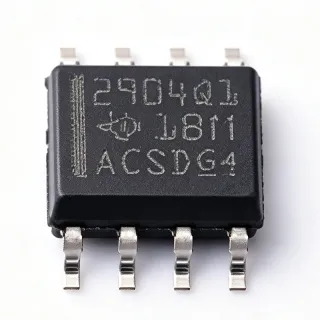
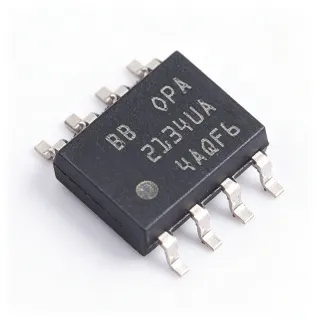
TLV2462CD - Dual 6.4MHz RRIO Op Amp | Texas Instruments
N.º de pieza: TLV2462CD ✓ ActivoTLV2462CD Descripción general
An operational amplifier is an analog signal-conditioning IC that provides high open-loop gain and negative feedback to amplify or buffer a voltage signal. The TLV2462 belongs to the RRIO operational-amplifier family, where RRIO denotes rail-to-rail input and rail-to-rail output. This places the device in the broader hierarchy of analog ICs, signal-chain ICs, amplifiers, and general-purpose amplifiers.
The TLV2462CD provides rail-to-rail input capability for a wide common-mode range and rail-to-rail output swing for improved dynamic range in low-voltage systems. Its 6.4 MHz bandwidth supports higher-frequency signal processing than a conventional micropower amplifier, while the 1.6 V/µs slew rate improves large-signal response. Two amplifiers in one SOIC package reduce board area, and the 500 µA-per-channel supply current supports battery-conscious portable equipment.
The dual architecture allows the two channels to perform related or independent functions. Common uses include signal buffering, gain stages, active filtering, sensor-interface amplification, and low-voltage logic-level signal conditioning. Because both amplifiers share a common supply in one package, designers must also account for shared supply current, thermal behavior, ground routing, and channel-to-channel interaction.
Typical applications include portable instrumentation, battery-powered monitors, sensor conditioning, audio and communication interfaces, and portable test equipment. The 80 mA output-drive capability is useful when driving moderate loads, while the rail-to-rail output allows useful output voltage to be obtained near the positive and negative supply limits.
When designing around the TLV2462CD, verify output-current demand and capacitive-load stability for the selected feedback network. Keep input and feedback traces short, maintain a low-impedance ground reference, and use decoupling close to the supply pins. The available verified material does not provide a complete order-specific pin table, so the pinout field is conservatively marked as unavailable rather than inferred.
This page combines verified manufacturer and distributor information with practical selection guidance, application analysis, honest data-gap notes, and same-family drop-in candidates. It distinguishes documented electrical attributes from specifications that require confirmation from the manufacturer datasheet before release to production.
Alternativas directas para TLV2462CD — mismo encapsulado, compatible pin a pin. Se excluyen las piezas de otro encapsulado que requieren retrabajo de la PCB.
TLV2462IDR
✅ Sustitución directa📋 Alternativa de referencia (no en el catálogo)
TLV2460IDR
✅ Sustitución directa📋 Alternativa de referencia (no en el catálogo)
TLV2462CDR
✅ Sustitución directa📋 Alternativa de referencia (no en el catálogo)
TLV2462CDRG4
✅ Sustitución directa📋 Alternativa de referencia (no en el catálogo)
TLV2462CDG4
✅ Sustitución directa📋 Alternativa de referencia (no en el catálogo)
TLV2462CD Valores máximos y características eléctricas
| Amplifier Type | Dual operational amplifier |
| Number of Channels | 2 channels |
| Gain-Bandwidth Product | 6.4 MHz |
| Slew Rate | 1.6 V/µs |
| Corriente de alimentación | 500 µA per channel |
| Output Drive Capability | 80 mA |
| Input Common-Mode Range | Rail-to-rail |
| Output Swing | Rail-to-rail |
| Nominal Supply Voltage | 6 V maximum |
| Encapsulado | SOIC-8 (D) |
| Recuento de pines | 8 pins |
| Tipo de montaje | Surface mount |
| Estado RoHS | unknown |
| REACH Status | unknown |
| AEC-Q100 Qualification | unknown |
| Lead-Free Status | unknown |
Guía de configuración de pines de TLV2462CD soic-8 (d)
Configuración de pines para TLV2462CD (encapsulado soic-8 (d)). Este componente analógico presenta pines de entrada, salida y alimentación. Consulte la hoja de datos del fabricante para conocer las configuraciones de los pines de ajuste de offset, compensación y habilitación. Ideal para circuitos de acondicionamiento de señal y amplificadores.
No hay datos detallados de patillaje disponibles para TLV2462CD.
Consulte la hoja de datos para ver la configuración completa de patillas.
Aplicaciones típicas
TLV2462CD es adecuado para 6 aplicacións: Portable Sensor Signal Conditioning, Battery-Powered Portable Instruments, Low-Voltage Active Filtering, Communications Interface Buffering, Portable Diagnostic and Monitoring Equipment, General-Purpose Analog Signal Conditioning.
Portable Sensor Signal Conditioning
The TLV2462CD suits low-voltage sensor front ends because its dual rail-to-rail input/output architecture accepts signals near the supply rails while consuming approximately 500 µA per channel. The two amplifiers can provide differential gain, filtering, or buffering stages without requiring two separate packages. Its 6.4 MHz gain-bandwidth product provides more bandwidth than a basic micropower op amp, although source impedance, input bias current, and offset specifications must be checked against the sensor interface requirements before release.
Recomendado
Battery-Powered Portable Instruments
The TLV2462CD fits portable measurement equipment where every milliamp of supply current affects battery life. Its approximately 500 µA per-channel supply current is combined with a 6.4 MHz gain-bandwidth product and 1.6 V/µs slew rate, allowing the same dual package to provide gain and buffering for a modest-speed analog channel. The rail-to-rail output is especially useful when the usable signal range is small relative to the supply voltage, though actual battery-life benefit depends on duty cycle and external load current.
Recomendado
Low-Voltage Active Filtering
The TLV2462CD can implement active filters in portable and low-voltage systems because both channels provide rail-to-rail operation within one 8-pin SOIC package. Its 6.4 MHz gain-bandwidth product supports filter bandwidths that are useful for signal conditioning beyond the audio baseband, while the 1.6 V/µs slew rate helps preserve large-signal behavior. Component selection must account for the closed-loop gain, expected capacitive loading, and the amplifier’s stability characteristics under the chosen feedback network.
Recomendado
Communications Interface Buffering
The TLV2462CD is applicable to low-speed communications and interface buffering because its 6.4 MHz bandwidth is sufficient for many control, level-shifting, and moderate-speed data conditioning stages. Rail-to-rail input capability increases common-mode range, while 80 mA output-drive capability can improve drive into moderate capacitive or resistive loads. Designers should still verify the required logic levels, edge rate, capacitive-load tolerance, and channel-to-channel behavior before using it as a direct replacement for a dedicated line driver.
Recomendado
Portable Diagnostic and Monitoring Equipment
The TLV2462CD supports compact diagnostic and monitoring equipment where sensor-derived voltages must be amplified and buffered within limited supply and power budgets. The dual configuration allows one channel to condition a sensor signal and the other to provide an active filter, gain stage, or output driver. Its approximately 500 µA per-channel current is favorable for portable operation, while rail-to-rail inputs and outputs maximize signal range in low-voltage systems. Medical or diagnostic claims require separate system-level validation and are not implied by the component qualification.
Recomendado
General-Purpose Analog Signal Conditioning
The TLV2462CD works as a general-purpose dual amplifier for voltage buffering, gain adjustment, and analog signal conditioning. Its 6.4 MHz gain-bandwidth product, 1.6 V/µs slew rate, and 80 mA drive capability provide useful performance above basic low-speed micropower operation. The device’s rail-to-rail characteristics are valuable when signals occupy much of the available supply range. Stable operation depends on correct feedback design, adequate supply decoupling, careful grounding, and verification of output-load requirements in the finished circuit.
Recomendado
Resumen de productos recomendados
Datos de referencia de ingeniería para TLV2462CD — comparación, orientación de diseño e información de cumplimiento.
Guía de selección
Comparación con alternativas
| Parámetro | Este producto | TLV2462IDR | TLV2460IDR | TLV2462CDR | TLV2462CDRG4 | TLV2462CDG4 |
|---|---|---|---|---|---|---|
| Package | SOIC-8 (D) | SOIC-8 (D) | SOIC-8 (D) | SOIC-8 (D) | SOIC-8 (D) | SOIC-8 (D) |
| Brand | Texas Instruments | Texas Instruments | Texas Instruments | Texas Instruments | Texas Instruments | Texas Instruments |
| Amplifier Configuration | Dual operational amplifier | TLV246x-family dual operational amplifier | TLV246x-family dual operational amplifier | Dual operational amplifier | Dual operational amplifier | Dual operational amplifier |
| Gain-Bandwidth Product | 6.4 MHz | 6.4 MHz | 6.4 MHz family rating | 6.4 MHz | 6.4 MHz | 6.4 MHz |
| Slew Rate | 1.6 V/µs | 1.6 V/µs | 1.6 V/µs family rating | 1.6 V/µs | 1.6 V/µs | 1.6 V/µs |
| Supply Current | 500 µA per channel | 500 µA per channel family rating | 500 µA per channel family rating | 500 µA per channel | 500 µA per channel | 500 µA per channel |
| Input Common-Mode Range | Rail-to-rail | Rail-to-rail | Rail-to-rail | Rail-to-rail | Rail-to-rail | Rail-to-rail |
| Output Swing | Rail-to-rail | Rail-to-rail | Rail-to-rail | Rail-to-rail | Rail-to-rail | Rail-to-rail |
| Output Drive Capability | 80 mA | 80 mA family rating | 80 mA family rating | 80 mA | 80 mA | 80 mA |
Diferenciadores clave
- Combines low-power operation with moderate-speed signal processing (frente a TLV2460IDR)
- Exact identified ordering option (frente a TLV2462IDR)
- Dual rail-to-rail signal path in a compact package (frente a TLV2462CDR)
Notas de diseño
Place the supply-decoupling capacitor immediately between the SOIC power and ground pins, with the shortest possible trace loop. Keep the feedback resistors and non-inverting input connections close to the amplifier to reduce parasitic pickup and sensitivity to board contamination. Because the TLV2462CD provides rail-to-rail operation, a quiet ground reference remains important even when the signal does not cross a supply rail.
Do not treat the 6.4 MHz gain-bandwidth figure as the usable bandwidth for every closed-loop gain. Higher closed-loop gain reduces bandwidth, and the required phase margin depends on the feedback network and load. The 80 mA output-drive rating is not a continuous-load guarantee for every capacitive load. Confirm stability, output-current limits, and expected load transients in the manufacturer datasheet and with the final load model.
The approximately 500 µA per-channel rating makes the TLV2462CD attractive for portable systems, but total supply current also includes the output-load current and bias requirements. Confirm the amplifier can start and operate across the battery’s voltage range without entering an unsupported region. Use a supply capable of reaching the required output swing, and remember that rail-to-rail output does not guarantee zero headroom under every load.
Route high-impedance input and feedback nets away from switching nodes, inductor fields, and fast digital return currents. If both channels process related signals, maintain symmetric routing where channel matching matters. For filters, provide a low-impedance reference ground and keep component grounding short. These practices are particularly important in portable products because small rails can make ground offsets and injected noise occupy a large share of the usable signal range.
Información de cumplimiento
The supplied verified excerpts do not state RoHS, REACH, AEC-Q100, lead-free, halogen-free, or conflict-minerals status. These fields remain unknown rather than being inferred from the manufacturer or package.