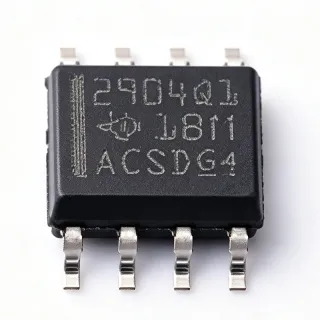
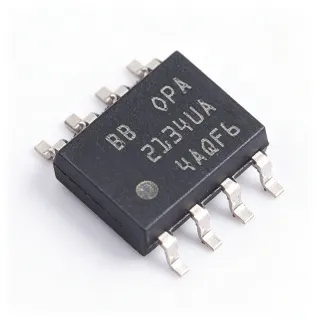
LM358DR - Dual 700kHz General Purpose Op Amp | Texas Instruments
N.º de pieza: LM358DR ✓ Activo| Cant. | Precio unitario | Total |
|---|---|---|
| 1 | $0.28 | $0,28 |
| 10 | $0.21 | $2,10 |
| 100 | $0.13 | $13,00 |
| 500 | $0.08 | $40,00 |
| 1.000 | $0.055 | $55,00 |
| 3.000 | $0.0514 | $154,20 |
LM358DR Descripción general
An operational amplifier (op amp) is a high-gain differential-input, single-ended-output voltage amplifier and one of the most fundamental building blocks in analog electronics. General-purpose op amps like the LM358 prioritize versatility, low cost, and ease of use over precision or bandwidth. The LM358 is the dual version of the LM321 single amplifier and the two-amp counterpart of the quad LM324.
Key features include a common-mode input voltage range that extends to ground, enabling direct sensing near ground in single-supply systems; low supply current of 0.7 mA typ, independent of supply voltage; internal frequency compensation for unity-gain stability; and short-circuit protected outputs. These characteristics suit battery-powered and cost-sensitive designs.
Technically, the LM358 uses a bipolar process with a class-AB output stage that can drive loads as low as 2 kΩ with a large output swing. The commercial temperature grade is 0°C to +70°C. Input bias and offset currents are low, and the two internal amplifiers are well matched, sharing the same supply and bias circuitry.
Typical applications include transducer amplifier front ends, DC gain blocks, active RC filters, voltage comparators and level shifters, power-supply feedback loops, and portable or industrial control electronics. The SOIC-8 package supports automated SMT assembly and reflow.
Design considerations: decouple V+ to GND with a 0.1 µF ceramic capacitor close to pin 8, and respect output swing limits near the rails (output saturates roughly 1.5V below V+ at moderate loads). For higher bandwidth or lower noise, consider the pin-compatible TLV9152 or TL072. Pricing as of 2026-08-30 starts around $0.05 at volume from distributors such as LCSC.
Alternativas directas para LM358DR — mismo encapsulado, compatible pin a pin. Se excluyen las piezas de otro encapsulado que requieren retrabajo de la PCB.
Variantes de esta serie
Modelos de la misma serie compatibles directamente con LM358DR (mismo factor de forma y huella) — difiere en Package, Input Offset Voltage, Slew Rate, Amplifier Type, Gain Bandwidth Product.
Herramienta de comparación rápida — seleccione piezas alternativas para compararlas lado a lado:
LM2904DR
✅ Sustitución directa✓ En stock
$0.1 / unidad
Ver hoja de datos →LM358QDRQ1
✅ Sustitución directa✓ En stock
$0.18 / unidad
Ver hoja de datos →LM358DRG4
✅ Sustitución directa📋 Alternativa de referencia (no en el catálogo)
TL072CDR
✅ Sustitución directa ⚠️ Especificaciones sin verificar✓ En stock
$0.093 / unidad
Ver hoja de datos →LM2904DR2G
✅ Sustitución directa📋 Alternativa de referencia (no en el catálogo)
NJM2904D
✅ Sustitución directa ⚠️ Especificaciones sin verificar📋 Alternativa de referencia (no en el catálogo)
LM358DR Valores máximos y características eléctricas
| Amplifier Type | General Purpose Operational Amplifier |
| Number of Circuits | 2 |
| Gain Bandwidth Product | 700 kHz |
| Slew Rate | 0.3 V/µs |
| Supply Voltage (Single) | 3 V to 32 V |
| Supply Voltage (Dual) | ±1.5 V to ±16 V |
| Supply Current (per channel) | 0.7 mA (typ) |
| Input Offset Voltage | 2 mV (typ), 7 mV (max) |
| Common-Mode Input Range | Extends to ground (V-) |
| Output Current | 20 mA (typ, short-circuit protected) |
| Minimum Load Resistance | 2 kΩ |
| Temperatura de funcionamiento | 0°C to +70°C |
| Encapsulado | SOIC-8 (D) |
| Tipo de montaje | Surface Mount |
| Internal Compensation | Yes (unity-gain stable) |
| Estado RoHS | Compliant |
Configuración de pines de LM358DR
| Pin 1 | OUT1 — Amplifier 1 output |
| Pin 2 | IN1- — Amplifier 1 inverting input |
| Pin 3 | IN1+ — Amplifier 1 non-inverting input |
| Pin 4 | GND / V- — Ground (single supply) or negative rail (dual supply) |
| Pin 5 | IN2+ — Amplifier 2 non-inverting input |
| Pin 6 | IN2- — Amplifier 2 inverting input |
| Pin 7 | OUT2 — Amplifier 2 output |
| Pin 8 | V+ — Positive supply, 3V to 32V |
Aplicaciones típicas
LM358DR es adecuado para 6 aplicacións: Transducer Amplifier Front End, DC Gain Blocks and Level Shifters, Active RC Filters, Power Supply Feedback and Control Loops, Industrial Control and Comparator Functions, Portable and Battery-Powered Electronics.
Transducer Amplifier Front End
The LM358DR fits single-supply sensor front ends because its input common-mode range extends to ground, letting a grounded-reference sensor (photodiode, thermistor bridge, strain gauge divider) drive the input directly without biasing circuitry. Configured as a non-inverting gain stage from a 5V or 12V rail, its 700 kHz bandwidth covers low-frequency sensor signals up to tens of kHz, and the 2 mV typical offset is acceptable for coarse measurements. The 0.7 mA per-amplifier supply current suits battery-powered dataloggers; the second amplifier is commonly used as a second gain stage or a 2.5V mid-supply reference buffer.
Recomendado
DC Gain Blocks and Level Shifters
As a DC gain block the LM358DR provides stable, unity-gain-compensated gain from 3V to 32V single supply or ±15V dual supply. Its 2 mV offset and low bias current support gain-of-10 to gain-of-100 DC amplification with resistor dividers; the second amplifier handles inversion, summing, or level shifting in the same SOIC-8. The short-circuit-protected class-AB output drives 2 kΩ loads with a large swing, tolerating accidental output faults in industrial wiring. Note the output saturates about 1.5V below V+ at moderate load, so scale gain so expected peaks stay inside the linear range.
Recomendado
Active RC Filters
The LM358DR implements Sallen-Key and multiple-feedback active RC filters for frequencies up to roughly 50 kHz, well inside its 700 kHz GBW so Q and cutoff accuracy remain intact. Internal compensation guarantees stability in unity-gain (Sallen-Key) configurations, and the input common-mode range to ground allows filters biased at mid-supply or referenced to ground in single-supply systems. Dual amplifiers per package enable second-order sections in one footprint. For cutoff frequencies above about 50 kHz or low-noise anti-alias duties, use the TL072CDR or OPA828IDR instead, since closed-loop bandwidth headroom drops with higher Q.
Recomendado
Power Supply Feedback and Control Loops
The LM358DR is widely used as an error amplifier in voltage-feedback loops of AC-DC and DC-DC supplies because it tolerates wide supply rails (up to 32V single), senses near ground, and drives optocoupler LEDs or PWM comparators from its protected output. Its 0.7 mA consumption is negligible against converter overhead. Designers should account for the ~1.5V headroom below V+ and the 0.3 V/µs slew rate, which limit loop bandwidth to a few kHz - usually adequate for output-voltage regulation. For automotive supplies, the LM358QDRQ1 AEC-Q100 variant provides the identical function with qualification.
Recomendado
Industrial Control and Comparator Functions
On factory floors, the LM358DR serves as a threshold detector, window comparator, or 4-20 mA signal conditioning stage from 24V single-supply rails - within its 32V maximum. One amplifier compares a sensor voltage against a resistor-divider threshold while the second provides hysteresis or drives an indicator. The short-circuit-protected output survives miswired field connections. Because slew rate is only 0.3 V/µs, switching delays are on the order of tens of microseconds; for faster fault detection use the LM393DR dedicated comparator, which also has an open-collector output for logic-level interfacing.
Recomendado
Portable and Battery-Powered Electronics
With 0.7 mA per amplifier supply current that is largely independent of supply voltage, the LM358DR suits portable instruments, chargers, and handheld meters running from 3-cell (4.5V) or Li-ion stacks. The 3V minimum supply supports operation down to two nearly depleted alkaline cells, and inputs sensing to ground allow direct battery-voltage monitoring without a reference offset. The SOIC-8 reflows on standard SMT lines. For extreme low-power designs where every microamp counts, modern nano-power op amps such as the TLV713-class devices cut quiescent current by orders of magnitude in the same pinout style.
Recomendado
Resumen de productos recomendados
Datos de referencia de ingeniería para LM358DR — comparación, orientación de diseño e información de cumplimiento.
Guía de selección
Comparación con alternativas
| Parámetro | Este producto | LM2904DR | LM358QDRQ1 | TL072CDR | LM2904DR2G |
|---|---|---|---|---|---|
| Package | SOIC-8 (D) | SOIC-8 (D) - same | SOIC-8 (D) - same | SOIC-8 (D) - same | SOIC-8 - same |
| Brand | Texas Instruments | Texas Instruments | Texas Instruments | Texas Instruments | onsemi |
| Gain Bandwidth Product | 700 kHz | 700 kHz | 700 kHz | 3 MHz | 700 kHz |
| Slew Rate | 0.3 V/µs | 0.3 V/µs | 0.3 V/µs | 13 V/µs | 0.3 V/µs |
| Supply Voltage Range (Single) | 3 V to 32 V | 3 V to 26 V | 3 V to 32 V | ±1.5 V to ±15 V (dual typical) | 3 V to 26 V |
| Operating Temperature | 0°C to +70°C | -40°C to +125°C | -40°C to +125°C | 0°C to +70°C | -40°C to +125°C |
| Automotive Grade | No | No | Yes (AEC-Q100) | No | No |
| Supply Current (per amp) | 0.7 mA typ | 0.7 mA typ | 0.7 mA typ | 1.4 mA typ | 0.7 mA typ |
Diferenciadores clave
- Input common-mode range extends to ground (frente a TL072CDR)
- Lowest cost per amplifier (frente a OPA2192IDR)
- Extended temperature range option in identical footprint (frente a LM358QDRQ1)
- Lower power than audio-grade upgrade (frente a TL072CDR)
Notas de diseño
Decouple V+ (pin 8) to ground with a 0.1 µF ceramic capacitor placed within 5 mm of the pin; the LM358 drives dynamic loads and its class-AB output stage can draw supply transients. When operated from dual supplies, decouple both rails. Remember maximum supply is 32V single (±16V dual) - derate for 24V industrial rails with tolerance of +10%.
The output cannot swing rail-to-rail: it saturates roughly 1.5V below V+ at moderate loads (and about 20 mV above V-). Design gain stages so expected output peaks stay at least 2V below the positive rail. Also, inputs must stay within the common-mode range (V- to V+ minus 1.5V); taking an input above this range can cause phase reversal.
The SOIC-8 footprint is the industry-standard dual op-amp pattern, so keeping the TL072/LM2904-compatible land pattern with short feedback traces (under 10 mm) eases future upgrades to higher-bandwidth parts. Keep the input resistor network close to the inverting input to minimize stray capacitance that erodes phase margin at gains near unity.
With only 700 kHz GBW, a gain-of-10 stage has a closed-loop bandwidth of about 70 kHz; do not attempt audio-band or faster filtering without verifying loop margin. For comparator-style use, add deliberate hysteresis (e.g., 1 MΩ positive feedback resistor) since the LM358 is not a specified comparator and slow edges can oscillate.
Información de cumplimiento
RoHS compliant per TI product data; LM358DRG3 variant offers NiPdAu lead finish. AEC-Q100 qualification applies only to the LM358QDRQ1 variant, not the standard LM358DR.