ESP32-S3-WROOM-1U - WiFi/BLE 5 Module, ESP32-S3 | Espressif
MPN: ESP32-S3-WROOM-1U ✓ فعال| تعداد | قیمت واحد | قیمت کل |
|---|---|---|
| 1 | $3.45 | $3.45 |
| 10 | $3.1 | $31.00 |
| 100 | $2.78 | $278.00 |
| 500 | $2.5 | $1,250.00 |
| 1,000 | $2.25 | $2,250.00 |
ESP32-S3-WROOM-1U نمای کلی
A Wi-Fi + Bluetooth LE MCU module is a surface-mount system-in-package that integrates a wireless SoC, flash memory, crystal oscillator, RF matching network, and power management onto a single castellated-edge PCB. Modules occupy the top of the embedded wireless hierarchy - above bare SoCs, which require RF layout expertise, and below finished development boards - and are the standard building block for IoT products that need certified radio performance without in-house RF engineering.
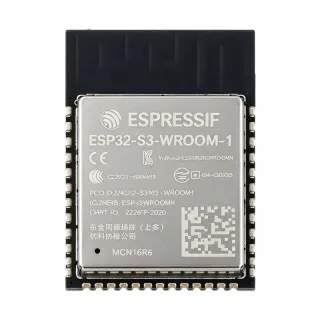
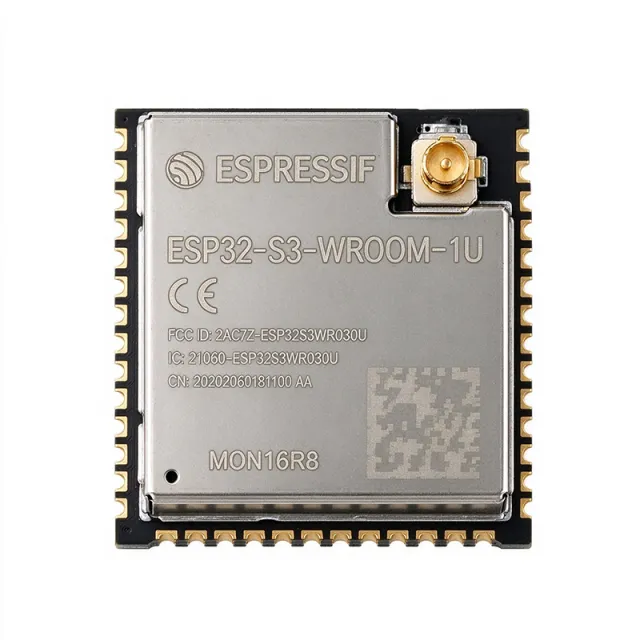
Key features of the ESP32-S3-WROOM-1U include up to 36 GPIOs with a rich peripheral set, hardware acceleration for neural network computing and signal processing workloads, native USB OTG on the ESP32-S3 SoC, and Bluetooth 5 LE long-range support. The U.FL (IPEX) antenna connector allows designers to place the antenna remotely or use higher-gain external antennas, which distinguishes it from the PCB-antenna ESP32-S3-WROOM-1 sibling in the same series.
Technically, the module is built around the ESP32-S3 SoC with dual-core LX7 CPUs clocked for general-purpose embedded workloads, integrating AI vector instructions that offload edge-inference tasks. The RF front end is pre-matched and pre-certified, dramatically reducing design risk compared to a discrete ESP32-S3 chip implementation where antenna matching and regulatory testing fall on the designer.
Typical applications include AIoT edge devices, voice assistant endpoints, smart-home controllers, industrial sensor gateways, and any product requiring an external or remote-mounted antenna such as metal-enclosure designs that route the U.FL cable to an external bulkhead antenna.
A key design consideration is strapping-pin handling: GPIO0, GPIO45, and GPIO46 configure boot mode and flash voltage at reset, so external circuits on these pins must respect datasheet pull-up/pull-down requirements to avoid boot failures.
This page synthesizes the Espressif datasheet, distributor availability, drop-in family alternatives, and practical design notes not found on the manufacturer product page alone.
جایگزینهای drop-in برای ESP32-S3-WROOM-1U — همان پکیج، سازگار پینبهپین. قطعات با پکیج متفاوت که نیاز به تغییر PCB دارند مستثنی هستند.
ابزار مقایسه سریع — قطعات جایگزین را برای مقایسه کنار به کنار انتخاب کنید:
ESP32-S3-WROOM-1-N8
✓ موجود
$2.8711 / واحد
مشاهده دیتاشیت ←ESP32-S3-WROOM-1-N16R8
✓ موجود
$2.8711 / واحد
مشاهده دیتاشیت ←ESP32-S3-WROOM-1U-N8
📋 جایگزین مرجع (خارج از کاتالوگ)
ESP32-S3-WROOM-1U-N16R2
✓ موجود
$2.7891 / واحد
مشاهده دیتاشیت ←ESP32-S3-WROOM-1U-N16R8
📋 جایگزین مرجع (خارج از کاتالوگ)
ESP32-S3-WROOM-1U مشخصات (منتشرشده توسط سازنده)
| Core Processor | Xtensa dual-core 32-bit LX7 (ESP32-S3 SoC) |
| Wi-Fi Standard | 802.11 b/g/n, 2.4 GHz |
| Bluetooth | Bluetooth 5 (LE) |
| Flash Memory | Up to 16 MB (variant dependent) |
| PSRAM | Up to 16 MB (variant dependent) |
| GPIO Count | Up to 36 GPIOs |
| Antenna Type | External antenna via U.FL connector (antenna not included) |
| AI Acceleration | Neural network computing and signal processing acceleration |
| USB | Native USB OTG (ESP32-S3 SoC) |
| نوع نصب | Surface Mount (castellated edges) |
رابطها و اتصالدهندههای ESP32-S3-WROOM-1U
ESP32-S3-WROOM-1U رابطها و اتصالدهندههای زیر را مطابق انتشار سازنده ارائه میدهد: بیسیم, Bluetooth, GPIO, USB. پینآوت هدر توسعه، شمارهگذاری پین اتصالدهنده و محدودیتهای الکتریکی در مستندات سازنده تعریف شدهاند.
| بیسیم | 802.11 b/g/n, 2.4 GHz |
| Bluetooth | Bluetooth 5 (LE) |
| GPIO | Up to 36 GPIOs |
| USB | Native USB OTG (ESP32-S3 SoC) |
به مستندات سازنده برای مشاهده کامل پینآوت هدر توسعه و شمارهگذاری پینهای کانکتور.
کاربردهای معمول
ESP32-S3-WROOM-1U مناسب است برای 6 کاربردs: AIoT Edge Inference Devices, Smart Home Controllers and Hubs, Industrial Sensor Gateways, Voice Assistant Endpoints, Battery-Powered IoT Sensor Nodes, Connected Displays and HMI Panels.
AIoT Edge Inference Devices
The ESP32-S3-WROOM-1U is purpose-built for AIoT because the ESP32-S3 SoC provides hardware acceleration for neural network computing and signal processing workloads, per the Espressif datasheet. Voice keyword spotting, small vision models, and sensor-fusion inference run directly on the dual-core LX7 cores with vector instructions, avoiding a separate AI coprocessor. For workloads needing large tensor buffers, select an R-suffix variant with up to 8-16 MB PSRAM. The U.FL antenna connector lets the radio be routed to an optimal location when the inference hardware sits inside a metal or dense enclosure, preserving Wi-Fi cloud connectivity for model updates and telemetry.
پیشنهادی
Smart Home Controllers and Hubs
Smart-home hubs need concurrent Wi-Fi station/access-point operation and Bluetooth LE provisioning, which the ESP32-S3-WROOM-1U delivers with 802.11 b/g/n and Bluetooth 5 LE on one certified module. Up to 36 GPIOs interface relays, buttons, and sensors, while the rich peripheral set covers I2C, SPI, and UART buses for Zigbee/Thread bridge front ends. The U.FL connector allows a bulkhead antenna on a metal DIN-rail or wall-box enclosure, solving the RF shielding problem that defeats PCB-antenna modules. Strapping pins GPIO0/45/46 must follow datasheet pull requirements since hubs power-cycle frequently.
پیشنهادی
Industrial Sensor Gateways
In factory environments, the ESP32-S3-WROOM-1U aggregates Modbus, CAN (via external transceiver), and analog sensor data over Wi-Fi to MQTT brokers. The dual-core LX7 separates protocol stacks from application logic for deterministic sampling, and the signal-processing acceleration supports on-node filtering and FFT analysis before transmission. Industrial cabinets are typically metal, so the U.FL connector routing to an external omnidirectional antenna is frequently the deciding factor over the PCB-antenna ESP32-S3-WROOM-1. Wide operating conditions and castellated SMD mounting support reflow assembly on standard industrial PCB processes.
پیشنهادی
Voice Assistant Endpoints
Espressif targets voice applications explicitly: the ESP32-S3 series adds vector instructions for neural network computing, enabling always-on wake-word detection with Espressif's ESP-SR library running on-module. The U variant's external antenna improves receive sensitivity placement away from speaker-induced EMI and metal speaker housings. Audio front ends use I2S microphones (e.g., INMP441) with the module's I2S peripheral, and PSRAM-equipped variants (N8R8/N16R8) hold acoustic models and audio buffers that exceed internal SRAM. Typical designs pair the module with an I2S power amplifier for full voice-interaction products.
پیشنهادی
Battery-Powered IoT Sensor Nodes
The ESP32-S3 supports deep-sleep modes in the low-microamp class (confirm exact figures in the module datasheet electrical characteristics), enabling multi-year battery life for periodic-reporting sensors. The dual-core LX7 completes burst sensing plus Wi-Fi transmission quickly, maximizing sleep duty cycle. ESP32-S3-WROOM-1U's U.FL antenna is advantageous when the node is mounted inside a weatherproof metal or foil-lined enclosure, where a PCB antenna would be detuned. Designers should route GPIO0 and GPIO46 free of leakage paths in sleep, since strapping-pin states are re-sampled at every wake from deep sleep.
پیشنهادی
Connected Displays and HMI Panels
The ESP32-S3 integrates an LCD peripheral with RGB and I80 interfaces plus SPI display support, letting the ESP32-S3-WROOM-1U drive GUI panels directly - a role the older ESP32 generation could not fill well. PSRAM variants (up to 16 MB per the datasheet) hold full framebuffers for LVGL-based touch interfaces, and Wi-Fi plus BLE delivers OTA updates and mobile provisioning. Products with metal bezels benefit from the U.FL external antenna to avoid detuning. Use the ESP32-S3 hardware design guidelines for trace impedance on RGB buses to keep signal integrity at high pixel clocks.
پیشنهادی
خلاصه محصولات پیشنهادی
دادههای مرجع مهندسی برای ESP32-S3-WROOM-1U — مقایسه، راهنمای طراحی و اطلاعات انطباق.
راهنمای انتخاب
مقایسه با جایگزینها
| پارامتر | این محصول | ESP32-S3-WROOM-1U-N8 | ESP32-S3-WROOM-1U-N16 | ESP32-S3-WROOM-1U-N16R8 | ESP32-S3-WROOM-1-N8 | ESP32-S3-WROOM-1-N16R8 |
|---|---|---|---|---|---|---|
| Package | Castellated SMD module with U.FL connector | Same - U.FL module footprint | Same - U.FL module footprint | Same - U.FL module footprint | Same footprint, PCB antenna instead of U.FL | Same footprint, PCB antenna instead of U.FL |
| Brand | Espressif Systems | Espressif Systems | Espressif Systems | Espressif Systems | Espressif Systems | Espressif Systems |
| Core | Xtensa dual-core 32-bit LX7 (ESP32-S3) | Xtensa dual-core 32-bit LX7 (ESP32-S3) | Xtensa dual-core 32-bit LX7 (ESP32-S3) | Xtensa dual-core 32-bit LX7 (ESP32-S3) | Xtensa dual-core 32-bit LX7 (ESP32-S3) | Xtensa dual-core 32-bit LX7 (ESP32-S3) |
| Wireless | Wi-Fi 802.11 b/g/n + Bluetooth 5 LE, 2.4 GHz | Wi-Fi 802.11 b/g/n + Bluetooth 5 LE | Wi-Fi 802.11 b/g/n + Bluetooth 5 LE | Wi-Fi 802.11 b/g/n + Bluetooth 5 LE | Wi-Fi 802.11 b/g/n + Bluetooth 5 LE | Wi-Fi 802.11 b/g/n + Bluetooth 5 LE |
| Antenna | External via U.FL (not included) | External via U.FL (not included) | External via U.FL (not included) | External via U.FL (not included) | On-board PCB antenna | On-board PCB antenna |
| Flash | Up to 16 MB (variant dependent) | 8 MB | 16 MB | 16 MB | 8 MB | 16 MB |
| PSRAM | Up to 16 MB (variant dependent) | None | None | 8 MB | None | 8 MB |
| GPIOs | Up to 36 | Up to 36 | Up to 36 | Up to 36 | Up to 36 | Up to 36 |
| AI Acceleration | Yes (NN + signal processing) | Yes (NN + signal processing) | Yes (NN + signal processing) | Yes (NN + signal processing) | Yes (NN + signal processing) | Yes (NN + signal processing) |
تفاوتهای کلیدی
- External antenna flexibility via U.FL connector (در مقابلESP32-S3-WROOM-1-N16R8)
- PSRAM options for AI workloads (در مقابلESP32-S3-WROOM-1U-N16)
- AI/NN hardware acceleration on-module (در مقابلESP32-WROOM-32UE-N4)
یادداشتهای طراحی
Strapping pins GPIO0, GPIO45, and GPIO46 are sampled at reset and determine boot mode and flash voltage. Route these nets with minimal capacitance and ensure external pull-up/pull-down resistors match the states required in the Espressif datasheet. A push-button on GPIO0 is the standard BOOT entry method; avoid buffers or large filter capacitors that delay the pin reaching its required level before sampling. Violating strapping requirements is the most common cause of 'module does not boot' field failures.
Power the module from a clean 3.3V rail sized for Wi-Fi TX bursts - the ESP32-S3 RF power amplifier draws high peak current during 802.11 transmissions (consult the datasheet electrical characteristics table for exact figures). Place a low-ESR bulk capacitor plus 100 nF and 1 uF ceramic decoupling capacitors close to the module's 3V3 and GND pins. An under-designed supply manifests as Wi-Fi disconnects or brown-out resets during transmission, not at idle, so test with the radio actively streaming.
Follow the Espressif ESP32-S3 hardware design guidelines for the module keep-out: no signal routing or ground plane under the module body near the RF section, and keep the U.FL connector's microstrip/coax route to the antenna connector as short as possible with controlled 50-ohm impedance. For metal enclosures, place a bulkhead antenna and use a short U.FL-to-SMA pigtail; never fold the pigtail tightly against the shield can. Verify the ground connection of the U.FL connector shell to the module GND pads per the datasheet footprint.
اطلاعات انطباق
Compliance details were not present in the provided web data; consult the Espressif product page and regulatory documentation for RoHS/REACH certification status.